Loading...
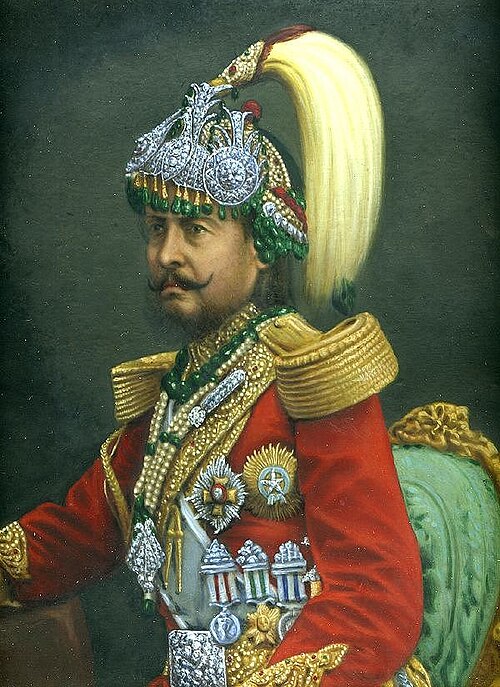
Jung Bahadur Rana
ModernGeneralNepal1817 — 1877
Founder of Rana dynasty, hereditary prime ministers.
Compare Jung Bahadur Rana with another historical figure:
Quick Facts
Born
1817
Died
1877
Country
Nepal
Era
Modern
Occupation
General
Score Overview
Military (10%)55
Political (20%)72
Influence (20%)57
Legacy (20%)55
Leadership (15%)78
Strategy (15%)55
Total Score61.4
Jung Bahadur Rana — Complete Timeline
1846 AD
Kot MassacrePolitical Action
Jung Bahadur Runa orchestrated the Kot Massacre in Kathmandu, where dozens of nobles and courtiers were killed. This event eliminated his political rivals and allowed him to seize effective control of the Nepalese government, establishing the hereditary Rana prime ministership.
CoupMassacreRana Dynasty
Impact: nationaldestructive
Establishment of Rana DynastyPolitical Action◆ Major
Following the Kot Massacre, Jung Bahadur Rana appointed himself prime minister and commander-in-chief. He made the position hereditary, founding the Rana dynasty that ruled Nepal for over a century, reducing the Shah monarchs to figureheads.
DynastyGovernmentNepal
Impact: national
1850 AD
Visit to EuropeCultural
Jung Bahadur Rana traveled to Britain and France, becoming the first South Asian ruler to visit Europe. He observed Western military and industrial technology, which influenced his modernization efforts in Nepal, including army reforms.
DiplomacyModernizationTravel
Impact: nationalconstructive
1856 AD
Nepal-Tibet War and Treaty of ThapathaliWar◆ Major
Jung Bahadur Rana led a Nepalese military campaign into Tibet. The conflict ended with the Treaty of Thapathali, which secured Nepalese territorial claims and established a tributary relationship with Tibet, enhancing Nepal's regional influence.
WarTreatyTibet
Impact: regional
Detailed Scores
▶View all detailed scores
Military
Strategy
7
Tactics
7
Battles
7
Army Scale
7
War Impact
7
Political
Governance
7
Reform
7
Stability
7
Policy
8
Power
8
Influence
History
10
Global
9
Culture
9
Ideology
10
Legacy
9
People often compare with
See how Jung Bahadur Rana stacks up against other historical figures
Popular Comparisons
Jung Bahadur Rana vs Albrecht von Wallenstein
vs Albrecht von Wallenstein74
Jung Bahadur Rana vs Napoleon Bonaparte
vs Napoleon Bonaparte71
Jung Bahadur Rana vs Yitzhak Rabin
vs Yitzhak Rabin66
Jung Bahadur Rana vs Andres de Santa Cruz
vs Andres de Santa Cruz61
Jung Bahadur Rana vs Ehud Barak
vs Ehud Barak60
Jung Bahadur Rana vs Shi Dakai
vs Shi Dakai60