Loading...
Jung Bahadur Rana vs Napoleon Bonaparte
Napoleon Bonaparte leads by 9.5 pts · 2 figures compared
…
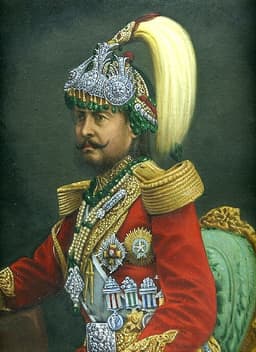
Jung Bahadur Rana
General · Modern
61.4Total

Napoleon Bonaparte
General · Modern
70.9Total
Basic Information
Born
1817
1769
Died
1877
1821
Era
Modern
Modern
Nationality
Nepal
France
Occupation
General
General
Civilization
Indian
Western
Score Comparison
Military (10%)
55.0
94.0
Political (20%)
72.0
72.0
Influence (20%)
56.7
40.0
Legacy (20%)
55.0
80.0
Leadership (15%)
78.0
78.0
Strategy (15%)
55.0
90.0
TOTAL
61.4
70.9
Jung Bahadur Rana — Complete Timeline
1846 AD
Kot MassacrePolitical Action
Jung Bahadur Runa orchestrated the Kot Massacre in Kathmandu, where dozens of nobles and courtiers were killed. This event eliminated his political rivals and allowed him to seize effective control of the Nepalese government, establishing the hereditary Rana prime ministership.
CoupMassacreRana Dynasty
Impact: nationaldestructive
Establishment of Rana DynastyPolitical Action◆ Major
Following the Kot Massacre, Jung Bahadur Rana appointed himself prime minister and commander-in-chief. He made the position hereditary, founding the Rana dynasty that ruled Nepal for over a century, reducing the Shah monarchs to figureheads.
DynastyGovernmentNepal
Impact: national
1850 AD
Visit to EuropeCultural
Jung Bahadur Rana traveled to Britain and France, becoming the first South Asian ruler to visit Europe. He observed Western military and industrial technology, which influenced his modernization efforts in Nepal, including army reforms.
DiplomacyModernizationTravel
Impact: nationalconstructive
1856 AD
Nepal-Tibet War and Treaty of ThapathaliWar◆ Major
Jung Bahadur Rana led a Nepalese military campaign into Tibet. The conflict ended with the Treaty of Thapathali, which secured Nepalese territorial claims and established a tributary relationship with Tibet, enhancing Nepal's regional influence.
WarTreatyTibet
Impact: regional
Napoleon Bonaparte — Complete Timeline
1799 AD
Coup of 18 BrumaireOther◆ Major
Napoleon Bonaparte, with support from his brother Lucien and key political figures, overthrew the Directory in a bloodless coup. He established the Consulate with himself as First Consul, effectively becoming the ruler of France. This event ended the French Revolution's most unstable period.
French RevolutionCoupRise to Power
Impact: regional
1804 AD
Promulgation of the Napoleonic CodeOther◆ Major
Napoleon enacted the Civil Code of the French, known as the Napoleonic Code, a comprehensive set of laws that replaced the fragmented feudal legal systems. The code established legal equality, protected property rights, and secularized law. It became the basis for legal systems in many European and world countries.
Legal ReformNapoleonic CodeCivil Law
Impact: globalconstructive
1805 AD
Battle of AusterlitzWar◆ Major
Napoleon's Grande Arm
Napoleonic WarsBattleDecisive Victory
Impact: global
1812 AD
Invasion of RussiaWar◆ Major
Napoleon led the Grande Arm
Napoleonic WarsInvasionDisaster
Impact: globaldestructive
1815 AD
Battle of WaterlooWar◆ Major
Napoleon's French army was defeated by the combined forces of the Duke of Wellington's Anglo-Allied army and Gebhard Leberecht von Bl
Napoleonic WarsBattleFinal Defeat
Impact: globaldestructive
Expert Analysis
jung-bahadur-rana-vs-napoleon-bonaparte
# The Conqueror and the Consolidator
In the winter of 1846, as Napoleon Bonaparte’s bones lay twenty-five years cold beneath the dome of Les Invalides in Paris, a very different kind of power grab unfolded six thousand miles away in the palace of Kathmandu. The Kot Massacre saw swords flash in a courtyard, nobles fall in heaps, and a young general named Jung Bahadur Rana emerge from the bloodshed as the unchallenged master of Nepal. One man had conquered Europe; the other would conquer his own country from within. Both were generals. Both reshaped their worlds. Yet their paths, their choices, and their endings could hardly have been more different.
Origins
Napoleon Bonaparte was born in 1769 on the Mediterranean island of Corsica, a place that had only become French the year before. His family was minor nobility, poor enough to feel the pinch but well-connected enough to send him to military school in mainland France. There, the awkward, accented boy was mocked by his aristocratic classmates—a humiliation that forged in him a relentless drive to prove himself. The French Revolution upended the old order, and for a man of talent rather than birth, it was a door flung wide open.
Jung Bahadur Rana, born in 1817 in Kathmandu, came from a different kind of marginality. His family were minor courtiers in the chaotic Shah dynasty, where the king was weak and the nobility fought like wolves over scraps of power. His father had fallen from favor; his uncle was executed. Jung Bahadur learned early that in Nepal, politics was a knife-fight in the dark. Where Napoleon’s world was being remade by revolutionary ideals, Jung Bahadur’s was a brutal game of survival in a medieval court.
Rise to Power
Napoleon’s ascent was meteoric and public. At twenty-four, he drove the British out of Toulon. At twenty-six, he crushed a royalist uprising in Paris with a “whiff of grapeshot.” Then came Italy—a stunning campaign where he outmarched, outthought, and outfought the Austrian armies, turning a ragged French force into a conquering legion. Each victory was a stepping stone, each battle a headline. By 1799, at age thirty, he was First Consul of France. By 1804, Emperor.
Jung Bahadur’s rise was quieter, darker, and far more intimate. In 1846, Queen Rajya Lakshmi Devi, desperate for a strongman to protect her son’s throne, summoned him. He came to the Kot—the royal armory—where hundreds of nobles had gathered. What happened next remains disputed, but the result is clear: Jung Bahadur’s men surrounded the courtyard, and in the ensuing massacre, dozens of Nepal’s most powerful families were cut down. Within hours, he was prime minister and commander-in-chief. Within days, he had made the position hereditary. No grand battles, no manifestos—just a single, ruthless evening.
Leadership & Governance
Napoleon ruled by charisma, speed, and system. His military genius—rated 94 in strategy, 93 in military skill—lay in his ability to concentrate force at the decisive point, to march his armies faster than anyone thought possible, and to inspire men who would follow him into hell. But he was also a builder. The Napoleonic Code standardized French law, abolished feudal privileges, and spread the ideals of the Revolution across Europe. He built roads, schools, and a central bank. His political score of 75 reflects a man who could organize a continent but could never stop conquering long enough to keep it.
Jung Bahadur governed by balance and fear. His military score of 63.6 and strategy of 59.4 suggest a competent commander, not a genius. But his political score of 68.3 and leadership of 78.4 tell a different story. He knew that in Nepal, survival meant controlling the court, not the battlefield. He modernized the army, yes, and in 1856 he led a campaign into Tibet that ended with the Treaty of Thapathali, securing Nepal’s northern border. But his real innovation was institutional: he made the prime ministership a hereditary Rana monopoly, reducing the king to a figurehead. For over a century, his family would rule Nepal.
Triumph & Tragedy
Napoleon’s greatest moment was Austerlitz in 1805, where he destroyed the combined armies of Russia and Austria in a single day. His worst was the invasion of Russia in 1812—600,000 men marched east; fewer than 100,000 returned. Waterloo in 1815 was the final act, a battle he might have won if his subordinates had arrived on time, if the ground had been drier, if he had been younger. But history does not deal in ifs.
Jung Bahadur’s triumph was subtler but more durable. In 1850, he became the first South Asian ruler to visit Europe, touring Britain and France. He studied Western military technology, observed parliamentary procedure, and returned to Nepal with new ideas about governance. His tragedy was the system he created: by concentrating all power in his family, he froze Nepal in time. The Rana dynasty grew fat and corrupt, isolated from the world, until it was overthrown in 1951. The man who opened Nepal to the West also locked it in a cage.
Character & Destiny
Napoleon was driven by an insatiable hunger for glory. “I live only for posterity,” he once said, and he meant it. His ambition was boundless, his energy terrifying, his ego colossal. He could not stop because he could not imagine stopping. That same fire that carried him to Moscow also consumed him on Saint Helena, where he died in 1821 at age fifty-one, dictating his memoirs and blaming everyone but himself.
Jung Bahadur was colder, more calculating. He knew when to strike and when to wait. He understood that power in a small kingdom meant keeping enemies close and secrets closer. He died in 1877 at age sixty, still in power, still feared. His ambition was not to change the world but to own it—and he did, for a lifetime.
Legacy
Napoleon’s legacy is everywhere. The Napoleonic Code underpins legal systems from France to Louisiana to Japan. His military tactics are still studied. He redrew the map of Europe and inspired nationalism across the continent. His influence score of 82 and legacy of 78 acknowledge a man who changed the course of history, for better and for worse.
Jung Bahadur’s legacy is more contained but no less profound. He gave Nepal a century of stability—but at the cost of democracy, development, and openness. His influence score of 71.8 and legacy of 80 reflect a man who shaped his nation’s destiny without ever leaving its shadow. Today, Nepalis remember him as a founder and a despot, a modernizer and a tyrant.
Conclusion
One man conquered an empire and lost it. The other conquered a kingdom and kept it. Napoleon’s story is a tragedy of overreach; Jung Bahadur’s is a tragedy of stasis. The Corsican wanted to be remembered by the world; the Nepali wanted to be forgotten by no one in his own land. In the end, both got what they wanted—and both paid the price. The difference between them is not just in their scores or their battles, but in the shape of their ambition: one dreamed of glory, the other of control. History remembers both, but for very different reasons.
Rankings
🥇
Napoleon BonaparteLeader
Mil: 94.0Pol: 72.0Inf: 40.0
70.9
🥈
Jung Bahadur Rana
Mil: 55.0Pol: 72.0Inf: 56.7
61.4
+9.5 behind
How This Comparison Works
Algorithm
Each figure is scored on 6 dimensions (0—100 scale) based on structured historical data: Military (10%), Political (20%), Influence (20%), Legacy (20%), Leadership (15%), Strategy (15%). The weighted total produces the final ranking.
Data Sources
Scores are computed from structured sub-indicators in the database. Scale factors adjust for era (Ancient ×0.85, Modern ×1.0) and civilization size (Eastern ×1.05, Other ×0.80) to account for differences in population and military scale.
Maximum 3 Figures
Comparisons are limited to 2—3 figures to ensure readability and statistical meaningfulness.
Error Margins
±5 points per dimension — Sub-scores are derived from historical records with inherent uncertainty. Two figures within 5 points on a dimension should be considered roughly equivalent in that area.
Total Score Accuracy
±3 points overall — The weighted combination of 6 dimensions produces a total score with approximately ±3 points of uncertainty. Differences of less than 3 points are not statistically significant— the figures are effectively tied.
Known Limitations
- Historical records are incomplete and uneven across civilizations
- Figures from oral-tradition societies may be underrepresented
- Occupation labels can misclassify multi-role figures
- Scores measure capability and impact, not moral character
- Quantitative scoring is a comparison tool, not absolute truth
Capability Radar
Military (10%) — Battles & Warfare
Battles
45
95
Win Rate
50
90
Expansion
40
95
Political (20%) — Governance & Reform
Reform
75
95
Diplomacy
70
80
Economy
65
85
Influence (20%) — Cultural & Global Reach
Cultural
55
85
Global
40
90
Legacy (20%) — Historical Impact
Historical
65
95
Longevity
60
90
Leadership (15%) — Power & Stability
Tenure
80
85
Stability
60
70
Strategy (15%) — Tactics & Innovation
Strategy
60
95
Tactics
55
98
Reform
70
92
Similar Comparisons
Comments & Discussion
Le Petit Caporal's Ghost6/17/2026
The comparison is absurd. Napoleon revolutionized warfare with the corps system, numerical tactics at Austerlitz, and the Napoleonic Code. Jung Bahadur staged a palace massacre, then imported some British guns and played "modernizer." One conquered Europe from the Pyrenees to Moscow; the other massacred unarmed courtiers for local supremacy. Please. Compare a storm to a cough.
科西嘉的雄狮6/17/2026
拿破仑的军事成就是世界级的——他指挥过六十多场战役,其中五十多场胜利。儒根·巴哈杜尔的最大成就呢?在科特广场用刀砍死了三十几个政敌。这就是"亚洲拿破仑"?别侮辱真正的拿破仑了。他的法典至今还是欧洲法系的基础,而儒根留下的不过是几个封建领主家族的回忆。
Skeptical Sam6/17/2026
Hang on. The analysis says Napoleon "conquered Europe" but conveniently forgets he ended up exiled on a speck in the Atlantic. Jung Bahadur actually consolidated power for life, founded a dynasty that ran Nepal for 104 years, and died in his bed. Napoleon's "genius" gave France a military dictatorship and then restored the Bourbons. Let's compare survival rates, not press releases.
兵马俑里的清醒者6/17/2026
拿破仑的功绩被严重神话了。滑铁卢战役中,他指挥十二万大军对抗威灵顿的六万八千人,最终还是输了。儒根·巴哈杜尔确实杀了很多人上位,但他带领一万二千尼泊尔军队在英国印度打出了威风,最终保住了尼泊尔的独立。拿破仑最后把法国打成什么样?巴黎被联军占领,国土缩小。谁更成功,真的不一定。