Loading...
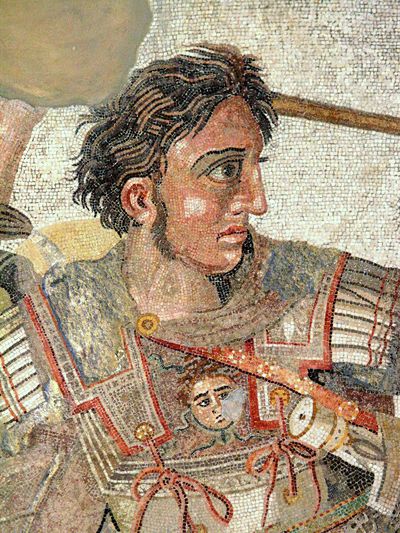
Alexander the Great
AncientGeneralMacedon-356 — -323
马其顿国王,古代史上最伟大的军事统帅之一。建立横跨欧亚非三大洲的庞大帝国。
Compare Alexander the Great with another historical figure:
Quick Facts
Born
356 BCE
Died
323 BCE
Country
Macedon
Era
Ancient
Occupation
General
Score Overview
Military (10%)95
Political (20%)60
Influence (20%)92
Legacy (20%)90
Leadership (15%)80
Strategy (15%)92
Total Score85.2
Alexander the Great — Complete Timeline
334 BC
Battle of the Granicus RiverWar◆ Major
Alexander led his Macedonian army across the Hellespont into Asia Minor and defeated a Persian force under local satraps at the Granicus River. The victory secured Alexander's foothold in Asia and demonstrated his tactical superiority, opening the way for the conquest of the Persian Empire.
Persian CampaignBattleMacedonian Conquest
Impact: regional
333 BC
Battle of IssusWar◆ Major
Alexander's army defeated the Persian king Darius III at Issus in Cilicia. Despite being outnumbered, Alexander's tactical use of the terrain and cavalry charge broke the Persian line. Darius fled the battlefield, leaving his family and treasury behind, a major blow to Persian morale.
Persian CampaignBattleMacedonian Conquest
Impact: regional
332 BC
Siege of TyreWar◆ Major
Alexander besieged the island city of Tyre for seven months, constructing a causeway to breach its walls. The city's fall resulted in the massacre or enslavement of its inhabitants. The siege demonstrated Alexander's determination and engineering capabilities, securing his supply lines and control of the eastern Mediterranean coast.
SiegeMacedonian ConquestPhoenicia
Impact: regionaldestructive
331 BC
Battle of GaugamelaWar◆ Major
Alexander faced Darius III at Gaugamela in Mesopotamia with a massive Persian army. Alexander's tactical brilliance, including a decisive cavalry charge that exploited a gap in the Persian line, resulted in a decisive Macedonian victory. Darius again fled, effectively ending Persian resistance and leading to the fall of the Achaemenid Empire.
Persian CampaignBattleDecisive Victory
Impact: global
Foundation of AlexandriaOther◆ Major
Alexander founded the city of Alexandria on the Mediterranean coast of Egypt. He personally selected the site and oversaw the initial planning. Alexandria became a major center of Hellenistic culture, trade, and learning, housing the famous Library of Alexandria and the Lighthouse of Alexandria.
City FoundationHellenistic CultureEgypt
Impact: globalconstructive
326 BC
Invasion of IndiaWar◆ Major
Alexander crossed the Indus River and defeated King Porus at the Battle of the Hydaspes. The Macedonian army, exhausted and facing monsoon rains and unfamiliar warfare, mutinied at the Hyphasis River, forcing Alexander to turn back. This campaign marked the easternmost extent of his conquests.
Indian CampaignBattleMutiny
Impact: regional
Detailed Scores
▶View all detailed scores
Military
Strategy
9
Tactics
9
Battles
9
Army Scale
9
War Impact
9
Political
Governance
6
Reform
6
Stability
6
Policy
6
Power
6
Influence
History
9
Global
9
Culture
9
Ideology
9
Legacy
9
People often compare with
See how Alexander the Great stacks up against other historical figures
Popular Comparisons
Alexander the Great vs Julius Caesar
vs Julius Caesar83
Alexander the Great vs Cao Cao
vs Cao Cao78
Alexander the Great vs Sun Tzu
vs Sun Tzu61
Alexander the Great vs Augustus
vs Augustus86
Alexander the Great vs Qin Shi Huang
vs Qin Shi Huang85
Alexander the Great vs Cyrus the Great
vs Cyrus the Great84