Loading...
Jung Bahadur Rana vs Shi Dakai
Jung Bahadur Rana leads by 1.8 pts · 2 figures compared
…
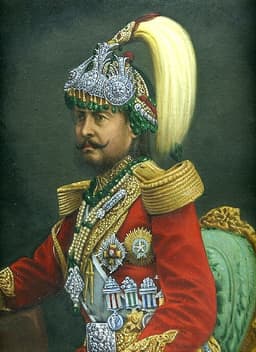
Jung Bahadur Rana
General · Modern
61.4Total
Shi Dakai
General · Modern
59.6Total
Basic Information
Born
1817
1831
Died
1877
1863
Era
Modern
Modern
Nationality
Nepal
China
Occupation
General
General
Civilization
Indian
Eastern
Score Comparison
Military (10%)
55.0
76.0
Political (20%)
72.0
45.0
Influence (20%)
56.7
56.7
Legacy (20%)
55.0
54.0
Leadership (15%)
78.0
72.0
Strategy (15%)
55.0
68.1
TOTAL
61.4
59.6
Jung Bahadur Rana — Complete Timeline
1846 AD
Kot MassacrePolitical Action
Jung Bahadur Runa orchestrated the Kot Massacre in Kathmandu, where dozens of nobles and courtiers were killed. This event eliminated his political rivals and allowed him to seize effective control of the Nepalese government, establishing the hereditary Rana prime ministership.
CoupMassacreRana Dynasty
Impact: nationaldestructive
Establishment of Rana DynastyPolitical Action◆ Major
Following the Kot Massacre, Jung Bahadur Rana appointed himself prime minister and commander-in-chief. He made the position hereditary, founding the Rana dynasty that ruled Nepal for over a century, reducing the Shah monarchs to figureheads.
DynastyGovernmentNepal
Impact: national
1850 AD
Visit to EuropeCultural
Jung Bahadur Rana traveled to Britain and France, becoming the first South Asian ruler to visit Europe. He observed Western military and industrial technology, which influenced his modernization efforts in Nepal, including army reforms.
DiplomacyModernizationTravel
Impact: nationalconstructive
1856 AD
Nepal-Tibet War and Treaty of ThapathaliWar◆ Major
Jung Bahadur Rana led a Nepalese military campaign into Tibet. The conflict ended with the Treaty of Thapathali, which secured Nepalese territorial claims and established a tributary relationship with Tibet, enhancing Nepal's regional influence.
WarTreatyTibet
Impact: regional
Shi Dakai — Complete Timeline
1851 AD
Jintian UprisingWar◆ Major
Shi Dakai joined the Taiping Rebellion at its inception in Jintian, Guangxi. As a core leader, he helped organize the rebel forces and was appointed Wing King, becoming one of the key military commanders of the Taiping Heavenly Kingdom.
Taiping RebellionUprisingMilitary Command
Impact: national
1854 AD
Battle of XiangtanWar◆ Major
Shi Dakai led Taiping forces to a major victory at Xiangtan, Hunan, defeating Qing imperial troops. This battle secured Taiping control over key territories in the Yangtze River valley and demonstrated his military skill.
Taiping RebellionBattleVictory
Impact: regional
1856 AD
Tianjing IncidentPolitical Action
Shi Dakai returned to Tianjing (Nanjing) after the internal purge of the Eastern King Yang Xiuqing and the murder of the Northern King Wei Changhui. He condemned the violence and was forced to flee, leading to a split in Taiping leadership.
Taiping RebellionInternal ConflictPurge
Impact: nationaltragic
1858 AD
Campaign in Zhejiang and FujianWar
Shi Dakai led a separate Taiping army into Zhejiang and Fujian provinces, capturing several cities. This campaign expanded Taiping influence into southeastern China but also isolated his forces from the main Taiping base.
Taiping RebellionCampaignExpansion
Impact: regional
1863 AD
Battle of Baishui RiverWar◆ Major
Shi Dakai's army was trapped and defeated by Qing forces at the Baishui River in Sichuan. He was captured and executed shortly after, marking the end of his military career and a significant loss for the Taiping cause.
Taiping RebellionBattleDefeatDeath
Impact: nationaltragic
Expert Analysis
Shi Dakai vs Jung Bahadur Rana
### The General and the Strongman: Shi Dakai and Jung Bahadur Rana
In the sweltering summer of 1863, a lone figure in a bloodstained robe stood before a Qing executioner on the banks of the Baishui River in Sichuan. Shi Dakai, the Wing King of the Taiping Heavenly Kingdom, had surrendered himself in a desperate gamble to save his surviving troops. Half a world away, in the cool halls of Kathmandu, another general, Jung Bahadur Rana, was hosting a lavish banquet for British diplomats, secure in the knowledge that he had not only conquered his enemies but had also founded a dynasty that would rule Nepal for a century. Both men were warriors; both were architects of their age. One died a martyr’s death, his kingdom crumbling into dust. The other died in his bed, his legacy etched into the very fabric of a nation. What set them apart? The answer lies not in their swords, but in their minds.
### Origins
Shi Dakai was born in 1831 into a prosperous Hakka family in Guangxi, southern China. The Qing Dynasty was in terminal decline, riven by corruption, opium addiction, and foreign humiliation. From his youth, Shi was steeped in classical Confucian learning, but he was also drawn to the radical, millenarian vision of Hong Xiuquan, a failed scholar who claimed to be the younger brother of Jesus Christ. The Taiping Rebellion, which erupted in 1851, was a fusion of Christian heresy, anti-Manchu nationalism, and peasant rage. Shi joined at the Jintian Uprising, a raw, desperate gathering of farmers and miners who believed they were building a “Heavenly Kingdom” on earth. His world was one of fire and faith, where survival depended on loyalty to a cause that was both sacred and suicidal.
Jung Bahadur Rana, born in 1817, came from a very different world. Nepal was a Hindu kingdom, fiercely independent but caught between the British Raj in India and the Tibetan plateau. His family, the Kunwars, were minor nobles in the court of Kathmandu, a place where power was measured in intrigue, not ideology. Jung was raised in the shadow of the 1816 Sugauli Treaty, which had forced Nepal to cede territory to the British. He learned early that survival meant mastering the art of the possible—of alliances, betrayals, and the careful cultivation of fear. Where Shi saw a holy war, Jung saw a chessboard.
### Rise to Power
Shi Dakai’s rise was meteoric. By 1854, at the age of 23, he was already a Wing King, one of the five core leaders of the Taiping state. His victory at the Battle of Xiangtan that year was a masterstroke: he outmaneuvered Qing forces in Hunan, using speed and deception to secure a key supply route. But his ascent was also a product of the rebellion’s desperate need for talent. In a movement that often devoured its own, Shi’s military brilliance made him indispensable—and vulnerable.
Jung Bahadur’s path was more deliberate. In 1846, he orchestrated the Kot Massacre, a single, bloody night in which dozens of rival nobles were slaughtered in the royal palace. He then appointed himself prime minister and commander-in-chief, making the position hereditary. This was not a revolution; it was a coup d’état disguised as a restoration. Jung understood that in Nepal, power flowed from the palace, not the battlefield. He did not need to conquer a kingdom—he needed to own it.
### Leadership & Governance
As a leader, Shi Dakai was a paradox. On the battlefield, he was a genius—his campaigns in Zhejiang and Fujian in 1858 showed a strategic flexibility that rivaled any general of his era. He could read terrain, morale, and timing with an intuitive grace. But in governance, he was a prisoner of the Taiping ideology. The Heavenly Kingdom demanded absolute obedience to Hong Xiuquan’s divine revelations, and Shi, despite his doubts, could not break free. After the Tianjing Incident of 1856—a brutal internal purge that saw the murder of the Eastern King Yang Xiuqing and the near-destruction of the leadership—Shi tried to restore order, but he lacked the political ruthlessness to impose his will. He was a general, not a king.
Jung Bahadur, by contrast, was a master of governance. He traveled to Europe in 1850, the first South Asian ruler to do so, and returned with a deep understanding of Western military technology, diplomacy, and bureaucratic efficiency. He modernized Nepal’s army, built roads, and reformed the tax system—all while keeping the king a figurehead. His rule was authoritarian but pragmatic. When he led a campaign into Tibet in 1856, he did not seek to convert or conquer; he sought tribute and trade, securing the Treaty of Thapathali that gave Nepal favorable terms. Jung governed not with a holy book, but with a ledger.
### Triumph & Tragedy
Shi Dakai’s greatest triumph was also his greatest tragedy. In 1863, trapped in Sichuan, his army starving and surrounded, he chose to surrender himself to the Qing forces at the Battle of Baishui River, hoping to save his men. It was a gesture of extraordinary nobility—and extraordinary naivety. The Qing executed him by slow slicing, and his troops were massacred. His last act was one of faith in human decency, but the world he inhabited had none.
Jung Bahadur’s triumph was the Rana dynasty itself. He died in 1877, still prime minister, having passed the title to his brother. He had crushed every rival, outmaneuvered every foreign power, and created a system that would outlast him by a century. His tragedy was the cost: a nation frozen in time, its people subjects of a hereditary oligarchy, its potential stifled by fear.
### Character & Destiny
Shi Dakai was a romantic. His military scores (84.6) and strategy (81.6) reflect a man who could win battles, but his political score (64.8) reveals a fatal inability to navigate the brutal realities of power. He believed in loyalty, honor, and the righteousness of his cause. Those virtues made him a legend, but they also made him a victim. Jung Bahadur, with a political score of 68.3 and leadership of 78.4, was a realist. He understood that history is written by the survivors, not the saints. His legacy score (80.0) is the highest of the two, because he built something that lasted—not a kingdom of heaven, but a kingdom of earth.
### Legacy
Today, Shi Dakai is remembered as a tragic hero in China, a symbol of doomed idealism. His story is taught in schools, his poetry recited, his sacrifice mourned. Jung Bahadur Rana is remembered more ambivalently: as the founder of modern Nepal, but also as the architect of a repressive system that kept the country isolated and poor. One is a martyr; the other, a founder. One died for his dream; the other died with his dream intact.
### Conclusion
Standing at the Baishui River, Shi Dakai must have known he was about to die. Perhaps he thought of the peasants he had led, the cities he had burned, the heaven he had promised. In Kathmandu, Jung Bahadur, surrounded by his sons and his spies, probably thought of the next treaty, the next alliance, the next generation. Both were generals. Both changed history. But one tried to change the world, and the other tried to own it. In the end, the world remembers the man who tried—and failed—far more than the man who succeeded. Perhaps that is the deepest tragedy of all.
Rankings
🥇
Jung Bahadur RanaLeader
Mil: 55.0Pol: 72.0Inf: 56.7
61.4
🥈
Shi Dakai
Mil: 76.0Pol: 45.0Inf: 56.7
59.6
+1.8 behind
How This Comparison Works
Algorithm
Each figure is scored on 6 dimensions (0—100 scale) based on structured historical data: Military (10%), Political (20%), Influence (20%), Legacy (20%), Leadership (15%), Strategy (15%). The weighted total produces the final ranking.
Data Sources
Scores are computed from structured sub-indicators in the database. Scale factors adjust for era (Ancient ×0.85, Modern ×1.0) and civilization size (Eastern ×1.05, Other ×0.80) to account for differences in population and military scale.
Maximum 3 Figures
Comparisons are limited to 2—3 figures to ensure readability and statistical meaningfulness.
Error Margins
±5 points per dimension — Sub-scores are derived from historical records with inherent uncertainty. Two figures within 5 points on a dimension should be considered roughly equivalent in that area.
Total Score Accuracy
±3 points overall — The weighted combination of 6 dimensions produces a total score with approximately ±3 points of uncertainty. Differences of less than 3 points are not statistically significant— the figures are effectively tied.
Known Limitations
- Historical records are incomplete and uneven across civilizations
- Figures from oral-tradition societies may be underrepresented
- Occupation labels can misclassify multi-role figures
- Scores measure capability and impact, not moral character
- Quantitative scoring is a comparison tool, not absolute truth
Capability Radar
Military (10%) — Battles & Warfare
Battles
45
75
Win Rate
50
70
Expansion
40
75
Political (20%) — Governance & Reform
Reform
75
50
Diplomacy
70
45
Economy
65
40
Influence (20%) — Cultural & Global Reach
Cultural
55
55
Global
40
40
Legacy (20%) — Historical Impact
Historical
65
60
Longevity
60
45
Leadership (15%) — Power & Stability
Tenure
80
55
Stability
60
35
Strategy (15%) — Tactics & Innovation
Strategy
60
80
Tactics
55
85
Reform
70
60
Similar Comparisons
Comments & Discussion
No comments yet. Be the first to share your thoughts!