Loading...
Winston Churchill vs Yoweri Museveni
Winston Churchill leads by 7.9 pts · 2 figures compared
…
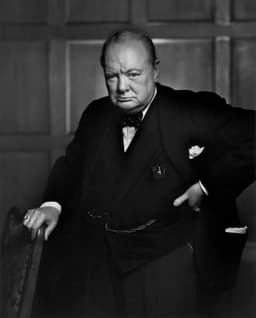
Winston Churchill
Politician · Modern
71.8Total
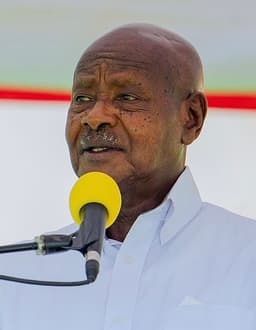
Yoweri Museveni
Politician · Modern
63.9Total
Basic Information
Born
1874
1944
Died
1965
—
Era
Modern
Modern
Nationality
United Kingdom
Uganda
Occupation
Politician
Politician
Civilization
Western
Other
Score Comparison
Military (10%)
55.0
67.5
Political (20%)
78.0
72.0
Influence (20%)
75.0
61.0
Legacy (20%)
68.0
50.0
Leadership (15%)
82.0
80.0
Strategy (15%)
65.0
66.3
TOTAL
71.8
63.9
Winston Churchill — Complete Timeline
1940 AD
Appointed Prime Minister of the United KingdomPolitical Action◆ Major
On May 10, 1940, Winston Churchill became Prime Minister of the United Kingdom, replacing Neville Chamberlain. His appointment came as Nazi Germany invaded France and the Low Countries, and Churchill formed a coalition government to lead Britain through World War II.
World War IILeadershipCoalition Government
Impact: globalconstructive
Delivered the 'We Shall Fight on the Beaches' SpeechOther◆ Major
On June 4, 1940, Churchill delivered a speech to the House of Commons following the evacuation of British forces from Dunkirk. He declared that Britain would fight on the beaches, landing grounds, fields, streets, and hills, and never surrender, rallying British morale during the darkest days of World War II.
World War IIOratoryMorale
Impact: nationalconstructive
1941 AD
Signed the Atlantic CharterOther◆ Major
On August 14, 1941, Churchill and U.S. President Franklin D. Roosevelt signed the Atlantic Charter aboard HMS Prince of Wales. This joint declaration outlined post-war goals including self-determination, disarmament, and free trade, and became a foundational document for the Allied war aims and the United Nations.
World War IIAllied CooperationPost-war Planning
Impact: globalconstructive
1945 AD
Attended the Yalta ConferenceOther◆ Major
In February 1945, Churchill attended the Yalta Conference with Roosevelt and Stalin to discuss the post-war reorganization of Europe. The conference agreed on the division of Germany, the establishment of the United Nations, and the fate of Eastern Europe, though Churchill later expressed regret over concessions to Stalin.
World War IIPost-war SettlementBig Three
Impact: global
1946 AD
Delivered the 'Iron Curtain' SpeechOther◆ Major
On March 5, 1946, Churchill delivered a speech at Westminster College in Fulton, Missouri, where he stated that an 'iron curtain' had descended across Europe from Stettin to Trieste. This speech is widely regarded as marking the beginning of the Cold War, as it highlighted the division between Soviet-controlled Eastern Europe and the West.
Cold WarSoviet UnionDivision of Europe
Impact: globaldestructive
1953 AD
Awarded the Nobel Prize in LiteratureOther◆ Major
In 1953, Churchill was awarded the Nobel Prize in Literature for his historical writings, particularly 'The Second World War' and 'A History of the English-Speaking Peoples'. The Nobel committee cited his mastery of historical and biographical description as well as his brilliant oratory in defending human values.
LiteratureNobel PrizeHistorical Writing
Impact: nationalconstructive
Yoweri Museveni — Complete Timeline
1986 AD
Bush War Victory and Capture of KampalaWar
Museveni's National Resistance Army (NRA) captured Kampala, ending the Ugandan Bush War. He was sworn in as President on January 29, 1986, overthrowing the government of Tito Okello and beginning his long rule.
Ugandan Bush WarSeizure of PowerNRA
Impact: national
Introduction of the Movement SystemPolitical Action◆ Major
Museveni established a 'no-party' Movement system, banning political party activity. This system concentrated power in the National Resistance Movement (NRM) and was justified as necessary to prevent ethnic conflict, but was criticized as authoritarian.
Political SystemNRMAuthoritarianism
Impact: national
1998 AD
Invasion of the Democratic Republic of CongoWar◆ Major
Ugandan forces, allied with Rwanda, invaded the Democratic Republic of Congo (DRC) to overthrow Laurent Kabila. This intervention escalated the Second Congo War, drawing in multiple African nations and causing widespread devastation.
Second Congo WarRegional ConflictIntervention
Impact: regionaldestructive
2005 AD
Constitutional Amendment Removing Term LimitsPolitical Action◆ Major
Museveni's government pushed through a constitutional amendment removing presidential term limits. This allowed him to run for a third term in 2006 and subsequent elections, consolidating his hold on power and drawing domestic and international criticism.
Constitutional ChangeTerm LimitsPower Consolidation
Impact: nationaldestructive
2014 AD
Anti-Homosexuality ActPolitical Action◆ Major
Museveni signed the Anti-Homosexuality Act, which imposed life imprisonment for certain same-sex acts. The law was widely condemned internationally, leading to aid cuts from some Western nations, though it was later annulled by the Constitutional Court on procedural grounds.
LGBTQ RightsLegislationInternational Condemnation
Impact: nationaldestructive
Expert Analysis
Winston Churchill vs Yoweri Museveni
**The Orator and the Guerrilla: Two Paths to Power, Two Legacies of Leadership**
On a grey May morning in 1940, Winston Churchill stood before the House of Commons and offered his country nothing but “blood, toil, tears and sweat.” Half a century later and half a world away, Yoweri Museveni emerged from the Ugandan bush at the head of a ragged army, promising not eloquence but liberation from tyranny. Both men seized history by the throat. Yet one became a global symbol of democratic resolve, the other a cautionary tale of revolutionary promise curdled into autocracy. Why did these two leaders, each forged in conflict, diverge so dramatically?
**Origins**
Churchill was born into the British aristocracy in 1874, the son of a prominent politician and an American heiress. His world was one of empire, privilege, and expectation—but also of neglect. His father dismissed him as slow; his schoolmasters despaired. Yet from this crucible of rejection emerged a restless ambition. He read history, studied military campaigns, and absorbed the conviction that Britain was a force for civilization. His era was the high noon of empire, when a man could believe that destiny and duty were the same thing.
Museveni, born in 1944 in rural Uganda, came of age in a world being remade. The British Empire was retreating; Africa was rising. His father was a cattle keeper, his mother a peasant farmer. Museveni attended missionary schools and later studied at the University of Dar es Salaam, where Marxist theory and anti-colonial fervor filled lecture halls. Where Churchill inherited a world order, Museveni inherited a world in revolt. He saw power not as stewardship but as seizure.
**Rise to Power**
Churchill’s ascent was parliamentary, a long climb through the ranks of a mature democracy. He was a cavalry officer in India and Sudan, a war correspondent in South Africa, a minister in Liberal and Conservative governments. His path was shaped by oratory and coalition-building, not by bullets. His great turning point came not in a battlefield victory but in 1940, when Neville Chamberlain fell and the nation turned to the man who had warned against Hitler. Churchill rose through the system because the system needed him.
Museveni rose through the bush. In the 1970s, he led a guerrilla campaign against Idi Amin, then against Milton Obote. His National Resistance Army was a small, mobile force fighting a classic insurgency. The turning point was January 1986, when the NRA captured Kampala after five years of war. Museveni, then 41, was sworn in as president. He did not inherit power; he took it. His legitimacy came not from votes but from victory.
**Leadership & Governance**
Churchill’s leadership was rhetorical, symbolic, and institutional. He rallied a nation through radio broadcasts and parliamentary defiance. He built a coalition government, worked with military chiefs, and deferred to democratic processes. His military strategy was often criticized—he was a romantic who loved frontal assaults and grand schemes like Gallipoli. But his political wisdom was immense: he understood that democracy required consent, not command. He governed through persuasion, not decree.
Museveni’s leadership was operational, personal, and authoritarian. He was a hands-on commander who knew the bush. Early on, he restored order, stabilized the economy, and won Western admiration. But he also introduced the “Movement System” in 1986, banning political parties and concentrating power in a single, supposedly non-partisan structure. He argued that Africa needed discipline, not democracy. Over time, this logic hardened. In 2005, his government amended the constitution to remove term limits, allowing him to stand for re-election indefinitely. In 2014, he signed the Anti-Homosexuality Act, a law widely condemned as draconian. The reformer became the autocrat.
**Triumph & Tragedy**
Churchill’s greatest moment was 1940–1941, when Britain stood alone against Nazi Germany. His defiance was not just strategic but spiritual. His tragedy was that he outlived his moment. In 1945, voters rejected him; in his second premiership, he was old, ill, and out of touch. Yet his fall was gentle—a loss of office, not of liberty.
Museveni’s triumph was the capture of Kampala in 1986 and the early years of stability after decades of chaos. His tragedy is the slow erosion of that promise. The invasion of the Democratic Republic of Congo in 1998—a war that drew in multiple African nations—tarnished his reputation. The removal of term limits in 2005 signaled that he would not let go of power. As of 2024, he remains president, a man who once inspired hope now presiding over a system that stifles it.
**Character & Destiny**
Churchill was a man of grand gestures, deep melancholy, and unshakable conviction. He believed in destiny—his own and his nation’s. That faith gave him courage but also blindness. He could not see that the empire he revered was dying. Yet his character fit his era: a world war demanded a lion.
Museveni is more calculating, more patient, more ideological. He studied guerrilla warfare and Leninist organization. He believed that Africa needed strong men, not free parliaments. His character fit his era too: a post-colonial world where power was often seized, not earned. But where Churchill’s character led him to defend institutions, Museveni’s led him to dismantle them.
**Legacy**
Churchill’s legacy is secure: the man who saved Britain, the voice of liberty, the writer of history. His scores—Military 55, Political 82, Leadership 85—reflect a leader whose power was moral and political, not martial. He is remembered in statues, speeches, and the survival of democracy itself.
Museveni’s legacy is contested. His scores—Military 61.8, Political 72, Leadership 80.8—show a leader competent in war and governance but flawed in vision. In Uganda, he is praised for stability and criticized for authoritarianism. Globally, he is a symbol of the African strongman who began as a liberator and ended as an obstacle to freedom.
**Conclusion**
Churchill and Museveni both rose through conflict, but they ruled through different systems and left different worlds. Churchill’s Britain was a mature democracy; Museveni’s Uganda was a fragile state. Churchill’s power was constrained by law; Museveni’s was expanded by decree. The difference is not just in character but in context. One man inherited a system that checked him; the other built a system that obeyed him. Their stories remind us that leadership is not only about the leader—it is about the soil in which the leader grows. And in the end, the soil determines what will bloom, and what will wither.
Rankings
🥇
Winston ChurchillLeader
Mil: 55.0Pol: 78.0Inf: 75.0
71.8
🥈
Yoweri Museveni
Mil: 67.5Pol: 72.0Inf: 61.0
63.9
+7.9 behind
How This Comparison Works
Algorithm
Each figure is scored on 6 dimensions (0—100 scale) based on structured historical data: Military (10%), Political (20%), Influence (20%), Legacy (20%), Leadership (15%), Strategy (15%). The weighted total produces the final ranking.
Data Sources
Scores are computed from structured sub-indicators in the database. Scale factors adjust for era (Ancient ×0.85, Modern ×1.0) and civilization size (Eastern ×1.05, Other ×0.80) to account for differences in population and military scale.
Maximum 3 Figures
Comparisons are limited to 2—3 figures to ensure readability and statistical meaningfulness.
Error Margins
±5 points per dimension — Sub-scores are derived from historical records with inherent uncertainty. Two figures within 5 points on a dimension should be considered roughly equivalent in that area.
Total Score Accuracy
±3 points overall — The weighted combination of 6 dimensions produces a total score with approximately ±3 points of uncertainty. Differences of less than 3 points are not statistically significant— the figures are effectively tied.
Known Limitations
- Historical records are incomplete and uneven across civilizations
- Figures from oral-tradition societies may be underrepresented
- Occupation labels can misclassify multi-role figures
- Scores measure capability and impact, not moral character
- Quantitative scoring is a comparison tool, not absolute truth
Capability Radar
Military (10%) — Battles & Warfare
Battles
55
65
Win Rate
60
70
Expansion
40
55
Political (20%) — Governance & Reform
Reform
70
60
Diplomacy
85
70
Economy
60
55
Influence (20%) — Cultural & Global Reach
Cultural
85
45
Global
85
50
Legacy (20%) — Historical Impact
Historical
90
55
Longevity
80
50
Leadership (15%) — Power & Stability
Tenure
75
85
Stability
70
50
Strategy (15%) — Tactics & Innovation
Strategy
85
80
Tactics
65
75
Reform
70
60
Similar Comparisons
Comments & Discussion
LordBlimp6/16/2026
Comparing Churchill's 1940 'blood and toil' speech to Museveni's bush liberation is like matching a vintage Rolls-Royce against a rusty pickup truck. Churchill united a nation with words—Museveni used armed violence to grab and keep power for 38 years. One stood for democratic resolve against fascism; the other started as a liberator and ended as a lifer president. Museveni's Uganda today has opposition jailed and term limits erased. That's not just divergence; that's a crack-up.
炮筒历史6/16/2026
把丘吉尔的议会雄辩跟穆塞维尼的丛林游击硬凑一对?简直是拿莎士比亚跟地方戏比高度。丘吉尔靠着贵族教育和旧帝国自信,喊出了民主的脊梁——1940年他真敢牺牲,因为他信这套传统。穆塞维尼呢?1986年说要'制度革新',结果现在2024年还在台上,儿子都快接班了。数据说话:Freedom House给丘吉尔时代的英国打95分,穆塞维尼的Uganda才36分。谁的口才是武器,谁把革命当了终身饭票?一眼看穿。
ScepticOwl6/16/2026
Everyone’s calling Churchill a hero, but he also firebombed Dresden and starved India. Museveni might be an autocrat, but at least he stopped the Idi Amin nightmare and restored basic stability. Churchill’s eloquence masked a racist empire that thought non-whites weren’t ready for self-rule; Museveni’s armed struggle actually toppled a maniac. The divergence isn’t just about democracy, it’s about different starting points. One inherited a global power; the other rebuilt a collapsed state.
血雨清谈6/16/2026
别总吹丘吉尔'血汗泪水'——他当首相时印度饿死几百万,他一句屁话没有。穆塞维尼至少把吃人魔王阿明赶跑了,1986年后乌干达有了医院和学校。但你以为这就高尚?他后来又修宪续命,打压反对派,本质上是个穿西装的新军阀。两人都是战争起家,一个用帝国大义包装殖民罪恶,一个用解放口号掩盖个人独裁。没什么英不英美不美,都是铁手腕加工软嘴皮子。
MapsNotMyths6/16/2026
You want strategic divergence? Look at geography. Churchill fought from a fortified island with a navy; Museveni fought from the bush with captured rifles. Churchill’s ‘iron curtain’ speech defined Cold War polarity; Museveni’s NRM regime merely managed ethnic bargains in a landlocked, fragile state. One had the Atlantic Charter; the other had the Lutembe declaration. Churchill’s global reach came from pre-existing empire; Museveni’s parochial rule reflects