Loading...
Franklin D. Roosevelt vs Winston Churchill
Winston Churchill leads by 0.8 pts · 2 figures compared
…
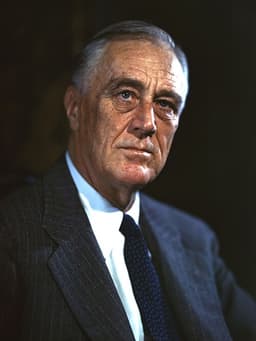
Franklin D. Roosevelt
Politician · Modern
71.0Total
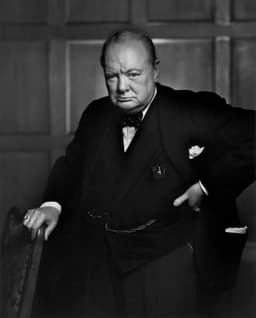
Winston Churchill
Politician · Modern
71.8Total
Basic Information
Born
1882
1874
Died
1945
1965
Era
Modern
Modern
Nationality
United States
United Kingdom
Occupation
Politician
Politician
Civilization
Western
Western
Score Comparison
Military (10%)
45.0
55.0
Political (20%)
85.0
78.0
Influence (20%)
75.0
75.0
Legacy (20%)
65.0
68.0
Leadership (15%)
85.0
82.0
Strategy (15%)
60.0
65.0
TOTAL
71.0
71.8
Franklin D. Roosevelt — Complete Timeline
1933 AD
Inaugurated as 32nd PresidentOther◆ Major
Franklin D. Roosevelt was inaugurated as President of the United States on March 4, 1933, during the Great Depression. His inaugural address declared 'the only thing we have to fear is fear itself,' and he immediately called Congress into special session to address the banking crisis.
Great DepressionPresidencyInauguration
Impact: national
Enacted the New DealOther◆ Major
Roosevelt launched the New Deal in 1933, a series of federal programs including the Civilian Conservation Corps, the Agricultural Adjustment Act, and the Tennessee Valley Authority. These measures aimed to provide relief, recovery, and reform during the Great Depression, fundamentally expanding the role of the federal government.
Great DepressionEconomic PolicySocial Reform
Impact: nationalconstructive
1935 AD
Signed the Social Security ActOther◆ Major
Roosevelt signed the Social Security Act into law on August 14, 1935, establishing a federal system of old-age pensions, unemployment insurance, and aid for dependent children. This created the modern American welfare state and provided a safety net for millions of citizens.
Social WelfareLegislationNew Deal
Impact: nationalconstructive
1941 AD
Lend-Lease ActOther◆ Major
Roosevelt signed the Lend-Lease Act on March 11, 1941, authorizing the transfer of military equipment and supplies to Allied nations, particularly Britain and the Soviet Union. This program provided critical material support to countries fighting the Axis powers before U.S. entry into World War II.
World War IIForeign PolicyMilitary Aid
Impact: globalconstructive
Declaration of War on JapanPolitical Action◆ Major
Following the Japanese attack on Pearl Harbor on December 7, 1941, Roosevelt delivered his 'Day of Infamy' speech to Congress the next day, requesting a declaration of war. Congress approved the declaration, bringing the United States into World War II.
World War IIPearl HarborDeclaration of War
Impact: globaldestructive
1942 AD
Executive Order 9066Other◆ Major
Roosevelt signed Executive Order 9066 on February 19, 1942, authorizing the forced relocation and internment of Japanese Americans living on the West Coast. Over 110,000 people, mostly U.S. citizens, were incarcerated in camps for the duration of the war, a decision later widely condemned as a violation of civil rights.
World War IICivil RightsInternment
Impact: nationaldestructive
1944 AD
Elected to Fourth TermOther◆ Major
Roosevelt was elected to an unprecedented fourth term as president in November 1944, defeating Republican Thomas E. Dewey. This election occurred during the final stages of World War II, and Roosevelt's continued leadership ensured stability in the war effort and post-war planning.
PresidencyElectionWorld War II
Impact: national
1945 AD
Yalta ConferenceOther◆ Major
Roosevelt met with Winston Churchill and Joseph Stalin at the Yalta Conference in February 1945 to discuss post-war Europe. Agreements included the division of Germany, Soviet entry into the war against Japan, and the creation of the United Nations, shaping the post-war world order.
World War IIDiplomacyPost-War Planning
Impact: global
Winston Churchill — Complete Timeline
1940 AD
Appointed Prime Minister of the United KingdomPolitical Action◆ Major
On May 10, 1940, Winston Churchill became Prime Minister of the United Kingdom, replacing Neville Chamberlain. His appointment came as Nazi Germany invaded France and the Low Countries, and Churchill formed a coalition government to lead Britain through World War II.
World War IILeadershipCoalition Government
Impact: globalconstructive
Delivered the 'We Shall Fight on the Beaches' SpeechOther◆ Major
On June 4, 1940, Churchill delivered a speech to the House of Commons following the evacuation of British forces from Dunkirk. He declared that Britain would fight on the beaches, landing grounds, fields, streets, and hills, and never surrender, rallying British morale during the darkest days of World War II.
World War IIOratoryMorale
Impact: nationalconstructive
1941 AD
Signed the Atlantic CharterOther◆ Major
On August 14, 1941, Churchill and U.S. President Franklin D. Roosevelt signed the Atlantic Charter aboard HMS Prince of Wales. This joint declaration outlined post-war goals including self-determination, disarmament, and free trade, and became a foundational document for the Allied war aims and the United Nations.
World War IIAllied CooperationPost-war Planning
Impact: globalconstructive
1945 AD
Attended the Yalta ConferenceOther◆ Major
In February 1945, Churchill attended the Yalta Conference with Roosevelt and Stalin to discuss the post-war reorganization of Europe. The conference agreed on the division of Germany, the establishment of the United Nations, and the fate of Eastern Europe, though Churchill later expressed regret over concessions to Stalin.
World War IIPost-war SettlementBig Three
Impact: global
1946 AD
Delivered the 'Iron Curtain' SpeechOther◆ Major
On March 5, 1946, Churchill delivered a speech at Westminster College in Fulton, Missouri, where he stated that an 'iron curtain' had descended across Europe from Stettin to Trieste. This speech is widely regarded as marking the beginning of the Cold War, as it highlighted the division between Soviet-controlled Eastern Europe and the West.
Cold WarSoviet UnionDivision of Europe
Impact: globaldestructive
1953 AD
Awarded the Nobel Prize in LiteratureOther◆ Major
In 1953, Churchill was awarded the Nobel Prize in Literature for his historical writings, particularly 'The Second World War' and 'A History of the English-Speaking Peoples'. The Nobel committee cited his mastery of historical and biographical description as well as his brilliant oratory in defending human values.
LiteratureNobel PrizeHistorical Writing
Impact: nationalconstructive
Expert Analysis
Franklin D. Roosevelt vs Winston Churchill
# The Lion and the Fox: Churchill, Roosevelt, and the Two Faces of Western Leadership
In the winter of 1941, as German bombs fell on London and Japanese planes darkened the skies over Pearl Harbor, two men sat in the White House, mapping a war that would decide the fate of the world. Winston Churchill, cigar clenched between his teeth, spoke of defiance and destiny. Franklin D. Roosevelt, wheelchair hidden from public view, spoke of systems and strategy. They were allies, friends even—yet they could hardly have been more different. One was a Victorian warrior-poet, the other a modern political architect. How did two men from the same civilization, facing the same crisis, come to embody such contrasting visions of leadership? The answer lies not just in their characters, but in the worlds that shaped them.
Origins
Churchill was born into the British aristocracy in 1874, the year Disraeli became prime minister. His father, Lord Randolph Churchill, was a brilliant but erratic politician; his mother, Jennie Jerome, was an American heiress. Young Winston grew up in a world of empire, cavalry charges, and the conviction that history was a stage for great men. He was sent to Harrow and Sandhurst, where he performed poorly in academics but excelled in military history and English. His era was one of Victorian certainty—the sun never set on the British Empire, and the rules of the game seemed fixed.
Roosevelt, born eight years later in 1882, came from a different America entirely. His family were Hudson Valley Dutch patricians, wealthy and progressive. He was educated at Groton, Harvard, and Columbia Law School—institutions that taught not martial valor but civic duty and social reform. His era was one of industrialization, immigration, and the first tremors of American global power. Where Churchill saw a world of honor and danger, Roosevelt saw a world of systems and problems to be solved.
Rise to Power
Churchill entered politics through war. As a young cavalry officer, he fought in Cuba, India, Sudan, and South Africa, where his daring escape from a Boer prison camp made him a national hero. He entered Parliament in 1900 as a Conservative, then crossed the floor to the Liberals, driven by a restless ambition that cared little for party loyalty. His rise was meteoric but unstable—by 1915, after the disastrous Gallipoli campaign, he was a political outcast, his reputation in ruins. He spent the 1920s and 1930s in the political wilderness, warning against Nazi Germany while being dismissed as a warmonger.
Roosevelt rose through the ranks of Democratic politics with a smoother, more calculating touch. He served as Assistant Secretary of the Navy under Woodrow Wilson, then ran for Vice President in 1920. When polio struck him in 1921, leaving him paralyzed from the waist down, he faced a choice: retreat or reinvent. He chose reinvention. His wife Eleanor became his political partner, and he learned to project strength from a wheelchair. In 1928, he was elected Governor of New York; in 1932, as the Great Depression deepened, he won the presidency in a landslide.
Leadership & Governance
Their leadership styles were as different as their origins. Churchill was a warlord in the ancient mold—he led by oratory, by personal courage, by sheer force of will. His speeches—“We shall fight on the beaches,” “Their finest hour”—were not just rhetoric but acts of defiance that steeled a nation. He micromanaged the war, demanding daily briefings, scribbling memos to generals, and insisting on bold offensives like the North Africa campaign. His military strategy was aggressive but often flawed—he was a brilliant instinctual leader but a poor operational planner, as Gallipoli and the disastrous 1941 Greek campaign showed.
Roosevelt governed through delegation and indirection. He was a master of the “brain trust,” building a team of advisors—Harry Hopkins, Henry Stimson, George Marshall—and letting them execute. His New Deal was not a single plan but a patchwork of experiments: the WPA, the AAA, the Social Security Act. Some worked, some failed, but Roosevelt’s genius was in keeping Americans hopeful through the worst economic crisis in their history. In war, he left strategy to his generals while focusing on grand alliances—the Lend-Lease Act, the Atlantic Charter, the Yalta Conference. His military score of 60 reflects his role as commander-in-chief rather than battlefield tactician.
Triumph & Tragedy
Churchill’s greatest moment was 1940, when Britain stood alone against Hitler. His defiance in the face of annihilation made him a symbol of freedom worldwide. His greatest failure was Gallipoli in 1915—a catastrophic amphibious assault that cost 250,000 casualties and nearly ended his career. Yet even in defeat, he learned: he never forgot the cost of overreach.
Roosevelt’s triumph was the New Deal, which transformed American society and created the modern welfare state. His tragedy was more subtle. He knew by 1944 that his health was failing—his heart was weak, his blood pressure dangerously high—but he ran for a fourth term anyway. He died of a cerebral hemorrhage on April 12, 1945, just weeks before victory in Europe. He never saw the peace he had helped build.
Character & Destiny
Churchill was a man of the 19th century trapped in the 20th. He believed in empire, in aristocracy, in the romance of war. His personality—grandiose, melancholic, stubborn—drove him to greatness but also to isolation. He once said, “We are all worms, but I do believe I am a glow-worm.” That mix of humility and arrogance defined him.
Roosevelt was a modern man through and through. He believed in government, in systems, in the power of information. His personality was opaque—even his closest advisors never knew what he really thought. He was a fox, Churchill a lion. Roosevelt once said, “I am a juggler. I never let my right hand know what my left hand does.” That calculation served him well in politics, but it meant he left behind no clear successor and a New Deal that was never fully institutionalized.
Legacy
Churchill’s legacy is the survival of democracy in its darkest hour. He is remembered as the voice of freedom, the man who said “never surrender.” But his legacy is also complicated—his imperialism, his opposition to Indian independence, his role in the Bengal famine of 1943. He was a great man with great flaws.
Roosevelt’s legacy is the modern American state. Social Security, the minimum wage, the Securities and Exchange Commission—these are his monuments. He also created the framework for the postwar world: the United Nations, the Bretton Woods system, the alliance with the Soviet Union that became the Cold War. His scores—Political 85, Leadership 85—reflect his mastery of governance, but his Influence and Legacy scores of 72 and 75 suggest a figure whose achievements were more institutional than inspirational.
Conclusion
In the end, Churchill and Roosevelt represent two poles of Western leadership. Churchill was the prophet who saw the abyss and refused to blink. Roosevelt was the engineer who built the bridge across it. One inspired; the other organized. One spoke of blood, toil, tears, and sweat; the other spoke of a New Deal, a new world. They needed each other—Churchill needed Roosevelt’s resources, Roosevelt needed Churchill’s resolve. Together, they saved the civilization that produced them. Their differences were not weaknesses but complementary strengths. And perhaps that is the deepest lesson: in the great crises of history, it takes both the lion and the fox to win the day.
Rankings
🥇
Winston ChurchillLeader
Mil: 55.0Pol: 78.0Inf: 75.0
71.8
🥈
Franklin D. Roosevelt
Mil: 45.0Pol: 85.0Inf: 75.0
71.0
+0.8 behind
How This Comparison Works
Algorithm
Each figure is scored on 6 dimensions (0—100 scale) based on structured historical data: Military (10%), Political (20%), Influence (20%), Legacy (20%), Leadership (15%), Strategy (15%). The weighted total produces the final ranking.
Data Sources
Scores are computed from structured sub-indicators in the database. Scale factors adjust for era (Ancient ×0.85, Modern ×1.0) and civilization size (Eastern ×1.05, Other ×0.80) to account for differences in population and military scale.
Maximum 3 Figures
Comparisons are limited to 2—3 figures to ensure readability and statistical meaningfulness.
Error Margins
±5 points per dimension — Sub-scores are derived from historical records with inherent uncertainty. Two figures within 5 points on a dimension should be considered roughly equivalent in that area.
Total Score Accuracy
±3 points overall — The weighted combination of 6 dimensions produces a total score with approximately ±3 points of uncertainty. Differences of less than 3 points are not statistically significant— the figures are effectively tied.
Known Limitations
- Historical records are incomplete and uneven across civilizations
- Figures from oral-tradition societies may be underrepresented
- Occupation labels can misclassify multi-role figures
- Scores measure capability and impact, not moral character
- Quantitative scoring is a comparison tool, not absolute truth
Capability Radar
Military (10%) — Battles & Warfare
Battles
10
55
Win Rate
10
60
Expansion
10
40
Political (20%) — Governance & Reform
Reform
95
70
Diplomacy
90
85
Economy
95
60
Influence (20%) — Cultural & Global Reach
Cultural
80
85
Global
90
85
Legacy (20%) — Historical Impact
Historical
90
90
Longevity
85
80
Leadership (15%) — Power & Stability
Tenure
90
75
Stability
75
70
Strategy (15%) — Tactics & Innovation
Strategy
65
85
Tactics
10
65
Reform
70
70
Similar Comparisons
Comments & Discussion
CavalryChargeCharlie6/16/2026
Churchill was the last great romantic warrior, FDR the first modern technocrat. When Churchill wrote Marlborough's biography, Roosevelt was building dams and Social Security. Churchill is overrated as a strategist—his Gallipoli disaster proves it, and he nearly bankrupted Britain defending an empire he couldn't save. Roosevelt had the vision to back Keynesian economics in 1933, while Churchill was still quoting the Battle of Blenheim. One man wrote speeches, the other built systems.
量化统计师6/16/2026
数据不会骗人:FDR任内四年,美国工业产量翻倍,失业率从25%降到2%;丘吉尔治下英国GDP缩水30%,靠美国救济才能活。说丘吉尔是“救世主”的,请算算租借法案占英国战时GDP的17%——没有罗斯福的支票,丘吉尔的“热血演说”早被破咖啡馆里的啤酒淹死了。情怀不能当炸弹用。
StratagemTurtle6/16/2026
Classics scholar here: their rivalry mirrors Pericles vs Themistocles. Churchill was the Periclean orator clinging to Athenian glory, FDR the Themistoclean realist who built wooden walls—here, the Arsenal of Democracy. Churchill’s “finest hour” speech is pure Agamemnon rhetoric; Roosevelt’s 1940 “garden hose” press conference is Themistocles tricking the Spartans. Both saved their nations, but Roosevelt understood Thucydides’ lesson: power flows from ships, not speeches. Churchill’s rhetoric won
长河读史人6/16/2026
说罗斯福只是“系统建筑师”太肤浅了。1933年他接手的是银行全关门的烂摊子,用蓝鹰计划给工人发工钱时,丘吉尔还在给《每日邮报》写文章骂“社会主义”。1944年罗斯福签《退伍军人权利法案》时,丘吉尔还在想战后怎么保住印度。丘吉尔是旧贵族的最后荣耀,罗斯福是平民世纪的敲门砖。一个是史诗的结尾,一个是历史的起笔。