Loading...
Joseph Stalin vs Winston Churchill
Winston Churchill leads by 3.0 pts · 2 figures compared
…
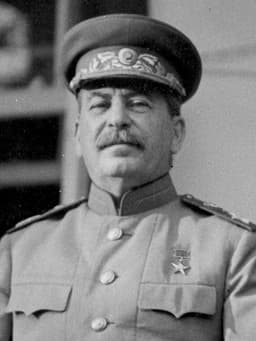
Joseph Stalin
Politician · Modern
68.8Total
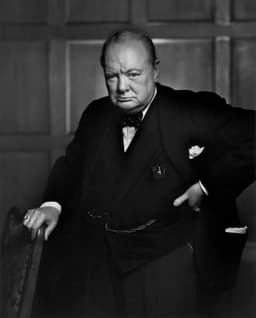
Winston Churchill
Politician · Modern
71.8Total
Basic Information
Born
1878
1874
Died
1953
1965
Era
Modern
Modern
Nationality
Russia
United Kingdom
Occupation
Politician
Politician
Civilization
Western
Western
Score Comparison
Military (10%)
75.0
55.0
Political (20%)
70.0
78.0
Influence (20%)
72.0
75.0
Legacy (20%)
55.0
68.0
Leadership (15%)
80.0
82.0
Strategy (15%)
70.0
65.0
TOTAL
68.8
71.8
Joseph Stalin — Complete Timeline
1928 AD
Launched the First Five-Year PlanReform
Stalin initiated a series of centralized economic plans aimed at rapid industrialization and collectivization of agriculture. The First Five-Year Plan set ambitious targets for heavy industry, leading to significant growth but also severe shortages and human cost.
Impact: global
1929 AD
Implemented forced collectivization of agricultureReform
Stalin ordered the consolidation of individual peasant farms into collective farms (kolkhozy). This was met with resistance, leading to the liquidation of kulaks (wealthy peasants) as a class. The policy caused a catastrophic famine, particularly in Ukraine (Holodomor), resulting in millions of deaths.
Impact: nationaldestructive
1937 AD
Conducted the Great Purge (Great Terror)Political Action
Stalin orchestrated a campaign of political repression against alleged enemies of the state. Millions were arrested, executed, or sent to the Gulag labor camps. The purges targeted the Communist Party, military leadership, intellectuals, and ordinary citizens, consolidating Stalin's absolute power.
Impact: nationaldestructive
1945 AD
Led the Soviet Union to victory in World War IIWar
Stalin served as Supreme Commander of the Soviet armed forces. The Soviet Union bore the brunt of the war against Nazi Germany, suffering immense casualties. The Red Army's victory at Stalingrad and the capture of Berlin were key turning points. The war ended with Soviet domination of Eastern Europe.
Impact: global
Established the Eastern Bloc and the Iron CurtainPolitical Action◆ Major
After WWII, Stalin imposed communist governments in Eastern European countries occupied by the Red Army, creating a buffer zone against the West. This division of Europe into Soviet and Western spheres of influence marked the beginning of the Cold War.
Impact: globaldestructive
Winston Churchill — Complete Timeline
1940 AD
Appointed Prime Minister of the United KingdomPolitical Action◆ Major
On May 10, 1940, Winston Churchill became Prime Minister of the United Kingdom, replacing Neville Chamberlain. His appointment came as Nazi Germany invaded France and the Low Countries, and Churchill formed a coalition government to lead Britain through World War II.
World War IILeadershipCoalition Government
Impact: globalconstructive
Delivered the 'We Shall Fight on the Beaches' SpeechOther◆ Major
On June 4, 1940, Churchill delivered a speech to the House of Commons following the evacuation of British forces from Dunkirk. He declared that Britain would fight on the beaches, landing grounds, fields, streets, and hills, and never surrender, rallying British morale during the darkest days of World War II.
World War IIOratoryMorale
Impact: nationalconstructive
1941 AD
Signed the Atlantic CharterOther◆ Major
On August 14, 1941, Churchill and U.S. President Franklin D. Roosevelt signed the Atlantic Charter aboard HMS Prince of Wales. This joint declaration outlined post-war goals including self-determination, disarmament, and free trade, and became a foundational document for the Allied war aims and the United Nations.
World War IIAllied CooperationPost-war Planning
Impact: globalconstructive
1945 AD
Attended the Yalta ConferenceOther◆ Major
In February 1945, Churchill attended the Yalta Conference with Roosevelt and Stalin to discuss the post-war reorganization of Europe. The conference agreed on the division of Germany, the establishment of the United Nations, and the fate of Eastern Europe, though Churchill later expressed regret over concessions to Stalin.
World War IIPost-war SettlementBig Three
Impact: global
1946 AD
Delivered the 'Iron Curtain' SpeechOther◆ Major
On March 5, 1946, Churchill delivered a speech at Westminster College in Fulton, Missouri, where he stated that an 'iron curtain' had descended across Europe from Stettin to Trieste. This speech is widely regarded as marking the beginning of the Cold War, as it highlighted the division between Soviet-controlled Eastern Europe and the West.
Cold WarSoviet UnionDivision of Europe
Impact: globaldestructive
1953 AD
Awarded the Nobel Prize in LiteratureOther◆ Major
In 1953, Churchill was awarded the Nobel Prize in Literature for his historical writings, particularly 'The Second World War' and 'A History of the English-Speaking Peoples'. The Nobel committee cited his mastery of historical and biographical description as well as his brilliant oratory in defending human values.
LiteratureNobel PrizeHistorical Writing
Impact: nationalconstructive
Expert Analysis
Winston Churchill vs Joseph Stalin
# The Two Titans of the Twentieth Century
On a grey November morning in 1943, two men sat across from each other in the Soviet Embassy in Tehran. One, portly and cigar-clenched, had just turned sixty-nine. The other, smaller and mustachioed, was sixty-five. Between them lay the fate of Europe. Winston Churchill and Joseph Stalin, allies by necessity, enemies by instinct, were about to carve up the world. They shared a century, a war, and a victory—yet their paths to that room could not have been more different, and the worlds they left behind would remain at war for decades after both were gone.
Origins
Churchill was born into the British aristocracy in 1874, at Blenheim Palace, a sprawling estate granted to his ancestor, the Duke of Marlborough, for military triumphs. His father was a politician; his mother, an American heiress. The young Winston grew up in a world of privilege, but also of neglect—his parents were distant, his schoolmasters harsh. He developed a fierce independence and a romantic view of history, reading about battles and empires. His era was the apex of British imperial power, and he absorbed its certainties: that the British Empire was a force for good, that civilization had a hierarchy, and that he was destined to lead.
Stalin was born Ioseb Dzhugashvili in 1878, in the Georgian town of Gori, then part of the Russian Empire. His father was a cobbler, often drunk and violent; his mother, a devoutly religious washerwoman. The family lived in poverty. Young Soso, as he was called, was beaten at home and bullied at school. He escaped into Georgian poetry and revolutionary pamphlets. His era was one of tsarist repression, rising industrial unrest, and revolutionary ferment. Where Churchill saw order and glory, Stalin saw exploitation and hypocrisy. One was raised to believe the system worked; the other, that it had to be destroyed.
Rise to Power
Churchill entered politics through the traditional route: a military commission, war correspondence in India and Sudan, then a seat in Parliament. His rise was meteoric but erratic. He switched parties—from Conservative to Liberal and back again—earning a reputation as a brilliant but unreliable opportunist. His early career was marked by dramatic successes (as Home Secretary, then First Lord of the Admiralty) and catastrophic failures (the Gallipoli campaign in 1915, which nearly ended him). He survived by sheer force of will, writing, speaking, and waiting. His moment came in 1940, when appeasement had failed and Britain needed a voice that would not whisper.
Stalin’s path was underground and bloody. He joined the Bolsheviks, robbed banks to fund the party, and was exiled to Siberia multiple times. He was not a theorist like Lenin or Trotsky; he was an organizer, a fixer, a man who remembered faces and grudges. After the 1917 Revolution, he rose through the party bureaucracy, becoming General Secretary in 1922—a position considered administrative, not strategic. He used it to place his allies in key posts, outmaneuver Trotsky, and, by 1928, stand alone as Lenin’s successor. Where Churchill’s rise was public and parliamentary, Stalin’s was silent and conspiratorial.
Leadership & Governance
As wartime leader, Churchill was a lion in winter. His speeches—“We shall fight on the beaches,” “Their finest hour”—were not just rhetoric; they were acts of defiance that held a nation together when invasion seemed certain. He micromanaged the war, demanding reports, proposing wild schemes (like attacking Norway’s coast), and clashing with his generals. His military judgment was often flawed—he had a weakness for peripheral campaigns—but his strategic instinct was sound: hold the line, keep America in the war, never negotiate with Hitler. Politically, he was a democrat who respected Parliament, even when it frustrated him.
Stalin governed through terror. The First Five-Year Plan (1928) forced rapid industrialization at immense human cost. Collectivization of agriculture (1929) caused a famine that killed millions. The Great Purge (1937) eliminated rivals, officers, and anyone suspected of disloyalty—perhaps a million executed, millions more sent to the Gulag. Yet in war, he proved a different leader. After the shock of the Nazi invasion in 1941, he rallied, appointed capable generals like Zhukov, and allowed a measure of patriotic freedom. He was ruthless but not reckless; he learned from defeats. His political genius lay in mobilizing a shattered nation to fight and win.
Triumph & Tragedy
Churchill’s greatest moment was 1940: standing alone against Hitler, rallying the free world. His greatest tragedy was the aftermath. In July 1945, with victory secured, he was voted out of office. The British people, exhausted and yearning for social reform, chose Labour over the hero who had saved them. He returned to power in 1951, but his second premiership was anticlimactic—marked by imperial decline and economic stagnation.
Stalin’s triumph was 1945: the Red Army in Berlin, the swastika torn down, the Soviet Union a superpower. His tragedy was the price. The war cost the USSR 27 million lives. The peace he built was a prison: the Eastern Bloc, the Iron Curtain, a system of repression that mirrored his own paranoia. He died in 1953, leaving a country victorious but traumatized, and a regime that would outlast him by decades.
Character & Destiny
Churchill was a man of immense ego and immense sentiment. He wept at news of defeats, adored his wife, wrote history as he lived it. His character drove his decisions: stubbornness in 1940, recklessness at Gallipoli, romanticism about empire. He believed in destiny—his own and Britain’s—and that belief became self-fulfilling.
Stalin was cold, calculating, and profoundly suspicious. He trusted no one, eliminated everyone who threatened him, and saw history as a series of conspiracies. His character shaped a regime of fear. Yet he was also capable of patience, of waiting for the right moment. He understood power as Churchill never could: not as a responsibility, but as a weapon.
Legacy
Churchill is remembered as the voice of freedom in its darkest hour. His legacy is complicated—he was a racist, an imperialist, a man who ordered the bombing of German cities and the suppression of colonial uprisings. But in 1940, he was indispensable. He is a statue in London, a name on a cigar, a speech that still echoes.
Stalin is remembered as a tyrant who saved his country and destroyed it. In Russia, polls show a surprising nostalgia—many see him as a strong leader who won the war. In the West, he is a symbol of totalitarian evil. His legacy is the Gulag, the Great Terror, and also the defeat of Nazism. He is a paradox that history has not resolved.
Conclusion
In Tehran, over dinner and vodka, Churchill proposed a toast: “To the proletarian masses of the world.” Stalin smiled and raised his glass: “To the Conservative Party of Great Britain.” They understood each other perfectly—two old men who had seen too much, who knew that the alliance was temporary, and that history would judge them both. It has, and it will continue to. They were products of their times, shaped by empire and revolution, privilege and poverty. They fought the same war, but for different futures. In the end, the question they leave us is not who was better or worse, but what it means to lead when the world is burning.
Rankings
🥇
Winston ChurchillLeader
Mil: 55.0Pol: 78.0Inf: 75.0
71.8
🥈
Joseph Stalin
Mil: 75.0Pol: 70.0Inf: 72.0
68.8
+3.0 behind
How This Comparison Works
Algorithm
Each figure is scored on 6 dimensions (0—100 scale) based on structured historical data: Military (10%), Political (20%), Influence (20%), Legacy (20%), Leadership (15%), Strategy (15%). The weighted total produces the final ranking.
Data Sources
Scores are computed from structured sub-indicators in the database. Scale factors adjust for era (Ancient ×0.85, Modern ×1.0) and civilization size (Eastern ×1.05, Other ×0.80) to account for differences in population and military scale.
Maximum 3 Figures
Comparisons are limited to 2—3 figures to ensure readability and statistical meaningfulness.
Error Margins
±5 points per dimension — Sub-scores are derived from historical records with inherent uncertainty. Two figures within 5 points on a dimension should be considered roughly equivalent in that area.
Total Score Accuracy
±3 points overall — The weighted combination of 6 dimensions produces a total score with approximately ±3 points of uncertainty. Differences of less than 3 points are not statistically significant— the figures are effectively tied.
Known Limitations
- Historical records are incomplete and uneven across civilizations
- Figures from oral-tradition societies may be underrepresented
- Occupation labels can misclassify multi-role figures
- Scores measure capability and impact, not moral character
- Quantitative scoring is a comparison tool, not absolute truth
Capability Radar
Military (10%) — Battles & Warfare
Battles
85
55
Win Rate
80
60
Expansion
85
40
Political (20%) — Governance & Reform
Reform
90
70
Diplomacy
70
85
Economy
85
60
Influence (20%) — Cultural & Global Reach
Cultural
70
85
Global
95
85
Legacy (20%) — Historical Impact
Historical
95
90
Longevity
80
80
Leadership (15%) — Power & Stability
Tenure
95
75
Stability
60
70
Strategy (15%) — Tactics & Innovation
Strategy
85
85
Tactics
60
65
Reform
90
70
Similar Comparisons
Comments & Discussion
KremlinCipher6/17/2026
Comparing Stalin and Churchill is like comparing a chess grandmaster to a poker bluffer. Stalin’s ruthless consolidation of Soviet industry during the Five-Year Plans gave him the tank armies that broke Hitler, while Churchill’s charisma kept Britain alive but his Dardanelles debacle and Bengal famine show strategic blindness. The real score? Stalin’s body count is higher, but his war-winning logistics were unmatched.
海魂骑士6/17/2026
丘吉尔是个演说家,斯大林是个刺客。看看两国二战初期的表现:斯大林差点让莫斯科沦陷,全赖冬天和西伯利亚师续命;丘吉尔却用皇家空军的铁钻打碎了希特勒的入侵梦。数据会说话,但历史更看重谁在绝境中没崩溃。
TractorFactory6/17/2026
The statistical comparison misses the core: Stalin’s USSR produced 100,000 tanks and 150,000 aircraft during WWII, while Churchill’s Britain managed 30,000 and 125,000. That’s not just a numbers game—it’s a testament to Stalin’s brutal industrialization. Churchill’s wit won debates; Stalin’s five-year plans won wars.
墨色书斋6/17/2026
英国佬总爱吹丘吉尔的雪茄,却忘了他把印度饿死几百万人。斯大林是暴君,但他在三十年代就预见到大战,库尔斯克战役证明了苏联工业的肌肉。数据不撒谎:没有红军的血肉,诺曼底登陆只是个笑话。
VETERAN_VOICEBLASTER6/16/2026
Comparing Churchill and Stalin as "equals" is like comparing a lion and a wolf. Churchill was a romantic imperialist who literally wept over the fall of the British Empire—his wartime leadership depended on borrowed American money and colonial conscripts. Stalin lost 27 million Soviet citizens but still crushed the Wehrmacht with industrial planning and sheer will. One wrote memoirs; the other rewrote history. One was a symbol; the other was a system.
数据铁拳6/16/2026
你们总是在道德层面比较,可数据不会撒谎。斯大林领导下的苏联工业产值在1930年代增长了400%,从木犁到T-34坦克只用了十几年。而丘吉尔的英国到1945年已经财政破产,欠美国47亿美元。一个创造了工业奇迹,一个只是用祖辈的荣光当遮羞布。谁更配得上"巨人"称号?数字说话。
CLASSICS_VS_CANNONS6/16/2026
Military historians love the "Big Three" narrative, but Churchill was a tactician's nightmare. He approved the disastrous Gallipoli campaign in 1915, costing 44,000 Allied casualties, then doubled down with the 1941 Greek intervention that drained North Africa. Stalin—despite the 1941 purges that gutted his officer corps—masterminded Operation Bagration, which destroyed 28 German divisions in six weeks. Give me the ruthless pragmatist over the romantic blunderer any day.
野史猎手6/16/2026
别被官方照片骗了,这两人的交锋远不止会议桌。1944年,丘吉尔秘密提出过"百分比协议",试图把希腊划给英国,斯大林只在上面打了个勾就同意了——他根本不在乎巴尔干的民族自决,只在乎控制东欧。而丘吉尔呢?一边大谈民主,一边用英国军队镇压希腊左翼。两个都是赤裸裸的帝国猎食者,只不过一个穿西装,一个裹皮大衣。
FORGOTTEN_AXIS6/16/2026
Every student knows Churchill's "iron curtain" speech, but nobody mentions that he privately admired Stalin's methods. In 1942, Churchill reportedly told his doctor, "Stalin has made Russia great—if only I could make England so unanimous." Both men understood that leadership requires terror. Churchill used it against Indian independence with the 1943 Bengal famine (3 million dead). Stalin used it in Ukraine. Different victims, same logic: power before people.