Loading...
Sitiveni Rabuka vs Suharto
Suharto leads by 5.5 pts · 2 figures compared
…
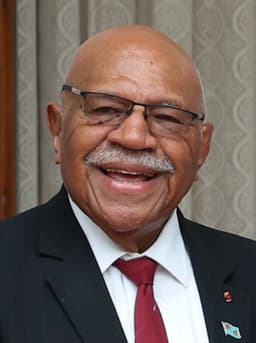
Sitiveni Rabuka
General · Modern
51.7Total
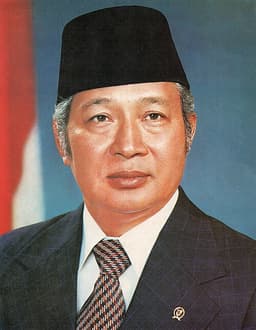
Suharto
General · Modern
57.2Total
Basic Information
Born
1948
1921
Died
—
—
Era
Modern
Modern
Nationality
Fiji
Indonesia
Occupation
General
General
Civilization
Other
Eastern
Score Comparison
Military (10%)
10.2
20.0
Political (20%)
60.0
59.3
Influence (20%)
53.3
60.0
Legacy (20%)
46.7
52.0
Leadership (15%)
85.0
82.0
Strategy (15%)
39.6
60.0
TOTAL
51.7
57.2
Sitiveni Rabuka — Complete Timeline
1987 AD
1987 Fijian Coup d'étatPolitical Action
Rabuka, as a colonel in the Fijian military, led a coup overthrowing the elected government of Timoci Bavadra. The coup was motivated by ethnic Fijian opposition to Indo-Fijian political influence. Rabuka declared Fiji a republic.
CoupMilitary InterventionEthnic Tension
Impact: nationaldestructive
1992 AD
1992 Election as Prime MinisterPolitical Action◆ Major
Rabuka transitioned from military leader to civilian politician, winning the 1992 general election as leader of the Fijian Political Party. He became Prime Minister, serving until 1999.
ElectionCivilian GovernmentPolitical Transition
Impact: national
1997 AD
1997 Constitution ReformReform◆ Major
Rabuka's government oversaw the adoption of a new constitution that removed ethnic-based voting and provided for a multi-ethnic government. The constitution aimed to reduce ethnic tensions and promote national unity.
ConstitutionReformEthnic Reconciliation
Impact: nationalconstructive
1999 AD
1999 General Election DefeatPolitical Action◆ Major
Rabuka's government was defeated in the general election by the Labour Party led by Mahendra Chaudhry. Rabuka stepped down as Prime Minister, marking the end of his first period in power.
Election DefeatGovernment ChangeChaudhry
Impact: national
2022 AD
2022 Return as Prime MinisterPolitical Action◆ Major
Rabuka led the People's Alliance to victory in the 2022 general election, forming a coalition government. He became Prime Minister again, 23 years after his previous tenure, promising democratic reforms.
ElectionReturn to PowerCoalition Government
Impact: national
Suharto — Complete Timeline
1966 AD
Supersemar and Transfer of PowerPolitical Action
President Sukarno signed the Supersemar order, delegating authority to General Suharto to restore order after the 30 September Movement. Suharto used this to ban the Communist Party, purge leftists, and gradually assume executive power, effectively beginning his New Order regime.
SupersemarNew OrderIndonesia
Impact: nationaldestructive
1967 AD
New Order Economic DevelopmentReform◆ Major
Suharto implemented the New Order's economic policies, focusing on foreign investment, agricultural self-sufficiency, and industrialization. The government achieved high growth rates, reduced poverty, and stabilized the economy, but also fostered crony capitalism and corruption.
Economic GrowthDevelopmentIndonesia
Impact: nationalconstructive
1975 AD
Invasion of East TimorWar◆ Major
Suharto ordered the invasion of East Timor after Portugal withdrew. Indonesian forces occupied the territory, leading to a 24-year occupation marked by widespread human rights abuses, including massacres and forced displacement, resulting in an estimated 100,000-200,000 deaths.
East TimorOccupationHuman Rights
Impact: regionaldestructive
1998 AD
Asian Financial Crisis and Fall from PowerPolitical Action
The Asian Financial Crisis devastated Indonesia's economy, leading to massive unemployment and food shortages. Widespread protests and riots forced Suharto to resign in May 1998 after 31 years in power, ending his authoritarian rule and ushering in the Reformasi era.
Financial CrisisResignationReformasi
Impact: nationaltragic
Expert Analysis
Sitiveni Rabuka vs Suharto
# The General Who Would Be President
In the sweltering heat of Jakarta, March 1966, a little-known general named Suharto stood at the precipice of power. Half a world away, in the South Pacific, another colonel named Sitiveni Rabuka would wait another twenty-one years before making his own dramatic entrance onto history's stage. Both men wore military uniforms, both seized power when their nations teetered on the edge of chaos, and both would go on to lead their countries for decades. Yet their paths diverged in ways that reveal something profound about power, character, and the strange alchemy of leadership.
Origins
Suharto was born in 1921 into a humble Javanese farming family in the Dutch East Indies. His father was a village irrigation official, his mother a woman of modest means. The young Suharto grew up in a world of traditional Javanese mysticism, where spiritual power and political authority were intertwined. He joined the Dutch colonial army, then the Japanese-sponsored forces during World War II, and finally the Indonesian independence struggle. By the time he emerged as a general in the 1960s, he embodied a particular Javanese ideal: the leader who appears calm, inscrutable, and divinely favored.
Rabuka, born in 1948 in a small Fijian village, came from a different world entirely. His father was a Methodist minister, and young Sitiveni grew up in a community where Christianity and traditional Fijian chiefly authority coexisted uneasily with the legacy of British colonialism. He joined the Fijian military, rising through the ranks to become a colonel by 1987. Unlike Suharto, who absorbed the hierarchical mysticism of Java, Rabuka was shaped by the tensions between Fiji's indigenous Fijian and Indo-Fijian communities—a fault line that would define his political career.
Rise to Power
Suharto's ascent came through a crisis. On September 30, 1965, a group of leftist military officers attempted a coup, killing six senior generals. The chaos that followed gave Suharto, then commander of the army's strategic reserve, his opening. He blamed the Indonesian Communist Party, orchestrated a brutal purge that killed hundreds of thousands, and by March 1966, President Sukarno—weakened and isolated—signed the Supersemar order, delegating authority to Suharto to restore order. It was a turning point that transformed a general into a de facto ruler.
Rabuka's rise was more abrupt. In May 1987, Fiji held an election that brought the first Indo-Fijian-led government to power under Timoci Bavadra. For indigenous Fijians who saw themselves as the rightful owners of the land, this was an existential threat. Rabuka, then a 38-year-old colonel, stormed parliament in a bloodless coup, declaring himself head of state. He later admitted that he acted out of a sense of duty to protect indigenous Fijian supremacy—a motivation far more ideological than Suharto's calculated power grab.
Leadership & Governance
As president, Suharto built what he called the "New Order"—a regime of stability, development, and authoritarian control. His military score of 45.5 and strategy rating of 58.2 suggest he was not a battlefield genius, but his political score of 68.8 and leadership rating of 80.7 reveal a master of bureaucratic power. He invited foreign investment, achieved agricultural self-sufficiency, and oversaw decades of economic growth that lifted millions from poverty. Yet this prosperity came at a terrible price: the 1975 invasion of East Timor led to decades of occupation and perhaps 200,000 deaths, while corruption flourished under his family's control.
Rabuka's governance was more turbulent and ultimately more democratic. After his 1987 coup, he initially ruled by decree, but within five years he had transformed himself into a civilian politician, winning the 1992 election as prime minister. His political score of 72.0 and leadership rating of 77.4 reflect a man who learned to wield power through persuasion rather than force. The 1997 constitution reform was his crowning achievement—a document that removed ethnic-based voting and attempted to create a multiracial Fiji. It was a remarkable reversal for a man who had seized power to protect ethnic supremacy.
Triumph & Tragedy
Suharto's greatest triumph was economic: by the 1990s, Indonesia was a "tiger economy," with growth rates that dazzled the world. But the Asian Financial Crisis of 1997-98 exposed the fragility of his system. The economy collapsed, unemployment soared, and protests erupted across the country. In May 1998, after 31 years in power, Suharto resigned in disgrace—a sudden fall that shocked a nation accustomed to his seemingly unshakeable rule.
Rabuka's tragedy was more personal. After losing the 1999 election to Mahendra Chaudhry—the very outcome he had once overthrown—he stepped down gracefully, accepting democratic defeat. For years, he seemed a figure of the past, a coup leader who had failed to build a lasting political legacy. Then, in a stunning twist, he returned to power in 2022, winning the election as prime minister once again. His total score of 61.0, lower than Suharto's 67.7, belies a story of redemption that Suharto never achieved.
Character & Destiny
Suharto was a man of masks. Javanese culture prizes *alus*—refined, controlled, inscrutable behavior—and Suharto perfected it. He rarely raised his voice, never showed anger in public, and governed through a network of family, cronies, and military officers. His personality was suited to a system of centralized control, but when the crisis came, he could not adapt. He had no Plan B because he had never imagined failure.
Rabuka was more transparent, more impulsive, and ultimately more human. He admitted his mistakes, apologized for the coup, and spent decades trying to atone. His character was suited to a small, fractious democracy where personal relationships matter as much as institutions. Where Suharto built a machine, Rabuka built bridges—sometimes burning them, but always trying to rebuild.
Legacy
Today, Suharto's legacy is deeply contested. Some Indonesians remember the stability and growth; others recall the corruption, repression, and East Timor's suffering. His legacy score of 67.1 reflects this ambiguity—a strongman who modernized his country but left it morally bankrupt.
Rabuka's legacy is evolving. Once reviled as a coup leader, he is now seen by many Fijians as a democrat who learned from his mistakes. His legacy score of 61.2 may rise as history judges his 1997 constitution and his 2022 return as a elder statesman who completed a remarkable journey.
Conclusion
The difference between these two generals is not simply that one clung to power and the other let go. It is that Suharto saw power as an end in itself—a possession to be held and passed to his family—while Rabuka came to see power as a trust, to be exercised and then surrendered. One ruled for thirty-one years and left a nation scarred; the other ruled for seven, lost, and returned to try again. In the end, Suharto's story is a cautionary tale about the seduction of absolute control, while Rabuka's is a reminder that even those who seize power can learn to let it go.
Rankings
🥇
SuhartoLeader
Mil: 20.0Pol: 59.3Inf: 60.0
57.2
🥈
Sitiveni Rabuka
Mil: 10.2Pol: 60.0Inf: 53.3
51.7
+5.5 behind
How This Comparison Works
Algorithm
Each figure is scored on 6 dimensions (0—100 scale) based on structured historical data: Military (10%), Political (20%), Influence (20%), Legacy (20%), Leadership (15%), Strategy (15%). The weighted total produces the final ranking.
Data Sources
Scores are computed from structured sub-indicators in the database. Scale factors adjust for era (Ancient ×0.85, Modern ×1.0) and civilization size (Eastern ×1.05, Other ×0.80) to account for differences in population and military scale.
Maximum 3 Figures
Comparisons are limited to 2—3 figures to ensure readability and statistical meaningfulness.
Error Margins
±5 points per dimension — Sub-scores are derived from historical records with inherent uncertainty. Two figures within 5 points on a dimension should be considered roughly equivalent in that area.
Total Score Accuracy
±3 points overall — The weighted combination of 6 dimensions produces a total score with approximately ±3 points of uncertainty. Differences of less than 3 points are not statistically significant— the figures are effectively tied.
Known Limitations
- Historical records are incomplete and uneven across civilizations
- Figures from oral-tradition societies may be underrepresented
- Occupation labels can misclassify multi-role figures
- Scores measure capability and impact, not moral character
- Quantitative scoring is a comparison tool, not absolute truth
Capability Radar
Military (10%) — Battles & Warfare
Battles
5
40
Win Rate
5
45
Expansion
5
30
Political (20%) — Governance & Reform
Reform
50
55
Diplomacy
45
60
Economy
40
65
Influence (20%) — Cultural & Global Reach
Cultural
30
40
Global
20
50
Legacy (20%) — Historical Impact
Historical
40
55
Longevity
30
45
Leadership (15%) — Power & Stability
Tenure
55
85
Stability
35
50
Strategy (15%) — Tactics & Innovation
Strategy
10
40
Tactics
10
35
Reform
5
50
Similar Comparisons
Comments & Discussion
Historian9626/16/2026
Everyone forgets: Suharto's rise was literally enabled by the CIA-backed 1965-66 mass killings that eliminated the
血染爪哇佬6/16/2026
Suharto 的腐败是制度性的,他家族在 32 年里搜刮了 150 亿到 350 亿美元,而 Rabuka 的贪腐指控简直像零花钱。但更关键的是,Suharto 用军队建立了一个官僚化镇压机器——印尼的 "新秩序" 让无数异议者消失。Rabuka 的政变后,斐济有了四年军事统治,却最终回归了民主选举。Suharto 直到 1998 年下台都没给受害者一个道歉,Rabuka 至少公开忏悔过。一个硬撑到死,一个知道何时放手。
经典学者6/16/2026
Suharto 的权力基础深深扎根于爪哇的 "Ratu Adil"(公正之王)神话——他被认为拥有神授的 wibawa(精神权威)。但 Rabuka 更像是斐济传统中的一位 warrior chief——他的 coup 直接针对宪法,而不是通过神秘的庇护。Suharto 用 wayang 皮影戏隐喻把自己塑造成宁静的保护者,而 Rabuka 公开宣称自己受基督教指导。两人都利用了传统,但 Suharto 的操控更隐蔽、更阴险,而 Rabuka 的行动更直率、更暴力。
Historian3146/16/2026
Let's gut-check the "both led for decades" claim. Suharto: 32 years as president, from 1967 to 1998. Rabuka: prime minister for only 5 years total (1987-1992, then 1992-1994, and later 1999-2000). That's a massive asymmetry — Rabuka's military rule was brief; Suharto's was a lifetime. Plus, Suharto's GDP growth averaged 7% annually in the 1970s-80s, but it was built on oil rents and crony capitalism. Rabuka's Fiji saw stagnant economic growth under his coups, with tourism cratering. So whose "ch
Chronicler41416/16/2026
Suharto and Rabuka both toppled shaky governments, but that's where the similarity ends. Rabuka's coups were reactionary—he was defending indigenous Fijian supremacy against Indo-Fijian political gains, a narrow racial play. Suharto's takeover was systemic: he annihilated the PKI (Communist Party) with mass slaughter, purging hundreds of thousands. Rabuka later repented, voluntarily stepping down in 1999 after elections. Suharto clung to power for 32 years, building a family dynasty. One grew a