Loading...
Suharto vs Yitzhak Rabin
Yitzhak Rabin leads by 9.2 pts · 2 figures compared
…
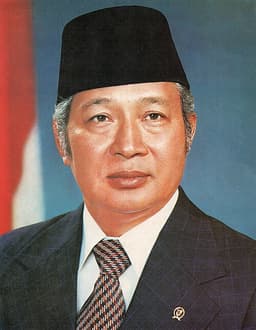
Suharto
General · Modern
57.2Total
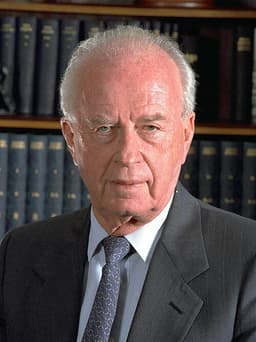
Yitzhak Rabin
General · Modern
66.4Total
Basic Information
Born
1921
1922
Died
—
—
Era
Modern
Modern
Nationality
Indonesia
Israel
Occupation
General
General
Civilization
Eastern
Middle Eastern
Score Comparison
Military (10%)
20.0
61.7
Political (20%)
59.3
82.0
Influence (20%)
60.0
68.0
Legacy (20%)
52.0
55.0
Leadership (15%)
82.0
78.0
Strategy (15%)
60.0
55.0
TOTAL
57.2
66.4
Suharto — Complete Timeline
1966 AD
Supersemar and Transfer of PowerPolitical Action
President Sukarno signed the Supersemar order, delegating authority to General Suharto to restore order after the 30 September Movement. Suharto used this to ban the Communist Party, purge leftists, and gradually assume executive power, effectively beginning his New Order regime.
SupersemarNew OrderIndonesia
Impact: nationaldestructive
1967 AD
New Order Economic DevelopmentReform◆ Major
Suharto implemented the New Order's economic policies, focusing on foreign investment, agricultural self-sufficiency, and industrialization. The government achieved high growth rates, reduced poverty, and stabilized the economy, but also fostered crony capitalism and corruption.
Economic GrowthDevelopmentIndonesia
Impact: nationalconstructive
1975 AD
Invasion of East TimorWar◆ Major
Suharto ordered the invasion of East Timor after Portugal withdrew. Indonesian forces occupied the territory, leading to a 24-year occupation marked by widespread human rights abuses, including massacres and forced displacement, resulting in an estimated 100,000-200,000 deaths.
East TimorOccupationHuman Rights
Impact: regionaldestructive
1998 AD
Asian Financial Crisis and Fall from PowerPolitical Action
The Asian Financial Crisis devastated Indonesia's economy, leading to massive unemployment and food shortages. Widespread protests and riots forced Suharto to resign in May 1998 after 31 years in power, ending his authoritarian rule and ushering in the Reformasi era.
Financial CrisisResignationReformasi
Impact: nationaltragic
Yitzhak Rabin — Complete Timeline
1967 AD
Chief of Staff during the Six-Day WarWar
As Chief of Staff of the Israel Defense Forces, Rabin commanded the Israeli military during the Six-Day War against Egypt, Jordan, and Syria. Israel captured the Sinai Peninsula, Gaza Strip, West Bank, East Jerusalem, and Golan Heights, reshaping the region.
Six-Day WarTerritorial ExpansionMilitary Victory
Impact: global
1993 AD
Signing of the Oslo AccordsPolitical Action
As prime minister, Rabin signed the Oslo Accords with PLO Chairman Yasser Arafat on the White House lawn. The agreement established the Palestinian Authority and set a framework for Palestinian self-governance in the West Bank and Gaza Strip.
Peace ProcessPalestiniansOslo
Impact: globalconstructive
1995 AD
Assassination at Peace RallyPolitical Action
Rabin was assassinated by Israeli extremist Yigal Amir after a peace rally in Tel Aviv. The assassination shocked Israel and the world, derailing the Oslo peace process and leading to a period of political instability.
AssassinationPeace ProcessPolitical Violence
Impact: globaltragic
Expert Analysis
Yitzhak Rabin vs Suharto
# The General’s Two Paths
On a September evening in 1995, Yitzhak Rabin stood before a crowd of 100,000 people in Tel Aviv’s Kings of Israel Square, singing a song of peace. Moments later, a young extremist’s bullet ended his life. Across the world, in a Jakarta hospital three years later, Suharto lay in a coma, his 31-year reign already shattered by economic collapse and student protests. Two generals, two fates—one killed by peace, the other consumed by power. What drove these men, born just a year apart, to such divergent ends?
Origins
Suharto was born in 1921 in a small village in Java, the son of a low-level civil servant and a peasant woman. His childhood was marked by poverty and a fractured family—his parents divorced, and he was passed between relatives. The Dutch colonial education system gave him little formal schooling but instilled a deep sense of Javanese mysticism and hierarchy. He joined the Dutch colonial army, then switched to the Japanese-sponsored forces during World War II, learning early that survival meant adapting to power.
Yitzhak Rabin, born in 1922 in Jerusalem, came from a different world. His parents were secular Zionist pioneers from Russia, committed to building a Jewish state. Rabin grew up in Tel Aviv, attended an agricultural school, and joined the Palmach, the elite strike force of the Haganah. His upbringing was ideological, disciplined, and fiercely nationalistic—but also rooted in the democratic values of the labor movement. Where Suharto learned to bow, Rabin learned to fight for a cause.
Rise to Power
Suharto’s ascent was a slow, careful climb through the ranks of the Indonesian military. The turning point came in 1965, when a failed coup attempt by leftist officers plunged Indonesia into chaos. Suharto, then commander of the Army’s Strategic Reserve, seized the moment. In March 1966, President Sukarno signed the Supersemar order, delegating authority to Suharto to restore order. It was a political masterstroke—Suharto used the document not to stabilize, but to systematically dismantle Sukarno’s power. By 1967, he was acting president, and by 1968, he was president for life in all but name.
Rabin’s rise was more conventional, yet no less dramatic. As Chief of Staff of the Israel Defense Forces, he commanded the Six-Day War in 1967, a stunning victory that captured the Sinai, Gaza, the West Bank, and the Golan Heights. That triumph made him a national hero. But unlike Suharto, Rabin did not cling to military power. He retired, served as ambassador to the United States, and entered politics. In 1974, he became Israel’s first native-born prime minister—a symbol of the nation’s new maturity.
Leadership & Governance
Suharto’s New Order was a paradox. On one hand, he brought stability to a nation torn by ethnic conflict and economic mismanagement. His economic reforms—opening Indonesia to foreign investment, achieving agricultural self-sufficiency in rice, and reducing poverty from 60% to 11%—were genuine achievements. But this prosperity came at a price. Suharto’s regime was a web of corruption, nepotism, and military repression. The invasion of East Timor in 1975, ordered after Portugal’s withdrawal, led to a brutal occupation that killed perhaps 200,000 people. Suharto ruled not through ideology, but through patronage and fear—a Javanese king in general’s uniform.
Rabin’s leadership was the opposite. He was not a charismatic speaker or a backroom schemer. He was blunt, pragmatic, and often awkward. But as prime minister, he had the courage to change. After decades of conflict, Rabin recognized that Israel could not forever rule over millions of Palestinians. The Oslo Accords, signed on the White House lawn in 1993, were his gamble for peace. He shook hands with Yasser Arafat, a man he once called a terrorist, and committed Israel to a two-state solution. His political wisdom lay not in crushing enemies, but in knowing when to stop fighting.
Triumph & Tragedy
Suharto’s greatest triumph was economic transformation. For three decades, Indonesia grew at an average of 7% annually, lifting millions from poverty. But his tragedy was that this growth was built on sand. When the Asian Financial Crisis hit in 1997, the rupiah collapsed, unemployment soared, and riots erupted. Suharto’s response—clinging to power, appointing cronies, and ignoring IMF advice—sealed his fate. In May 1998, he resigned, a broken man. His legacy was a nation that had advanced, but at the cost of democracy and justice.
Rabin’s triumph was the Six-Day War, but his true greatness came later. The Oslo Accords were his finest hour—a moment when a warrior chose peace. His tragedy was that this choice cost him his life. On November 4, 1995, Yigal Amir, a Jewish extremist who believed Rabin was betraying Israel, shot him dead. The assassin’s bullet did more than kill a man; it shattered the peace process. Rabin’s death left a void that no Israeli leader has fully filled.
Character & Destiny
Suharto was a man of masks. In public, he projected calm and fatherly authority; in private, he was ruthless and calculating. He believed in Javanese concepts of power as a mystical force that must be preserved at all costs. This worldview made him incapable of sharing power or admitting failure. His personality drove him to accumulate wealth and control, but it also blinded him to the fragility of his system.
Rabin was a man of contradictions. He was a soldier who hated war, a pragmatist who took risks, a secular Jew who sought peace with Islam. His character was shaped by the burden of command—he suffered a nervous breakdown during the Six-Day War but recovered to lead. He was not a visionary in the grand sense; he was a problem-solver. And when the problem of occupation became clear, he acted. His destiny was to be killed by the very extremism he sought to overcome.
Legacy
Suharto’s legacy is deeply contested. In Indonesia, some remember him as the “Father of Development” who brought order and prosperity. Others recall the corruption, the repression, and the stolen elections. His name is rarely spoken with pride. The New Order’s institutions—the military’s political role, the culture of impunity—survived him, but his family’s fortune was scattered, and his reputation eroded.
Rabin’s legacy is clearer, though no less complex. He is remembered as a martyr for peace, his name invoked at every anniversary of the Oslo Accords. The square where he died was renamed Rabin Square. But his peace did not hold. The second intifada, the rise of Hamas, and the expansion of settlements all followed. Yet Rabin’s example endures as a reminder that leadership means choosing the hard path.
Conclusion
Two generals, born a year apart, on opposite sides of the world. One ruled for three decades and was forgotten; one ruled for a few years and is remembered forever. Suharto sought power and found emptiness. Rabin sought peace and found immortality. Their stories force us to ask: What is the purpose of leadership? To hold power, or to use it for something greater? In the end, history judges not by how long a leader rules, but by what they dare to do with their moment.
Rankings
🥇
Yitzhak RabinLeader
Mil: 61.7Pol: 82.0Inf: 68.0
66.4
🥈
Suharto
Mil: 20.0Pol: 59.3Inf: 60.0
57.2
+9.2 behind
How This Comparison Works
Algorithm
Each figure is scored on 6 dimensions (0—100 scale) based on structured historical data: Military (10%), Political (20%), Influence (20%), Legacy (20%), Leadership (15%), Strategy (15%). The weighted total produces the final ranking.
Data Sources
Scores are computed from structured sub-indicators in the database. Scale factors adjust for era (Ancient ×0.85, Modern ×1.0) and civilization size (Eastern ×1.05, Other ×0.80) to account for differences in population and military scale.
Maximum 3 Figures
Comparisons are limited to 2—3 figures to ensure readability and statistical meaningfulness.
Error Margins
±5 points per dimension — Sub-scores are derived from historical records with inherent uncertainty. Two figures within 5 points on a dimension should be considered roughly equivalent in that area.
Total Score Accuracy
±3 points overall — The weighted combination of 6 dimensions produces a total score with approximately ±3 points of uncertainty. Differences of less than 3 points are not statistically significant— the figures are effectively tied.
Known Limitations
- Historical records are incomplete and uneven across civilizations
- Figures from oral-tradition societies may be underrepresented
- Occupation labels can misclassify multi-role figures
- Scores measure capability and impact, not moral character
- Quantitative scoring is a comparison tool, not absolute truth
Capability Radar
Military (10%) — Battles & Warfare
Battles
40
65
Win Rate
45
70
Expansion
30
50
Political (20%) — Governance & Reform
Reform
55
65
Diplomacy
60
85
Economy
65
60
Influence (20%) — Cultural & Global Reach
Cultural
40
55
Global
50
70
Legacy (20%) — Historical Impact
Historical
55
75
Longevity
45
60
Leadership (15%) — Power & Stability
Tenure
85
70
Stability
50
40
Strategy (15%) — Tactics & Innovation
Strategy
40
75
Tactics
35
60
Reform
50
55
Similar Comparisons
Comments & Discussion
GENERALSMATTER6/16/2026
Here's the thing: both were generals who took power in the 1960s—Rabin as Chief of Staff in 1964, Suharto in 1966 after Gestapu. But Rabin actually won a defensive war in 1967, and then had the guts to negotiate with Arafat in 1993. Suharto crushed East Timor and ran a family kleptocracy. Rabin was killed by a Jewish extremist; Suharto died in luxury. This isn't a comparison—it's a moral chasm. One served his nation; the other served himself.
将军判官6/16/2026
一个死于和平,一个死于贪婪——这就是铁证。拉宾1995年遇刺前,刚签署奥斯陆协议,推动两国方案;苏哈托1998年下台时,印尼经济崩盘,他家族敛财超过150亿美元。两人起点都是将军,但拉宾用军阶换政绩,苏哈托用权力换金库。历史审判:一个成了和平烈士,一个成了腐败标本。你有什么好争论的?
DATA_BREAKER6/16/2026
Let's be real: the "comparison" is just a feel-good narrative. Rabin's Israel in the 1990s had a GDP per capita of ~$13,000; Suharto's Indonesia hit ~$1,000. Rabin inherited a Cold War-era military state; Suharto ran a petrodollar-backed dictatorship. The real driver? Context, not character. Rabin's peace push came after the Gulf War shifted regional alignments; Suharto's fall came from the 1997 Asian Financial Crisis. Compare outcomes all you want, but don't pretend these men had equivalent cho
经史通鉴6/16/2026
我赌五毛钱,这个比较忽略了一个关键节点:1965年9月30日。那一天,印度尼西亚发生了九三零运动,苏哈托趁机清洗左翼,掌权后屠杀约50万人;而拉比同年做了什么?担任以色列总参谋长,打赢六日战争,占领西岸和加沙。两种路径的起点是同一场风暴,但一个选择了恐怖统治,一个选择了军事胜利后妥协。别美化暴力,也别简化和平。
MYSTIC_SOLDIER6/16/2026
The real divide isn't policy—it's mysticism. Suharto's Javanese worldview saw power as a cosmic force, personified by his *kejawen* beliefs and his manipulation of shadow puppet symbolism. Rabin, the secular kibbutznik, saw politics as problem-solving. When Suharto faced the 1998 crisis, he consulted dukun (shamans); when Rabin faced Oslo, he consulted diplomats. One treated power like a sacred talisman, the other like a tool. That's why one died clinging to control, while