Loading...
Muhammadu Buhari vs Suharto
Suharto leads by 5.7 pts · 2 figures compared
…
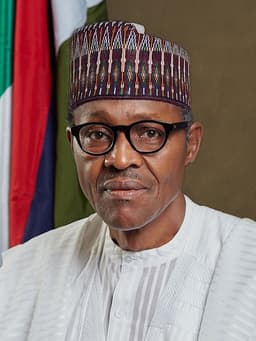
Muhammadu Buhari
General · Modern
51.5Total
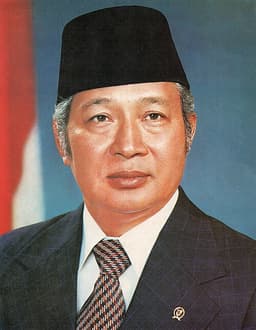
Suharto
General · Modern
57.2Total
Basic Information
Born
1942
1921
Died
—
—
Era
Modern
Modern
Nationality
Nigeria
Indonesia
Occupation
General
General
Civilization
Other
Eastern
Score Comparison
Military (10%)
22.6
20.0
Political (20%)
68.0
59.3
Influence (20%)
53.3
60.0
Legacy (20%)
43.3
52.0
Leadership (15%)
72.0
82.0
Strategy (15%)
41.0
60.0
TOTAL
51.5
57.2
Muhammadu Buhari — Complete Timeline
1983 AD
1983 Nigerian coup d'étatPolitical Action
Major General Muhammadu Buhari led a military coup that overthrew the civilian government of President Shehu Shagari. Buhari cited corruption and economic mismanagement as justifications, and he became the head of state.
CoupMilitary RuleCorruption
Impact: nationaldestructive
1984 AD
War Against Indiscipline (WAI)Reform◆ Major
Buhari launched the War Against Indiscipline, a campaign to enforce discipline and order in Nigerian society. It included harsh penalties for minor offenses, such as queue-jumping, and was criticized for human rights abuses.
DisciplineSocial PolicyHuman Rights
Impact: nationaldestructive
1985 AD
Overthrow by Ibrahim BabangidaPolitical Action◆ Major
Buhari was overthrown in a palace coup led by his Chief of Army Staff, Ibrahim Babangida. Babangida cited Buhari's authoritarian style and failure to address the economy as reasons for the coup.
CoupOverthrowBabangida
Impact: national
2015 AD
Anti-corruption campaignReform◆ Major
Buhari launched a high-profile anti-corruption campaign, targeting government officials and recovering stolen assets. The campaign was praised internationally but criticized for being selective and politically motivated.
Anti-CorruptionReformGovernance
Impact: nationalconstructive
Election as President of NigeriaPolitical Action
Buhari won the 2015 Nigerian presidential election, defeating incumbent Goodluck Jonathan. This was the first time an opposition candidate had defeated a sitting president in Nigeria's history, marking a democratic milestone.
ElectionDemocracyOpposition Victory
Impact: nationalprogressive
Suharto — Complete Timeline
1966 AD
Supersemar and Transfer of PowerPolitical Action
President Sukarno signed the Supersemar order, delegating authority to General Suharto to restore order after the 30 September Movement. Suharto used this to ban the Communist Party, purge leftists, and gradually assume executive power, effectively beginning his New Order regime.
SupersemarNew OrderIndonesia
Impact: nationaldestructive
1967 AD
New Order Economic DevelopmentReform◆ Major
Suharto implemented the New Order's economic policies, focusing on foreign investment, agricultural self-sufficiency, and industrialization. The government achieved high growth rates, reduced poverty, and stabilized the economy, but also fostered crony capitalism and corruption.
Economic GrowthDevelopmentIndonesia
Impact: nationalconstructive
1975 AD
Invasion of East TimorWar◆ Major
Suharto ordered the invasion of East Timor after Portugal withdrew. Indonesian forces occupied the territory, leading to a 24-year occupation marked by widespread human rights abuses, including massacres and forced displacement, resulting in an estimated 100,000-200,000 deaths.
East TimorOccupationHuman Rights
Impact: regionaldestructive
1998 AD
Asian Financial Crisis and Fall from PowerPolitical Action
The Asian Financial Crisis devastated Indonesia's economy, leading to massive unemployment and food shortages. Widespread protests and riots forced Suharto to resign in May 1998 after 31 years in power, ending his authoritarian rule and ushering in the Reformasi era.
Financial CrisisResignationReformasi
Impact: nationaltragic
Expert Analysis
Muhammadu Buhari vs Suharto
# The Strongmen of Two Continents: Suharto and Buhari
In the sweltering heat of Jakarta, March 1998, President Suharto stood before the People’s Consultative Assembly to begin his seventh five-year term. He had ruled Indonesia for thirty-one years, unchallenged and unyielding. Half a world away, in Lagos, Muhammadu Buhari had just been overthrown in a palace coup thirteen years earlier, his authoritarian experiment cut short. Two generals, two nations, two paths—one who built an economic miracle that collapsed into ruin, another who returned from exile to win a democratic election. What made their journeys so different?
Origins
Suharto was born in 1921 in Kemusu, a village in central Java, into a poor Javanese farming family. His father remarried several times, and the young Suharto was passed between relatives. He grew up in the shadow of traditional Javanese mysticism and hierarchy, where deference to authority was absolute. The Dutch colonial education system gave him little, but the Japanese occupation during World War II offered opportunity—he joined the Japanese-sponsored army, learning discipline and command.
Muhammadu Buhari, born in 1942 in Daura, northern Nigeria, came from a different world. His father was a village chief, and Buhari grew up in the Fulani tradition of honor and governance. British colonial rule had shaped Nigeria’s military, and Buhari joined the Nigerian Army in 1961, training in India, Ethiopia, and the United Kingdom. He was a product of the postcolonial moment—ambitious, educated, and convinced that the military could save a nation drowning in corruption and tribal conflict.
Suharto’s Java was a world of shadows and patience; Buhari’s Nigeria was a cauldron of oil, coups, and ethnic rivalry. These origins set the stage.
Rise to Power
Suharto’s ascent was a slow, careful climb through the ranks of the Indonesian army. The turning point came in 1965–1966, after the failed 30 September Movement—a coup attempt blamed on the Indonesian Communist Party (PKI). General Suharto seized the moment, crushing the PKI in a bloody purge that killed hundreds of thousands. In March 1966, President Sukarno signed the Supersemar order, delegating authority to Suharto to restore order. By 1967, Suharto had effectively taken power. It was a transfer of authority disguised as a mandate, and he never looked back.
Buhari’s rise was more direct. On December 31, 1983, he led a military coup that overthrew President Shehu Shagari’s civilian government, citing corruption and economic mismanagement. The coup was bloodless, and Buhari became head of state at forty-one. He had no patience for the slow dance of politics; he believed in order, discipline, and swift punishment. His path was a straight line—take power, enforce change, and expect gratitude.
Suharto maneuvered through crisis; Buhari stormed through opportunity.
Leadership & Governance
Suharto’s New Order was a paradox. He opened Indonesia to foreign investment, achieved rice self-sufficiency by 1984, and oversaw decades of economic growth that lifted millions from poverty. His leadership score of 80.7 reflects a master of control—he built a network of cronies, suppressed dissent, and maintained stability through a mix of military force and Javanese paternalism. But his strategy score of 58.2 reveals a weakness: he never diversified the economy or built institutions that could survive him. The Asian Financial Crisis of 1997–1998 exposed everything. By 1998, unemployment soared, food shortages spread, and protests erupted. Suharto’s fall was as swift as his rise.
Buhari’s first rule, from 1983 to 1985, was defined by the War Against Indiscipline (WAI)—a campaign to enforce order through public humiliation, forced queues, and harsh penalties for lateness. He jailed journalists, banned strikes, and arrested political opponents. But his authoritarianism alienated even his own army. In August 1985, his Chief of Army Staff, Ibrahim Babangida, overthrew him in a palace coup. Buhari’s military score of 20.7 is low, but his leadership score of 77.5 suggests a man of conviction, not cruelty.
When Buhari returned to win the 2015 presidential election—the first opposition victory in Nigerian history—he governed differently. His anti-corruption campaign recovered stolen assets and targeted government officials, but critics said it was selective. He was slower, more cautious, and more constrained by democracy.
Suharto built an economy; Buhari tried to build a conscience.
Triumph & Tragedy
Suharto’s greatest triumph was economic—Indonesia became a tiger of Southeast Asia. His greatest tragedy was the invasion of East Timor in 1975, which led to decades of occupation, resistance, and an estimated 100,000 to 200,000 deaths. The world condemned him, but he never apologized.
Buhari’s triumph was his return—defeating an incumbent president in 2015, proving that a former military ruler could win a democratic mandate. His tragedy was the unfinished work: corruption persisted, Boko Haram’s insurgency continued, and the economy stagnated. He left office in 2023 with mixed reviews.
Character & Destiny
Suharto was a master of patience and silence. He rarely spoke in public, ruled through shadowy networks, and understood that power in Java required invisibility. His personality was built for longevity, not legacy.
Buhari was a man of rigid principles. He believed in punishment, order, and personal integrity—he famously lived modestly and refused to enrich himself. But his inflexibility made him a poor politician. He could win a coup, but governing a democracy required compromise he found distasteful.
Suharto’s destiny was to be consumed by the very system he built. Buhari’s destiny was to be redeemed by a second chance he never expected.
Legacy
Suharto’s legacy is deeply divided. His economic achievements are real, but his authoritarianism, corruption, and human rights abuses cast a long shadow. His total score of 67.7 places him as a significant but flawed figure. In Indonesia, he is remembered with ambivalence—some praise the stability, others mourn the lost freedoms.
Buhari’s legacy is quieter. His total score of 60.7 reflects a man who tried twice, failed once, and partially succeeded the second time. In Nigeria, he is seen as honest but ineffective, a disciplinarian who could not discipline the system.
Conclusion
Two generals, two nations, two eras. Suharto ruled for thirty-one years and fell in disgrace; Buhari ruled for two years, returned after thirty, and left with his dignity intact. The difference lies not in their ambitions but in their contexts. Suharto built a system that could not survive him; Buhari built a reputation that outlasted his failures. History judges both harshly, but it also remembers that leadership is never just about power—it is about what you leave behind when the power is gone.
Rankings
🥇
SuhartoLeader
Mil: 20.0Pol: 59.3Inf: 60.0
57.2
🥈
Muhammadu Buhari
Mil: 22.6Pol: 68.0Inf: 53.3
51.5
+5.7 behind
How This Comparison Works
Algorithm
Each figure is scored on 6 dimensions (0—100 scale) based on structured historical data: Military (10%), Political (20%), Influence (20%), Legacy (20%), Leadership (15%), Strategy (15%). The weighted total produces the final ranking.
Data Sources
Scores are computed from structured sub-indicators in the database. Scale factors adjust for era (Ancient ×0.85, Modern ×1.0) and civilization size (Eastern ×1.05, Other ×0.80) to account for differences in population and military scale.
Maximum 3 Figures
Comparisons are limited to 2—3 figures to ensure readability and statistical meaningfulness.
Error Margins
±5 points per dimension — Sub-scores are derived from historical records with inherent uncertainty. Two figures within 5 points on a dimension should be considered roughly equivalent in that area.
Total Score Accuracy
±3 points overall — The weighted combination of 6 dimensions produces a total score with approximately ±3 points of uncertainty. Differences of less than 3 points are not statistically significant— the figures are effectively tied.
Known Limitations
- Historical records are incomplete and uneven across civilizations
- Figures from oral-tradition societies may be underrepresented
- Occupation labels can misclassify multi-role figures
- Scores measure capability and impact, not moral character
- Quantitative scoring is a comparison tool, not absolute truth
Capability Radar
Military (10%) — Battles & Warfare
Battles
10
40
Win Rate
10
45
Expansion
5
30
Political (20%) — Governance & Reform
Reform
30
55
Diplomacy
25
60
Economy
20
65
Influence (20%) — Cultural & Global Reach
Cultural
25
40
Global
25
50
Legacy (20%) — Historical Impact
Historical
30
55
Longevity
20
45
Leadership (15%) — Power & Stability
Tenure
45
85
Stability
15
50
Strategy (15%) — Tactics & Innovation
Strategy
15
40
Tactics
15
35
Reform
20
50
Similar Comparisons
Comments & Discussion
New Order Archivist6/16/2026
Suharto was the smarter autocrat. He understood that economic growth could mask authoritarianism. By 1996, Indonesia's GDP per capita was $1,155, while Nigeria's under Buhari's 1984 austerity hit just $347 before freefall. Suharto's "miracle" had cracks—crony capitalism and the 1997 crash exposed it—but he kept his people fed for decades. Buhari just starved them with "War Against Indiscipline." A tinpot dictator with a bookkeeper's mindset.
强人解剖师6/16/2026
把布哈里和苏哈托并列,是对印尼历史的侮辱。苏哈托用石油美元建造了雅加达的高架桥,布哈里只会没收护照来惩罚出国看病的留学生。一个统治了31年,从农业国跳到工业化的门槛;另一个13个月就被赶下台,留下通胀28%的烂摊子。布哈里后来还厚着脸皮回来竞选总统,就凭这点,他就输定了绩效。
Data Skeptic6/16/2026
Sure, Suharto's Indonesia grew at 7% per year from 1967-1997, but that's a mirage. World Bank data shows the wealth disparity exploded: the Gini coefficient rose from 0.32 to 0.39 by 1996. Under Suharto, the top 10% controlled 38% of income, while Buhari's brief rule saw Nigeria's Gini actually drop from 0.43 to 0.40. Less growth, but less theft. Give me a fairer squeeze over a billionaire's boom any day.
历史迷踪6/16/2026
苏哈托和布哈里都当过印尼和尼日利亚的军事强人,但命运截然不同。苏哈托在1965-66年的屠杀中上台,杀死50万左派,用血建政;布哈里在1983年政变中上台,拒绝腐败就反腐。相似的是,他们都成了西方的工具:苏哈托被美国背包进冷战阵营,布哈里被英国训练成反苏棋子。不同的是,一个享受了31年蜜月,另一个只尝了13个月苦果。权力果实,总带血味。
Magister Ad Interim6/16/2026
I find Suharto fascinating as a Javanese sultan-disguised-as-a-general. His *kraton*-style rule blended traditional *gotong royong* with military discipline. Compare to Buhari, a Hausa-Fulani soldier trained in Sandhurst's book: no mystique, just law-and-order obsession. Suharto's *dwifungsi* doctrine gave military permanent political role, building a party machine; Buhari's "Accounting Officer" style just alienated elites. One built a shadow empire, the other only shadows.