Loading...
Ramon Castilla vs Tadeusz Kosciuszko
Tadeusz Kosciuszko leads by 4.4 pts · 2 figures compared
…
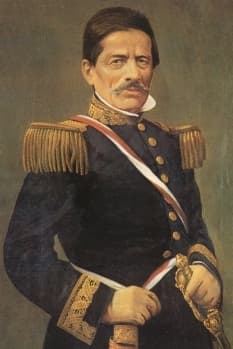
Ramon Castilla
General · Modern
59.7Total
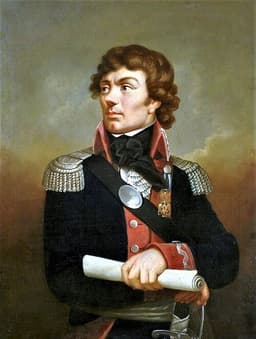
Tadeusz Kosciuszko
General · Modern
64.1Total
Basic Information
Born
1797
1746
Died
1867
1817
Era
Modern
Modern
Nationality
Peru
Poland
Occupation
General
General
Civilization
Western
Western
Score Comparison
Military (10%)
40.0
47.5
Political (20%)
72.0
68.0
Influence (20%)
56.7
68.0
Legacy (20%)
52.0
68.0
Leadership (15%)
78.0
64.5
Strategy (15%)
60.0
55.0
TOTAL
59.7
64.1
Ramon Castilla — Complete Timeline
1824 AD
Battle of AyacuchoWar
Castilla fought as a junior officer in the decisive Battle of Ayacucho, which ended Spanish rule in Peru. This victory secured Peruvian independence and marked the end of the Spanish Empire in South America, shaping Castilla's nationalist views.
Peruvian War of IndependenceBattleLiberation
Impact: regional
1845 AD
First Presidency of PeruPolitical Action◆ Major
Castilla was elected President of Peru in 1845, serving until 1851. His first term focused on economic development, including the guano boom, and infrastructure projects such as railroads and ports, modernizing the Peruvian state.
PresidencyEconomic DevelopmentGuano
Impact: nationalconstructive
1854 AD
Abolition of Slavery in PeruReform◆ Major
During his second presidency, Castilla issued a decree abolishing slavery in Peru on December 3, 1854. This reform freed approximately 25,000 slaves and was part of a broader liberal agenda, though it faced opposition from slave-owning elites.
AbolitionSlaveryHuman Rights
Impact: nationalprogressive
Abolition of Indigenous TributeReform◆ Major
Castilla also abolished the indigenous tribute tax in 1854, which had been a burden on native communities since colonial times. This measure aimed to integrate indigenous peoples into the Peruvian state as equal citizens, though its implementation was uneven.
Indigenous RightsTax ReformCitizenship
Impact: nationalprogressive
1855 AD
Second Presidency and Guano BoomPolitical Action◆ Major
Castilla served a second term from 1855 to 1862, during the peak of the guano export boom. He used guano revenues to fund public works, pay off foreign debt, and modernize the military, but also faced criticism for corruption and over-reliance on a single resource.
PresidencyGuanoModernization
Impact: nationalconstructive
1860 AD
Constitutional Reform of 1860Reform◆ Major
Castilla oversaw the adoption of a new constitution in 1860, which established a centralized republic with a strong executive. The constitution remained in effect until 1920 and shaped Peru's political structure, though it limited regional autonomy.
ConstitutionPolitical ReformCentralization
Impact: nationalconstructive
Tadeusz Kosciuszko — Complete Timeline
1777 AD
Battle of Saratoga (engineering contributions)War◆ Major
Kosciuszko designed fortifications and selected defensive positions for the American army at Saratoga. His work contributed to the American victory, a turning point in the Revolutionary War.
American RevolutionSaratogaEngineering
Impact: regional
1778 AD
Fortification of West PointWar◆ Major
Kosciuszko was assigned to fortify West Point on the Hudson River. He designed and supervised the construction of fortifications that made the site a key American stronghold for the remainder of the war.
American RevolutionWest PointFortifications
Impact: regionalconstructive
1794 AD
Kosciuszko UprisingWar
Kosciuszko led a national uprising in Poland against Russian and Prussian occupation. He proclaimed the Act of Insurrection and won the Battle of Rac
Polish UprisingIndependenceDefeat
Impact: nationaltragic
Battle of RacławiceWar◆ Major
Kosciuszko led Polish forces, including peasant scythemen, to victory over a larger Russian army at Rac
Kosciuszko UprisingBattlePeasants
Impact: national
Capture and imprisonment at the Battle of MaciejowiceWar◆ Major
Kosciuszko was wounded and captured by Russian forces at the Battle of Maciejowice. His capture effectively ended the uprising, and he was imprisoned in St. Petersburg until 1796.
Kosciuszko UprisingCaptureImprisonment
Impact: nationaltragic
Expert Analysis
Ramon Castilla vs Tadeusz Kosciuszko
# The Engineer and the Emancipator
On a muddy field in upstate New York in 1777, a young Polish engineer watched as British troops marched into a trap he had helped design. Thirty-seven years later, at a high-altitude plain in Peru, a junior officer from a modest family charged into the smoke of a battle that would end three centuries of Spanish rule. Neither man knew it then, but their paths—so different in geography and circumstance—would converge on a single, haunting question: How does a military man build a nation?
Tadeusz Kosciuszko and Ramon Castilla both rose from the margins of their societies to shape history. One became a symbol of freedom that never came; the other, a president who abolished slavery with the stroke of a pen. Their lives, separated by half a century and an ocean, offer a profound meditation on the difference between fighting for liberty and actually building it.
Origins
Kosciuszko was born in 1746 into the minor nobility of the Polish-Lithuanian Commonwealth, a vast but decaying state already being carved up by its neighbors. His family estate was modest, his education rigorous. Sent to the Royal Military Academy in Warsaw, he absorbed Enlightenment ideas about natural rights and republican virtue. But Poland in the 1760s was a dying patient: its parliament paralyzed by the *liberum veto*, its borders prey to Russia, Prussia, and Austria. Kosciuszko would spend his life trying to revive a corpse.
Castilla, born in 1797 in Tarapacá, then part of the Viceroyalty of Peru, came from a different world entirely. His father was an Argentine-born Spanish official, his mother a Peruvian of indigenous descent. The family was respectable but not wealthy. As a young man, Castilla joined the Spanish army—only to switch sides when the independence movement gained momentum. He was a pragmatist in an age of revolution, a man who learned early that survival meant choosing the winning horse.
Rise to Power
Kosciuszko’s path to greatness ran through America. After finishing his military studies in France, he volunteered for the Continental Army in 1776, armed with engineering manuals and a burning hatred of tyranny. At Saratoga in 1777, his fortifications and choice of defensive positions helped seal a victory that changed the war’s course. Two years later, George Washington personally entrusted him with fortifying West Point—a fortress Kosciuszko designed so well that the British never dared attack it. The American Revolution gave him a model: a republic born from armed struggle.
Castilla rose more slowly. He fought at Ayacucho in 1824, the battle that ended Spanish rule in Peru, but as a junior officer, not a commander. For the next two decades, he navigated the chaos of post-independence Peru—a country torn by caudillos, coups, and bankruptcies. He served as minister of war, built alliances, and waited. When he was elected president in 1845, he was already 48 years old, seasoned by failure and compromise.
Leadership & Governance
Kosciuszko never held political power. He was a revolutionary, not a ruler. When he returned to Poland in 1792, he found his homeland already partitioned. In 1794, he launched the Kosciuszko Uprising, a desperate gamble to restore Polish independence. At Racławice that April, he led peasant scythemen to a stunning victory over a larger Russian army—a triumph of spirit over steel. But he could not sustain it. By October, he was wounded, captured, and imprisoned at Maciejowice. His uprising collapsed, and Poland would not exist as an independent state for another 123 years.
Castilla, by contrast, governed. His first term (1845–1851) was a masterclass in using unexpected wealth wisely. Peru sat atop mountains of guano—bird droppings that made the finest fertilizer in the world. While other Latin American leaders squandered such windfalls, Castilla invested. He paid off foreign debt, built railroads, and modernized the army. But his greatest acts came in his second term (1855–1862). On December 3, 1854, he abolished slavery in Peru, freeing thousands of enslaved Africans and their descendants. Months earlier, he had abolished the indigenous tribute tax, a colonial relic that had crushed native communities for centuries. He then oversaw the Constitution of 1860, which centralized the state and strengthened executive power—a framework that would last for decades.
Triumph & Tragedy
Kosciuszko’s greatest moment was also his most heartbreaking. The victory at Racławice proved that ordinary Poles would fight for freedom. But the uprising was doomed from the start: outnumbered, outgunned, and betrayed by Prussia. His capture at Maciejowice ended the dream. Yet even in defeat, Kosciuszko became a symbol. He died in Switzerland in 1817, having freed the slaves on his own American estate and left his fortune to educate Black children—a gesture Thomas Jefferson called “the noblest act of his life.”
Castilla’s triumph was quieter but more lasting. He left office in 1862 with Peru more stable and prosperous than it had ever been. But the guano boom did not last. After his death in 1867, the revenues dried up, and Peru slid into debt and war. His abolition of slavery, however, endured—a permanent break with the past.
Character & Destiny
Why did one man fail and the other succeed? The answer lies partly in circumstance. Kosciuszko fought against empires with overwhelming force; Castilla worked within a system he could reform. But character mattered too. Kosciuszko was an idealist who believed that liberty was a universal right—a conviction that made him a hero but also a poor strategist. He trusted that peasants would become citizens, that Russia could be shamed into retreat. He was wrong.
Castilla was a realist. He did not seek to overturn the social order; he sought to manage it. He abolished slavery not only because it was just, but because it was practical: Peru needed labor and international legitimacy. He ended the indigenous tribute because it fueled resentment and instability. His reforms were moral, but they were also political. He understood what Kosciuszko never could: that freedom is not won in a single battle, but built through institutions.
Legacy
Kosciuszko is remembered as a martyr—a man whose name adorns bridges, streets, and monuments across Poland and the United States. He is the patron saint of lost causes, the engineer who built fortifications for freedom but could not save his own country. His legacy is one of inspiration, not achievement.
Castilla is remembered as a founder—the president who modernized Peru and ended slavery. His legacy is tangible: the 1860 Constitution, the freed slaves, the railroads. Yet he is less known outside Peru, a footnote in the story of Latin American independence. His pragmatism made him effective, but it also made him forgettable.
Conclusion
Standing at the end of their lives, both men would likely have felt a deep ambivalence. Kosciuszko died knowing Poland was erased from the map. Castilla died knowing the guano boom that made his reforms possible would soon collapse. Yet their stories persist because they answer a question that haunts every age: What does it mean to serve one’s country?
Kosciuszko’s answer was sacrifice; Castilla’s was governance. One gave his life for a dream; the other gave his skill to a nation. Both were necessary. But if history teaches anything, it is that dreams without institutions fade, while institutions without dreams become prisons. The engineer and the emancipator—each incomplete, together a portrait of what it takes to build a world worth living in.
Rankings
🥇
Tadeusz KosciuszkoLeader
Mil: 47.5Pol: 68.0Inf: 68.0
64.1
🥈
Ramon Castilla
Mil: 40.0Pol: 72.0Inf: 56.7
59.7
+4.4 behind
How This Comparison Works
Algorithm
Each figure is scored on 6 dimensions (0—100 scale) based on structured historical data: Military (10%), Political (20%), Influence (20%), Legacy (20%), Leadership (15%), Strategy (15%). The weighted total produces the final ranking.
Data Sources
Scores are computed from structured sub-indicators in the database. Scale factors adjust for era (Ancient ×0.85, Modern ×1.0) and civilization size (Eastern ×1.05, Other ×0.80) to account for differences in population and military scale.
Maximum 3 Figures
Comparisons are limited to 2—3 figures to ensure readability and statistical meaningfulness.
Error Margins
±5 points per dimension — Sub-scores are derived from historical records with inherent uncertainty. Two figures within 5 points on a dimension should be considered roughly equivalent in that area.
Total Score Accuracy
±3 points overall — The weighted combination of 6 dimensions produces a total score with approximately ±3 points of uncertainty. Differences of less than 3 points are not statistically significant— the figures are effectively tied.
Known Limitations
- Historical records are incomplete and uneven across civilizations
- Figures from oral-tradition societies may be underrepresented
- Occupation labels can misclassify multi-role figures
- Scores measure capability and impact, not moral character
- Quantitative scoring is a comparison tool, not absolute truth
Capability Radar
Military (10%) — Battles & Warfare
Battles
45
55
Win Rate
50
60
Expansion
30
30
Political (20%) — Governance & Reform
Reform
85
45
Diplomacy
70
55
Economy
75
35
Influence (20%) — Cultural & Global Reach
Cultural
55
65
Global
50
55
Legacy (20%) — Historical Impact
Historical
65
70
Longevity
60
60
Leadership (15%) — Power & Stability
Tenure
65
40
Stability
60
30
Strategy (15%) — Tactics & Innovation
Strategy
45
65
Tactics
40
70
Reform
55
50
Similar Comparisons
Comments & Discussion
IronBridgeTactician6/16/2026
Comparing Kosciuszko’s failed 1794 uprising to Castilla’s 1854 abolition decree misses the point. Kosciuszko was trying to resurrect a corpse—Poland had no functional state to leverage, whereas Castilla inherited a republic with an army and a treasury. One fought with pitchforks and hope, the other with budgets and constitutional powers. Ask any military historian: ‘building a nation’ from a defeat is romantic nonsense. Building it from a desk? That’s Castilla’s real legacy. But neither engineer
HistoryWrench6/16/2026
The comparison is off: Kosciuszko died in exile, penniless, having never governed a square meter of free Poland, while Castilla died in office, having modernized Peru’s economy and ended slavery. That’s not symmetrical; it’s a chasm. I’d argue Castilla was the better ‘builder’ precisely because he never had to be a revolutionary hero. Serf emancipation in 1794 Poland was a war cry, not a policy. Castilla’s abolition was a law with a date and a budget. Data doesn’t lie.
PolisHeroic6/16/2026
Kosciuszko fought for a nation that was erased from maps—Poland vanished for 123 years after his death. Castilla fought for one that already existed, just under colonial rule. That’s the brutal asymmetry. Kosciuszko’s Serf Proclamation of 1794 was a moral bomb that never exploded, while Castilla’s 1854 decree dismantled slavery in a functioning state. One was a martyr for a phantom, the other a pragmatist for a real country. I respect the engineer more, but the emancipator actually delivered.
铁轨革命家6/16/2026
拿柯斯丘什科在波兰的庄园背景跟卡斯蒂利亚在塔拉帕卡的卑微出身比,根本是两码事。柯斯丘什科是贵族出身,就算家道中落也受过军事学院教育,卡斯蒂利亚呢?他爹是个穷军官,他自己靠战功爬上去的。一个是旧秩序里的理想主义者,一个是新世界的实用主义者。别拿“都是军人建国”糊弄人——柯斯丘什科一辈子没建过国,卡斯蒂利亚却真干了。
解放者还是幻想家6/16/2026
说柯斯丘什科是“解放者”太过了。他在1794年起兵时许诺农奴自由,但波兰贵族根本不可能同意。结果呢?农民支援他,但没土地改革,起义就垮了。卡斯蒂利亚不一样,他1854年废奴是实打实的,因为他控制了军队和国家机器。柯斯丘什科是浪漫的英雄,卡斯蒂利亚是冷血的实干家。你选哪个?我选后者,毕竟废奴不是