Loading...
Ramon Castilla vs Suharto
Ramon Castilla leads by 2.5 pts · 2 figures compared
…
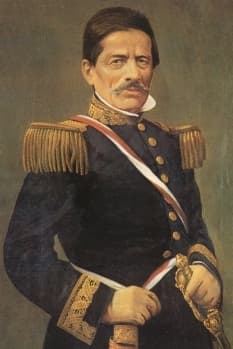
Ramon Castilla
General · Modern
59.7Total
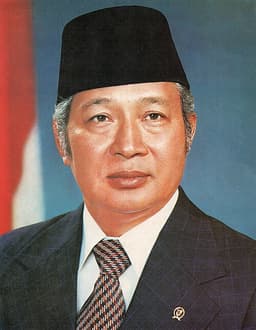
Suharto
General · Modern
57.2Total
Basic Information
Born
1797
1921
Died
1867
—
Era
Modern
Modern
Nationality
Peru
Indonesia
Occupation
General
General
Civilization
Western
Eastern
Score Comparison
Military (10%)
40.0
20.0
Political (20%)
72.0
59.3
Influence (20%)
56.7
60.0
Legacy (20%)
52.0
52.0
Leadership (15%)
78.0
82.0
Strategy (15%)
60.0
60.0
TOTAL
59.7
57.2
Ramon Castilla — Complete Timeline
1824 AD
Battle of AyacuchoWar
Castilla fought as a junior officer in the decisive Battle of Ayacucho, which ended Spanish rule in Peru. This victory secured Peruvian independence and marked the end of the Spanish Empire in South America, shaping Castilla's nationalist views.
Peruvian War of IndependenceBattleLiberation
Impact: regional
1845 AD
First Presidency of PeruPolitical Action◆ Major
Castilla was elected President of Peru in 1845, serving until 1851. His first term focused on economic development, including the guano boom, and infrastructure projects such as railroads and ports, modernizing the Peruvian state.
PresidencyEconomic DevelopmentGuano
Impact: nationalconstructive
1854 AD
Abolition of Slavery in PeruReform◆ Major
During his second presidency, Castilla issued a decree abolishing slavery in Peru on December 3, 1854. This reform freed approximately 25,000 slaves and was part of a broader liberal agenda, though it faced opposition from slave-owning elites.
AbolitionSlaveryHuman Rights
Impact: nationalprogressive
Abolition of Indigenous TributeReform◆ Major
Castilla also abolished the indigenous tribute tax in 1854, which had been a burden on native communities since colonial times. This measure aimed to integrate indigenous peoples into the Peruvian state as equal citizens, though its implementation was uneven.
Indigenous RightsTax ReformCitizenship
Impact: nationalprogressive
1855 AD
Second Presidency and Guano BoomPolitical Action◆ Major
Castilla served a second term from 1855 to 1862, during the peak of the guano export boom. He used guano revenues to fund public works, pay off foreign debt, and modernize the military, but also faced criticism for corruption and over-reliance on a single resource.
PresidencyGuanoModernization
Impact: nationalconstructive
1860 AD
Constitutional Reform of 1860Reform◆ Major
Castilla oversaw the adoption of a new constitution in 1860, which established a centralized republic with a strong executive. The constitution remained in effect until 1920 and shaped Peru's political structure, though it limited regional autonomy.
ConstitutionPolitical ReformCentralization
Impact: nationalconstructive
Suharto — Complete Timeline
1966 AD
Supersemar and Transfer of PowerPolitical Action
President Sukarno signed the Supersemar order, delegating authority to General Suharto to restore order after the 30 September Movement. Suharto used this to ban the Communist Party, purge leftists, and gradually assume executive power, effectively beginning his New Order regime.
SupersemarNew OrderIndonesia
Impact: nationaldestructive
1967 AD
New Order Economic DevelopmentReform◆ Major
Suharto implemented the New Order's economic policies, focusing on foreign investment, agricultural self-sufficiency, and industrialization. The government achieved high growth rates, reduced poverty, and stabilized the economy, but also fostered crony capitalism and corruption.
Economic GrowthDevelopmentIndonesia
Impact: nationalconstructive
1975 AD
Invasion of East TimorWar◆ Major
Suharto ordered the invasion of East Timor after Portugal withdrew. Indonesian forces occupied the territory, leading to a 24-year occupation marked by widespread human rights abuses, including massacres and forced displacement, resulting in an estimated 100,000-200,000 deaths.
East TimorOccupationHuman Rights
Impact: regionaldestructive
1998 AD
Asian Financial Crisis and Fall from PowerPolitical Action
The Asian Financial Crisis devastated Indonesia's economy, leading to massive unemployment and food shortages. Widespread protests and riots forced Suharto to resign in May 1998 after 31 years in power, ending his authoritarian rule and ushering in the Reformasi era.
Financial CrisisResignationReformasi
Impact: nationaltragic
Expert Analysis
Ramon Castilla vs Suharto
### The Strongman and the Reformer: Two Paths to Power in a Turbulent Century
On a sweltering March morning in 1966, President Sukarno of Indonesia signed a single sheet of paper that would end his revolution. The document, known as Supersemar, transferred executive authority to a quiet, methodical general named Suharto. Ninety years earlier, across the Pacific, another general named Ramon Castilla had used a different kind of document to transform his nation: a decree abolishing slavery. Both men were soldiers who seized history by the throat. But where Suharto built a system of control that collapsed under its own weight, Castilla forged a nation that could stand on its own. The difference was not merely in their choices, but in the worlds that shaped them.
### Origins
Suharto was born in 1921 into the dusty uncertainty of Dutch colonial Java. His father was a minor village official, his mother a woman of Javanese peasant stock. The boy grew up in a world where power was something distant and arbitrary, wielded by pale foreigners and their local puppets. He learned early that survival meant obedience, patience, and the careful reading of who held the gun. His education was sparse; his real schooling came from the Japanese occupation during World War II, where he served in the Dutch colonial army, then switched allegiance to the Japanese-sponsored militia. He absorbed the lesson that power was a matter of force and loyalty, not law or principle.
Ramon Castilla entered the world in 1797, in a very different corner of the Spanish Empire. Born in Tarapacá, then part of the Viceroyalty of Peru, he was the son of a Spanish official and a Creole mother. His family was not wealthy, but they were connected. Young Castilla grew up in the twilight of colonialism, where the air was thick with the ideas of the French Revolution and the example of Bolívar. He joined the royalist army as a teenager, but when the winds of independence began to blow, he switched sides—a pragmatic choice common among ambitious Creoles. He fought at the Battle of Ayacucho in 1824, a decisive victory that ended Spanish rule. For Castilla, war was not a way of life but a ladder to something greater: the chance to build a republic.
### Rise to Power
Suharto’s ascent was silent and lethal. After Indonesia’s independence in 1945, he rose through the ranks of the new national army, a force born in guerrilla struggle. He was not a charismatic orator like Sukarno, nor a fiery ideologue. He was a bureaucrat of violence. The turning point came in 1965, when a failed coup by leftist army officers plunged the nation into chaos. Suharto, then commander of the strategic reserve, moved with cold precision. He crushed the coup, then orchestrated a purge of communists that killed hundreds of thousands. By 1966, he had forced Sukarno to sign the Supersemar order. The transfer of power was framed as a temporary measure to restore order. It became permanent.
Castilla’s rise was more conventional, but no less dramatic. After Ayacucho, he served in various military and administrative posts, building a reputation for competence and integrity. He was elected president in 1845, not through a coup but through a political system that, though flawed, was functional. His first term focused on economic development, paying off foreign debts and stabilizing the currency. He won a second term in 1855, during the peak of the guano boom, when Peru’s coastal islands were piled high with bird droppings worth more than gold. Castilla used this windfall not for personal enrichment but for national transformation.
### Leadership & Governance
Suharto’s New Order was a masterpiece of control. He opened Indonesia to foreign investment, achieving rapid economic growth and agricultural self-sufficiency. Rice production soared; poverty declined. But the price was political repression. Suharto eliminated rivals, muzzled the press, and created a system of patronage that rewarded loyalty. His military genius was not on the battlefield but in the boardroom and the security apparatus. He ruled for 31 years, a seemingly stable pyramid built on fear and corruption.
Castilla governed with a different philosophy. He believed that a nation’s strength came from its institutions, not its strongmen. During his second presidency, he abolished slavery in 1854, freeing tens of thousands of Africans and their descendants. He also ended the indigenous tribute tax, a colonial relic that had crushed native communities for centuries. He used guano revenues to build railroads, modernize the navy, and fund education. In 1860, he oversaw a new constitution that centralized power but also established clear limits on executive authority. He was a reformer, not a revolutionary.
### Triumph & Tragedy
Suharto’s greatest triumph was economic: Indonesia became a middle-income country, a rare success story in the developing world. But his tragedy was equally immense. When the Asian Financial Crisis struck in 1997, his system of crony capitalism collapsed. The currency cratered; unemployment soared; riots erupted. In May 1998, after weeks of protests, Suharto resigned. He left behind a nation shattered by debt and a democracy that would take years to rebuild.
Castilla’s triumph was moral and institutional: he ended slavery and built the foundations of a modern state. His tragedy was that Peru’s guano boom was not sustainable. After his presidency, the country fell into debt, war, and political chaos. But the institutions he built—the abolition of slavery, the end of tribute, the constitution—survived. Peru would stumble, but it would not fall.
### Character & Destiny
Suharto was a man of immense patience and calculation. He was not cruel for cruelty’s sake, but he was ruthless when necessary. He believed that order was the highest good, and that any means justified its preservation. His personality was shaped by the Javanese concept of *halus*—a refined, indirect, and controlled exterior that concealed immense power. He was a man who trusted no one and controlled everything. In the end, that control became his prison.
Castilla was a man of principle and pragmatism. He was a soldier who believed in law, a politician who believed in reform. He understood that power was a tool, not an end. His personality was shaped by the Enlightenment ideals of his youth and the brutal realities of nation-building. He was a man who could fight a war and then write a constitution. He was, in short, a statesman.
### Legacy
Suharto’s legacy is deeply ambivalent. He is remembered as the father of Indonesia’s economic development, but also as a dictator whose regime was built on corruption and violence. His name is still spoken with a mix of respect and anger. In modern Indonesia, his New Order is a cautionary tale about the dangers of unchecked power.
Castilla is remembered as one of Peru’s greatest presidents. His abolition of slavery is celebrated as a moral landmark. His guano-era reforms are studied as a model of how to use natural resource wealth for national development. His constitution lasted until 1920. He died in 1867, still respected, still admired.
### Conclusion
The difference between Suharto and Castilla is not one of skill or intelligence. Both were capable men who rose to power in turbulent times. The difference is one of vision. Suharto saw power as something to be held; Castilla saw it as something to be used. Suharto built a system that depended on him; Castilla built institutions that outlasted him. One left a nation that had to tear down his legacy to move forward. The other left a nation that could build on his foundations. In the end, the measure of a leader is not how long they rule, but what remains when they are gone.
Rankings
🥇
Ramon CastillaLeader
Mil: 40.0Pol: 72.0Inf: 56.7
59.7
🥈
Suharto
Mil: 20.0Pol: 59.3Inf: 60.0
57.2
+2.5 behind
How This Comparison Works
Algorithm
Each figure is scored on 6 dimensions (0—100 scale) based on structured historical data: Military (10%), Political (20%), Influence (20%), Legacy (20%), Leadership (15%), Strategy (15%). The weighted total produces the final ranking.
Data Sources
Scores are computed from structured sub-indicators in the database. Scale factors adjust for era (Ancient ×0.85, Modern ×1.0) and civilization size (Eastern ×1.05, Other ×0.80) to account for differences in population and military scale.
Maximum 3 Figures
Comparisons are limited to 2—3 figures to ensure readability and statistical meaningfulness.
Error Margins
±5 points per dimension — Sub-scores are derived from historical records with inherent uncertainty. Two figures within 5 points on a dimension should be considered roughly equivalent in that area.
Total Score Accuracy
±3 points overall — The weighted combination of 6 dimensions produces a total score with approximately ±3 points of uncertainty. Differences of less than 3 points are not statistically significant— the figures are effectively tied.
Known Limitations
- Historical records are incomplete and uneven across civilizations
- Figures from oral-tradition societies may be underrepresented
- Occupation labels can misclassify multi-role figures
- Scores measure capability and impact, not moral character
- Quantitative scoring is a comparison tool, not absolute truth
Capability Radar
Military (10%) — Battles & Warfare
Battles
45
40
Win Rate
50
45
Expansion
30
30
Political (20%) — Governance & Reform
Reform
85
55
Diplomacy
70
60
Economy
75
65
Influence (20%) — Cultural & Global Reach
Cultural
55
40
Global
50
50
Legacy (20%) — Historical Impact
Historical
65
55
Longevity
60
45
Leadership (15%) — Power & Stability
Tenure
65
85
Stability
60
50
Strategy (15%) — Tactics & Innovation
Strategy
45
40
Tactics
40
35
Reform
55
50
Similar Comparisons
Comments & Discussion
Gunpowder Reformer6/16/2026
Castilla abolished slavery in Peru while still fighting a war—that’s a politician who understood moral legitimacy beats bayonets. Suharto’s 1966 Supersemar was a legal hallucination designed to cloak a coup. One man outlawed human bondage in real time; the other spent 32 years perfecting the bondage of corruption. Castilla built a republic of citizens; Suharto built a family business with tanks.
数据侦探6/16/2026
别被“解放奴隶”的光环骗了。Castilla 废除奴隶制时,秘鲁全靠鸟粪经济支撑,他不过是在对英国废奴压力交差。Suharto 虽然独裁,但他让印尼人均GDP翻了三倍。Castilla 的“改革”更多是殖民贸易结构的顺势而为。比较这两人,先搞清楚谁真的改变了数字,谁只是被历史镀了金。
The Archive Rat6/16/2026
Castilla’s 1854 decree didn’t just free slaves—it forced ex-slave owners to sell land to fund compensation, which blew up the hacienda system. Suharto’s 1967 “New Order” was a bureaucratic coup wrapped in mysticism, using an invented Javanese “harmony” to justify massacres. Castilla fought Chile in 1879; Suharto invaded East Timor in 1975. One died in office as national patriarch; the other left behind a CIA-funded graveyard.
冷眼史学6/16/2026
你们忽略了最关键的一点:Castilla 早死十年,他其实是秘鲁的“早产强人”,国家还没工业化就被架上了神坛。Suharto 聪明得多,他先清空政治对手,再用五年计划填补真空。Castilla 的棉花出口经济毫无抗风险能力,而 Suharto 的石油美元至少让雅加达有了地铁。说穿了,一个被时代推着走,一个操控了时代。我选后者——如果必须选独裁者的话。
Peruvian Flame6/16/2026
You armchair strategists love Suharto’s GDP stats, but Castilla’s army actually won a war against Spain in 1866. Suharto’s military crumbled in East Timor and Aceh. Castilla built Peru’s first railway and compulsory education; Suharto built a family net worth of $15 billion. One left a nation with functioning institutions; the other left piles of cash and kleptocracy as his legacy. Numbers don’t erase bodies.