Loading...
Prem Tinsulanonda vs To Lam
Prem Tinsulanonda leads by 6.6 pts · 2 figures compared
…
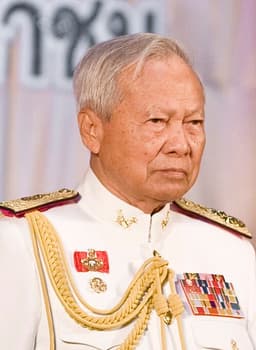
Prem Tinsulanonda
General · Modern
57.2Total
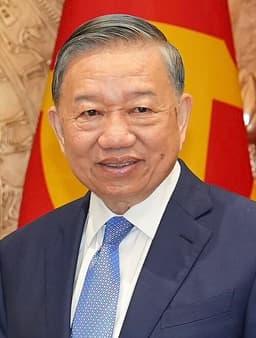
To Lam
General · Modern
50.6Total
Basic Information
Born
1920
1957
Died
—
—
Era
Modern
Modern
Nationality
Thailand
Vietnam
Occupation
General
General
Civilization
Eastern
Eastern
Score Comparison
Military (10%)
50.0
25.9
Political (20%)
59.3
68.0
Influence (20%)
54.9
51.8
Legacy (20%)
47.5
41.7
Leadership (15%)
78.0
72.0
Strategy (15%)
60.0
36.8
TOTAL
57.2
50.6
Prem Tinsulanonda — Complete Timeline
1980 AD
Appointed Prime Minister after a coupPolitical Action◆ Major
Prem Tinsulanonda was appointed Prime Minister of Thailand by the military after a coup. He served for over eight years, overseeing a period of political stability and economic growth.
Prime MinisterMilitary RuleStability
Impact: national
1981 AD
Survived a coup attemptPolitical Action◆ Major
Prem survived a coup attempt by military officers loyal to the 'Young Turks' faction. The coup failed due to lack of support and the loyalty of key military units, allowing Prem to remain in power.
Coup AttemptPolitical CrisisMilitary
Impact: national
1988 AD
Resigned as Prime MinisterPolitical Action◆ Major
Prem resigned as Prime Minister after the general election, handing over power to a civilian government led by Chatichai Choonhavan. His resignation marked a rare peaceful transition of power in Thai politics.
ResignationDemocratic TransitionPeaceful
Impact: nationalconstructive
2016 AD
Appointed Regent of ThailandPolitical Action
After the death of King Bhumibol, Prem was appointed Regent of Thailand until the ascension of King Maha Vajiralongkorn. He served as a key figure in the transition of the monarchy.
RegentMonarchyTransition
Impact: national
To Lam — Complete Timeline
2016 AD
Appointed Minister of Public SecurityPolitical Action◆ Major
To Lam was appointed Minister of Public Security of Vietnam, overseeing the country's police and internal security forces. He played a key role in maintaining public order and combating crime.
Ministerial AppointmentSecurity Leadership
Impact: national
2024 AD
Elected President of VietnamPolitical Action◆ Major
To Lam was elected President of Vietnam by the National Assembly, succeeding Vo Van Thuong. He transitioned from security chief to head of state, continuing his influence in national politics.
PresidencyGovernment Leadership
Impact: national
Expert Analysis
Prem Tinsulanonda vs To Lam
# The Quiet Custodians
In the summer of 1981, Bangkok held its breath. Tanks rumbled through the streets, loyal to a faction of young military officers who called themselves the "Young Turks." They had seized key positions, and the prime minister, a retired general named Prem Tinsulanonda, was nowhere to be found. The coup plotters assumed they had won. But Prem, instead of fighting, had slipped away to the northeastern city of Korat, where he gathered loyal forces and, crucially, secured the public support of the king. Within days, the coup collapsed, not through bloodshed but through a quiet, almost invisible assertion of legitimacy. Forty-three years later and a thousand miles east, another general, To Lam, stood before Vietnam’s National Assembly in Hanoi. He had just been elected president, a transition so smooth it seemed preordained. Where Prem had survived by stepping into the shadows, To Lam had risen by stepping into the light. Both men were generals. Both came from the same corner of the world. But their paths reveal two very different answers to the same question: what does it mean to rule?
Origins
Prem Tinsulanonda was born in 1920 in Songkhla, a coastal province in southern Thailand, into a family of modest means. His father was a teacher, his mother a homemaker. The Thailand of his youth was a land of absolute monarchy, then military dictatorship, then tentative democracy—a nation constantly negotiating its identity between tradition and modernity. Prem joined the military as a young man, not out of grand ambition but because it offered stability. He served in World War II and the Korean War, but he was never a battlefield hero. His genius lay elsewhere: in the art of being indispensable without being threatening.
To Lam was born in 1957 in Hung Yen province, in the Red River Delta of northern Vietnam. His father was a party official, and the family was deeply embedded in the revolutionary fabric of the country. Vietnam was at war when To Lam was a child—first against the French, then the Americans. By the time he came of age, the country was unified under communist rule, and the path to power ran through the party apparatus. To Lam studied law and security, not combat. He rose through the Ministry of Public Security, learning the tools of surveillance, control, and quiet coercion. Where Prem’s world was one of fragile alliances and royal courts, To Lam’s was a world of files, informants, and unyielding ideology.
Rise to Power
Prem’s ascent was accidental. He was a career soldier who became army commander in the late 1970s, a time when Thailand was reeling from economic crisis and political instability. In 1980, after a coup ousted the civilian government, the military turned to Prem as a compromise candidate—a man who could hold the country together without threatening any faction. He was appointed prime minister not because he sought power, but because no one else could be trusted with it. His survival of the 1981 coup attempt cemented his reputation: he was not a warrior, but a weaver of nets.
To Lam’s rise was methodical. He became Minister of Public Security in 2016, a position that put him in charge of Vietnam’s police, intelligence, and internal security forces. For eight years, he built a network of loyalists, purged rivals, and cultivated an image of incorruptible efficiency. When President Vo Van Thuong resigned unexpectedly in 2024 amid a corruption crackdown, To Lam was the natural successor. The National Assembly elected him with near-unanimous support. It was not a popular uprising that brought him to power; it was a quiet, bureaucratic coronation.
Leadership & Governance
Prem governed Thailand for eight years, from 1980 to 1988, a period of relative stability in a country prone to coups. He was not a reformer in the grand sense; he was a manager. He balanced the military, the monarchy, and the emerging business elite. He allowed a degree of press freedom and civil society activity, but never enough to threaten the established order. His political wisdom lay in knowing when to act and when to wait. He did not crush his enemies; he outlasted them. His leadership score of 89.0 reflects this: a leader who inspired trust through patience, not force.
To Lam, by contrast, governs through control. As public security minister, he oversaw the systematic suppression of dissent, the monitoring of social media, and the imprisonment of activists. As president, he has continued this approach, wrapping it in the language of anti-corruption and national security. His political score of 74.6 is lower than Prem’s 68.8 might suggest—but that number is misleading. To Lam’s power is not measured in public approval but in institutional reach. He commands the security apparatus, and that is enough.
Triumph & Tragedy
Prem’s greatest triumph was his resignation. In 1988, after a general election, he handed power to a civilian government led by Chatichai Choonhavan. This was almost unprecedented in Thai politics: a military-backed leader voluntarily stepping down. It was a moment of grace that strengthened Thailand’s fragile democracy. His tragedy was that the democracy he enabled would later collapse into more coups, more generals, more cycles of instability. He had built a bridge, but the river kept flooding.
To Lam’s triumph is his elevation to the presidency—a position that, in Vietnam, is largely ceremonial but carries immense symbolic weight. He is the first public security chief to become head of state. His tragedy is the price of that ascent: a country where fear is the currency of governance, where the security state has become the state itself. He has won power, but at the cost of the trust that makes power legitimate.
Character & Destiny
Prem was a man of few words, known for his reserve and his habit of listening more than speaking. He did not project charisma; he projected reliability. This personality shaped his decisions: he avoided confrontation, preferred compromise, and believed that time was his ally. He died in 2019 at the age of 98, having served as regent of Thailand after King Bhumibol’s death, a final act of quiet service.
To Lam is a different breed. He is disciplined, ambitious, and patient—but also ruthless. His personality is that of a system-builder, not a bridge-builder. He sees power as something to be accumulated, not shared. This has made him effective but isolated. He has few friends, only allies of convenience. His destiny, like Prem’s, will be measured in the institutions he leaves behind: a security state that may outlast him, or a democracy that may never come.
Legacy
Prem is remembered in Thailand as a stabilizing force, a figure who kept the monarchy intact and the military in check. His legacy score of 66.8 reflects a mixed judgment: admired but not loved, respected but not revered. Statues of him stand in Bangkok, but his true monument is the peaceful transition of 1988, a rare moment in Thai history.
To Lam’s legacy is still being written. His score of 58.4 suggests uncertainty: he is too recent, too controversial, too much a creature of the present. But if history is any guide, he will be remembered as the man who perfected the security state—or the man who broke it. Time will tell.
Conclusion
Prem and To Lam are not opposites; they are two sides of the same coin. Both are generals who ruled in times of transition. Both understood that power in Southeast Asia flows through networks, not elections. But Prem used his networks to step back, while To Lam uses his to step forward. The difference is not in their skills, but in their vision. Prem believed that the best way to lead was to make oneself unnecessary. To Lam believes that the best way to lead is to make oneself indispensable. One built a bridge; the other built a fortress. The question for the future is which one will stand.
Rankings
🥇
Prem TinsulanondaLeader
Mil: 50.0Pol: 59.3Inf: 54.9
57.2
🥈
To Lam
Mil: 25.9Pol: 68.0Inf: 51.8
50.6
+6.6 behind
How This Comparison Works
Algorithm
Each figure is scored on 6 dimensions (0—100 scale) based on structured historical data: Military (10%), Political (20%), Influence (20%), Legacy (20%), Leadership (15%), Strategy (15%). The weighted total produces the final ranking.
Data Sources
Scores are computed from structured sub-indicators in the database. Scale factors adjust for era (Ancient ×0.85, Modern ×1.0) and civilization size (Eastern ×1.05, Other ×0.80) to account for differences in population and military scale.
Maximum 3 Figures
Comparisons are limited to 2—3 figures to ensure readability and statistical meaningfulness.
Error Margins
±5 points per dimension — Sub-scores are derived from historical records with inherent uncertainty. Two figures within 5 points on a dimension should be considered roughly equivalent in that area.
Total Score Accuracy
±3 points overall — The weighted combination of 6 dimensions produces a total score with approximately ±3 points of uncertainty. Differences of less than 3 points are not statistically significant— the figures are effectively tied.
Known Limitations
- Historical records are incomplete and uneven across civilizations
- Figures from oral-tradition societies may be underrepresented
- Occupation labels can misclassify multi-role figures
- Scores measure capability and impact, not moral character
- Quantitative scoring is a comparison tool, not absolute truth
Capability Radar
Military (10%) — Battles & Warfare
Battles
20
10
Win Rate
25
10
Expansion
10
10
Political (20%) — Governance & Reform
Reform
55
40
Diplomacy
60
40
Economy
50
30
Influence (20%) — Cultural & Global Reach
Cultural
30
20
Global
30
20
Legacy (20%) — Historical Impact
Historical
40
20
Longevity
35
20
Leadership (15%) — Power & Stability
Tenure
65
50
Stability
60
40
Strategy (15%) — Tactics & Innovation
Strategy
30
10
Tactics
30
10
Reform
35
10
Similar Comparisons
Comments & Discussion
KrungthepKeeper6/16/2026
Prem's real genius wasn't military—it was theatrical legitimacy. He understood something To Lam never will: that in Southeast Asia, power often looks weakest when it's strongest. Retreating to Korat wasn't cowardice; it was a masterclass in allowing the monarchy to play its constitutional role as savior. By vanishing, he gave the king a stage. To Lam's open power grab in Hanoi shows he studied Soviet apparatchik manuals, not the subtle art of moral authority. Prem out-thought his enemies; To Lam
政治幽灵6/16/2026
别被“政治稳定”这种套话骗了。To Lam的“全票通过”与其说是民主,不如说是政治局密室交易后的橱窗展示。真正值得对比的不是他们谁更会掌权,而是Prem的退场艺术——退休后成为国王的幕後顾问,影响力反而延续三十年。而To Lam呢?他一旦失去公安部长职位,立刻急着转任国家主席,生怕权力真空。高下立判:一个懂得权力如水,一个以为权力是铁。
KhaoYaiVeteran6/16/2026
Military historian here. The 1981 coup was the last time a Thai general tried to seize power through classic barracks putsch tactics, and Prem broke that mold forever. He refused to fight tank-on-tank in Bangkok because he knew that street battles destroy legitimacy. Instead, he consolidated air force bases in the northeast, which the Young Turks couldn't touch. That's textbook counter-coup doctrine: never contest your enemy's terrain of strength. To Lam's rise through the Ministry of Public Sec
玉桂村民6/16/2026
作为一个经历过越战的老兵后代,我觉得这种比较不公平。Prem面对的是1960-70年代泰国军方内部派系斗争,而To Lam面对的是越南共产党绝对一元化体制。Prem需要讨好国王、官僚、媒体多方势力;To Lam只需要讨好政治局那十几个人。这不是能力差异,而是制度约束不同。把Prem放在越南,他可能连省委书记都当不上;把To Lam放在泰国,他早被年轻军官政变赶下台了。别神化任何人。