Loading...
To Lam vs Yitzhak Rabin
Yitzhak Rabin leads by 15.8 pts · 2 figures compared
…
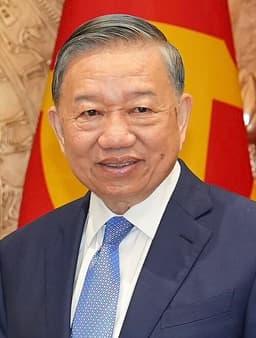
To Lam
General · Modern
50.6Total
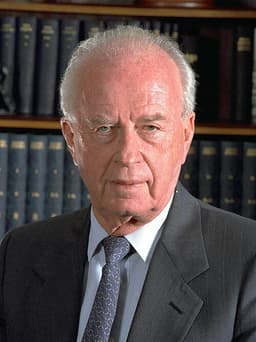
Yitzhak Rabin
General · Modern
66.4Total
Basic Information
Born
1957
1922
Died
—
—
Era
Modern
Modern
Nationality
Vietnam
Israel
Occupation
General
General
Civilization
Eastern
Middle Eastern
Score Comparison
Military (10%)
25.9
61.7
Political (20%)
68.0
82.0
Influence (20%)
51.8
68.0
Legacy (20%)
41.7
55.0
Leadership (15%)
72.0
78.0
Strategy (15%)
36.8
55.0
TOTAL
50.6
66.4
To Lam — Complete Timeline
2016 AD
Appointed Minister of Public SecurityPolitical Action◆ Major
To Lam was appointed Minister of Public Security of Vietnam, overseeing the country's police and internal security forces. He played a key role in maintaining public order and combating crime.
Ministerial AppointmentSecurity Leadership
Impact: national
2024 AD
Elected President of VietnamPolitical Action◆ Major
To Lam was elected President of Vietnam by the National Assembly, succeeding Vo Van Thuong. He transitioned from security chief to head of state, continuing his influence in national politics.
PresidencyGovernment Leadership
Impact: national
Yitzhak Rabin — Complete Timeline
1967 AD
Chief of Staff during the Six-Day WarWar
As Chief of Staff of the Israel Defense Forces, Rabin commanded the Israeli military during the Six-Day War against Egypt, Jordan, and Syria. Israel captured the Sinai Peninsula, Gaza Strip, West Bank, East Jerusalem, and Golan Heights, reshaping the region.
Six-Day WarTerritorial ExpansionMilitary Victory
Impact: global
1993 AD
Signing of the Oslo AccordsPolitical Action
As prime minister, Rabin signed the Oslo Accords with PLO Chairman Yasser Arafat on the White House lawn. The agreement established the Palestinian Authority and set a framework for Palestinian self-governance in the West Bank and Gaza Strip.
Peace ProcessPalestiniansOslo
Impact: globalconstructive
1995 AD
Assassination at Peace RallyPolitical Action
Rabin was assassinated by Israeli extremist Yigal Amir after a peace rally in Tel Aviv. The assassination shocked Israel and the world, derailing the Oslo peace process and leading to a period of political instability.
AssassinationPeace ProcessPolitical Violence
Impact: globaltragic
Expert Analysis
Yitzhak Rabin vs To Lam
# The General's Peace and the General's Power
On a warm November evening in 1995, Yitzhak Rabin stood before a crowd of 100,000 Israelis in Tel Aviv's Kings of Israel Square, singing a song of peace. Moments later, three bullets fired by a fellow Jew would end his life. Across the world, in a very different time, another general, To Lam, rose through the ranks of Vietnam's security apparatus, never once fearing for his life from his own people—only wielding the power to take it. Both men were generals who became political leaders, but their paths could not have diverged more sharply. Why did one become a martyr for peace while the other became a master of control? The answer lies not just in their choices, but in the worlds that shaped them.
Origins
Yitzhak Rabin was born in Jerusalem in 1922 to socialist Zionist parents who had emigrated from Russia. He grew up in a land of pioneers, where the dream of a Jewish state was both a cause and a constant struggle. The British Mandate of Palestine was a crucible of conflict, and Rabin's generation learned early that survival required strength. He joined the Palmach, the elite strike force of the Haganah, at age 18, and by 1948, he was a commander in the War of Independence. His Israel was a nation forged in fire, surrounded by enemies who denied its right to exist. For Rabin, the military was not a career—it was a necessity.
To Lam was born in 1957 in Hung Yen province, northern Vietnam, just three years after the Geneva Accords divided his country. He grew up in a communist state at war, first with the South and the United States, then with its own internal dissent. His father, a veteran of the revolution, instilled in him a deep loyalty to the Party. Lam studied law and joined the Ministry of Public Security in the 1980s, rising through a system where loyalty was rewarded and dissent was crushed. His Vietnam was a one-party state where the line between protecting the nation and suppressing opposition was deliberately blurred.
Rise to Power
Rabin's ascent was defined by war. In 1967, as Chief of Staff of the Israel Defense Forces, he orchestrated the Six-Day War, a stunning preemptive strike that captured the Sinai, Gaza, the West Bank, and the Golan Heights in just six days. The victory made him a national hero, but it also planted the seeds of his later tragedy: Israel now ruled over millions of Palestinians, a burden that would haunt him. After a brief stint as ambassador to the United States, Rabin entered politics, becoming prime minister in 1974. His path was one of military triumph turned political responsibility.
To Lam's rise was quieter, more bureaucratic, but no less ruthless. In 2016, he was appointed Minister of Public Security, overseeing Vietnam's police and internal security forces. His power grew not through battlefield glory but through surveillance, intelligence, and the quiet elimination of rivals. In 2024, he was elected President of Vietnam, a largely ceremonial role that nonetheless signaled his dominance. Unlike Rabin, who rose through the crucible of national survival, Lam rose through the machinery of state control.
Leadership & Governance
Rabin governed as a pragmatist. After decades of conflict, he came to believe that Israel could not maintain both a Jewish democracy and control over the occupied territories. In 1993, he signed the Oslo Accords with PLO Chairman Yasser Arafat on the White House lawn, shaking hands with a man he had once called a terrorist. It was a stunning reversal for a general who had spent his life fighting. Rabin's leadership was marked by a willingness to take risks for peace, even when his own people turned against him. He once said, "You don't make peace with friends. You make peace with very nasty enemies."
To Lam governs as a consolidator. His leadership is defined not by peacemaking but by power preservation. As Minister of Public Security, he led crackdowns on dissidents, journalists, and human rights activists. As president, he continues to oversee a system where political opposition is nonexistent and the Party's authority is absolute. His strategy is not military conquest but internal control, using the security apparatus to ensure stability at any cost. Where Rabin sought to transform his enemies into partners, Lam seeks to eliminate his.
Triumph & Tragedy
Rabin's greatest triumph was also his tragedy. The Oslo Accords earned him the Nobel Peace Prize in 1994, shared with Arafat and Shimon Peres. But the peace process enraged Israeli extremists who saw it as a betrayal. On November 4, 1995, after a peace rally where he sang "Song for Peace," Yigal Amir, a right-wing Jewish extremist, shot him dead. Rabin's assassination was a national trauma, a moment when Israel's internal divisions erupted into violence. His death marked the end of an era of hope.
To Lam's triumph is less dramatic but more enduring. He has reached the pinnacle of Vietnam's political system, a position of immense behind-the-scenes influence. There is no tragedy—only the steady accumulation of power. He faces no assassins because his system tolerates no opposition. His victory is the victory of the machine.
Character & Destiny
Rabin was a man of contradictions: a general who hated war, a tough politician who wept at funerals. His character was shaped by the weight of command and the realization that military solutions could not solve political problems. He once reflected, "The war in Lebanon began as a war against terror, but it turned into a war against the Palestinian people." His destiny was to be killed by a fellow Jew, a martyr to the very peace he pursued.
To Lam is a man of the system: disciplined, loyal, and opaque. His character is shaped by the Party's ethos of collective leadership and individual ambition. He has never faced a moment of moral reckoning like Rabin's, because his world does not allow for such moments. His destiny is to continue rising, until he steps down or is replaced by another loyalist.
Legacy
Rabin's legacy is one of unfinished peace. He is remembered as a hero who dared to compromise, a soldier who became a peacemaker. His assassination is a warning about the cost of extremism. The Oslo Accords failed to bring lasting peace, but Rabin's example endures as a model of courageous leadership.
To Lam's legacy is still being written. He will be remembered as a security chief who became president, a man who kept Vietnam stable but not free. In a country where history is written by the Party, his legacy will be measured by his loyalty to the system, not by his transformation of it.
Conclusion
Two generals, two paths. Rabin rose through war and fell through peace. Lam rose through control and continues to rule through it. Their differences are not just personal—they reflect the different demands of their nations. Israel, a democracy, required a leader willing to risk everything for peace. Vietnam, a one-party state, required a leader willing to do anything for stability. One became a martyr; the other became a master. The lesson is not that one path is better, but that history gives each leader the challenges they are meant to face—and the fate they are meant to endure.
Rankings
🥇
Yitzhak RabinLeader
Mil: 61.7Pol: 82.0Inf: 68.0
66.4
🥈
To Lam
Mil: 25.9Pol: 68.0Inf: 51.8
50.6
+15.8 behind
How This Comparison Works
Algorithm
Each figure is scored on 6 dimensions (0—100 scale) based on structured historical data: Military (10%), Political (20%), Influence (20%), Legacy (20%), Leadership (15%), Strategy (15%). The weighted total produces the final ranking.
Data Sources
Scores are computed from structured sub-indicators in the database. Scale factors adjust for era (Ancient ×0.85, Modern ×1.0) and civilization size (Eastern ×1.05, Other ×0.80) to account for differences in population and military scale.
Maximum 3 Figures
Comparisons are limited to 2—3 figures to ensure readability and statistical meaningfulness.
Error Margins
±5 points per dimension — Sub-scores are derived from historical records with inherent uncertainty. Two figures within 5 points on a dimension should be considered roughly equivalent in that area.
Total Score Accuracy
±3 points overall — The weighted combination of 6 dimensions produces a total score with approximately ±3 points of uncertainty. Differences of less than 3 points are not statistically significant— the figures are effectively tied.
Known Limitations
- Historical records are incomplete and uneven across civilizations
- Figures from oral-tradition societies may be underrepresented
- Occupation labels can misclassify multi-role figures
- Scores measure capability and impact, not moral character
- Quantitative scoring is a comparison tool, not absolute truth
Capability Radar
Military (10%) — Battles & Warfare
Battles
10
65
Win Rate
10
70
Expansion
10
50
Political (20%) — Governance & Reform
Reform
40
65
Diplomacy
40
85
Economy
30
60
Influence (20%) — Cultural & Global Reach
Cultural
20
55
Global
20
70
Legacy (20%) — Historical Impact
Historical
20
75
Longevity
20
60
Leadership (15%) — Power & Stability
Tenure
50
70
Stability
40
40
Strategy (15%) — Tactics & Innovation
Strategy
10
75
Tactics
10
60
Reform
10
55
Similar Comparisons
Comments & Discussion
Sabra Strategist6/16/2026
Rabin’s tragedy is that he actually believed in the peace process he signed at Oslo. To Lam? He runs a one-party surveillance state where the word "peace" means total submission to the Politburo. One general died singing songs to a crowd; the other rose by silencing them. Rabin was a flawed but genuine convert—To Lam never converted to anything but absolute control.
红色档案员6/16/2026
拿一个在广场上被同胞刺杀的总理,跟一个从未输过任何选举的安全机器头子比?这压根不是历史比较,是道德煽情。拉宾的“和平”建立在放弃领土、纵容恐怖分子之上;苏林则懂得:没有稳定,就没有发展。越南四十年没打仗,以色列一天不打仗都不行,这才是将军治国的真正分界线。
Velvet Boot6/16/2026
Rabin's security background taught him that land could be traded for security. To Lam's background taught him that land is security—control the map, control the people. I'd argue Rabin was the more intellectually flexible strategist, but To Lam understands something Rabin never grasped: in a revolutionary state, the Party is the only legitimate peacemaker. Dissent is not dialogue; it is sabotage.
数据怀疑论者6/16/2026
说苏林“从不怕自己人杀他”是不准确的。越南1980年代末至今,政治清洗中自杀、猝死、失踪的干部不计其数,只是没有广场直播而已。拉宾死于公开的三个子弹,苏林的对手死于秘密的“心脏病发作”。数字上看,拉宾的死亡是悲剧事件,苏林上位的过程是整个系统的慢性窒息。哪个更可怕?我选后者。
Old School Classicist6/16/2026
The comparison misses the deeper irony: Rabin’s martyrdom turned him into a symbol of a peace that never came. To Lam’s survival turns him into the symbol of a peace that never leaves. Rabin is the tragic hero of a democratic tragedy; To Lam is the protagonist of an authoritarian epic without a third act. History will remember Rabin as a man who changed his mind. It may remember To Lam as a man who never had to.