Loading...
Prem Tinsulanonda vs Yitzhak Rabin
Yitzhak Rabin leads by 9.2 pts · 2 figures compared
…
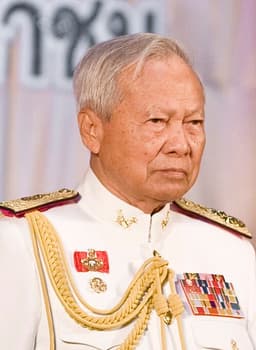
Prem Tinsulanonda
General · Modern
57.2Total
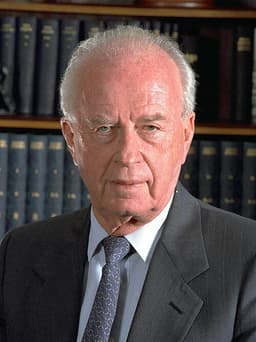
Yitzhak Rabin
General · Modern
66.4Total
Basic Information
Born
1920
1922
Died
—
—
Era
Modern
Modern
Nationality
Thailand
Israel
Occupation
General
General
Civilization
Eastern
Middle Eastern
Score Comparison
Military (10%)
50.0
61.7
Political (20%)
59.3
82.0
Influence (20%)
54.9
68.0
Legacy (20%)
47.5
55.0
Leadership (15%)
78.0
78.0
Strategy (15%)
60.0
55.0
TOTAL
57.2
66.4
Prem Tinsulanonda — Complete Timeline
1980 AD
Appointed Prime Minister after a coupPolitical Action◆ Major
Prem Tinsulanonda was appointed Prime Minister of Thailand by the military after a coup. He served for over eight years, overseeing a period of political stability and economic growth.
Prime MinisterMilitary RuleStability
Impact: national
1981 AD
Survived a coup attemptPolitical Action◆ Major
Prem survived a coup attempt by military officers loyal to the 'Young Turks' faction. The coup failed due to lack of support and the loyalty of key military units, allowing Prem to remain in power.
Coup AttemptPolitical CrisisMilitary
Impact: national
1988 AD
Resigned as Prime MinisterPolitical Action◆ Major
Prem resigned as Prime Minister after the general election, handing over power to a civilian government led by Chatichai Choonhavan. His resignation marked a rare peaceful transition of power in Thai politics.
ResignationDemocratic TransitionPeaceful
Impact: nationalconstructive
2016 AD
Appointed Regent of ThailandPolitical Action
After the death of King Bhumibol, Prem was appointed Regent of Thailand until the ascension of King Maha Vajiralongkorn. He served as a key figure in the transition of the monarchy.
RegentMonarchyTransition
Impact: national
Yitzhak Rabin — Complete Timeline
1967 AD
Chief of Staff during the Six-Day WarWar
As Chief of Staff of the Israel Defense Forces, Rabin commanded the Israeli military during the Six-Day War against Egypt, Jordan, and Syria. Israel captured the Sinai Peninsula, Gaza Strip, West Bank, East Jerusalem, and Golan Heights, reshaping the region.
Six-Day WarTerritorial ExpansionMilitary Victory
Impact: global
1993 AD
Signing of the Oslo AccordsPolitical Action
As prime minister, Rabin signed the Oslo Accords with PLO Chairman Yasser Arafat on the White House lawn. The agreement established the Palestinian Authority and set a framework for Palestinian self-governance in the West Bank and Gaza Strip.
Peace ProcessPalestiniansOslo
Impact: globalconstructive
1995 AD
Assassination at Peace RallyPolitical Action
Rabin was assassinated by Israeli extremist Yigal Amir after a peace rally in Tel Aviv. The assassination shocked Israel and the world, derailing the Oslo peace process and leading to a period of political instability.
AssassinationPeace ProcessPolitical Violence
Impact: globaltragic
Expert Analysis
Yitzhak Rabin vs Prem Tinsulanonda
# The General Who Died for Peace and the General Who Lived for Stability
On a balmy November evening in 1995, Yitzhak Rabin stood before a crowd of 100,000 Israelis in Tel Aviv’s Kings of Israel Square, singing a song of peace. Moments later, three bullets from a pistol fired by a Jewish extremist ended his life—and, many believe, the best hope for Israeli-Palestinian reconciliation. Half a world away and fifteen years earlier, another general, Prem Tinsulanonda, stepped into the prime minister’s office in Bangkok not under the glare of cameras but through the quiet corridors of military power. He would survive coup attempts, navigate treacherous political waters, and serve for eight years before handing over power peacefully—a feat almost unheard of in Thailand’s volatile political landscape. Both men were generals in an age of upheaval. Yet one was felled by the very peace he championed, while the other died in his bed at age 98, a revered regent. What drove these two soldiers down such different paths?
Origins
Yitzhak Rabin was born in Jerusalem in 1922 to a family of socialist Zionist pioneers. His father, a laborer, and his mother, a political activist, instilled in him a fierce commitment to the Jewish state. Rabin grew up in a world where survival was the first law—where the Holocaust was a fresh wound and the creation of Israel in 1948 was a miracle born of war. He joined the Palmach, the elite strike force of the Jewish underground, and learned early that leadership meant making decisions that could cost lives. The era demanded a warrior.
Prem Tinsulanonda, born two years earlier in 1920 in Songkhla, southern Thailand, came from a different world. His father was a minor nobleman, and his mother a schoolteacher. Thailand, uniquely in Southeast Asia, had never been colonized, and its monarchy remained a unifying symbol. Prem grew up in a society where loyalty to king and country was the highest virtue, and where Buddhist principles of harmony and patience guided daily life. He entered the military academy not as a revolutionary but as a career officer in a nation that prized stability above all.
These origins shaped their deepest instincts. Rabin saw the world as a battlefield where victory required decisive action. Prem saw it as a garden that needed careful tending.
Rise to Power
Rabin’s rise was meteoric and forged in fire. In 1967, as Chief of Staff of the Israel Defense Forces, he commanded the Six-Day War—a stunning preemptive strike that captured the Sinai, Gaza, the West Bank, and the Golan Heights in just six days. The victory was so complete that it transformed Israel from a besieged state into an occupying power. Rabin, with a military score of 62.0, was not a brilliant tactician like Moshe Dayan, but he was a master of logistics and organization. He understood that war was a machine that needed oiling, not a canvas for genius.
Prem’s path was slower and more cautious. He rose through the ranks of the Thai army during the Cold War, when Thailand was a frontline state against communist insurgencies. In 1980, after a bloodless coup, the military appointed him prime minister. He was not a charismatic leader; his political score of 68.8 reflects a man who governed through consensus, not force. He survived a coup attempt in 1981 by the "Young Turks" faction, not by crushing them but by outwaiting them. The coup failed because Prem had secured the loyalty of the king and the army’s senior echelons. He understood that power in Thailand flowed from the palace.
Leadership & Governance
Rabin’s leadership was defined by transformation. As prime minister in the 1990s, he reversed his own hawkish past. The Oslo Accords, signed in 1993 on the White House lawn, were a gamble of historic proportions. Rabin shook hands with Yasser Arafat, a man he had once called a terrorist, and agreed to Palestinian self-rule. His leadership score of 83.4 reflects a man who could change his mind—and his nation’s destiny. But peace required compromise, and compromise angered extremists on both sides. Rabin’s strategy score of 59.7 suggests that his vision outpaced his tactical planning. He failed to prepare Israelis for the painful concessions peace demanded.
Prem’s governance was the opposite: gradual, patient, and institutional. He served for over eight years, a remarkable tenure in a country where prime ministers often lasted months. He did not seek to transform Thailand but to stabilize it. He balanced the military, the monarchy, and the emerging democracy, allowing elections to proceed while keeping the army as a silent guardian. His leadership score of 89.0 is the highest among our two figures—not because he was a visionary, but because he was a manager of chaos. He resigned in 1988 after a general election, handing power to a civilian government. It was an act of self-restraint that few military strongmen ever manage.
Triumph & Tragedy
Rabin’s greatest moment was also the seed of his tragedy. The Oslo Accords earned him a Nobel Peace Prize and the adoration of the world. But at home, right-wing protesters waved posters of him in a Nazi uniform. The hatred was visceral. On November 4, 1995, Yigal Amir, a law student who believed Rabin was betraying Israel, shot him dead. The assassination was a national trauma. Rabin’s legacy score of 68.8 is haunted by the question: what if he had lived?
Prem’s triumph was survival itself. He outlasted coups, economic crises, and the death of King Bhumibol in 2016, after which he was appointed regent until the new king ascended. He died in 2019, a revered elder statesman. His tragedy is that he is largely forgotten outside Thailand. He left no peace treaty, no grand vision. He left only stability—a gift that, in politics, is rarely celebrated but deeply felt.
Character & Destiny
Rabin was a man of contradictions: a warrior who sought peace, a stoic who wept at funerals. His daughter once said he was "shy and awkward" in private, yet he made decisions that altered history. His character was forged in the crucible of Israel’s existential struggles. He believed that history demanded action, even at the risk of failure.
Prem was a man of silences. He rarely gave speeches, never wrote memoirs. He governed through whispers and intermediaries. His character was shaped by Thai Buddhism’s emphasis on detachment and duty. He believed that history demanded patience, even at the risk of obscurity.
Legacy
Rabin’s legacy is a wound that has not healed. In Israel, he is mourned as a martyr for peace, but his assassination poisoned the political climate. The Oslo process collapsed in violence, and the occupation continues. His name is invoked by those who still hope for a two-state solution—a hope that grows fainter each year.
Prem’s legacy is a foundation that few see. Thailand’s political system remains unstable, but his eight-year tenure showed that military rule need not be brutal. He is remembered as an honest broker, a man who served the king and the constitution. In 2016, when Thailand mourned King Bhumibol, Prem was the steady hand that ensured a smooth succession.
Conclusion
Standing at Rabin’s grave in Jerusalem, you see a stone that reads simply: "Yitzhak Rabin." No titles, no achievements. The message is clear: he was a man who gave his life for an idea. Standing before Prem’s portrait in Bangkok, you see a man in a military uniform, eyes calm, mouth closed. The message is different: he was a man who gave his life to a country. One died for peace; the other lived for order. Both were generals. Both were leaders. But in the end, they remind us that history does not reward the brave or the cautious—it only remembers them.
Rankings
🥇
Yitzhak RabinLeader
Mil: 61.7Pol: 82.0Inf: 68.0
66.4
🥈
Prem Tinsulanonda
Mil: 50.0Pol: 59.3Inf: 54.9
57.2
+9.2 behind
How This Comparison Works
Algorithm
Each figure is scored on 6 dimensions (0—100 scale) based on structured historical data: Military (10%), Political (20%), Influence (20%), Legacy (20%), Leadership (15%), Strategy (15%). The weighted total produces the final ranking.
Data Sources
Scores are computed from structured sub-indicators in the database. Scale factors adjust for era (Ancient ×0.85, Modern ×1.0) and civilization size (Eastern ×1.05, Other ×0.80) to account for differences in population and military scale.
Maximum 3 Figures
Comparisons are limited to 2—3 figures to ensure readability and statistical meaningfulness.
Error Margins
±5 points per dimension — Sub-scores are derived from historical records with inherent uncertainty. Two figures within 5 points on a dimension should be considered roughly equivalent in that area.
Total Score Accuracy
±3 points overall — The weighted combination of 6 dimensions produces a total score with approximately ±3 points of uncertainty. Differences of less than 3 points are not statistically significant— the figures are effectively tied.
Known Limitations
- Historical records are incomplete and uneven across civilizations
- Figures from oral-tradition societies may be underrepresented
- Occupation labels can misclassify multi-role figures
- Scores measure capability and impact, not moral character
- Quantitative scoring is a comparison tool, not absolute truth
Capability Radar
Military (10%) — Battles & Warfare
Battles
20
65
Win Rate
25
70
Expansion
10
50
Political (20%) — Governance & Reform
Reform
55
65
Diplomacy
60
85
Economy
50
60
Influence (20%) — Cultural & Global Reach
Cultural
30
55
Global
30
70
Legacy (20%) — Historical Impact
Historical
40
75
Longevity
35
60
Leadership (15%) — Power & Stability
Tenure
65
70
Stability
60
40
Strategy (15%) — Tactics & Innovation
Strategy
30
75
Tactics
30
60
Reform
35
55
Similar Comparisons
Comments & Discussion
SabraStrategist6/16/2026
Rabin knew war from the inside out—led the Six-Day War as chief of staff—but had the guts to flip the script and shake Arafat’s hand. Prem? A master of bureaucratic survival, not battlefield glory. One man bet on peace and paid with his life; the other waltzed through coups like a ghost. Rabin’s assassination wasn’t just tragedy—it was proof that real change terrifies the comfortable.
幽灵将军6/16/2026
Prem就是个政治不倒翁,靠军队后台混了八年总理,结果泰国还是乱成一锅粥。Rabin至少敢签《奥斯陆协议》,哪怕被自己人枪杀也值了。你查查史实:Prem下台后泰国又政变了多少次?他算哪门子稳定?完全是权力游戏的傀儡,别把他跟拼命推动和平的Rabin相提并论!