Loading...
Muhammadu Buhari vs Prem Tinsulanonda
Prem Tinsulanonda leads by 5.7 pts · 2 figures compared
…
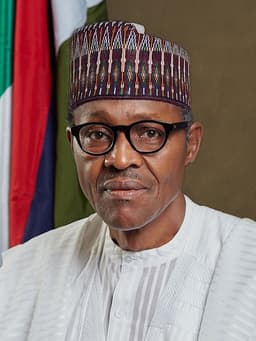
Muhammadu Buhari
General · Modern
51.5Total
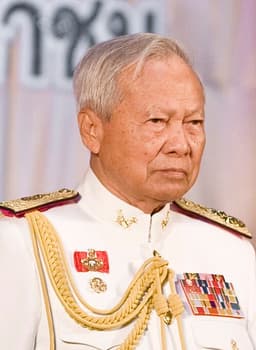
Prem Tinsulanonda
General · Modern
57.2Total
Basic Information
Born
1942
1920
Died
—
—
Era
Modern
Modern
Nationality
Nigeria
Thailand
Occupation
General
General
Civilization
Other
Eastern
Score Comparison
Military (10%)
22.6
50.0
Political (20%)
68.0
59.3
Influence (20%)
53.3
54.9
Legacy (20%)
43.3
47.5
Leadership (15%)
72.0
78.0
Strategy (15%)
41.0
60.0
TOTAL
51.5
57.2
Muhammadu Buhari — Complete Timeline
1983 AD
1983 Nigerian coup d'étatPolitical Action
Major General Muhammadu Buhari led a military coup that overthrew the civilian government of President Shehu Shagari. Buhari cited corruption and economic mismanagement as justifications, and he became the head of state.
CoupMilitary RuleCorruption
Impact: nationaldestructive
1984 AD
War Against Indiscipline (WAI)Reform◆ Major
Buhari launched the War Against Indiscipline, a campaign to enforce discipline and order in Nigerian society. It included harsh penalties for minor offenses, such as queue-jumping, and was criticized for human rights abuses.
DisciplineSocial PolicyHuman Rights
Impact: nationaldestructive
1985 AD
Overthrow by Ibrahim BabangidaPolitical Action◆ Major
Buhari was overthrown in a palace coup led by his Chief of Army Staff, Ibrahim Babangida. Babangida cited Buhari's authoritarian style and failure to address the economy as reasons for the coup.
CoupOverthrowBabangida
Impact: national
2015 AD
Anti-corruption campaignReform◆ Major
Buhari launched a high-profile anti-corruption campaign, targeting government officials and recovering stolen assets. The campaign was praised internationally but criticized for being selective and politically motivated.
Anti-CorruptionReformGovernance
Impact: nationalconstructive
Election as President of NigeriaPolitical Action
Buhari won the 2015 Nigerian presidential election, defeating incumbent Goodluck Jonathan. This was the first time an opposition candidate had defeated a sitting president in Nigeria's history, marking a democratic milestone.
ElectionDemocracyOpposition Victory
Impact: nationalprogressive
Prem Tinsulanonda — Complete Timeline
1980 AD
Appointed Prime Minister after a coupPolitical Action◆ Major
Prem Tinsulanonda was appointed Prime Minister of Thailand by the military after a coup. He served for over eight years, overseeing a period of political stability and economic growth.
Prime MinisterMilitary RuleStability
Impact: national
1981 AD
Survived a coup attemptPolitical Action◆ Major
Prem survived a coup attempt by military officers loyal to the 'Young Turks' faction. The coup failed due to lack of support and the loyalty of key military units, allowing Prem to remain in power.
Coup AttemptPolitical CrisisMilitary
Impact: national
1988 AD
Resigned as Prime MinisterPolitical Action◆ Major
Prem resigned as Prime Minister after the general election, handing over power to a civilian government led by Chatichai Choonhavan. His resignation marked a rare peaceful transition of power in Thai politics.
ResignationDemocratic TransitionPeaceful
Impact: nationalconstructive
2016 AD
Appointed Regent of ThailandPolitical Action
After the death of King Bhumibol, Prem was appointed Regent of Thailand until the ascension of King Maha Vajiralongkorn. He served as a key figure in the transition of the monarchy.
RegentMonarchyTransition
Impact: national
Expert Analysis
Muhammadu Buhari vs Prem Tinsulanonda
# The General as Statesman: Prem Tinsulanonda and Muhammadu Buhari
In 1980, a soft-spoken Thai general stepped into the prime minister’s office in Bangkok, his uniform still crisp, his demeanor cautious. Eight years later, he walked out voluntarily, handing power to an elected civilian—a rarity in a country where coups were the norm. Half a world away, in 1983, another general seized control in Lagos, promising to cleanse Nigeria of corruption and indiscipline. Within two years, he was overthrown by his own men. Three decades later, he returned as a democratically elected president, only to face the same demons. Why did one general’s path lead to stability and quiet influence, while the other’s became a cycle of promise and disappointment?
Origins
Prem Tinsulanonda was born in 1920 in Songkhla, southern Thailand, into a family of modest means but deep loyalty to the monarchy. He grew up in an era when Thailand—then Siam—was navigating the pressures of colonialism and modernization, its kings revered as semi-divine figures. The military was a path to respect, and Prem entered the army young, learning that survival meant discretion. He rose through the ranks not by charisma but by competence—a quiet man who knew when to speak and when to listen.
Muhammadu Buhari, born in 1942 in Daura, northern Nigeria, came of age in a different world. Nigeria was a British colony teetering toward independence, its ethnic and religious fractures already visible. Buhari’s father was a farmer, and the boy’s path out of poverty was the military academy. He trained in Britain and India, absorbing a rigid sense of order. By the time Nigeria plunged into civil war in the 1960s, Buhari had learned that force could hold a nation together—and that chaos was the enemy.
Rise to Power
Prem’s ascent was incremental. He served in the Korean War, held staff positions, and became army commander in the late 1970s. When a coup ousted the civilian government in 1980, the military needed a leader who could stabilize without offending the monarchy. Prem was the compromise: a general who looked like a bureaucrat. He accepted the prime ministership reluctantly, knowing his authority depended on balancing the army, the king, and an emerging democracy.
Buhari’s rise was abrupt. On December 31, 1983, he led a coup that toppled President Shehu Shagari, whose regime was riddled with corruption and economic mismanagement. Buhari was 41, stern, and convinced that only iron discipline could save Nigeria. He banned political parties, arrested journalists, and launched the “War Against Indiscipline”—a campaign to make Nigerians queue at bus stops and salute the flag. He saw himself as a surgeon, excising decay. But surgery without consent bleeds.
Leadership & Governance
Prem governed as a mediator. He survived a coup attempt in 1981 by the “Young Turks”—radical junior officers—by refusing to escalate, letting the king’s moral authority and internal divisions collapse the rebellion. He kept the military at arm’s length, appointing technocrats to manage the economy. His political wisdom was in knowing his limits: he never sought to rewrite the constitution or crush dissent. Instead, he presided over a slow return to parliamentary rule, stepping aside after the 1988 election.
Buhari governed as a crusader. His War Against Indiscipline was popular among Nigerians tired of chaos, but its methods—flogging, detention without trial, forced queuing—turned the state into a bully. He jailed critics and froze assets, but the economy worsened. Oil prices collapsed, and his refusal to negotiate with the International Monetary Fund left Nigeria isolated. His strategy was pure willpower, but willpower cannot fix a broken oil pipeline. In August 1985, his own chief of army staff, Ibrahim Babangida, overthrew him in a bloodless palace coup. Buhari was imprisoned for three years.
Triumph & Tragedy
Prem’s triumph was his resignation. In a region where leaders cling to power until death or exile, he walked away. He became a trusted elder, serving as regent after King Bhumibol’s death in 2016, bridging the transition to King Maha Vajiralongkorn. His tragedy was that his legacy—stability through compromise—left Thailand vulnerable to future coups. The generals he kept in check would later seize power again.
Buhari’s triumph came in 2015, when he won the presidency in Nigeria’s first democratic transfer of power to an opposition candidate. He defeated Goodluck Jonathan, a sitting president, by promising to crush Boko Haram and end corruption. For a moment, Nigeria seemed to have redeemed itself. But his tragedy was that the old habits returned. His anti-corruption campaign recovered billions, but it also targeted rivals. His health declined, and his government became as opaque as the regimes he had condemned. The surgeon had aged, and the patient was still sick.
Character & Destiny
Prem was a listener. He understood that power in Thailand flowed through the monarchy, not through him. His personality—reserved, patient, almost invisible—allowed him to survive where louder men fell. He did not seek glory; he sought order. Destiny gave him a nation that needed a caretaker, and he became one.
Buhari was a believer. He believed in discipline, in honesty, in the power of a firm hand. But belief without flexibility becomes dogma. His personality—rigid, moralistic, distrustful—made him a hero to those who wanted change and a villain to those who wanted freedom. Destiny gave him a nation that needed a reformer, but also a nation that refused to be reformed.
Legacy
Prem is remembered in Thailand as a figure of stability—the general who did not cling to power, the regent who guarded the throne. His legacy is institutional: he helped preserve a monarchy that has since faced unprecedented challenges. Critics say he enabled military dominance, but admirers call him a statesman.
Buhari leaves a divided legacy. In northern Nigeria, he is a hero, an honest man who tried. In the south, he is a symbol of failure—a leader who promised change and delivered stagnation. His anti-corruption drive was real but partial; his economic policies left Nigeria poorer. He will be remembered as a man of integrity who could not translate integrity into prosperity.
Conclusion
Standing at opposite ends of the world, Prem Tinsulanonda and Muhammadu Buhari share a common origin: the belief that a soldier can heal a nation. But one learned that healing requires patience, the other that it requires purity. Prem’s Thailand accepted slow, imperfect progress; Buhari’s Nigeria demanded immediate, total transformation. The difference was not in their will but in their world. Prem governed a society with a single, revered institution—the monarchy—that could absorb shocks. Buhari governed a society of fractures—ethnic, religious, economic—that no general could weld together. In the end, the quiet general left power on his own terms; the stern general returned to power only to find that the past had not forgiven him. History does not judge by intention. It judges by outcome.
Rankings
🥇
Prem TinsulanondaLeader
Mil: 50.0Pol: 59.3Inf: 54.9
57.2
🥈
Muhammadu Buhari
Mil: 22.6Pol: 68.0Inf: 53.3
51.5
+5.7 behind
How This Comparison Works
Algorithm
Each figure is scored on 6 dimensions (0—100 scale) based on structured historical data: Military (10%), Political (20%), Influence (20%), Legacy (20%), Leadership (15%), Strategy (15%). The weighted total produces the final ranking.
Data Sources
Scores are computed from structured sub-indicators in the database. Scale factors adjust for era (Ancient ×0.85, Modern ×1.0) and civilization size (Eastern ×1.05, Other ×0.80) to account for differences in population and military scale.
Maximum 3 Figures
Comparisons are limited to 2—3 figures to ensure readability and statistical meaningfulness.
Error Margins
±5 points per dimension — Sub-scores are derived from historical records with inherent uncertainty. Two figures within 5 points on a dimension should be considered roughly equivalent in that area.
Total Score Accuracy
±3 points overall — The weighted combination of 6 dimensions produces a total score with approximately ±3 points of uncertainty. Differences of less than 3 points are not statistically significant— the figures are effectively tied.
Known Limitations
- Historical records are incomplete and uneven across civilizations
- Figures from oral-tradition societies may be underrepresented
- Occupation labels can misclassify multi-role figures
- Scores measure capability and impact, not moral character
- Quantitative scoring is a comparison tool, not absolute truth
Capability Radar
Military (10%) — Battles & Warfare
Battles
10
20
Win Rate
10
25
Expansion
5
10
Political (20%) — Governance & Reform
Reform
30
55
Diplomacy
25
60
Economy
20
50
Influence (20%) — Cultural & Global Reach
Cultural
25
30
Global
25
30
Legacy (20%) — Historical Impact
Historical
30
40
Longevity
20
35
Leadership (15%) — Power & Stability
Tenure
45
65
Stability
15
60
Strategy (15%) — Tactics & Innovation
Strategy
15
30
Tactics
15
30
Reform
20
35
Similar Comparisons
Comments & Discussion
MilitaryMandarin6/16/2026
This comparison misses the key difference: Prem Tinsulanonda ruled through a constitutional monarchy with a revered king, giving him institutional cover to step down gracefully. Buhari had no such safety net—Nigeria's presidency is a naked power struggle. Prem was a manager of elites; Buhari tried to be a reformer, which made enemies. Apples and oranges dressed up as generals. I'd take Prem's stealth over Buhari's purges any day.
数据侦探6/16/2026
把两人放在一起比较本身就是历史误导。Buhari执政时期尼日利亚GDP增长和通胀数据与Prem在位的泰国截然不同,更别说人口结构和资源依赖度。1983年Buhari上台时尼日利亚刚经历石油价格暴跌,这根本不是同一个游戏。Prem的"稳定"有多少是靠美国冷战援助堆出来的?别拿宏观数据骗人。
RevisionistQuill6/16/2026
The framing of Prem as the "good general" is colonial nostalgia. Thailand's prem-thaksin era didn't end coups; it normalized military oversight of civilian governments through his Privy Council role. Buhari's 1983 coup was brutal but honest about its authoritarian intent. Prem's "voluntary exit" still left him pulling strings from behind the throne—more insidious, not more virtuous. Give me Buhari's blunt failure over Prem's velvet glove any day.
古典迷6/16/2026
说Prem"自愿交权"太天真了。1988年他辞职是因为军队内部分裂,再撑着可能被政变推翻。而Buhari在1985年被推翻后,1999年才以民主形式回归,整整14年流放。Prem的"贵族"姿态是泰国精英文化的产物,Buhari的"军阀"气质是尼日利亚部落政治的缩影。两个人都是各自历史环境的囚徒。
HistoryHype6/16/2026
This comparison romanticizes Prem while scapegoating Buhari for Nigeria's structural problems. Prem inherited a Cold War-era Thai economy with US backing; Buhari inherited a collapsed oil state. One played golf with the king, the other tried to jail corrupt politicians. Prem didn't "choose" stability—he was handed it. Buhari's failure is real, but so is the fact that Nigeria's rot predates him.