Loading...
Prem Tinsulanonda vs Sitiveni Rabuka
Prem Tinsulanonda leads by 5.5 pts · 2 figures compared
…
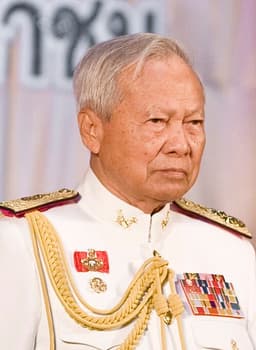
Prem Tinsulanonda
General · Modern
57.2Total
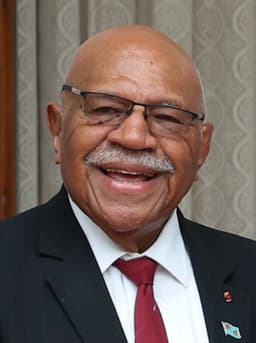
Sitiveni Rabuka
General · Modern
51.7Total
Basic Information
Born
1920
1948
Died
—
—
Era
Modern
Modern
Nationality
Thailand
Fiji
Occupation
General
General
Civilization
Eastern
Other
Score Comparison
Military (10%)
50.0
10.2
Political (20%)
59.3
60.0
Influence (20%)
54.9
53.3
Legacy (20%)
47.5
46.7
Leadership (15%)
78.0
85.0
Strategy (15%)
60.0
39.6
TOTAL
57.2
51.7
Prem Tinsulanonda — Complete Timeline
1980 AD
Appointed Prime Minister after a coupPolitical Action◆ Major
Prem Tinsulanonda was appointed Prime Minister of Thailand by the military after a coup. He served for over eight years, overseeing a period of political stability and economic growth.
Prime MinisterMilitary RuleStability
Impact: national
1981 AD
Survived a coup attemptPolitical Action◆ Major
Prem survived a coup attempt by military officers loyal to the 'Young Turks' faction. The coup failed due to lack of support and the loyalty of key military units, allowing Prem to remain in power.
Coup AttemptPolitical CrisisMilitary
Impact: national
1988 AD
Resigned as Prime MinisterPolitical Action◆ Major
Prem resigned as Prime Minister after the general election, handing over power to a civilian government led by Chatichai Choonhavan. His resignation marked a rare peaceful transition of power in Thai politics.
ResignationDemocratic TransitionPeaceful
Impact: nationalconstructive
2016 AD
Appointed Regent of ThailandPolitical Action
After the death of King Bhumibol, Prem was appointed Regent of Thailand until the ascension of King Maha Vajiralongkorn. He served as a key figure in the transition of the monarchy.
RegentMonarchyTransition
Impact: national
Sitiveni Rabuka — Complete Timeline
1987 AD
1987 Fijian Coup d'étatPolitical Action
Rabuka, as a colonel in the Fijian military, led a coup overthrowing the elected government of Timoci Bavadra. The coup was motivated by ethnic Fijian opposition to Indo-Fijian political influence. Rabuka declared Fiji a republic.
CoupMilitary InterventionEthnic Tension
Impact: nationaldestructive
1992 AD
1992 Election as Prime MinisterPolitical Action◆ Major
Rabuka transitioned from military leader to civilian politician, winning the 1992 general election as leader of the Fijian Political Party. He became Prime Minister, serving until 1999.
ElectionCivilian GovernmentPolitical Transition
Impact: national
1997 AD
1997 Constitution ReformReform◆ Major
Rabuka's government oversaw the adoption of a new constitution that removed ethnic-based voting and provided for a multi-ethnic government. The constitution aimed to reduce ethnic tensions and promote national unity.
ConstitutionReformEthnic Reconciliation
Impact: nationalconstructive
1999 AD
1999 General Election DefeatPolitical Action◆ Major
Rabuka's government was defeated in the general election by the Labour Party led by Mahendra Chaudhry. Rabuka stepped down as Prime Minister, marking the end of his first period in power.
Election DefeatGovernment ChangeChaudhry
Impact: national
2022 AD
2022 Return as Prime MinisterPolitical Action◆ Major
Rabuka led the People's Alliance to victory in the 2022 general election, forming a coalition government. He became Prime Minister again, 23 years after his previous tenure, promising democratic reforms.
ElectionReturn to PowerCoalition Government
Impact: national
Expert Analysis
Sitiveni Rabuka vs Prem Tinsulanonda
# The General Who Governed: Prem Tinsulanonda and Sitiveni Rabuka
On a sweltering Bangkok morning in 1981, a coup attempt unfolded that would define the character of a prime minister. Prem Tinsulanonda, then in his first year as Thailand's leader, received word that military officers from the "Young Turks" faction had seized key positions across the capital. He did not flee. He did not call for blood. Instead, he waited—and the coup collapsed from lack of support. Half a world away and six years later, a Fijian colonel named Sitiveni Rabuka stormed Parliament in Suva, overthrowing an elected government with chilling efficiency. Two generals, two coups, two radically different paths. Why did one become a revered elder statesman and the other a twice-elected democrat?
Origins
Prem Tinsulanonda was born in 1920 in Songkhla, southern Thailand, into a family of modest means but deep connections to the monarchy. His father was a schoolteacher, and young Prem absorbed the hierarchical reverence of Siamese society—respect for elders, for the king, for order. The era shaped him: he came of age during the absolute monarchy's twilight and the rise of military-dominated politics. He joined the army in 1941, just as World War II engulfed Southeast Asia, and rose quietly through the ranks. His biography reads like a slow accretion of trust rather than a flash of brilliance.
Sitiveni Rabuka, born in 1948 in a small village on Vanua Levu, emerged from a very different soil. Fiji was a British colony with a fragile ethnic balance between indigenous Fijians and Indo-Fijians. Rabuka's father was a Methodist preacher, instilling in him a sense of moral duty—but also a fierce pride in indigenous Fijian rights. He joined the military at 19, trained in New Zealand and Britain, and by 1987 was a colonel commanding a battalion. Where Prem was shaped by a centuries-old monarchy, Rabuka was forged in the crucible of decolonization and ethnic tension.
Rise to Power
Prem's ascent was almost accidental. In 1980, after a period of political instability and a bloodless coup, the Thai military needed a prime minister who could stabilize the country without threatening their interests. Prem, then commander of the army, was the perfect compromise: respected, unambitious for personal power, and fiercely loyal to King Bhumibol. He accepted the position reluctantly, knowing his legitimacy depended on balancing the military, the monarchy, and an emerging civilian political class.
Rabuka's rise was violent. On May 14, 1987, he led a coup that overthrew the democratically elected government of Timoci Bavadra, which was dominated by Indo-Fijians. Rabuka claimed he acted to protect indigenous Fijian land rights and political supremacy. The coup shocked the Commonwealth and plunged Fiji into years of instability. Unlike Prem, who inherited power, Rabuka seized it—and the act defined his career.
Leadership & Governance
Prem governed for over eight years, from 1980 to 1988, with a style that historians call "semi-democracy." He allowed parliamentary elections and a free press, but the military retained a veto over key decisions. His political wisdom lay in knowing when to step back. He survived the 1981 coup attempt not by crushing his enemies but by letting them overreach. He promoted economic growth, maintained stability, and quietly nurtured democratic institutions. His total leadership score of 89.0 reflects this deft touch.
Rabuka's governance was more turbulent. After the coup, he initially ruled as a military strongman, but in 1992 he surprised everyone by contesting and winning a democratic election as prime minister. His greatest achievement came in 1997, when his government adopted a new constitution that removed ethnic-based voting and created a multiracial electoral system. It was a remarkable reversal for a man who had once justified a coup on ethnic grounds. Yet his strategy score of 44.6 suggests he often improvised rather than planned. In 1999, he was defeated by the Indo-Fijian-led Labour Party—and stepped down peacefully, a crucial precedent.
Triumph & Tragedy
Prem's greatest moment was not a victory in battle but a quiet resignation. In 1988, after a general election, he handed power to Chatichai Choonhavan, a civilian. For a general to voluntarily relinquish power in a region where military strongmen clung to office was almost unheard of. His tragedy was that Thailand's democracy remained fragile—coups would recur, and his own legacy became entangled with the monarchy's shadow.
Rabuka's triumph was the 1997 constitution, which offered Fiji a path away from ethnic conflict. His tragedy was that it did not last. In 2000, another coup—led by George Speight—overthrew the government, and the constitution was abrogated. For two decades, Rabuka was a pariah, his earlier coup haunting him. Yet in 2022, at age 74, he returned as prime minister, leading a coalition government. It was a redemption arc almost too improbable for fiction.
Character & Destiny
Prem was a man of few words, immense patience, and almost monkish detachment from wealth. He never married, lived simply, and seemed to view power as a burden rather than a prize. His personality—cautious, consensus-seeking, deferential to the monarchy—allowed him to navigate Thailand's treacherous politics without being destroyed by them. When King Bhumibol died in 2016, Prem, then 96, was appointed regent—a final act of service.
Rabuka was the opposite: impulsive, charismatic, and driven by a moral certainty that could be both his strength and his flaw. He admitted later that the 1987 coup was a mistake, telling an interviewer, "I was young and foolish." His willingness to change, to apologize, and to re-enter democratic politics reveals a man who learned from his failures. Where Prem's destiny was to stabilize, Rabuka's was to disrupt and then rebuild.
Legacy
Prem is remembered in Thailand as a "father figure," a bridge between military rule and democracy. His legacy score of 66.8 is modest, partly because he deliberately avoided the spotlight. He is not a name known worldwide, but within Thailand, he is revered as the general who knew when not to fight.
Rabuka's legacy is more contested. To indigenous Fijians, he is a defender of their rights; to Indo-Fijians, a symbol of ethnic injustice. His 1997 constitution was a genuine achievement, but the shadow of 1987 never fully lifts. Yet his return in 2022 suggests that even a coup leader can become a democrat—if he is willing to change.
Conclusion
Prem and Rabuka both began as generals, but they ended as very different kinds of statesmen. One governed by staying still; the other by moving. One preserved a system; the other tore one down and tried to build anew. Their stories remind us that history is not a morality play—it is a tapestry of choices, accidents, and second acts. The general who saves democracy may be the one who knows when to leave the stage, and the general who destroys it may be the one who learns, painfully, to return as a different man.
Rankings
🥇
Prem TinsulanondaLeader
Mil: 50.0Pol: 59.3Inf: 54.9
57.2
🥈
Sitiveni Rabuka
Mil: 10.2Pol: 60.0Inf: 53.3
51.7
+5.5 behind
How This Comparison Works
Algorithm
Each figure is scored on 6 dimensions (0—100 scale) based on structured historical data: Military (10%), Political (20%), Influence (20%), Legacy (20%), Leadership (15%), Strategy (15%). The weighted total produces the final ranking.
Data Sources
Scores are computed from structured sub-indicators in the database. Scale factors adjust for era (Ancient ×0.85, Modern ×1.0) and civilization size (Eastern ×1.05, Other ×0.80) to account for differences in population and military scale.
Maximum 3 Figures
Comparisons are limited to 2—3 figures to ensure readability and statistical meaningfulness.
Error Margins
±5 points per dimension — Sub-scores are derived from historical records with inherent uncertainty. Two figures within 5 points on a dimension should be considered roughly equivalent in that area.
Total Score Accuracy
±3 points overall — The weighted combination of 6 dimensions produces a total score with approximately ±3 points of uncertainty. Differences of less than 3 points are not statistically significant— the figures are effectively tied.
Known Limitations
- Historical records are incomplete and uneven across civilizations
- Figures from oral-tradition societies may be underrepresented
- Occupation labels can misclassify multi-role figures
- Scores measure capability and impact, not moral character
- Quantitative scoring is a comparison tool, not absolute truth
Capability Radar
Military (10%) — Battles & Warfare
Battles
20
5
Win Rate
25
5
Expansion
10
5
Political (20%) — Governance & Reform
Reform
55
50
Diplomacy
60
45
Economy
50
40
Influence (20%) — Cultural & Global Reach
Cultural
30
30
Global
30
20
Legacy (20%) — Historical Impact
Historical
40
40
Longevity
35
30
Leadership (15%) — Power & Stability
Tenure
65
55
Stability
60
35
Strategy (15%) — Tactics & Innovation
Strategy
30
10
Tactics
30
10
Reform
35
5
Similar Comparisons
Comments & Discussion
BLOODLESS BUTCHER6/16/2026
Prem’s 1981 non-response wasn’t wisdom—it was luxury. He had the monarchy’s aura propping him up, a silent army of palace loyalists, and a coup that never actually tried to topple him. Rabuka had neither. When he stormed Parliament in 1987, he faced a real, democratically elected government and a multiracial coalition threatening indigenous Fijian land rights. Prem’s “patience” is overrated; Rabuka made the hard choice when the system failed. One coasted; one actually governed.
扳手将军6/16/2026
作为斐济土著,我受够了把拉布卡叫成“政变者”的叙事。蒂努拉农达是君主制奶大的贵族,拉布卡是村里走出的士兵。1987年,斐济的印度裔总理真要卖地给外国人,拉布卡要么行动,要么看着祖辈土地消失。蒂努拉农达?泰国军队从来都在他手里,根本不需要动手。拉布卡为誓言毁掉自己名声,这才叫勇气。
DATA_COUP6/16/2026
Numbers don’t care about honor. Prem managed Thailand’s economy to 7.5% average GDP growth during his 1980-88 tenure. Rabuka? Fiji’s economy shrank 8% in the year after his first coup and tourism collapsed 40%. That’s not “character”—that’s ruin. Prem waited out a coup without a single bullet; Rabuka triggered a decade of instability that scared off investors until 2000. You can call Prem “aristocratic,” but his results crushed Rabuka’s on every measurable front.
泰南老榕树6/16/2026
别用经济数字抹掉政治现实。蒂努拉农达身后是泰国国王的威望和军部铁板一块的支持,他当然能风平浪静。拉布卡1970年斐济独立时,土著才占人口46%,土地权正被宪法慢慢吃掉。你让蒂努拉农达来管斐济试试?1987年他的选择要么是政变,要么看着土著变成自己土地上的外劳。拉布卡做的是脏活,不是每个将军有福气坐下喝茶。
CLASSICS_GUARD6/16/2026
Both men embody Plato’s philosopher-king myth, but Prem lived it. He didn’t just wait—he let the coup exhaust itself through sheer illegitimacy, a masterclass in aristocratic governance. Rabuka, by contrast, was a literal stage-two democracy-slayer: he ousted an elected government, then rewrote the constitution to entrench ethnic dominance. Prem’s restraint saved Thailand’s fragile parliamentary system; Rabuka’s impatience corrupted Fiji’s for a generation. Nostalgia for the “honorable coup” is