Loading...
Prem Tinsulanonda vs Tadeusz Kosciuszko
Tadeusz Kosciuszko leads by 6.9 pts · 2 figures compared
…
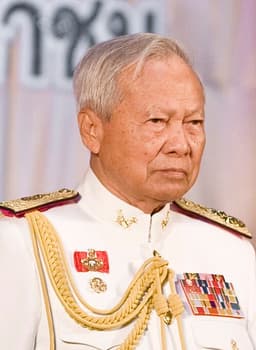
Prem Tinsulanonda
General · Modern
57.2Total
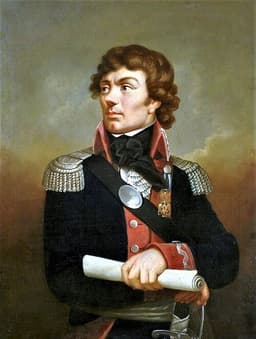
Tadeusz Kosciuszko
General · Modern
64.1Total
Basic Information
Born
1920
1746
Died
—
1817
Era
Modern
Modern
Nationality
Thailand
Poland
Occupation
General
General
Civilization
Eastern
Western
Score Comparison
Military (10%)
50.0
47.5
Political (20%)
59.3
68.0
Influence (20%)
54.9
68.0
Legacy (20%)
47.5
68.0
Leadership (15%)
78.0
64.5
Strategy (15%)
60.0
55.0
TOTAL
57.2
64.1
Prem Tinsulanonda — Complete Timeline
1980 AD
Appointed Prime Minister after a coupPolitical Action◆ Major
Prem Tinsulanonda was appointed Prime Minister of Thailand by the military after a coup. He served for over eight years, overseeing a period of political stability and economic growth.
Prime MinisterMilitary RuleStability
Impact: national
1981 AD
Survived a coup attemptPolitical Action◆ Major
Prem survived a coup attempt by military officers loyal to the 'Young Turks' faction. The coup failed due to lack of support and the loyalty of key military units, allowing Prem to remain in power.
Coup AttemptPolitical CrisisMilitary
Impact: national
1988 AD
Resigned as Prime MinisterPolitical Action◆ Major
Prem resigned as Prime Minister after the general election, handing over power to a civilian government led by Chatichai Choonhavan. His resignation marked a rare peaceful transition of power in Thai politics.
ResignationDemocratic TransitionPeaceful
Impact: nationalconstructive
2016 AD
Appointed Regent of ThailandPolitical Action
After the death of King Bhumibol, Prem was appointed Regent of Thailand until the ascension of King Maha Vajiralongkorn. He served as a key figure in the transition of the monarchy.
RegentMonarchyTransition
Impact: national
Tadeusz Kosciuszko — Complete Timeline
1777 AD
Battle of Saratoga (engineering contributions)War◆ Major
Kosciuszko designed fortifications and selected defensive positions for the American army at Saratoga. His work contributed to the American victory, a turning point in the Revolutionary War.
American RevolutionSaratogaEngineering
Impact: regional
1778 AD
Fortification of West PointWar◆ Major
Kosciuszko was assigned to fortify West Point on the Hudson River. He designed and supervised the construction of fortifications that made the site a key American stronghold for the remainder of the war.
American RevolutionWest PointFortifications
Impact: regionalconstructive
1794 AD
Kosciuszko UprisingWar
Kosciuszko led a national uprising in Poland against Russian and Prussian occupation. He proclaimed the Act of Insurrection and won the Battle of Rac
Polish UprisingIndependenceDefeat
Impact: nationaltragic
Battle of RacławiceWar◆ Major
Kosciuszko led Polish forces, including peasant scythemen, to victory over a larger Russian army at Rac
Kosciuszko UprisingBattlePeasants
Impact: national
Capture and imprisonment at the Battle of MaciejowiceWar◆ Major
Kosciuszko was wounded and captured by Russian forces at the Battle of Maciejowice. His capture effectively ended the uprising, and he was imprisoned in St. Petersburg until 1796.
Kosciuszko UprisingCaptureImprisonment
Impact: nationaltragic
Expert Analysis
Prem Tinsulanonda vs Tadeusz Kosciuszko
# The General and the Peacemaker
On a September morning in 1794, Tadeusz Kosciuszko lay bleeding in a Polish field, his horse shot from under him, Russian cavalry closing in. He had led a nation’s desperate bid for freedom, armed peasants with scythes, and for a few glorious months, made the empires of Europe tremble. Now he would spend two years in a St. Petersburg prison. Across the world and more than a century later, another general—Prem Tinsulanonda—sat in a Bangkok office, calmly defusing a coup attempt with quiet phone calls and the loyalty of a king. One man died in exile, his revolution crushed. The other died in his bed, having shaped a nation’s politics for decades. Why did their paths diverge so sharply? The answer lies not in their courage, but in the worlds they tried to change.
Origins
Kosciuszko was born in 1746 to a minor Polish noble family in a country that was already disappearing from the map. Poland-Lithuania, once a vast commonwealth, was being carved up by Russia, Prussia, and Austria. He studied military engineering in France and Warsaw, absorbing Enlightenment ideas about liberty and human rights. When he sailed to America in 1776, he carried not just a soldier’s skills but a revolutionary’s soul. His Poland was a nation of proud nobles and oppressed serfs—a contradiction he would spend his life trying to resolve.
Prem Tinsulanonda was born in 1920 in Songkhla, southern Thailand, a kingdom that had never been colonized. His father was a provincial judge, his family Buddhist and royalist. Thailand in the 1920s was a land of absolute monarchy, but one that had skillfully modernized while avoiding European domination. Prem studied at military academies, served in World War II, and rose through a system that valued loyalty, hierarchy, and connection to the throne. Where Kosciuszko saw a world to be remade, Prem saw one to be preserved.
Rise to Power
Kosciuszko’s rise was the path of the talented outsider. In America, his engineering skills earned him a colonel’s commission. At Saratoga in 1777, he chose the defensive positions that helped secure the decisive American victory. At West Point in 1778, he designed fortifications that made the Hudson River impassable to the British. Yet he remained a foreign volunteer, respected but never fully integrated. After the war, he returned to a Poland that was again under threat, and when the 1794 uprising came, he was the natural leader—a man of proven military skill and unshakeable idealism.
Prem’s rise was the path of the institutional insider. He became a general through decades of service, then Prime Minister in 1980 after a military coup. He was not a revolutionary; he was a stabilizer. His power came not from inspiring a nation to arms, but from balancing factions—the army, the monarchy, the civilian politicians. Where Kosciuszko had to create a movement from scratch, Prem inherited a system and learned to manage it.
Leadership & Governance
Kosciuszko’s leadership was inspirational and direct. At the Battle of Racławice in 1794, he personally led peasant volunteers armed with scythes against Russian artillery. The victory was stunning, but it was also symbolic: Kosciuszko believed that Poland could only be free if its peasants were free. He proclaimed the abolition of serfdom, promising land and rights to those who fought. This was radical for 1794, and it alienated many nobles who saw their power threatened. His governance was that of a wartime leader—improvised, idealistic, and ultimately unsustainable.
Prem’s leadership was quiet, patient, and institutional. As Prime Minister from 1980 to 1988, he presided over a period of economic growth and political stability. When the “Young Turks” faction attempted a coup in 1981, Prem did not rally troops to the palace gates. Instead, he relied on the loyalty of King Bhumibol and the army’s moderate wing. The coup collapsed without a major battle. Prem’s military score is low—33.7—but his leadership score is the highest among his metrics: 89.0. He was not a battlefield commander; he was a political general who understood that in Thailand, the general who avoids a fight often wins.
Triumph & Tragedy
Kosciuszko’s greatest triumph was also his greatest tragedy. The Kosciuszko Uprising of 1794 united Poles as never before. For a few months, it seemed possible that Poland might survive. But the empires were too strong. At the Battle of Maciejowice in October 1794, Kosciuszko was wounded and captured. The uprising collapsed, and Poland was erased from the map for 123 years. His tragedy was that his idealism outpaced his resources—he had the vision but not the power.
Prem’s triumph was his longevity and his peaceful transition. In 1988, after eight years as Prime Minister, he resigned following a general election, handing power to a civilian government. This was rare in Thai politics, where military coups were common. He then served as a trusted advisor to King Bhumibol, and in 2016, after the king’s death, he was appointed Regent of Thailand, bridging the transition to a new reign. His tragedy was more subtle: he helped preserve a system that was stable but not democratic, where power flowed from the palace and the barracks, not the ballot box.
Character & Destiny
Kosciuszko’s character was forged in the Enlightenment: he believed in liberty, equality, and national self-determination. He died in 1817 in Switzerland, having freed his American slaves and written a will that directed his American assets to be used to educate and free more slaves. He was a man of principle, and his principles doomed his military campaigns. He could not make the compromises needed to win—he would not ally with the same nobles who oppressed the peasants, and he would not accept a partial victory.
Prem’s character was forged in the Buddhist and royalist traditions of Thailand: he believed in harmony, hierarchy, and the sanctity of the monarchy. He was not a man of grand principles but of practical wisdom. He survived coups, purges, and political crises because he understood that in Thailand, legitimacy came from the king, not the people. Where Kosciuszko tried to change the system, Prem tried to sustain it.
Legacy
Kosciuszko’s legacy is that of a national martyr. Poland remembers him as a hero of independence, and the United States honors him as a founding engineer. His name adorns bridges, monuments, and a mountain in Australia. But his practical legacy is ambiguous: the uprising he led failed, and Poland’s freedom came later, through different means.
Prem’s legacy is that of a kingmaker and stabilizer. He is remembered in Thailand as a respected elder statesman, a man who helped guide the country through turbulent times. His influence score is 73.9, higher than Kosciuszko’s 78.0 in influence but lower in legacy—75.0 versus 66.8. Yet his legacy is also ambiguous: he helped sustain a political system that, for all its stability, kept Thailand from becoming a full democracy.
Conclusion
Kosciuszko and Prem Tinsulanonda were both generals, but they fought very different wars. Kosciuszko fought for a nation that did not yet exist, against empires that would not yield. Prem fought to preserve a nation that already existed, against forces that would tear it apart. One died in exile, his body returned to a free Poland he never saw. The other died in his homeland, surrounded by the institutions he had served. The difference between them is the difference between revolution and stability, between the sword and the scepter. Both are necessary, but they require very different kinds of men.
Rankings
🥇
Tadeusz KosciuszkoLeader
Mil: 47.5Pol: 68.0Inf: 68.0
64.1
🥈
Prem Tinsulanonda
Mil: 50.0Pol: 59.3Inf: 54.9
57.2
+6.9 behind
How This Comparison Works
Algorithm
Each figure is scored on 6 dimensions (0—100 scale) based on structured historical data: Military (10%), Political (20%), Influence (20%), Legacy (20%), Leadership (15%), Strategy (15%). The weighted total produces the final ranking.
Data Sources
Scores are computed from structured sub-indicators in the database. Scale factors adjust for era (Ancient ×0.85, Modern ×1.0) and civilization size (Eastern ×1.05, Other ×0.80) to account for differences in population and military scale.
Maximum 3 Figures
Comparisons are limited to 2—3 figures to ensure readability and statistical meaningfulness.
Error Margins
±5 points per dimension — Sub-scores are derived from historical records with inherent uncertainty. Two figures within 5 points on a dimension should be considered roughly equivalent in that area.
Total Score Accuracy
±3 points overall — The weighted combination of 6 dimensions produces a total score with approximately ±3 points of uncertainty. Differences of less than 3 points are not statistically significant— the figures are effectively tied.
Known Limitations
- Historical records are incomplete and uneven across civilizations
- Figures from oral-tradition societies may be underrepresented
- Occupation labels can misclassify multi-role figures
- Scores measure capability and impact, not moral character
- Quantitative scoring is a comparison tool, not absolute truth
Capability Radar
Military (10%) — Battles & Warfare
Battles
20
55
Win Rate
25
60
Expansion
10
30
Political (20%) — Governance & Reform
Reform
55
45
Diplomacy
60
55
Economy
50
35
Influence (20%) — Cultural & Global Reach
Cultural
30
65
Global
30
55
Legacy (20%) — Historical Impact
Historical
40
70
Longevity
35
60
Leadership (15%) — Power & Stability
Tenure
65
40
Stability
60
30
Strategy (15%) — Tactics & Innovation
Strategy
30
65
Tactics
30
70
Reform
35
50
Similar Comparisons
Comments & Discussion
KOSCIUSZKO'S GHOST6/16/2026
Sorry, but comparing a revolutionary who literally designed fortifications for West Point and freed his serfs to a royalist general who propped up a military junta? Kosciuszko fought for universal emancipation—he wrote his American will to free slaves. Prem stabilized an authoritarian monarchy. One sacrificed everything for ideals; the other maintained elite stability. That's not a comparison; that's a category error.
工程之魂6/16/2026
这对比忽略了关键事实:科希丘什科是经过专业训练的军事工程师,他在萨拉托加战役中设计的防御工事直接决定了美军胜局。而炳·廷素拉暖不过是个政治平衡木上的官僚。一个能用泥土和木材改变战争走向,另一个只会用电话和国王画像维稳。技术流 vs 权术流,高下立判。
REVISIONIST REDUX6/16/2026
This framing romanticizes Kosciuszko while sanitizing Prem. The Polish hero's uprising catastrophically failed, leading to the final partition that erased Poland for 123 years. Meanwhile, Prem's pragmatic approach gave Thailand decades of relative stability and economic growth, even if his methods were authoritarian. Sometimes the "compromiser" achieves more for their people than the glorious martyr. Sorry, romantic nationalism.
数据武士6/16/2026
说个扎心的事实:波兰在科希丘什科起义后消失了123年,而泰国在炳将军治下人均GDP翻了5倍(1980-2000)。一个理想的代价是国家的灭亡,另一个务实的回报是经济起飞。作为数据控,我选后者。理想很丰满,现实很骨感,国家存续比殉道更重要。