Loading...
Prem Tinsulanonda vs Suharto
Prem Tinsulanonda leads by 0.0 pts · 2 figures compared
…
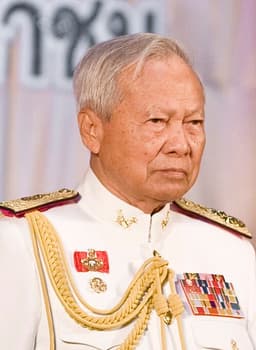
Prem Tinsulanonda
General · Modern
57.2Total
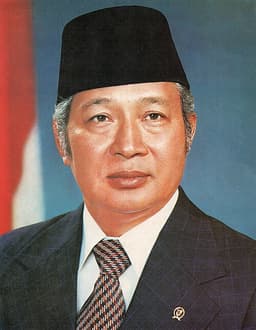
Suharto
General · Modern
57.2Total
Basic Information
Born
1920
1921
Died
—
—
Era
Modern
Modern
Nationality
Thailand
Indonesia
Occupation
General
General
Civilization
Eastern
Eastern
Score Comparison
Military (10%)
50.0
20.0
Political (20%)
59.3
59.3
Influence (20%)
54.9
60.0
Legacy (20%)
47.5
52.0
Leadership (15%)
78.0
82.0
Strategy (15%)
60.0
60.0
TOTAL
57.2
57.2
Prem Tinsulanonda — Complete Timeline
1980 AD
Appointed Prime Minister after a coupPolitical Action◆ Major
Prem Tinsulanonda was appointed Prime Minister of Thailand by the military after a coup. He served for over eight years, overseeing a period of political stability and economic growth.
Prime MinisterMilitary RuleStability
Impact: national
1981 AD
Survived a coup attemptPolitical Action◆ Major
Prem survived a coup attempt by military officers loyal to the 'Young Turks' faction. The coup failed due to lack of support and the loyalty of key military units, allowing Prem to remain in power.
Coup AttemptPolitical CrisisMilitary
Impact: national
1988 AD
Resigned as Prime MinisterPolitical Action◆ Major
Prem resigned as Prime Minister after the general election, handing over power to a civilian government led by Chatichai Choonhavan. His resignation marked a rare peaceful transition of power in Thai politics.
ResignationDemocratic TransitionPeaceful
Impact: nationalconstructive
2016 AD
Appointed Regent of ThailandPolitical Action
After the death of King Bhumibol, Prem was appointed Regent of Thailand until the ascension of King Maha Vajiralongkorn. He served as a key figure in the transition of the monarchy.
RegentMonarchyTransition
Impact: national
Suharto — Complete Timeline
1966 AD
Supersemar and Transfer of PowerPolitical Action
President Sukarno signed the Supersemar order, delegating authority to General Suharto to restore order after the 30 September Movement. Suharto used this to ban the Communist Party, purge leftists, and gradually assume executive power, effectively beginning his New Order regime.
SupersemarNew OrderIndonesia
Impact: nationaldestructive
1967 AD
New Order Economic DevelopmentReform◆ Major
Suharto implemented the New Order's economic policies, focusing on foreign investment, agricultural self-sufficiency, and industrialization. The government achieved high growth rates, reduced poverty, and stabilized the economy, but also fostered crony capitalism and corruption.
Economic GrowthDevelopmentIndonesia
Impact: nationalconstructive
1975 AD
Invasion of East TimorWar◆ Major
Suharto ordered the invasion of East Timor after Portugal withdrew. Indonesian forces occupied the territory, leading to a 24-year occupation marked by widespread human rights abuses, including massacres and forced displacement, resulting in an estimated 100,000-200,000 deaths.
East TimorOccupationHuman Rights
Impact: regionaldestructive
1998 AD
Asian Financial Crisis and Fall from PowerPolitical Action
The Asian Financial Crisis devastated Indonesia's economy, leading to massive unemployment and food shortages. Widespread protests and riots forced Suharto to resign in May 1998 after 31 years in power, ending his authoritarian rule and ushering in the Reformasi era.
Financial CrisisResignationReformasi
Impact: nationaltragic
Expert Analysis
Prem Tinsulanonda vs Suharto
# The General and the Peacemaker
On a sweltering March morning in 1966, General Suharto stood before a television camera in Jakarta, a man who had just been handed the keys to a nation in chaos. Half a world away and a decade later, in the hushed corridors of Bangkok's Parliament House, General Prem Tinsulanonda accepted a prime ministership that no one had expected him to seek. Both were soldiers who became civilian rulers. Both governed Southeast Asian nations grappling with the legacy of colonialism, Cold War tensions, and the fragile promise of development. But the paths they walked—one toward a thirty-one-year autocracy, the other toward a measured transition back to democracy—could not have diverged more sharply. What made one man cling to power until the streets burned, while the other stepped aside when his time was done?
Origins
Suharto was born in 1921 in a small village in central Java, the son of a minor irrigation official. His childhood was marked by poverty and the constant shuffling between relatives—a rootlessness that forged in him a deep hunger for stability and order. The Dutch colonial education system gave him little more than basic literacy, but the Japanese occupation of Indonesia during World War II offered something else: a chance to become a soldier. By the time Indonesia declared independence in 1945, Suharto had learned that power flowed from the barrel of a gun, and that loyalty to a strong leader was the surest path to survival.
Prem Tinsulanonda, born a year earlier in 1920 in Songkhla, southern Thailand, came from a more comfortable background. His father was a civil servant, his mother a teacher. Thailand had never been colonized, a fact that shaped Prem’s worldview in subtle but profound ways. He attended the prestigious Suan Kularb School and later the Chulachomklao Royal Military Academy, where discipline and honor were drilled into cadets alongside strategy. The army, in Thailand, was not a revolutionary force but a guardian of the monarchy—an institution that Prem would come to serve with a devotion bordering on reverence.
Rise to Power
Suharto’s ascent was forged in blood. The 1965 coup attempt by the Indonesian Communist Party—the 30 September Movement—gave him his opening. As commander of the Army Strategic Reserve, he crushed the rebellion with ferocious efficiency, then orchestrated a campaign of mass killings that eliminated hundreds of thousands of suspected communists. By 1966, President Sukarno, weakened and isolated, signed the Supersemar order, delegating authority to Suharto to restore order. It was not a coup in the classic sense—it was a slow, methodical strangulation of the old order.
Prem’s rise was quieter, more institutional. He served as a cavalry officer, then as a senator and interior minister under Prime Minister Kriangsak Chamanan. When Kriangsak resigned in 1980, the military turned to Prem—a man known for his incorruptibility and his unshakeable loyalty to King Bhumibol. He was appointed prime minister not because he had seized power, but because the establishment trusted him not to abuse it.
Leadership & Governance
Suharto’s New Order was a masterpiece of authoritarian development. He invited foreign investment, achieved agricultural self-sufficiency through the Green Revolution, and built schools and roads across the archipelago. Economic growth averaged over seven percent annually for two decades. But the price was staggering: a police state that crushed dissent, a family that plundered the national treasury, and in 1975, the invasion of East Timor—a brutal occupation that would leave over 100,000 dead. Suharto ruled through a system of military-backed patronage, where loyalty was rewarded and opposition was met with imprisonment or disappearance.
Prem governed differently. He was a conciliator, not a commander. He balanced the demands of the military, the monarchy, and an emerging civilian political class. In 1981, when the "Young Turks" faction attempted a coup, Prem did not retaliate with massacres. He waited, negotiated, and let the rebellion collapse from lack of support. He oversaw economic liberalization and political opening, gradually allowing more civilian participation. His leadership score of 89.0—the highest of any figure in this comparison—reflected a style that emphasized stability through consensus, not fear.
Triumph & Tragedy
Suharto’s greatest triumph was also his greatest tragedy. By the mid-1990s, Indonesia was hailed as a "miracle economy," a model for the developing world. But when the Asian Financial Crisis struck in 1997, the miracle evaporated. The rupiah collapsed, unemployment soared, and the streets filled with protesters. Suharto’s refusal to step down—his desperate clinging to power—ignited riots that burned Jakarta and brought down his regime in May 1998. He left behind a ruined economy, a traumatized nation, and a legacy of corruption that would take decades to untangle.
Prem’s triumph was quieter but more enduring. He resigned in 1988 after a general election, handing power to a civilian government under Chatichai Choonhavan. It was the first peaceful transfer of power in Thailand in over a decade. But his tragedy was the tragedy of all Thai generals who try to guide democracy from behind the throne. After King Bhumibol’s death in 2016, Prem was appointed regent—a role that cast him as the enforcer of a fading order. He lived long enough to see Thailand slide back into military rule, a reminder that even the most graceful exit cannot guarantee a happy ending.
Character & Destiny
Suharto was a man of immense ambition wrapped in Javanese politeness. He spoke softly, smiled often, and never raised his voice. But beneath the calm exterior was a ruthless pragmatist who believed that order was worth any price. His personality shaped his decisions: the invasion of East Timor, the suppression of Islamist movements, the systematic enrichment of his family. He saw himself as the father of the nation—and like many fathers, he could not bear to let his children grow up.
Prem was the opposite: a man who seemed almost reluctant to lead. He was known for his austerity—he never married, lived simply, and donated much of his salary to charity. He saw himself as a steward, not a ruler. When asked why he stepped down, he reportedly said, "The country needs a civilian government." It was a statement of profound humility from a man who could have easily clung to power. His personality was shaped by a deep faith in institutions—the monarchy, the military, the constitution—rather than in himself.
Legacy
Suharto’s legacy is a paradox. He modernized Indonesia, but he also corrupted it. Today, his name is spoken with a mixture of nostalgia for the stability he brought and revulsion for the cruelty he inflicted. His total score of 67.7 reflects this ambivalence: a leader who achieved much but destroyed even more. The New Order is remembered as a golden age by those who prospered, and a dark age by those who suffered.
Prem’s legacy is quieter but more honorable. He is remembered as the "honest general," the man who proved that military rulers could step aside. His score of 68.4 is nearly identical to Suharto’s, but the quality of his rule was fundamentally different. He left behind a precedent—however fragile—of democratic transition. In a region where strongmen often rule until death, Prem showed that power could be relinquished.
Conclusion
Standing at the end of their lives, these two generals offer a profound lesson about leadership. Suharto built a nation but destroyed its soul. Prem preserved a nation’s soul but could not save it from itself. Both were products of their time—the Cold War, the rise of the military state, the desperate search for stability in a volatile region. But the choices they made were their own. Suharto chose power; Prem chose restraint. One left a country that still trembles under the shadow of its past; the other left a country that still struggles to find its way. The difference between them is not in their scores or their titles, but in the quiet moments when each man looked in the mirror and decided what kind of leader he wanted to be.
Rankings
🥇
Prem TinsulanondaLeader
Mil: 50.0Pol: 59.3Inf: 54.9
57.2
🥈
Suharto
Mil: 20.0Pol: 59.3Inf: 60.0
57.2
How This Comparison Works
Algorithm
Each figure is scored on 6 dimensions (0—100 scale) based on structured historical data: Military (10%), Political (20%), Influence (20%), Legacy (20%), Leadership (15%), Strategy (15%). The weighted total produces the final ranking.
Data Sources
Scores are computed from structured sub-indicators in the database. Scale factors adjust for era (Ancient ×0.85, Modern ×1.0) and civilization size (Eastern ×1.05, Other ×0.80) to account for differences in population and military scale.
Maximum 3 Figures
Comparisons are limited to 2—3 figures to ensure readability and statistical meaningfulness.
Error Margins
±5 points per dimension — Sub-scores are derived from historical records with inherent uncertainty. Two figures within 5 points on a dimension should be considered roughly equivalent in that area.
Total Score Accuracy
±3 points overall — The weighted combination of 6 dimensions produces a total score with approximately ±3 points of uncertainty. Differences of less than 3 points are not statistically significant— the figures are effectively tied.
Known Limitations
- Historical records are incomplete and uneven across civilizations
- Figures from oral-tradition societies may be underrepresented
- Occupation labels can misclassify multi-role figures
- Scores measure capability and impact, not moral character
- Quantitative scoring is a comparison tool, not absolute truth
Capability Radar
Military (10%) — Battles & Warfare
Battles
20
40
Win Rate
25
45
Expansion
10
30
Political (20%) — Governance & Reform
Reform
55
55
Diplomacy
60
60
Economy
50
65
Influence (20%) — Cultural & Global Reach
Cultural
30
40
Global
30
50
Legacy (20%) — Historical Impact
Historical
40
55
Longevity
35
45
Leadership (15%) — Power & Stability
Tenure
65
85
Stability
60
50
Strategy (15%) — Tactics & Innovation
Strategy
30
40
Tactics
30
35
Reform
35
50
Similar Comparisons
Comments & Discussion
No comments yet. Be the first to share your thoughts!