Loading...
Prem Tinsulanonda vs Sengge Rinchen
Prem Tinsulanonda leads by 0.3 pts · 2 figures compared
…
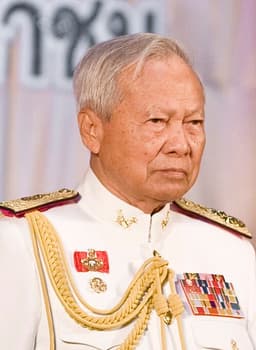
Prem Tinsulanonda
General · Modern
57.2Total
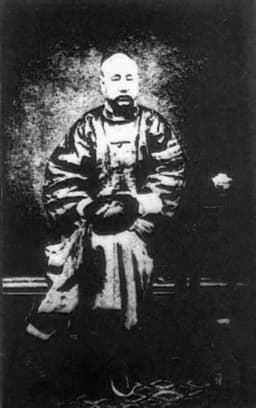
Sengge Rinchen
General · Modern
56.9Total
Basic Information
Born
1920
1811
Died
—
1865
Era
Modern
Modern
Nationality
Thailand
China
Occupation
General
General
Civilization
Eastern
Eastern
Score Comparison
Military (10%)
50.0
70.0
Political (20%)
59.3
43.7
Influence (20%)
54.9
55.0
Legacy (20%)
47.5
54.0
Leadership (15%)
78.0
67.0
Strategy (15%)
60.0
60.7
TOTAL
57.2
56.9
Prem Tinsulanonda — Complete Timeline
1980 AD
Appointed Prime Minister after a coupPolitical Action◆ Major
Prem Tinsulanonda was appointed Prime Minister of Thailand by the military after a coup. He served for over eight years, overseeing a period of political stability and economic growth.
Prime MinisterMilitary RuleStability
Impact: national
1981 AD
Survived a coup attemptPolitical Action◆ Major
Prem survived a coup attempt by military officers loyal to the 'Young Turks' faction. The coup failed due to lack of support and the loyalty of key military units, allowing Prem to remain in power.
Coup AttemptPolitical CrisisMilitary
Impact: national
1988 AD
Resigned as Prime MinisterPolitical Action◆ Major
Prem resigned as Prime Minister after the general election, handing over power to a civilian government led by Chatichai Choonhavan. His resignation marked a rare peaceful transition of power in Thai politics.
ResignationDemocratic TransitionPeaceful
Impact: nationalconstructive
2016 AD
Appointed Regent of ThailandPolitical Action
After the death of King Bhumibol, Prem was appointed Regent of Thailand until the ascension of King Maha Vajiralongkorn. He served as a key figure in the transition of the monarchy.
RegentMonarchyTransition
Impact: national
Sengge Rinchen — Complete Timeline
1859 AD
Battle of Dagu FortsWar◆ Major
Sengge Rinchen commanded Qing forces defending the Dagu Forts against a British and French naval attack. His forces repelled the assault, sinking several enemy ships and inflicting heavy casualties, a rare Qing victory in the Second Opium War.
Second Opium WarBattleVictory
Impact: regional
1860 AD
Battle of PalikaoWar◆ Major
Sengge Rinchen commanded Qing cavalry at the Battle of Palikao against Anglo-French forces. His forces were decisively defeated by superior firepower, leading to the fall of Beijing and the burning of the Old Summer Palace.
Second Opium WarBattleDefeat
Impact: regionaltragic
1863 AD
Suppression of the Nian RebellionWar◆ Major
Sengge Rinchen led Qing forces against the Nian rebels in northern China. He achieved several victories but was ultimately killed in battle against the Nian in 1865, marking a turning point in the rebellion.
Nian RebellionCampaignDeath
Impact: regionaltragic
Expert Analysis
Prem Tinsulanonda vs Sengge Rinchen
### The General and the Prince: Two Paths Through the Storm of Modernity
In the summer of 1860, a Mongol prince named Sengge Rinchen watched his cavalry charge into the guns of the Anglo-French army at the Battle of Palikao. The charge was a thing of terrible beauty—horses and men driven forward by centuries of steppe tradition, only to be shredded by modern artillery. Five years later, he would be dead, his severed head a trophy for rebels. A world away, in 1981, a Thai general named Prem Tinsulanonda sat in a Bangkok office as army tanks rolled toward him. He did not charge. He waited. The coup failed, and Prem remained prime minister for seven more years. Both men were generals. Both faced the collision of tradition and modernity. But one was broken by history, while the other learned to ride it.
### Origins
Sengge Rinchen was born in 1811 into the Mongol aristocracy, a world of horsemen and khans that had served the Qing dynasty for two centuries. His bloodline was his destiny. The Manchu emperors trusted Mongol princes to command their northern borders, and Sengge Rinchen was raised to believe that honor meant fighting as his ancestors had—on horseback, with lance and bow, in open battle. He was a product of a fading age, and he knew no other way.
Prem Tinsulanonda was born in 1920 in southern Thailand, the son of a schoolteacher. His world was smaller, less romantic. He attended military academy, then staff college, then served as a junior officer during World War II. He watched the old absolute monarchy fall, saw the Japanese occupation, and witnessed the constant churn of military coups. By the time he reached high command, he understood that power in modern Thailand was not about glory on a battlefield—it was about patience, alliances, and knowing when to yield.
### Rise to Power
Sengge Rinchen’s rise came through war. He fought the Taiping rebels in the 1850s, proving himself a ruthless and effective commander. The Qing dynasty, desperate for men who could fight, promoted him rapidly. By 1859, he was the empire’s best hope against the foreign devils at the Dagu Forts. He won that battle—repelling a British and French naval attack with a tactical mix of cannons and obstacles. It was the first time a Chinese force had defeated a Western power in decades. The emperor celebrated. Sengge Rinchen believed he had found the formula.
Prem Tinsulanonda rose through politics. He served as a trusted staff officer under Field Marshal Thanom Kittikachorn, then as army commander in the 1970s. When the military staged a coup in 1980, they chose him as prime minister because he was seen as a safe pair of hands—a man who could stabilize a country torn by student protests, communist insurgency, and factional infighting. He accepted the job not as a conqueror, but as a manager.
### Leadership & Governance
Their styles could not have been more different. Sengge Rinchen commanded from the front. At the Battle of Palikao in 1860, he led his cavalry personally, believing that a general’s courage could inspire men to overcome any obstacle. But the Anglo-French forces had rifled muskets and artillery that outranged his archers and lancers. His tactics were medieval; their firepower was modern. He lost 1,000 men in an hour. The lesson was brutal: courage without adaptation is suicide.
Prem Tinsulanonda governed from the center. He did not command armies in the field; he managed factions in the capital. His strategy was to balance the military, the monarchy, and the emerging democratic forces. He survived the 1981 coup attempt not by fighting, but by convincing the king to support him. He then slowly, carefully, allowed elections to take place. In 1988, after eight years, he resigned voluntarily—handing power to a civilian government. It was a revolutionary act for a military man.
### Triumph & Tragedy
Sengge Rinchen’s greatest moment was the 1859 victory at Dagu. For a brief, shining time, he was the hero of the Qing empire. But his tragedy was that he could not replicate it. The following year, he was crushed at Palikao. Then, in 1863, he was sent to suppress the Nian Rebellion—a guerrilla war that could not be won by cavalry charges. He fought bravely, but the rebels learned to avoid his strength and strike his supply lines. In 1865, he was ambushed and killed. His head was taken as a trophy. The Qing dynasty, which had placed its last hope in him, was left to decay.
Prem Tinsulanonda’s triumph was subtler. He did not win a great battle; he prevented a great collapse. Thailand in the 1980s was a powder keg of military ambition, royal succession anxiety, and communist insurgency. By stepping down when he did, he set a precedent that military rule could end peacefully. His tragedy came later: in 2016, at age 96, he was appointed regent after King Bhumibol’s death. He became the ultimate insider, the man who held the crown until the new king was ready. Critics said he had become a symbol of the very military dominance he once seemed to curb.
### Character & Destiny
Sengge Rinchen was a man of the old world. He believed in honor, in direct confrontation, in the power of the warrior spirit. His personality was forged in the steppe—proud, stubborn, and unyielding. When the world changed around him, he could not change with it. He met modernity head-on and was destroyed.
Prem Tinsulanonda was a man of the in-between. He was neither a warrior nor a democrat; he was a survivor. His personality was shaped by decades of watching others fail. He learned that the key to power was not winning every fight, but choosing which fights to avoid. He was flexible, patient, and quietly ruthless. He did not try to stop the tide of history; he rode it, steering where he could.
### Legacy
Sengge Rinchen is remembered in China as a tragic hero—a loyal servant of a dying dynasty, a man who fought bravely but could not save his empire. His name appears in textbooks as a symbol of Qing military decline. In Mongolia, he is honored as a warrior prince. But his legacy is one of failure: the failure of tradition to adapt, the failure of courage to overcome technology.
Prem Tinsulanonda’s legacy is more ambiguous. He is remembered as a stabilizing force, a kingmaker, and a guardian of the monarchy. His supporters credit him with guiding Thailand through a dangerous transition. His critics see him as the architect of a system that kept the military in power behind a democratic facade. In 2019, after his death at age 98, the Thai government declared a period of national mourning. The streets were quiet. The tanks stayed in their garages.
### Conclusion
One man charged into the guns. The other stepped aside to let history take its course. Both were generals. Both faced the same fundamental question: how does a traditional military leader survive the modern world? Sengge Rinchen gave the old answer—fight harder. Prem Tinsulanonda gave the new one—adapt, endure, and know when to retreat. In the end, the Mongol prince lost his head, and the Thai general lost his relevance. But one of them, at least, kept his country intact. The lesson is not that courage is obsolete, but that the most dangerous battlefield is not the one with cannons. It is the one inside the mind, where the decision to change—or not—is made.
Rankings
🥇
Prem TinsulanondaLeader
Mil: 50.0Pol: 59.3Inf: 54.9
57.2
🥈
Sengge Rinchen
Mil: 70.0Pol: 43.7Inf: 55.0
56.9
+0.3 behind
How This Comparison Works
Algorithm
Each figure is scored on 6 dimensions (0—100 scale) based on structured historical data: Military (10%), Political (20%), Influence (20%), Legacy (20%), Leadership (15%), Strategy (15%). The weighted total produces the final ranking.
Data Sources
Scores are computed from structured sub-indicators in the database. Scale factors adjust for era (Ancient ×0.85, Modern ×1.0) and civilization size (Eastern ×1.05, Other ×0.80) to account for differences in population and military scale.
Maximum 3 Figures
Comparisons are limited to 2—3 figures to ensure readability and statistical meaningfulness.
Error Margins
±5 points per dimension — Sub-scores are derived from historical records with inherent uncertainty. Two figures within 5 points on a dimension should be considered roughly equivalent in that area.
Total Score Accuracy
±3 points overall — The weighted combination of 6 dimensions produces a total score with approximately ±3 points of uncertainty. Differences of less than 3 points are not statistically significant— the figures are effectively tied.
Known Limitations
- Historical records are incomplete and uneven across civilizations
- Figures from oral-tradition societies may be underrepresented
- Occupation labels can misclassify multi-role figures
- Scores measure capability and impact, not moral character
- Quantitative scoring is a comparison tool, not absolute truth
Capability Radar
Military (10%) — Battles & Warfare
Battles
20
75
Win Rate
25
60
Expansion
10
20
Political (20%) — Governance & Reform
Reform
55
20
Diplomacy
60
50
Economy
50
20
Influence (20%) — Cultural & Global Reach
Cultural
30
40
Global
30
35
Legacy (20%) — Historical Impact
Historical
40
55
Longevity
35
30
Leadership (15%) — Power & Stability
Tenure
65
40
Stability
60
30
Strategy (15%) — Tactics & Innovation
Strategy
30
70
Tactics
30
80
Reform
35
30
Similar Comparisons
Comments & Discussion
No comments yet. Be the first to share your thoughts!