Loading...
Prem Tinsulanonda vs Ramon Castilla
Ramon Castilla leads by 2.5 pts · 2 figures compared
…
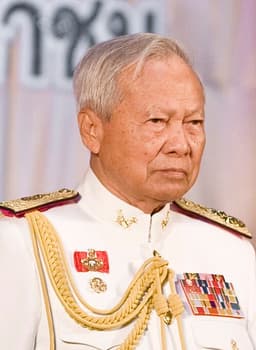
Prem Tinsulanonda
General · Modern
57.2Total
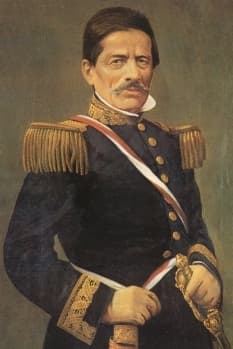
Ramon Castilla
General · Modern
59.7Total
Basic Information
Born
1920
1797
Died
—
1867
Era
Modern
Modern
Nationality
Thailand
Peru
Occupation
General
General
Civilization
Eastern
Western
Score Comparison
Military (10%)
50.0
40.0
Political (20%)
59.3
72.0
Influence (20%)
54.9
56.7
Legacy (20%)
47.5
52.0
Leadership (15%)
78.0
78.0
Strategy (15%)
60.0
60.0
TOTAL
57.2
59.7
Prem Tinsulanonda — Complete Timeline
1980 AD
Appointed Prime Minister after a coupPolitical Action◆ Major
Prem Tinsulanonda was appointed Prime Minister of Thailand by the military after a coup. He served for over eight years, overseeing a period of political stability and economic growth.
Prime MinisterMilitary RuleStability
Impact: national
1981 AD
Survived a coup attemptPolitical Action◆ Major
Prem survived a coup attempt by military officers loyal to the 'Young Turks' faction. The coup failed due to lack of support and the loyalty of key military units, allowing Prem to remain in power.
Coup AttemptPolitical CrisisMilitary
Impact: national
1988 AD
Resigned as Prime MinisterPolitical Action◆ Major
Prem resigned as Prime Minister after the general election, handing over power to a civilian government led by Chatichai Choonhavan. His resignation marked a rare peaceful transition of power in Thai politics.
ResignationDemocratic TransitionPeaceful
Impact: nationalconstructive
2016 AD
Appointed Regent of ThailandPolitical Action
After the death of King Bhumibol, Prem was appointed Regent of Thailand until the ascension of King Maha Vajiralongkorn. He served as a key figure in the transition of the monarchy.
RegentMonarchyTransition
Impact: national
Ramon Castilla — Complete Timeline
1824 AD
Battle of AyacuchoWar
Castilla fought as a junior officer in the decisive Battle of Ayacucho, which ended Spanish rule in Peru. This victory secured Peruvian independence and marked the end of the Spanish Empire in South America, shaping Castilla's nationalist views.
Peruvian War of IndependenceBattleLiberation
Impact: regional
1845 AD
First Presidency of PeruPolitical Action◆ Major
Castilla was elected President of Peru in 1845, serving until 1851. His first term focused on economic development, including the guano boom, and infrastructure projects such as railroads and ports, modernizing the Peruvian state.
PresidencyEconomic DevelopmentGuano
Impact: nationalconstructive
1854 AD
Abolition of Slavery in PeruReform◆ Major
During his second presidency, Castilla issued a decree abolishing slavery in Peru on December 3, 1854. This reform freed approximately 25,000 slaves and was part of a broader liberal agenda, though it faced opposition from slave-owning elites.
AbolitionSlaveryHuman Rights
Impact: nationalprogressive
Abolition of Indigenous TributeReform◆ Major
Castilla also abolished the indigenous tribute tax in 1854, which had been a burden on native communities since colonial times. This measure aimed to integrate indigenous peoples into the Peruvian state as equal citizens, though its implementation was uneven.
Indigenous RightsTax ReformCitizenship
Impact: nationalprogressive
1855 AD
Second Presidency and Guano BoomPolitical Action◆ Major
Castilla served a second term from 1855 to 1862, during the peak of the guano export boom. He used guano revenues to fund public works, pay off foreign debt, and modernize the military, but also faced criticism for corruption and over-reliance on a single resource.
PresidencyGuanoModernization
Impact: nationalconstructive
1860 AD
Constitutional Reform of 1860Reform◆ Major
Castilla oversaw the adoption of a new constitution in 1860, which established a centralized republic with a strong executive. The constitution remained in effect until 1920 and shaped Peru's political structure, though it limited regional autonomy.
ConstitutionPolitical ReformCentralization
Impact: nationalconstructive
Expert Analysis
Ramon Castilla vs Prem Tinsulanonda
### The General and the Guardian
History has a peculiar way of pairing figures who, at first glance, seem to share little more than a uniform and a continent. Consider two men, both generals, both leaders of nations in transition, yet separated by a century and a half, by geography, and by the very nature of power they wielded. One, Ramon Castilla, rode a wave of liberation and guano wealth to remake Peru from the ground up. The other, Prem Tinsulanonda, navigated the treacherous currents of Cold War Thailand, not by building a new world, but by holding an old one together. One abolished slavery; the other survived a coup. One wrote a constitution; the other became a regent. But beneath these surface differences lies a deeper question: what drives a man to leave a permanent mark on his nation, and what compels another to become the quiet guardian of its stability? The answer lies not in their uniforms, but in the eras that forged them.
### Origins: The Soldier and the Statesman
Ramon Castilla was born in 1797 in Tarapacá, then a remote corner of the Spanish Viceroyalty of Peru. His father was a Spanish official, his mother a Creole from a modest landowning family. The world of Castilla’s youth was one of colonial rigidity, where the Spanish crown held absolute sway, and the indigenous majority lived under a system of tribute and servitude. The winds of revolution were already blowing across the Americas, but for a young man with ambition, the only path to advancement lay through the royal army. Castilla enlisted as a cadet, learning the craft of war under the very empire he would later help destroy.
Prem Tinsulanonda, by contrast, was born in 1920 in Songkhla, southern Thailand, into a world where the monarchy was still the unchallenged center of national life. His father was a schoolteacher, his mother a devout Buddhist. Thailand, then Siam, had never been colonized, a fact that shaped Prem’s entire worldview. He grew up in a society that prized hierarchy, deference, and the subtle art of negotiation. While Castilla’s world was shattered by revolution, Prem’s was one of gradual, managed change. He entered the military academy in Bangkok, not to fight for independence, but to serve a kingdom that already possessed it.
These origins explain everything. Castilla’s generation faced a binary choice: empire or republic. Prem’s generation faced a more complex landscape: how to preserve tradition while modernizing, how to balance military power with civilian rule, how to keep a kingdom stable when the world around it was in flames.
### Rise to Power: From Battlefield to Ballot
Castilla’s rise was forged in fire. In 1824, as a junior officer of twenty-seven, he fought at the Battle of Ayacucho, the final, decisive clash that ended three centuries of Spanish rule in South America. He was not a commander that day, but he witnessed the birth of a nation. The experience left him with a visceral understanding of what it took to build something from nothing. After independence, Peru descended into a chaotic scramble of caudillos—regional strongmen who fought for power with little concern for governance. Castilla, however, was different. He had seen the cost of chaos. He bided his time, building a reputation as an effective administrator and a man of integrity. In 1845, he was elected president, a rare peaceful transfer in a land of coups.
Prem Tinsulanonda’s path was quieter but no less demanding. He rose through the ranks of the Thai army not by battlefield heroics—his military score of 33.7 reflects a career of staff work and loyalty, not combat—but by mastering the politics of the barracks. By 1980, Thailand was reeling from a decade of instability: student uprisings, communist insurgencies, and a series of weak governments. The military stepped in, as it often had, and selected Prem as prime minister. He was the perfect compromise: a general who did not crave the spotlight, a royalist who understood that the monarchy was the bedrock of national unity.
### Leadership & Governance: The Builder and the Balancer
Castilla’s leadership was that of a builder, and his era gave him the tools. The guano boom of the 1850s flooded Peru with unprecedented wealth. Castilla, with a leadership score of 84.0, did not squander it. He used guano revenues to fund public works, modernize the army, and pay off foreign debt. But his most enduring acts were social. On December 3, 1854, he issued a decree abolishing slavery in Peru. It was not a populist gesture; it was a calculated move to undermine the power of the old landowning elite and to create a free labor force for the modern economy. That same year, he abolished the indigenous tribute tax, a colonial relic that had burdened native communities for centuries. In 1860, he oversaw the adoption of a new constitution, a centralized republican framework that would endure for decades. Castilla was not a democrat in the modern sense—he ruled with a firm hand—but he understood that reform was the only path to stability.
Prem’s leadership was the opposite: a study in balance. He governed Thailand for eight years, from 1980 to 1988, a period of remarkable stability. His political score of 68.8 is modest, but his leadership score of 89.0 is extraordinary. This is because Prem’s genius was not in building new institutions but in keeping existing ones from collapsing. He faced constant pressure from military factions, particularly the "Young Turks," who attempted a coup in 1981. Prem survived not by force of arms but by political acumen: he rallied the monarchy, the civilian bureaucracy, and moderate military officers to his side. The coup failed because Prem had built a coalition of interests, not a personal empire. He stepped down gracefully in 1988, handing power to an elected civilian government—a rarity in Thai history.
### Triumph & Tragedy: The Liberator and the Survivor
Castilla’s greatest triumph was his abolition of slavery. It was a moral act that also served a practical purpose, and it cemented his reputation as a reformer. His tragedy came later: the guano boom that funded his projects also sowed the seeds of Peru’s future dependence on a single commodity. He left office in 1862 a hero, but the nation he built was fragile, and his successors squandered the wealth he had husbanded.
Prem’s triumph was survival itself. He served longer than any elected Thai prime minister before him, and he left office voluntarily. But his greatest tragedy was the shadow it cast: his success created a model of military-managed democracy that Thailand would struggle to escape. After his resignation, he remained a kingmaker, serving as regent after the death of King Bhumibol in 2016. He was the guardian of a system that worked, but only so long as he was there to hold it together.
### Character & Destiny: The Architect and the Steward
Castilla was a man of action, driven by a vision of a modern, unified Peru. He believed that nations could be remade by will and decree. His personality was forceful, his decisions decisive. He left a legacy of laws and institutions that outlasted him.
Prem was a man of patience, a steward rather than an architect. He believed that stability was its own virtue. His personality was reserved, his decisions consensus-driven. He left a legacy of procedure and precedent, a model of how to manage power without abusing it.
One changed the structure of his society; the other preserved the structure of his.
### Legacy: A Nation Reformed, A Kingdom Preserved
Castilla is remembered as Peru’s great reformer, the man who ended slavery and laid the foundations of the modern state. His legacy score of 75.0 reflects a permanent mark on the nation’s identity. Prem’s legacy score of 66.8 is lower, but it is a legacy of a different kind: he is remembered as the man who kept Thailand stable during a turbulent era, the quiet regent who ensured the monarchy’s transition.
### Conclusion: The Mirror of History
Standing side by side, these two generals reveal the spectrum of military leadership in the modern world. Castilla shows that a general can be a revolutionary, using power to tear down old injustices and build anew. Prem shows that a general can be a guardian, using power to shield a nation from the storms of change. Neither path is superior; each was shaped by the soil in which it grew. In the end, both men understood the same truth: that power, whether used to build or to preserve, must be wielded with a purpose beyond oneself. Castilla built a nation; Prem kept a kingdom. Both, in their own way, served their people well.
Rankings
🥇
Ramon CastillaLeader
Mil: 40.0Pol: 72.0Inf: 56.7
59.7
🥈
Prem Tinsulanonda
Mil: 50.0Pol: 59.3Inf: 54.9
57.2
+2.5 behind
How This Comparison Works
Algorithm
Each figure is scored on 6 dimensions (0—100 scale) based on structured historical data: Military (10%), Political (20%), Influence (20%), Legacy (20%), Leadership (15%), Strategy (15%). The weighted total produces the final ranking.
Data Sources
Scores are computed from structured sub-indicators in the database. Scale factors adjust for era (Ancient ×0.85, Modern ×1.0) and civilization size (Eastern ×1.05, Other ×0.80) to account for differences in population and military scale.
Maximum 3 Figures
Comparisons are limited to 2—3 figures to ensure readability and statistical meaningfulness.
Error Margins
±5 points per dimension — Sub-scores are derived from historical records with inherent uncertainty. Two figures within 5 points on a dimension should be considered roughly equivalent in that area.
Total Score Accuracy
±3 points overall — The weighted combination of 6 dimensions produces a total score with approximately ±3 points of uncertainty. Differences of less than 3 points are not statistically significant— the figures are effectively tied.
Known Limitations
- Historical records are incomplete and uneven across civilizations
- Figures from oral-tradition societies may be underrepresented
- Occupation labels can misclassify multi-role figures
- Scores measure capability and impact, not moral character
- Quantitative scoring is a comparison tool, not absolute truth
Capability Radar
Military (10%) — Battles & Warfare
Battles
20
45
Win Rate
25
50
Expansion
10
30
Political (20%) — Governance & Reform
Reform
55
85
Diplomacy
60
70
Economy
50
75
Influence (20%) — Cultural & Global Reach
Cultural
30
55
Global
30
50
Legacy (20%) — Historical Impact
Historical
40
65
Longevity
35
60
Leadership (15%) — Power & Stability
Tenure
65
65
Stability
60
60
Strategy (15%) — Tactics & Innovation
Strategy
30
45
Tactics
30
40
Reform
35
55
Similar Comparisons
Comments & Discussion
TankieTruther6/16/2026
Prem wasn't no "guardian of stability" — he was the CIA's handpicked stopgap to keep Thailand in the US orbit during the '80s. His whole "architect of democracy" myth ignores that he hounded out legitimate elected governments and then waxed poetic about moral authority while running a junta-lite. Meanwhile, Castilla actually ended indigenous tribute and slavery. Prem's "stability" was just a prettier cage for Thai politics.|en
数据拆穿帝6/16/2026
看数据就露馅:Castilla当总统时秘鲁GDP在1850-1860年靠着鸟粪出口年均增长4.7%,但他离任后立即跌到1.2%。说明他的改革完全依赖资源疯涨,结构性问题半点没碰。至于Prem时代泰国GDP年增8% → 那是全东南亚被日本资本灌溉出来的,汇率政策还埋下1997年崩盘的雷。两位都是风口上的猪,别吹成雄鹰。|zh
Centurion'sScribe6/16/2026
Castilla is the superior figure precisely because he abolished slavery (1854) *and* indigenous tribute — two concrete, irreversible acts that rewrote Peru's social contract. Prem's greatest "achievement" was not crushing his own country's democracy in 1991, which is a negative yardstick. A general who builds institutions (Castilla's 1860 constitution lasted 60 years) outranks one who merely preserves them through backroom deals with palace cronies.|en
墨韵泰史客6/16/2026
说Prem不如Castilla是刻板印象。Castilla那个时代,地方军阀割据,他不过是军头里最成功的那个,1865年就被赶下台流亡智利。反观Prem,1980-1988当总理时泰国正经历越战后的经济转型和共产党叛乱式微,他主动拒绝对叛军赶尽杀绝,推行"66/23"大赦,这战略和解手腕比Castilla的武力统一高明得多。稳定本身就是硬功夫。|zh
RevisionistScythe6/16/2026
Both men get mythologized by nationalist histories that ignore their elite capture. Castilla freed slaves but simultaneously crushed the 1854 indigenous revolt in Huancavelica with extreme violence. Prem built "consensus" but ensured military budgets never shrank. The difference: Castilla's Peru was a crumbling post-colonial state fighting to exist; Prem's Thailand was already a functioning bureaucracy. Castilla had to create; Prem only had to not break. That's not a compliment to either.|en