Loading...
Otto von Bismarck vs Yoweri Museveni
Otto von Bismarck leads by 1.9 pts · 2 figures compared
…
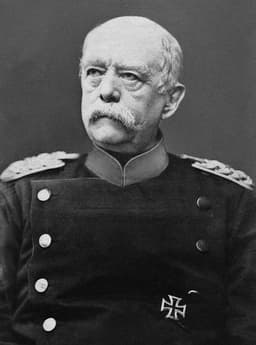
Otto von Bismarck
Politician · Modern
65.8Total
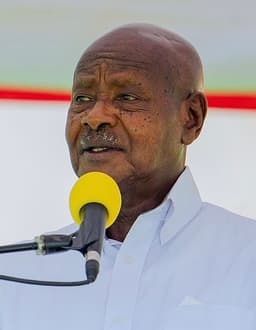
Yoweri Museveni
Politician · Modern
63.9Total
Basic Information
Born
1815
1944
Died
1898
—
Era
Modern
Modern
Nationality
Germany
Uganda
Occupation
Politician
Politician
Civilization
Western
Other
Score Comparison
Military (10%)
55.0
67.5
Political (20%)
85.0
72.0
Influence (20%)
82.0
61.0
Legacy (20%)
40.0
50.0
Leadership (15%)
80.0
80.0
Strategy (15%)
50.0
66.3
TOTAL
65.8
63.9
Otto von Bismarck — Complete Timeline
1870 AD
Franco-Prussian WarWar
Bismarck provoked France into declaring war by editing the Ems Dispatch to appear insulting. The resulting conflict saw Prussia and its allies decisively defeat France, leading to the fall of Napoleon III, the capture of Paris, and the annexation of Alsace-Lorraine.
WarProvocationAnnexation
Impact: globaldestructive
1871 AD
Unification of Germany ProclaimedPolitical Action
Following the Franco-Prussian War, Bismarck orchestrated the proclamation of the German Empire in the Hall of Mirrors at Versailles. King Wilhelm I of Prussia was declared German Emperor, uniting the German states under Prussian leadership and establishing the Second Reich.
UnificationGerman EmpireNationalism
Impact: globalconstructive
1878 AD
Enactment of the Anti-Socialist LawsPolitical Action◆ Major
After two assassination attempts on Kaiser Wilhelm I, Bismarck pushed through laws banning socialist organizations, publications, and meetings. The laws remained in force until 1890, suppressing the Social Democratic Party while Bismarck simultaneously introduced welfare reforms to undercut its appeal.
RepressionSocialismWelfare State
Impact: nationaldestructive
Congress of BerlinPolitical Action◆ Major
Bismarck hosted the Congress of Berlin to revise the Treaty of San Stefano and resolve the Eastern Crisis. He acted as 'honest broker,' reducing Russian gains, granting independence to Romania, Serbia, and Montenegro, and placing Bosnia-Herzegovina under Austro-Hungarian administration.
DiplomacyBalkansBalance of Power
Impact: global
1883 AD
Establishment of the Welfare StateReform◆ Major
Bismarck introduced the Health Insurance Bill (1883), Accident Insurance Bill (1884), and Old Age and Disability Insurance Bill (1889). These laws created the first modern welfare state, providing workers with social security and aiming to reduce support for socialist movements.
Social ReformWelfareInsurance
Impact: globalprogressive
1890 AD
Dismissal as ChancellorPolitical Action◆ Major
Emperor Wilhelm II forced Bismarck to resign due to policy disagreements, particularly over anti-socialist laws and foreign policy. Bismarck's departure marked the end of an era, leading to a more aggressive German foreign policy and the eventual unraveling of his alliance system.
ResignationWilhelm IIPolicy Shift
Impact: global
Yoweri Museveni — Complete Timeline
1986 AD
Bush War Victory and Capture of KampalaWar
Museveni's National Resistance Army (NRA) captured Kampala, ending the Ugandan Bush War. He was sworn in as President on January 29, 1986, overthrowing the government of Tito Okello and beginning his long rule.
Ugandan Bush WarSeizure of PowerNRA
Impact: national
Introduction of the Movement SystemPolitical Action◆ Major
Museveni established a 'no-party' Movement system, banning political party activity. This system concentrated power in the National Resistance Movement (NRM) and was justified as necessary to prevent ethnic conflict, but was criticized as authoritarian.
Political SystemNRMAuthoritarianism
Impact: national
1998 AD
Invasion of the Democratic Republic of CongoWar◆ Major
Ugandan forces, allied with Rwanda, invaded the Democratic Republic of Congo (DRC) to overthrow Laurent Kabila. This intervention escalated the Second Congo War, drawing in multiple African nations and causing widespread devastation.
Second Congo WarRegional ConflictIntervention
Impact: regionaldestructive
2005 AD
Constitutional Amendment Removing Term LimitsPolitical Action◆ Major
Museveni's government pushed through a constitutional amendment removing presidential term limits. This allowed him to run for a third term in 2006 and subsequent elections, consolidating his hold on power and drawing domestic and international criticism.
Constitutional ChangeTerm LimitsPower Consolidation
Impact: nationaldestructive
2014 AD
Anti-Homosexuality ActPolitical Action◆ Major
Museveni signed the Anti-Homosexuality Act, which imposed life imprisonment for certain same-sex acts. The law was widely condemned internationally, leading to aid cuts from some Western nations, though it was later annulled by the Constitutional Court on procedural grounds.
LGBTQ RightsLegislationInternational Condemnation
Impact: nationaldestructive
Expert Analysis
Otto von Bismarck vs Yoweri Museveni
# The Iron Chancellor and the Guerrilla President
In the Hall of Mirrors at Versailles, on January 18, 1871, Otto von Bismarck stood in the gilded splendor of Louis XIV’s palace and watched as the German Empire was proclaimed. One hundred and fifteen years later, on January 26, 1986, Yoweri Museveni, clad in guerrilla fatigues, rode into Kampala at the head of his rebel army. Both men had seized history by the throat. But where Bismarck unified a fragmented nation and then spent two decades building institutions to contain his own power, Museveni came to power promising liberation and ended up dismantling the very safeguards that might have checked him. Why did one become the architect of a stable state and the other the author of his own entrenchment?
Origins
Otto von Bismarck was born in 1815 into the Prussian Junker aristocracy, a class defined by land, military service, and a deep suspicion of liberalism. His father was a country squire, his mother a bourgeois intellectual. The contradiction shaped him: he had the instincts of a reactionary but the mind of a modern strategist. The revolutions of 1848 terrified him; he saw democracy as chaos waiting to happen. Yet he also understood that the old order could not survive by stubbornness alone. He would need to outmaneuver his enemies—both foreign and domestic.
Yoweri Museveni, born in 1944 in western Uganda, came from a different world entirely. His father was a cattle herder, his mother a peasant. Colonial rule was collapsing across Africa, and the young Museveni was drawn to the revolutionary currents of the 1960s: Mao Zedong’s peasant warfare, Frantz Fanon’s critique of colonial elites, and the liberation movements of Mozambique and Zimbabwe. He studied political science in Tanzania, where he absorbed the idea that violence was not merely a tool but a necessary cleansing force. Where Bismarck saw revolution as a threat, Museveni saw it as an opportunity.
Rise to Power
Bismarck’s path to power was a masterclass in patience. He spent years as a diplomat, learning the chessboard of European politics. In 1862, when Prussia’s parliament refused to fund military reforms, King Wilhelm I turned to Bismarck, the only man willing to defy the legislature. Bismarck’s famous “blood and iron” speech was not a threat—it was a declaration of method. He then spent a decade engineering three wars: against Denmark (1864), Austria (1866), and France (1870–71). Each was short, decisive, and carefully provoked. The Ems Dispatch, which he edited to make it seem as if the French ambassador had been insulted, was a work of political art: a lie that became a justification for war.
Museveni took a different route. In the 1970s, he joined the failed rebellion of Tanzania’s Julius Nyerere against Uganda’s Idi Amin. He then fled to Mozambique, where he trained with FRELIMO guerrillas. When he returned to Uganda in 1980, he contested a rigged election and then took up arms. The Bush War (1981–1986) was a brutal, grinding conflict fought in the swamps and forests of central Uganda. Museveni’s National Resistance Army was small, poorly equipped, and often on the run. But he had a gift for organization and propaganda. He issued the “Ten Points Programme,” a manifesto that promised democracy, human rights, and economic reconstruction. It was a brilliant political document—and it would later become a cage he built for others.
Leadership & Governance
Bismarck governed as a conservative revolutionary. Domestically, he was ruthless: the Anti-Socialist Laws of 1878 banned socialist parties and trade unions, and he used the Reichstag as a stage for his contempt. But he also understood that repression alone was unstable. So he pioneered the welfare state: health insurance (1883), accident insurance (1884), and old-age pensions (1889). The goal was not compassion but calculation—to steal the socialists’ thunder by giving workers a stake in the state. Internationally, he became the “honest broker” of Europe, hosting the Congress of Berlin in 1878 to prevent a great-power war. He built a system of alliances so intricate that no one could move without his permission.
Museveni’s early years were promising. He restored stability after the horrors of Idi Amin and Milton Obote, brought inflation under control, and won international praise for his AIDS prevention campaign. But he also introduced the “Movement system” in 1986—a no-party state that banned political competition. He argued that Africa needed unity, not division. In practice, it concentrated all power in his hands. In 2005, he removed presidential term limits. In 2014, he signed the Anti-Homosexuality Act, pandering to populism while crushing dissent. Where Bismarck built institutions to outlast him, Museveni dismantled them to survive.
Triumph & Tragedy
Bismarck’s greatest triumph was the unification of Germany—a feat that reshaped Europe. His tragedy came in 1890, when the young Kaiser Wilhelm II, jealous and insecure, forced him to resign. Bismarck left office in a fury, warning that the new emperor would steer Germany into disaster. He was right: within two decades, Wilhelm II had dismantled Bismarck’s alliance system and plunged Europe into war.
Museveni’s triumph was ending Uganda’s civil war and bringing a semblance of order. His tragedy is that he became the very thing he fought against. The invasion of the Democratic Republic of Congo in 1998, undertaken with Rwanda, plunged the region into a conflict that killed millions. At home, corruption flourished, and the opposition was jailed or exiled. The young guerrilla who had promised liberation became Africa’s longest-serving president, his country poorer and more divided than when he began.
Character & Destiny
Bismarck was cold, calculating, and deeply cynical. “Politics is the art of the possible,” he said. He believed in power, not morality. Yet that cynicism had a limit: he understood that power unchecked would destroy itself. He built a system of checks and balances—not out of idealism, but out of fear. He knew that the passions of nationalism, once unleashed, could consume everything.
Museveni, by contrast, seems to have believed his own propaganda. He came to power convinced that he alone could save Uganda. Over time, that conviction hardened into paranoia. He purged rivals, manipulated elections, and rewrote the constitution. Where Bismarck’s fear of chaos led him to build order, Museveni’s fear of losing power led him to destroy it.
Legacy
Bismarck is remembered as the Iron Chancellor—the unifier of Germany, the father of the welfare state, and a master of realpolitik. But his legacy is ambiguous. He unified Germany by war, and that militarism would later find its darkest expression. He created a welfare state, but also a culture of deference to authority. He was a genius of statecraft, but his methods left scars that would not heal.
Museveni’s legacy is still being written. To some, he is the liberator who ended Uganda’s nightmare. To others, he is a dictator who betrayed his own ideals. He has outlasted nearly every African leader of his generation, but longevity is not the same as greatness. The question history will ask is not whether he stayed in power, but what he did with it.
Conclusion
Two men, two centuries, two continents. Bismarck unified a nation and then spent twenty years trying to contain the forces he had unleashed. Museveni liberated a country and then spent forty years becoming its jailer. Both were brilliant, ruthless, and deeply flawed. But the difference is this: Bismarck knew that power, like fire, must be banked and contained. Museveni never learned that lesson. In the end, the Iron Chancellor built a state that outlasted him. The guerrilla president built a prison that he refuses to leave.
Rankings
🥇
Otto von BismarckLeader
Mil: 55.0Pol: 85.0Inf: 82.0
65.8
🥈
Yoweri Museveni
Mil: 67.5Pol: 72.0Inf: 61.0
63.9
+1.9 behind
How This Comparison Works
Algorithm
Each figure is scored on 6 dimensions (0—100 scale) based on structured historical data: Military (10%), Political (20%), Influence (20%), Legacy (20%), Leadership (15%), Strategy (15%). The weighted total produces the final ranking.
Data Sources
Scores are computed from structured sub-indicators in the database. Scale factors adjust for era (Ancient ×0.85, Modern ×1.0) and civilization size (Eastern ×1.05, Other ×0.80) to account for differences in population and military scale.
Maximum 3 Figures
Comparisons are limited to 2—3 figures to ensure readability and statistical meaningfulness.
Error Margins
±5 points per dimension — Sub-scores are derived from historical records with inherent uncertainty. Two figures within 5 points on a dimension should be considered roughly equivalent in that area.
Total Score Accuracy
±3 points overall — The weighted combination of 6 dimensions produces a total score with approximately ±3 points of uncertainty. Differences of less than 3 points are not statistically significant— the figures are effectively tied.
Known Limitations
- Historical records are incomplete and uneven across civilizations
- Figures from oral-tradition societies may be underrepresented
- Occupation labels can misclassify multi-role figures
- Scores measure capability and impact, not moral character
- Quantitative scoring is a comparison tool, not absolute truth
Capability Radar
Military (10%) — Battles & Warfare
Battles
60
65
Win Rate
70
70
Expansion
80
55
Political (20%) — Governance & Reform
Reform
90
60
Diplomacy
95
70
Economy
80
55
Influence (20%) — Cultural & Global Reach
Cultural
65
45
Global
75
50
Legacy (20%) — Historical Impact
Historical
85
55
Longevity
70
50
Leadership (15%) — Power & Stability
Tenure
85
85
Stability
70
50
Strategy (15%) — Tactics & Innovation
Strategy
85
80
Tactics
55
75
Reform
75
60
Similar Comparisons
Comments & Discussion
边疆铁血6/16/2026
俾斯麦的“铁血政策”是用三次王朝战争拼出来的统一,而穆塞维尼的游击战更像是权力游戏的前奏。一个在1871年普法战争后捏住威廉一世的鼻子搞宪法,确保容克集团利益;另一个1986年进坎帕拉后就开始洗白自己的NRM政权。别拿俾斯麦的五年统一计划碰瓷穆塞维尼的终身制——前者是为了德意志,后者是为了自己。
BURY THE REVISIONIST6/16/2026
Museveni fanboys love comparing him to Bismarck, but that's like comparing a railway architect to a bus conductor. Bismarck built national institutions—the Reichstag, universal male suffrage, a central bank—that constrained even him. Museveni promised term limits in Uganda's 1995 constitution, then deleted them in 2005. One man designed a state; the other designed a system of personal retention. The difference isn't in their origins—it's in their institutions.
数据屠夫6/16/2026
从GDP数据看,1871年普鲁士统一后到1890年,德国工业产量翻了三倍;穆塞维尼执政35年,乌干达人均GDP到现在还不到800美元。你说他稳定?乌干达腐败指数全球排名142。俾斯麦虽然铁腕,但至少搞了社会保险法,给工人留了口饭吃。这哪是继承普鲁士精神,分明是在消费殖民地遗产。
CLASSICS GUY6/16/2026
Bismarck had Tacitus in his pocket; Museveni has Machiavelli on his shelf but read only chapter 18. The Iron Chancellor built a realpolitik cathedral in Berlin—complete with constitutional columns and social insurance ceilings. Museveni's NRM movement is a mud-hut dictatorship: no separation of powers, no free press, just a "no-party system" that means one-party rule. The difference? Bismarck's treaties lasted decades; Museveni's promises last until the next constitutional amendment.