Loading...
Charles de Gaulle vs Otto von Bismarck
Charles de Gaulle leads by 2.4 pts · 2 figures compared
…
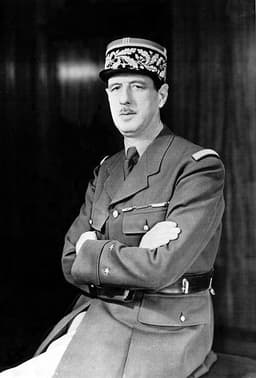
Charles de Gaulle
Politician · Modern
68.2Total
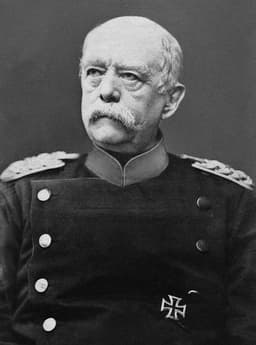
Otto von Bismarck
Politician · Modern
65.8Total
Basic Information
Born
1890
1815
Died
1970
1898
Era
Modern
Modern
Nationality
France
Germany
Occupation
Politician
Politician
Civilization
Western
Western
Score Comparison
Military (10%)
55.0
55.0
Political (20%)
75.0
85.0
Influence (20%)
65.0
82.0
Legacy (20%)
68.0
40.0
Leadership (15%)
78.0
80.0
Strategy (15%)
65.0
50.0
TOTAL
68.2
65.8
Charles de Gaulle — Complete Timeline
1940 AD
Appeal of 18 June 1940Political Action
From London, de Gaulle broadcast a radio appeal urging French resistance against Nazi occupation. He called on French soldiers and citizens to continue the fight, founding the Free French Forces and becoming the symbol of French defiance.
World War IIResistanceLeadership
Impact: nationalconstructive
1958 AD
Founding of the Fifth RepublicPolitical Action
De Gaulle returned to power during the Algerian crisis and oversaw the drafting of a new constitution. The Fifth Republic established a strong executive presidency, replacing the unstable parliamentary system of the Fourth Republic.
ConstitutionGovernment ReformPolitical System
Impact: nationalconstructive
1962 AD
End of the Algerian WarPolitical Action◆ Major
De Gaulle negotiated the
DecolonizationPeace TreatyAlgeria
Impact: regionalconstructive
1968 AD
May 1968 CrisisPolitical Action◆ Major
Mass student protests and general strikes paralyzed France, challenging de Gaulle's government. De Gaulle briefly fled to Germany, then returned to dissolve the National Assembly and call elections, which his party won, but his authority was weakened.
ProtestPolitical CrisisSocial Unrest
Impact: nationaldestructive
1969 AD
Resignation as PresidentPolitical Action
De Gaulle resigned after losing a referendum on regional reform and Senate restructuring. The defeat marked the end of his political career, as he withdrew from public life and died the following year.
ResignationPolitical DefeatReferendum
Impact: nationaltragic
Otto von Bismarck — Complete Timeline
1870 AD
Franco-Prussian WarWar
Bismarck provoked France into declaring war by editing the Ems Dispatch to appear insulting. The resulting conflict saw Prussia and its allies decisively defeat France, leading to the fall of Napoleon III, the capture of Paris, and the annexation of Alsace-Lorraine.
WarProvocationAnnexation
Impact: globaldestructive
1871 AD
Unification of Germany ProclaimedPolitical Action
Following the Franco-Prussian War, Bismarck orchestrated the proclamation of the German Empire in the Hall of Mirrors at Versailles. King Wilhelm I of Prussia was declared German Emperor, uniting the German states under Prussian leadership and establishing the Second Reich.
UnificationGerman EmpireNationalism
Impact: globalconstructive
1878 AD
Enactment of the Anti-Socialist LawsPolitical Action◆ Major
After two assassination attempts on Kaiser Wilhelm I, Bismarck pushed through laws banning socialist organizations, publications, and meetings. The laws remained in force until 1890, suppressing the Social Democratic Party while Bismarck simultaneously introduced welfare reforms to undercut its appeal.
RepressionSocialismWelfare State
Impact: nationaldestructive
Congress of BerlinPolitical Action◆ Major
Bismarck hosted the Congress of Berlin to revise the Treaty of San Stefano and resolve the Eastern Crisis. He acted as 'honest broker,' reducing Russian gains, granting independence to Romania, Serbia, and Montenegro, and placing Bosnia-Herzegovina under Austro-Hungarian administration.
DiplomacyBalkansBalance of Power
Impact: global
1883 AD
Establishment of the Welfare StateReform◆ Major
Bismarck introduced the Health Insurance Bill (1883), Accident Insurance Bill (1884), and Old Age and Disability Insurance Bill (1889). These laws created the first modern welfare state, providing workers with social security and aiming to reduce support for socialist movements.
Social ReformWelfareInsurance
Impact: globalprogressive
1890 AD
Dismissal as ChancellorPolitical Action◆ Major
Emperor Wilhelm II forced Bismarck to resign due to policy disagreements, particularly over anti-socialist laws and foreign policy. Bismarck's departure marked the end of an era, leading to a more aggressive German foreign policy and the eventual unraveling of his alliance system.
ResignationWilhelm IIPolicy Shift
Impact: global
Expert Analysis
Charles de Gaulle vs Otto von Bismarck
# The Iron Chancellor and the Last Great Frenchman
On a January morning in 1871, Otto von Bismarck stood in the Hall of Mirrors at Versailles, watching as German princes proclaimed Wilhelm I Emperor of a unified Germany. The room, dripping with Louis XIV's gilded excess, had been chosen deliberately—a humiliation for the French, whose armies had just been crushed. Nearly a century later, in the summer of 1940, another man stood before a microphone in London, his gaunt frame trembling slightly as he told his countrymen that France had lost a battle, but not the war. Bismarck built an empire from blood and iron. De Gaulle rebuilt a nation from shame and defiance. Both men shaped Europe, but their paths—and their legacies—could not have been more different.
Origins
Otto von Bismarck was born in 1815 into the Junker aristocracy of Prussia, a class defined by its land, its military tradition, and its deep suspicion of liberal democracy. His mother, however, was from a bourgeois family, and she pushed him toward education and diplomacy rather than the cavalry. Bismarck responded by becoming a brilliant, cynical, and ruthlessly pragmatic man—a conservative who understood that to preserve the old order, one must sometimes destroy it.
Charles de Gaulle was born in 1890 in Lille, into a devoutly Catholic, nationalist family. His father taught philosophy and history, instilling in young Charles a sense of France’s eternal grandeur. De Gaulle grew up reading the great military strategists, dreaming of glory, and nursing a wounded pride over France’s decline since 1815. Where Bismarck was cold and calculating, de Gaulle was aloof and mystical. Bismarck saw politics as a game of power. De Gaulle saw it as a duty to destiny.
Rise to Power
Bismarck entered politics almost by accident, serving as a delegate to the Prussian parliament before catching the attention of King Wilhelm I during a constitutional crisis. In 1862, Wilhelm appointed him Minister President of Prussia. Bismarck famously told parliament that "the great questions of the day will not be decided by speeches and majority decisions—but by blood and iron." He then proceeded to prove it.
De Gaulle’s rise was slower and more painful. A colonel in 1940, he commanded a tank division during the German invasion. When France fell, he fled to London, virtually unknown. On June 18, 1940, he broadcast his appeal, calling on French soldiers to resist. At that moment, he was a rebel without an army, a general without troops. Yet he possessed something Bismarck never needed: moral authority. While Bismarck manipulated parliaments, de Gaulle conjured a nation from a radio studio.
Leadership & Governance
Bismarck governed through crisis and control. He provoked three wars—against Denmark, Austria, and France—to unify Germany under Prussian dominance. His military strategy was competent but not brilliant; his genius lay in diplomacy. He isolated France, kept Austria neutral, and manipulated the Ems Dispatch in 1870 to goad Napoleon III into declaring war. After unification, he became Chancellor and spent two decades balancing Europe’s powers, preventing any general war.
Domestically, Bismarck was a paradox. He crushed socialists with the Anti-Socialist Laws of 1878, yet simultaneously introduced the world’s first welfare state—health insurance in 1883, accident insurance in 1884, old-age pensions in 1889. He was not a humanitarian; he was a strategist. He wanted to steal the socialists’ thunder while keeping workers loyal to the Kaiser.
De Gaulle’s governance was shaped by crisis of a different order. In 1958, as France teetered on the brink of civil war over Algeria, he returned to power and founded the Fifth Republic, creating a strong presidency that could act decisively. He then did what few expected: he granted Algeria independence in 1962, facing down assassination attempts from his own former supporters. He pursued an independent foreign policy, pulling France from NATO’s military command, vetoing British entry into the European Economic Community, and building a nuclear deterrent. Where Bismarck built a system of alliances, de Gaulle built a system of obstinacy.
Triumph & Tragedy
Bismarck’s greatest triumph was the unification of Germany in 1871—a feat that reshaped Europe. His tragedy was that his creation outgrew his control. After his dismissal by Wilhelm II in 1890, the young Emperor abandoned Bismarck’s careful diplomacy, setting Germany on a collision course with its neighbors. Bismarck died in 1898, warning that "some damned foolish thing in the Balkans" would ignite the next war. He was right.
De Gaulle’s triumph was the liberation of France’s honor. His tragedy was that he could not escape the limits of his own grandeur. The May 1968 crisis—student protests and general strikes—revealed that his vision of France no longer matched its reality. He briefly fled to Baden-Baden, then returned, but the magic was broken. In 1969, he lost a referendum on regional reform and resigned. He died a year later, at home in Colombey-les-Deux-Églises, a lonely monument to a France that was fading.
Character & Destiny
Bismarck was a man of immense appetites—food, drink, power. He suffered from hypochondria, insomnia, and bouts of depression. He could be charming, brutal, and petty by turns. His personality shaped his politics: he believed in force, in realism, in the primacy of the state. He once said, "Politics is the art of the possible." He meant it.
De Gaulle was austere, distant, and convinced of his own mission. He wrote, "France cannot be France without greatness." He lived as if he were already a statue. His personality made him impossible to compromise with, but it also made him indispensable in moments of national crisis. He was not a man of his time; he was a man who tried to bend time to his will.
Legacy
Bismarck left behind a unified Germany, a welfare state, and a diplomatic system that kept peace for a generation. But he also left behind a militaristic, authoritarian tradition that would be hijacked by lesser men. His legacy is contested: admired by realists, despised by liberals, studied by every diplomat.
De Gaulle left behind a constitution that still governs France, a tradition of presidential authority, and a sense of national independence that outlasted the Cold War. His legacy is less contested but more fragile. The Fifth Republic has survived, but the grandeur he embodied has faded into memory.
Conclusion
Standing at Versailles in 1871, Bismarck could see the future he had made. Standing at a London microphone in 1940, de Gaulle could only hope for a future he might never see. One built an empire; the other saved a soul. Both understood that history is not made by committees or consensus, but by individuals who refuse to accept the world as it is. In the end, Bismarck’s Germany became too powerful for Europe to contain. De Gaulle’s France became too proud for the world to ignore. The iron chancellor and the last great Frenchman—each, in his own way, a necessary monster.
Rankings
🥇
Charles de GaulleLeader
Mil: 55.0Pol: 75.0Inf: 65.0
68.2
🥈
Otto von Bismarck
Mil: 55.0Pol: 85.0Inf: 82.0
65.8
+2.4 behind
How This Comparison Works
Algorithm
Each figure is scored on 6 dimensions (0—100 scale) based on structured historical data: Military (10%), Political (20%), Influence (20%), Legacy (20%), Leadership (15%), Strategy (15%). The weighted total produces the final ranking.
Data Sources
Scores are computed from structured sub-indicators in the database. Scale factors adjust for era (Ancient ×0.85, Modern ×1.0) and civilization size (Eastern ×1.05, Other ×0.80) to account for differences in population and military scale.
Maximum 3 Figures
Comparisons are limited to 2—3 figures to ensure readability and statistical meaningfulness.
Error Margins
±5 points per dimension — Sub-scores are derived from historical records with inherent uncertainty. Two figures within 5 points on a dimension should be considered roughly equivalent in that area.
Total Score Accuracy
±3 points overall — The weighted combination of 6 dimensions produces a total score with approximately ±3 points of uncertainty. Differences of less than 3 points are not statistically significant— the figures are effectively tied.
Known Limitations
- Historical records are incomplete and uneven across civilizations
- Figures from oral-tradition societies may be underrepresented
- Occupation labels can misclassify multi-role figures
- Scores measure capability and impact, not moral character
- Quantitative scoring is a comparison tool, not absolute truth
Capability Radar
Military (10%) — Battles & Warfare
Battles
60
60
Win Rate
55
70
Expansion
20
80
Political (20%) — Governance & Reform
Reform
95
90
Diplomacy
90
95
Economy
70
80
Influence (20%) — Cultural & Global Reach
Cultural
70
65
Global
80
75
Legacy (20%) — Historical Impact
Historical
85
85
Longevity
75
70
Leadership (15%) — Power & Stability
Tenure
85
85
Stability
75
70
Strategy (15%) — Tactics & Innovation
Strategy
85
85
Tactics
70
55
Reform
80
75
Similar Comparisons
Comments & Discussion
CHANCELLOR'S WHIP6/16/2026
You can't compare these two unless you're willing to admit that Bismarck had the harder job. De Gaulle inherited a glorious tradition, even in defeat—France had been a major power for centuries. Bismarck had to invent Germany from scratch, stitching together petty kingdoms and city-states while fending off Austria, France, and a suspicious Russia. One built from wreckage, yes, but the other built from nothing but raw ambition and brute political genius. Give me Iron Chancellor every time.
BISMARCK'S SHADOW6/16/2026
As a military historian, I say de Gaulle wins by sheer resilience. Bismarck's unification was sealed at Sedan in 1870, a classic set-piece victory. De Gaulle's moment came in 1940 when he refused to surrender, then led Free French forces from exile, ultimately marching into Paris in 1944. That's not just tactics—that's strategic survival. Bismarck never had to fight from the wilderness. De Gaulle did, and he won.
铁血指针6/16/2026
作为数据怀疑论者,我质疑这种“英雄对比”的叙事。俾斯麦统一德国时只有约3000万人口,而法国当时有近3800万。他用了巧妙的军事和外交策略,但这并不证明他更伟大。德高乐在1940年面对的法国已经被纳粹碾碎,人口不过4000万,他却用广播和意志拯救了国家。数字不撒谎:德高乐在劣势中做得更多。
高卢之剑6/16/2026
我研究古典策略多年。德高乐更像一位古典悲剧英雄,比如尤利西斯,从流亡中归来重塑国家。俾斯麦更像马基雅维利的王子,冷酷务实。两人都伟大,但德高乐的行为承载了更多精神象征——他在伦敦的“6月18日呼吁”堪比古代演说。俾斯麦用血和铁,德高乐用记忆和希望。我更尊敬后者。
德意志铁锤6/16/2026
我是历史爱好者,但我得替俾斯麦说话。德高乐重新定义了法国,但法国本身已经存在千年。俾斯麦在1866年赢下柯尼希格雷茨,1871年赢下凡尔赛,他创建了一个从未存在过的国家。德高乐的领导力在1944年解放巴黎时达到顶峰,但俾斯麦的遗产——德意志帝国——直到1918年才崩溃。谁更持久?谁更影响世界?答案不言而喻。