Loading...
Mao Zedong vs Otto von Bismarck
Mao Zedong leads by 13.6 pts · 2 figures compared
…
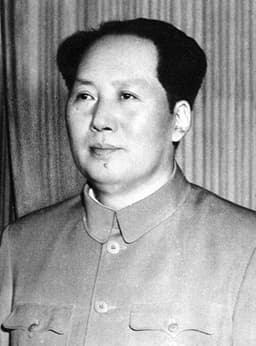
Mao Zedong
Politician · Modern
79.4Total
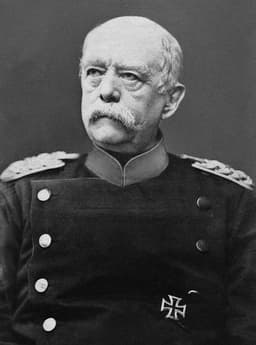
Otto von Bismarck
Politician · Modern
65.8Total
Basic Information
Born
1893
1815
Died
1976
1898
Era
Modern
Modern
Nationality
China
Germany
Occupation
Politician
Politician
Civilization
Eastern
Western
Score Comparison
Military (10%)
75.0
55.0
Political (20%)
88.0
85.0
Influence (20%)
85.0
82.0
Legacy (20%)
70.0
40.0
Leadership (15%)
85.0
80.0
Strategy (15%)
72.0
50.0
TOTAL
79.4
65.8
Mao Zedong — Complete Timeline
1934 AD
Long MarchWar
Mao Zedong led the Chinese Red Army on a strategic retreat from Nationalist forces, covering approximately 6,000 miles over 370 days. The march solidified Mao's leadership within the Chinese Communist Party and became a foundational myth of the Communist revolution.
Chinese Civil WarCommunist RevolutionRetreat
Impact: national
1949 AD
Proclamation of the People's Republic of ChinaPolitical Action
Mao Zedong declared the founding of the People's Republic of China from Tiananmen Gate in Beijing. This ended the Chinese Civil War and established Communist rule over mainland China, with Mao as Chairman of the Central People's Government.
Founding of PRCCommunist VictoryRevolution
Impact: global
1958 AD
Great Leap ForwardReform◆ Major
Mao launched a campaign to rapidly industrialize China and collectivize agriculture. The policy led to widespread mismanagement, resulting in a famine that caused an estimated 15-45 million deaths between 1959 and 1961.
FamineIndustrializationCollectivization
Impact: nationaldestructive
1960 AD
Sino-Soviet SplitPolitical Action◆ Major
Mao's ideological differences with Soviet leader Nikita Khrushchev led to a breakdown in relations between China and the Soviet Union. The split ended the Sino-Soviet alliance and reshaped global Cold War dynamics, with China pursuing an independent path.
Cold WarIdeological ConflictAlliance Breakdown
Impact: global
1966 AD
Cultural RevolutionPolitical Action
Mao initiated a sociopolitical movement to purge capitalist and traditional elements from Chinese society. The Red Guard youth groups attacked intellectuals and officials, leading to widespread violence, destruction of cultural artifacts, and an estimated 1-2 million deaths.
Political PurgeSocial UpheavalRed Guard
Impact: nationaldestructive
1971 AD
Ping-Pong DiplomacyCultural◆ Major
Mao approved an invitation for the U.S. table tennis team to visit China, initiating a thaw in Sino-American relations. This cultural exchange paved the way for President Nixon's visit to China in 1972 and the eventual normalization of diplomatic ties.
DiplomacyU.S.-China RelationsCultural Exchange
Impact: globalconstructive
Otto von Bismarck — Complete Timeline
1870 AD
Franco-Prussian WarWar
Bismarck provoked France into declaring war by editing the Ems Dispatch to appear insulting. The resulting conflict saw Prussia and its allies decisively defeat France, leading to the fall of Napoleon III, the capture of Paris, and the annexation of Alsace-Lorraine.
WarProvocationAnnexation
Impact: globaldestructive
1871 AD
Unification of Germany ProclaimedPolitical Action
Following the Franco-Prussian War, Bismarck orchestrated the proclamation of the German Empire in the Hall of Mirrors at Versailles. King Wilhelm I of Prussia was declared German Emperor, uniting the German states under Prussian leadership and establishing the Second Reich.
UnificationGerman EmpireNationalism
Impact: globalconstructive
1878 AD
Enactment of the Anti-Socialist LawsPolitical Action◆ Major
After two assassination attempts on Kaiser Wilhelm I, Bismarck pushed through laws banning socialist organizations, publications, and meetings. The laws remained in force until 1890, suppressing the Social Democratic Party while Bismarck simultaneously introduced welfare reforms to undercut its appeal.
RepressionSocialismWelfare State
Impact: nationaldestructive
Congress of BerlinPolitical Action◆ Major
Bismarck hosted the Congress of Berlin to revise the Treaty of San Stefano and resolve the Eastern Crisis. He acted as 'honest broker,' reducing Russian gains, granting independence to Romania, Serbia, and Montenegro, and placing Bosnia-Herzegovina under Austro-Hungarian administration.
DiplomacyBalkansBalance of Power
Impact: global
1883 AD
Establishment of the Welfare StateReform◆ Major
Bismarck introduced the Health Insurance Bill (1883), Accident Insurance Bill (1884), and Old Age and Disability Insurance Bill (1889). These laws created the first modern welfare state, providing workers with social security and aiming to reduce support for socialist movements.
Social ReformWelfareInsurance
Impact: globalprogressive
1890 AD
Dismissal as ChancellorPolitical Action◆ Major
Emperor Wilhelm II forced Bismarck to resign due to policy disagreements, particularly over anti-socialist laws and foreign policy. Bismarck's departure marked the end of an era, leading to a more aggressive German foreign policy and the eventual unraveling of his alliance system.
ResignationWilhelm IIPolicy Shift
Impact: global
Expert Analysis
Mao Zedong vs Otto von Bismarck
### The Iron Chancellor and the Great Helmsman
On a January morning in 1871, Otto von Bismarck stood in the Hall of Mirrors at Versailles, a palace still reeking of Prussian victory, and watched as King Wilhelm I of Prussia was proclaimed German Emperor. The ceremony was a masterpiece of stagecraft, designed to humiliate France and cement Prussian dominance. Almost a century later, on October 1, 1949, Mao Zedong stood atop the Tiananmen Gate in Beijing and declared the founding of the People’s Republic of China, his voice crackling over loudspeakers to a sea of red flags. Both men forged nations from chaos. Both wielded power with terrifying precision. Yet one built a welfare state and died in bed, while the other unleashed famines and revolutions that consumed millions. What separates a nation-builder from a destroyer? The answer lies not in their goals, but in the soil from which they grew, the wars they fought, and the demons they chose to embrace.
### Origins
Otto von Bismarck was born in 1815, the year Napoleon fell, into a world of aristocratic certainties. His Junker family owned estates in Brandenburg, and young Otto learned early that power was a birthright, not a gift. He studied law, drank heavily, and earned a reputation as a wild man before settling into politics. His Prussia was a patchwork of German states, overshadowed by Austria and haunted by revolutionary fervor. Bismarck saw liberalism as a disease and nationalism as a tool. He believed in God, king, and the iron logic of *Realpolitik*—the art of the possible.
Mao Zedong was born in 1893 in Shaoshan, a Hunan village where his father was a prosperous farmer who beat him. Mao read Chinese classics but also devoured tales of peasant rebellions. His China was the “sick man of Asia,” carved into spheres of influence by European powers, its Qing Dynasty crumbling. Where Bismarck inherited a stable state and sought to expand it, Mao inherited a broken empire and sought to rebuild it from scratch. One was a conservative who wanted to preserve; the other was a revolutionary who wanted to burn.
### Rise to Power
Bismarck’s path was a masterclass in opportunism. Appointed Minister President of Prussia in 1862, he famously told parliament that “the great questions of the day will not be decided by speeches and majority resolutions—but by blood and iron.” He provoked three wars: against Denmark (1864), Austria (1866), and France (1870). Each was short, brutal, and perfectly timed. The Ems Dispatch—a telegram he edited to sound insulting to the French ambassador—triggered the Franco-Prussian War. Bismarck did not fight battles; he manipulated nations into fighting them for him.
Mao’s rise was forged in retreat. During the Long March of 1934–35, he led the Communist Red Army on a 6,000-mile flight from Nationalist forces. It was a catastrophe in human terms—tens of thousands died—but it made Mao’s legend. He emerged as the leader who could survive the impossible. While Bismarck used diplomacy to corner enemies, Mao used guerrilla warfare to outlast them. The Chinese Civil War ended in 1949 with the Nationalists fleeing to Taiwan. Mao stood alone, victorious, with no coalition to answer to.
### Leadership & Governance
Bismarck governed with a velvet glove over an iron fist. He crushed the Catholic Church in the *Kulturkampf*, then made peace. He banned socialist parties in 1878 after two assassination attempts on the Kaiser, yet simultaneously pioneered the welfare state: health insurance in 1883, accident insurance in 1884, old-age pensions in 1889. His logic was cold: give workers enough bread to keep them from revolution. He was a conservative who invented modern social democracy.
Mao governed with fire. The Great Leap Forward of 1958 aimed to industrialize China overnight. Backyard steel furnaces melted plows into useless slag; grain quotas led to mass starvation. An estimated 15 to 45 million people died. Then came the Cultural Revolution in 1966, when Mao unleashed the Red Guards—teenage zealots—to purge “bourgeois” elements. Teachers were beaten, temples smashed, intellectuals sent to labor camps. Where Bismarck co-opted his enemies, Mao annihilated them. One managed risk; the other embraced chaos as a creative force.
### Triumph & Tragedy
Bismarck’s greatest triumph was the Congress of Berlin in 1878, where he acted as “honest broker” among European powers, redrawing Balkan borders without a war. His tragedy came in 1890, when the young Kaiser Wilhelm II, bristling under his shadow, forced him to resign. The Iron Chancellor retired to his estate, bitter, watching his creations unravel.
Mao’s triumph was the Sino-Soviet Split in 1960, when he defied Khrushchev and positioned China as an independent pole of communism. His tragedy was the Cultural Revolution itself—a movement that devoured its creators. By his death in 1976, China was impoverished, isolated, and traumatized. Yet he had also restored national pride, broken the landlord class, and brought literacy to millions. The balance sheet is ambiguous, but the human cost is not.
### Character & Destiny
Bismarck was cynical, calculating, and deeply afraid of democracy. He once said, “Politics is the art of the next best.” He used war as a scalpel. Mao was apocalyptic, poetic, and convinced that “a revolution is not a dinner party.” He used war as a flood. Bismarck’s personality drove him to create a system that could outlast him—checks, balances, and a welfare state. Mao’s personality drove him to destroy any system that might outlast him, including his own party. One trusted institutions; the other trusted only himself.
### Legacy
Bismarck is remembered as the unifier of Germany and the father of the welfare state. His name is now a brand of battleships and political realism. Yet his legacy is haunted by the militarism he unleashed, which would lead to two world wars. Mao’s legacy is even more contested. He is the founder of modern China, the man who ended the “century of humiliation.” But his policies caused mass death, and his cult of personality left a scar on Chinese politics. Today, the Chinese Communist Party celebrates his achievements while quietly burying his mistakes.
### Conclusion
Standing in the Hall of Mirrors, Bismarck looked at a map of Europe and saw a stable balance of power. Standing on Tiananmen Gate, Mao looked at a map of China and saw a blank slate. Both were architects of the modern world. But Bismarck built with stone, while Mao built with fire. The difference is not in their vision—both wanted strong nations—but in their relationship with humanity. Bismarck believed people were chess pieces to be moved. Mao believed they were fuel to be burned. History chooses its builders carefully, and the cost of construction is never evenly paid.
Rankings
🥇
Mao ZedongLeader
Mil: 75.0Pol: 88.0Inf: 85.0
79.4
🥈
Otto von Bismarck
Mil: 55.0Pol: 85.0Inf: 82.0
65.8
+13.6 behind
How This Comparison Works
Algorithm
Each figure is scored on 6 dimensions (0—100 scale) based on structured historical data: Military (10%), Political (20%), Influence (20%), Legacy (20%), Leadership (15%), Strategy (15%). The weighted total produces the final ranking.
Data Sources
Scores are computed from structured sub-indicators in the database. Scale factors adjust for era (Ancient ×0.85, Modern ×1.0) and civilization size (Eastern ×1.05, Other ×0.80) to account for differences in population and military scale.
Maximum 3 Figures
Comparisons are limited to 2—3 figures to ensure readability and statistical meaningfulness.
Error Margins
±5 points per dimension — Sub-scores are derived from historical records with inherent uncertainty. Two figures within 5 points on a dimension should be considered roughly equivalent in that area.
Total Score Accuracy
±3 points overall — The weighted combination of 6 dimensions produces a total score with approximately ±3 points of uncertainty. Differences of less than 3 points are not statistically significant— the figures are effectively tied.
Known Limitations
- Historical records are incomplete and uneven across civilizations
- Figures from oral-tradition societies may be underrepresented
- Occupation labels can misclassify multi-role figures
- Scores measure capability and impact, not moral character
- Quantitative scoring is a comparison tool, not absolute truth
Capability Radar
Military (10%) — Battles & Warfare
Battles
85
60
Win Rate
80
70
Expansion
85
80
Political (20%) — Governance & Reform
Reform
95
90
Diplomacy
80
95
Economy
70
80
Influence (20%) — Cultural & Global Reach
Cultural
90
65
Global
90
75
Legacy (20%) — Historical Impact
Historical
95
85
Longevity
85
70
Leadership (15%) — Power & Stability
Tenure
95
85
Stability
60
70
Strategy (15%) — Tactics & Innovation
Strategy
85
85
Tactics
75
55
Reform
90
75
Similar Comparisons
Comments & Discussion
TheIronChancellor6/16/2026
Fascinating how Bismarck's social insurance programs—health, accident, old-age pensions—were designed to poison the socialist allure, while Mao's Great Leap Forward starved millions in pursuit of utopia. One man understood that preempting rebellion through policy was smarter than crushing it with ideology. The other believed the state could reshape human nature itself. Steel versus fire, both forged nations, but only one kept his people fed.
数据侦探6/16/2026
别被“铁血宰相”和“伟大舵手”的对称叙事骗了。两个看似相似的历史人物,数据差异惊人:1871年统一德国时,普鲁士人均GDP大约是中国的3-4倍;而1949年中国文盲率超80%,德国几乎全民识字。这些数字决定了一切——Bismarck管理的是工业化国家,Mao面对的是前现代农业社会。根本没法比,强行对比只会扭曲历史语境。
GloriousReformer6/16/2026
The Hall of Mirrors ceremony wasn't just about humiliating France; it was Bismarck's masterful use of symbols to unify fractious German princes under Prussian hegemony. Mao's Tiananmen declaration was equally symbolic but served a different purpose: claiming a mandate from revolutionary victory, not divine right. Both understood pageantry as political weapon. Bismarck's theatrical humility contrasted with Mao's revolutionary fervor, yet both crafted national myths that would outlive their creato
哲学猎手6/16/2026
两位都擅长“现实政治”,但本质不同:Bismarck是保守主义的实用主义者,他的统一战争有明确边界(把奥地利排除在德国之外);Mao是激进主义的革命者,他的斗争永无止境(从土地改革到文革)。对比他们的起点:一个继承了容克地主的稳固基础,另一个接手了满目疮痍的内战废墟。所以Bismarck能“建”而Mao必须“破”——这是时代赋予的宿命,而非个人伦理的优劣。
OldGuardian6/16/2026
Let's not romanticize either. Bismarck's unification was built on blood and iron—three wars in seven years, including the deliberate provocation of France through the Ems Dispatch. Mao's revolution cost tens of millions. Both were authoritarian realists who understood that nations are forged through violence, not votes. The difference? Bismarck knew when to stop expanding; Mao's revolutionary engine consumed everything, including his own comrades. Temperament, not ideology, explains their diverg