Loading...
Franklin D. Roosevelt vs Otto von Bismarck
Franklin D. Roosevelt leads by 5.2 pts · 2 figures compared
…
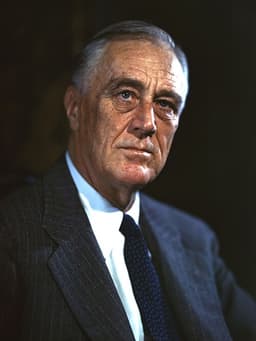
Franklin D. Roosevelt
Politician · Modern
71.0Total
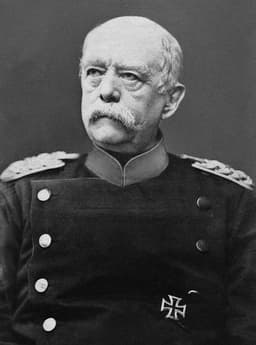
Otto von Bismarck
Politician · Modern
65.8Total
Basic Information
Born
1882
1815
Died
1945
1898
Era
Modern
Modern
Nationality
United States
Germany
Occupation
Politician
Politician
Civilization
Western
Western
Score Comparison
Military (10%)
45.0
55.0
Political (20%)
85.0
85.0
Influence (20%)
75.0
82.0
Legacy (20%)
65.0
40.0
Leadership (15%)
85.0
80.0
Strategy (15%)
60.0
50.0
TOTAL
71.0
65.8
Franklin D. Roosevelt — Complete Timeline
1933 AD
Inaugurated as 32nd PresidentOther◆ Major
Franklin D. Roosevelt was inaugurated as President of the United States on March 4, 1933, during the Great Depression. His inaugural address declared 'the only thing we have to fear is fear itself,' and he immediately called Congress into special session to address the banking crisis.
Great DepressionPresidencyInauguration
Impact: national
Enacted the New DealOther◆ Major
Roosevelt launched the New Deal in 1933, a series of federal programs including the Civilian Conservation Corps, the Agricultural Adjustment Act, and the Tennessee Valley Authority. These measures aimed to provide relief, recovery, and reform during the Great Depression, fundamentally expanding the role of the federal government.
Great DepressionEconomic PolicySocial Reform
Impact: nationalconstructive
1935 AD
Signed the Social Security ActOther◆ Major
Roosevelt signed the Social Security Act into law on August 14, 1935, establishing a federal system of old-age pensions, unemployment insurance, and aid for dependent children. This created the modern American welfare state and provided a safety net for millions of citizens.
Social WelfareLegislationNew Deal
Impact: nationalconstructive
1941 AD
Lend-Lease ActOther◆ Major
Roosevelt signed the Lend-Lease Act on March 11, 1941, authorizing the transfer of military equipment and supplies to Allied nations, particularly Britain and the Soviet Union. This program provided critical material support to countries fighting the Axis powers before U.S. entry into World War II.
World War IIForeign PolicyMilitary Aid
Impact: globalconstructive
Declaration of War on JapanPolitical Action◆ Major
Following the Japanese attack on Pearl Harbor on December 7, 1941, Roosevelt delivered his 'Day of Infamy' speech to Congress the next day, requesting a declaration of war. Congress approved the declaration, bringing the United States into World War II.
World War IIPearl HarborDeclaration of War
Impact: globaldestructive
1942 AD
Executive Order 9066Other◆ Major
Roosevelt signed Executive Order 9066 on February 19, 1942, authorizing the forced relocation and internment of Japanese Americans living on the West Coast. Over 110,000 people, mostly U.S. citizens, were incarcerated in camps for the duration of the war, a decision later widely condemned as a violation of civil rights.
World War IICivil RightsInternment
Impact: nationaldestructive
1944 AD
Elected to Fourth TermOther◆ Major
Roosevelt was elected to an unprecedented fourth term as president in November 1944, defeating Republican Thomas E. Dewey. This election occurred during the final stages of World War II, and Roosevelt's continued leadership ensured stability in the war effort and post-war planning.
PresidencyElectionWorld War II
Impact: national
1945 AD
Yalta ConferenceOther◆ Major
Roosevelt met with Winston Churchill and Joseph Stalin at the Yalta Conference in February 1945 to discuss post-war Europe. Agreements included the division of Germany, Soviet entry into the war against Japan, and the creation of the United Nations, shaping the post-war world order.
World War IIDiplomacyPost-War Planning
Impact: global
Otto von Bismarck — Complete Timeline
1870 AD
Franco-Prussian WarWar
Bismarck provoked France into declaring war by editing the Ems Dispatch to appear insulting. The resulting conflict saw Prussia and its allies decisively defeat France, leading to the fall of Napoleon III, the capture of Paris, and the annexation of Alsace-Lorraine.
WarProvocationAnnexation
Impact: globaldestructive
1871 AD
Unification of Germany ProclaimedPolitical Action
Following the Franco-Prussian War, Bismarck orchestrated the proclamation of the German Empire in the Hall of Mirrors at Versailles. King Wilhelm I of Prussia was declared German Emperor, uniting the German states under Prussian leadership and establishing the Second Reich.
UnificationGerman EmpireNationalism
Impact: globalconstructive
1878 AD
Enactment of the Anti-Socialist LawsPolitical Action◆ Major
After two assassination attempts on Kaiser Wilhelm I, Bismarck pushed through laws banning socialist organizations, publications, and meetings. The laws remained in force until 1890, suppressing the Social Democratic Party while Bismarck simultaneously introduced welfare reforms to undercut its appeal.
RepressionSocialismWelfare State
Impact: nationaldestructive
Congress of BerlinPolitical Action◆ Major
Bismarck hosted the Congress of Berlin to revise the Treaty of San Stefano and resolve the Eastern Crisis. He acted as 'honest broker,' reducing Russian gains, granting independence to Romania, Serbia, and Montenegro, and placing Bosnia-Herzegovina under Austro-Hungarian administration.
DiplomacyBalkansBalance of Power
Impact: global
1883 AD
Establishment of the Welfare StateReform◆ Major
Bismarck introduced the Health Insurance Bill (1883), Accident Insurance Bill (1884), and Old Age and Disability Insurance Bill (1889). These laws created the first modern welfare state, providing workers with social security and aiming to reduce support for socialist movements.
Social ReformWelfareInsurance
Impact: globalprogressive
1890 AD
Dismissal as ChancellorPolitical Action◆ Major
Emperor Wilhelm II forced Bismarck to resign due to policy disagreements, particularly over anti-socialist laws and foreign policy. Bismarck's departure marked the end of an era, leading to a more aggressive German foreign policy and the eventual unraveling of his alliance system.
ResignationWilhelm IIPolicy Shift
Impact: global
Expert Analysis
Otto von Bismarck vs Franklin D. Roosevelt
### The Architect and the Navigator: How Bismarck Forged a Nation and Roosevelt Saved One
On a January morning in 1933, as Franklin D. Roosevelt prepared to take the oath of office, the United States was a nation in freefall—one in four workers jobless, banks shuttered, and the American dream reduced to a breadline. Sixty-two years earlier, in the gilded Hall of Mirrors at Versailles, Otto von Bismarck had watched a different kind of birth: the proclamation of a unified German Empire, forged in blood and iron, with himself as its master builder. Two men, two crises, two radically different visions of how to wield power. Why did one choose to build a fortress of steel and law, while the other chose to throw open the doors of government to the desperate? The answer lies not just in their eras, but in the marrow of their characters.
### Origins
Bismarck was born in 1815, a child of the Prussian Junker aristocracy, a class that saw land, duty, and the sword as the natural order of things. His father was a country squire; his mother came from a family of intellectuals. This tension—between the blunt conservatism of the estate and the sharp, calculating mind of a scholar—shaped him. He entered politics not as a democrat but as a royalist, a man who believed that history was made by the iron will of statesmen, not the messy will of the people. He learned early that the world was a chessboard of interests, and that sentiment was a weapon to be used, not a guide to be followed.
Roosevelt, born in 1882, was the product of a different aristocracy: the landed gentry of New York’s Hudson Valley. His world was one of privilege, but also of noblesse oblige. He was educated at Groton, Harvard, and Columbia Law, but his real education came from a crucible far more personal than any battlefield: polio. Stricken in 1921 at age 39, he spent years learning to walk again, his legs locked in steel braces. The disease burned away the patrician arrogance and left behind something rarer—a profound empathy for suffering, and a relentless, almost cheerful determination. Where Bismarck saw a world to be mastered, Roosevelt saw a world to be healed.
### Rise to Power
Bismarck’s path was a masterclass in opportunism. He rose not by popular acclaim but by royal favor, appointed Minister President of Prussia in 1862 when the parliament refused to fund a military reform. He dismissed the legislature, governed by decree, and famously told a budget committee, “The great questions of the day will not be decided by speeches and majority decisions… but by blood and iron.” He then engineered three short, decisive wars—against Denmark, Austria, and France—each one a surgical strike that expanded Prussian power and forced the smaller German states to kneel before the Hohenzollern crown. The Franco-Prussian War of 1870 was his masterpiece: he provoked France by editing the Ems Dispatch to appear insulting, knowing Napoleon III’s pride would do the rest.
Roosevelt’s rise was a study in resilience. He was elected governor of New York in 1928, then swept into the presidency in 1932 on a wave of despair and hope. His path was democratic, not dynastic. He didn’t need to provoke a war; he needed to end a depression. Where Bismarck manipulated kings, Roosevelt had to persuade a nation. His famous fireside chats—calm, intimate radio addresses—were the opposite of Bismarck’s strategy of intimidation. He spoke to the American people as equals, not subjects.
### Leadership & Governance
Their styles of governance were as different as their origins. Bismarck ruled through division and consolidation. He saw the new German Empire as a fragile mosaic of rival states and classes, and his genius was to buy loyalty through policy. He enacted the world’s first modern welfare state—health insurance in 1883, accident insurance in 1884, old-age pensions in 1889—not out of compassion, but to undercut the appeal of socialism. “The state must take care of its needy citizens,” he said, “if it is to expect them to defend its existence.” Simultaneously, he passed the Anti-Socialist Laws in 1878, banning socialist parties while stealing their ideas. He was a conservative revolutionary, a man who built a fortress with one hand and threw bread to the mob with the other.
Roosevelt, by contrast, governed through expansion and inclusion. The New Deal was not a strategy to crush opposition but to absorb it. He created the Social Security system, the Works Progress Administration, and the Tennessee Valley Authority—permanent institutions that bound the American people to their government. Where Bismarck saw the state as a tool of elite control, Roosevelt saw it as a vehicle for collective security. His leadership during World War II was similarly expansive: he forged the Grand Alliance with Britain and the Soviet Union, understanding that victory required not just military might but a shared vision of a post-war world. He was a democrat who believed that the best way to defeat tyranny was to prove that democracy could deliver.
### Triumph & Tragedy
Bismarck’s greatest triumph was the unification of Germany itself—a feat that reshaped Europe. His greatest tragedy was that he built a machine he could not control. In 1890, the young, impulsive Kaiser Wilhelm II forced him to resign, and Bismarck’s intricate system of alliances and domestic balances was dismantled within a generation. The “Iron Chancellor” ended his days writing bitter memoirs, watching his creation march toward catastrophe.
Roosevelt’s triumph was dual: he saved capitalism from itself during the Great Depression, and he led the United States to victory in World War II. His tragedy was that he did not live to see the peace. He died of a cerebral hemorrhage on April 12, 1945, just weeks before Germany’s surrender. His final act was to shape the United Nations, a fragile vessel for the hope that nations could learn to cooperate.
### Character & Destiny
Bismarck’s character was cynical, strategic, and deeply pessimistic. He believed that human nature was base and that only force and cunning could impose order. This worldview made him an unparalleled tactician but a flawed architect—he built a state that depended on his own genius to survive. Roosevelt’s character was optimistic, pragmatic, and deeply human. His polio taught him that setbacks could be overcome, that suffering did not have to be permanent. This worldview made him a flawed strategist—his New Deal did not fully end the Depression, and his wartime decisions were sometimes muddled—but a supreme leader in a crisis of morale.
### Legacy
Bismarck’s legacy is a paradox: the father of the welfare state and the father of German militarism. He left behind a united Germany, but also a political culture that prized obedience over liberty. His scores—Political 88, Influence 80, Leadership 82—reflect a man who changed the world through sheer will, but whose methods sowed the seeds of two world wars.
Roosevelt’s legacy is more straightforward: he redefined the relationship between the American people and their government. He left behind Social Security, the GI Bill, and the expectation that the state would protect its citizens in times of crisis. His scores—Political 85, Leadership 85, Legacy 75—reflect a man who changed the world through persuasion and compassion, but whose reforms were incomplete and sometimes contradictory.
### Conclusion
In the end, the difference between Bismarck and Roosevelt is the difference between a fortress and a lighthouse. Bismarck built walls to keep the world out; Roosevelt built beacons to guide the world in. One believed that power was the ultimate currency; the other believed that trust was. Both were realists, but their realism pointed in opposite directions. Bismarck’s Germany was a masterpiece of control; Roosevelt’s America was a work in progress, messy and unfinished. Perhaps the deepest lesson is this: the leaders who build the most enduring structures are not those who command the most fear, but those who inspire the most hope. Bismarck unified a nation; Roosevelt unified a people. And in the long arc of history, the latter proves the harder task.
Rankings
🥇
Franklin D. RooseveltLeader
Mil: 45.0Pol: 85.0Inf: 75.0
71.0
🥈
Otto von Bismarck
Mil: 55.0Pol: 85.0Inf: 82.0
65.8
+5.2 behind
How This Comparison Works
Algorithm
Each figure is scored on 6 dimensions (0—100 scale) based on structured historical data: Military (10%), Political (20%), Influence (20%), Legacy (20%), Leadership (15%), Strategy (15%). The weighted total produces the final ranking.
Data Sources
Scores are computed from structured sub-indicators in the database. Scale factors adjust for era (Ancient ×0.85, Modern ×1.0) and civilization size (Eastern ×1.05, Other ×0.80) to account for differences in population and military scale.
Maximum 3 Figures
Comparisons are limited to 2—3 figures to ensure readability and statistical meaningfulness.
Error Margins
±5 points per dimension — Sub-scores are derived from historical records with inherent uncertainty. Two figures within 5 points on a dimension should be considered roughly equivalent in that area.
Total Score Accuracy
±3 points overall — The weighted combination of 6 dimensions produces a total score with approximately ±3 points of uncertainty. Differences of less than 3 points are not statistically significant— the figures are effectively tied.
Known Limitations
- Historical records are incomplete and uneven across civilizations
- Figures from oral-tradition societies may be underrepresented
- Occupation labels can misclassify multi-role figures
- Scores measure capability and impact, not moral character
- Quantitative scoring is a comparison tool, not absolute truth
Capability Radar
Military (10%) — Battles & Warfare
Battles
10
60
Win Rate
10
70
Expansion
10
80
Political (20%) — Governance & Reform
Reform
95
90
Diplomacy
90
95
Economy
95
80
Influence (20%) — Cultural & Global Reach
Cultural
80
65
Global
90
75
Legacy (20%) — Historical Impact
Historical
90
85
Longevity
85
70
Leadership (15%) — Power & Stability
Tenure
90
85
Stability
75
70
Strategy (15%) — Tactics & Innovation
Strategy
65
85
Tactics
10
55
Reform
70
75
Similar Comparisons
Comments & Discussion
No comments yet. Be the first to share your thoughts!