Loading...
Otto von Bismarck vs Suleiman the Magnificent
Suleiman the Magnificent leads by 7.4 pts · 2 figures compared
…
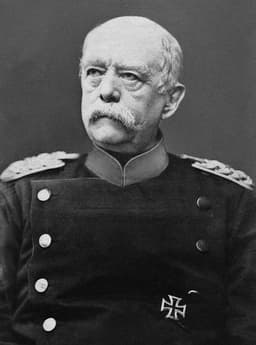
Otto von Bismarck
Politician · Modern
65.8Total
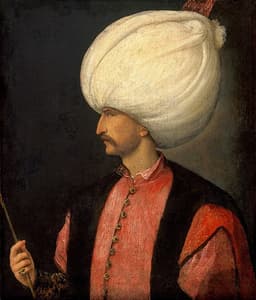
Suleiman the Magnificent
Emperor · Medieval
73.2Total
Basic Information
Born
1815
1494
Died
1898
1566
Era
Modern
Medieval
Nationality
Germany
Ottoman Empire
Occupation
Politician
Emperor
Civilization
Western
Middle Eastern
Score Comparison
Military (10%)
55.0
85.0
Political (20%)
85.0
78.0
Influence (20%)
82.0
72.0
Legacy (20%)
40.0
68.0
Leadership (15%)
80.0
72.0
Strategy (15%)
50.0
72.0
TOTAL
65.8
73.2
Otto von Bismarck — Complete Timeline
1870 AD
Franco-Prussian WarWar
Bismarck provoked France into declaring war by editing the Ems Dispatch to appear insulting. The resulting conflict saw Prussia and its allies decisively defeat France, leading to the fall of Napoleon III, the capture of Paris, and the annexation of Alsace-Lorraine.
WarProvocationAnnexation
Impact: globaldestructive
1871 AD
Unification of Germany ProclaimedPolitical Action
Following the Franco-Prussian War, Bismarck orchestrated the proclamation of the German Empire in the Hall of Mirrors at Versailles. King Wilhelm I of Prussia was declared German Emperor, uniting the German states under Prussian leadership and establishing the Second Reich.
UnificationGerman EmpireNationalism
Impact: globalconstructive
1878 AD
Enactment of the Anti-Socialist LawsPolitical Action◆ Major
After two assassination attempts on Kaiser Wilhelm I, Bismarck pushed through laws banning socialist organizations, publications, and meetings. The laws remained in force until 1890, suppressing the Social Democratic Party while Bismarck simultaneously introduced welfare reforms to undercut its appeal.
RepressionSocialismWelfare State
Impact: nationaldestructive
Congress of BerlinPolitical Action◆ Major
Bismarck hosted the Congress of Berlin to revise the Treaty of San Stefano and resolve the Eastern Crisis. He acted as 'honest broker,' reducing Russian gains, granting independence to Romania, Serbia, and Montenegro, and placing Bosnia-Herzegovina under Austro-Hungarian administration.
DiplomacyBalkansBalance of Power
Impact: global
1883 AD
Establishment of the Welfare StateReform◆ Major
Bismarck introduced the Health Insurance Bill (1883), Accident Insurance Bill (1884), and Old Age and Disability Insurance Bill (1889). These laws created the first modern welfare state, providing workers with social security and aiming to reduce support for socialist movements.
Social ReformWelfareInsurance
Impact: globalprogressive
1890 AD
Dismissal as ChancellorPolitical Action◆ Major
Emperor Wilhelm II forced Bismarck to resign due to policy disagreements, particularly over anti-socialist laws and foreign policy. Bismarck's departure marked the end of an era, leading to a more aggressive German foreign policy and the eventual unraveling of his alliance system.
ResignationWilhelm IIPolicy Shift
Impact: global
Suleiman the Magnificent — Complete Timeline
1522 AD
Siege of RhodesWar◆ Major
Suleiman personally led a massive Ottoman campaign against the Knights Hospitaller on Rhodes. After a six-month siege, the knights surrendered and were allowed to leave. This victory secured Ottoman control over the eastern Mediterranean.
SiegeMediterraneanKnights Hospitaller
Impact: regional
1526 AD
Battle of MohácsWar
Suleiman's Ottoman army defeated the Hungarian forces of King Louis II at Moh
BattleHungaryOttoman expansion
Impact: regional
1529 AD
Siege of ViennaWar◆ Major
Suleiman besieged Vienna, the Habsburg capital, with a large army. The siege failed due to supply issues, disease, and strong defenses. This defeat halted Ottoman expansion into central Europe and marked the empire's furthest advance westward.
SiegeViennaDefeat
Impact: regional
1530 AD
Codification of Ottoman lawReform◆ Major
Suleiman oversaw the compilation and standardization of Ottoman legal codes, known as Kanun. These laws regulated criminal justice, land tenure, and taxation, creating a unified legal system that balanced sharia with secular law. He earned the title 'Kanuni' (the Lawgiver).
Legal reformKanunOttoman Empire
Impact: nationalconstructive
1536 AD
Execution of Ibrahim PashaPolitical Action◆ Major
Suleiman ordered the execution of his grand vizier and close friend Ibrahim Pasha, who had served for 13 years. The reasons remain debated, but likely involved Ibrahim's growing power and conflicts with Suleiman's wife, Hurrem Sultan. This event demonstrated the absolute power of the sultan.
ExecutionCourt politicsPower
Impact: nationaltragic
Expert Analysis
Suleiman the Magnificent vs Otto von Bismarck
# The Architect and the Emperor: Bismarck and Suleiman Compared
On a winter morning in 1890, Otto von Bismarck, the Iron Chancellor who had forged a unified German Empire from the blood of three wars, stood in the study of his Friedrichsruh estate, staring at a portrait of Kaiser Wilhelm I. His successor, the young and impetuous Wilhelm II, had just demanded his resignation. Across centuries and continents, another ruler faced a different kind of solitude: Suleiman the Magnificent, in 1566, lay dying in his tent outside the fortress of Szigetvár, his body worn from a lifetime of campaigns, his empire at its zenith. One was a statesman who built a nation through political cunning; the other, a sultan who ruled a sprawling empire through military might and legal reform. What forces shaped these two titans, and why did their paths diverge so dramatically?
Origins
Otto von Bismarck was born in 1815, the year Napoleon was finally defeated, into the Junker aristocracy of Prussia. His upbringing on the family estate of Schönhausen instilled in him a deep attachment to the land and a conservative skepticism of liberal ideals. He studied law at Göttingen and Berlin, but his true education came from observing the chaos of the 1848 revolutions, which convinced him that power, not parliament, was the engine of history. Suleiman, born in 1494, was the son of Sultan Selim I, a conqueror who doubled the Ottoman Empire’s size. Raised in the Topkapi Palace, Suleiman was groomed for rule from childhood, trained in the arts of war, administration, and Islamic jurisprudence. Where Bismarck’s world was fragmented and competitive—a patchwork of German states jostling for supremacy—Suleiman inherited a unified empire with centuries of tradition, where the sultan was both caliph and lawgiver.
Rise to Power
Bismarck’s ascent was slow and tactical. He entered politics in 1847 as a reactionary delegate, then served as ambassador to Russia and France, where he honed his ability to read adversaries. In 1862, at age 47, he was appointed Minister President of Prussia during a constitutional crisis. His famous declaration to the Prussian parliament—“The great questions of the day will not be settled by speeches and majority decisions… but by blood and iron”—was a warning to liberals that he would rule by force if necessary. Suleiman’s rise was seamless: he became sultan in 1520 at age 26, upon his father’s death, without opposition. The Ottoman system of succession was brutal—Selim had killed his own brothers—but once enthroned, Suleiman faced no internal rivals. His first act was to launch a campaign against Belgrade, signaling that his reign would be one of expansion.
Leadership & Governance
Bismarck governed through manipulation and pragmatism. He engineered the Franco-Prussian War in 1870 by editing the Ems Dispatch to provoke France into declaring war, a masterstroke of political theater. After victory, he proclaimed the German Empire in the Hall of Mirrors at Versailles in 1871, humiliating France and cementing his power. Domestically, he was a paradox: he crushed socialists with the Anti-Socialist Laws of 1878, yet pioneered the welfare state—health insurance in 1883, accident insurance in 1884, old-age pensions—to undercut their appeal. His strategy was to preserve the monarchy by stealing the left’s thunder.
Suleiman ruled as a sultan-caliph, combining military command with legal reform. He codified Ottoman law into the *Kanun* in the 1530s, standardizing criminal, land, and tax codes across a diverse empire. His campaigns were relentless: the Siege of Rhodes in 1522 expelled the Knights Hospitaller, the Battle of Mohács in 1526 shattered Hungary, and he pushed to the gates of Vienna in 1529. Yet the Vienna siege failed due to supply shortages and disease, revealing the limits of Ottoman logistics. Suleiman was also a patron of the architect Sinan, who built the Süleymaniye Mosque, a testament to the fusion of power and art.
Triumph & Tragedy
Bismarck’s triumph was unification itself: he transformed Prussia from a middling power into the heart of a European empire. His tragedy was his dismissal in 1890 by Wilhelm II, who resented his dominance and dismantled his careful diplomatic system, setting Europe on a path to war. Suleiman’s greatest moment was the conquest of Rhodes, a fortress thought impregnable. His deepest tragedy was personal: he executed his closest friend and grand vizier, Ibrahim Pasha, in 1536, likely due to palace intrigue and the influence of his wife, Roxelana. The act haunted his later years, a reminder that even a sultan’s power could not secure loyalty.
Character & Destiny
Bismarck was cynical, calculating, and fiercely independent. He once said, “Politics is the art of the possible,” and he lived that creed—never overreaching, always waiting for the opponent’s mistake. His personality shaped a Germany that was strong but brittle, built on his own genius rather than institutions. Suleiman was more enigmatic: a warrior, a lawgiver, and a poet who wrote under the pen name “Muhibbi” (the Lover). His destiny was to embody the Ottoman golden age, but his reliance on a single vizier and the harem’s influence sowed seeds of decay. Where Bismarck’s downfall came from a clash with a new emperor, Suleiman’s empire declined after his death because it depended on his personal authority.
Legacy
Bismarck left a unified Germany and a welfare state that influenced the modern world, but his legacy is ambiguous: he is revered as a nation-builder and reviled as a militarist who paved the way for Hitler. His political score of 88.0 reflects his mastery, but his military score of 55.0 shows he avoided war when possible. Suleiman is remembered as the Magnificent in the West and the Lawgiver in the East. His codification of law and architectural patronage endure, but the Battle of Lepanto in 1571, though after his death, exposed the naval weakness he had neglected. His total score of 75.1 slightly edges Bismarck’s 74.0, but the comparison is misleading: Suleiman inherited an empire; Bismarck built one.
Conclusion
Two men, two worlds. Bismarck, the Junker who unified Germany through deception and iron will, and Suleiman, the sultan who expanded an empire through conquest and law. One was a politician in an age of nationalism; the other, a monarch in an age of faith. Their differences stem from their eras: Bismarck’s Europe was a chessboard of competing states, Suleiman’s Mediterranean a stage for imperial glory. Yet both grappled with the same human dilemmas: how to wield power, how to secure loyalty, and how to leave a mark that outlasts death. In the end, Bismarck’s Germany crumbled within a century, while Suleiman’s Ottoman Empire survived for four more centuries. Perhaps the architect’s creation was more fragile because it was built on his own genius; the emperor’s, because it was built on a tradition that could outlive any single ruler.
Rankings
🥇
Suleiman the MagnificentLeader
Mil: 85.0Pol: 78.0Inf: 72.0
73.2
🥈
Otto von Bismarck
Mil: 55.0Pol: 85.0Inf: 82.0
65.8
+7.4 behind
How This Comparison Works
Algorithm
Each figure is scored on 6 dimensions (0—100 scale) based on structured historical data: Military (10%), Political (20%), Influence (20%), Legacy (20%), Leadership (15%), Strategy (15%). The weighted total produces the final ranking.
Data Sources
Scores are computed from structured sub-indicators in the database. Scale factors adjust for era (Ancient ×0.85, Modern ×1.0) and civilization size (Eastern ×1.05, Other ×0.80) to account for differences in population and military scale.
Maximum 3 Figures
Comparisons are limited to 2—3 figures to ensure readability and statistical meaningfulness.
Error Margins
±5 points per dimension — Sub-scores are derived from historical records with inherent uncertainty. Two figures within 5 points on a dimension should be considered roughly equivalent in that area.
Total Score Accuracy
±3 points overall — The weighted combination of 6 dimensions produces a total score with approximately ±3 points of uncertainty. Differences of less than 3 points are not statistically significant— the figures are effectively tied.
Known Limitations
- Historical records are incomplete and uneven across civilizations
- Figures from oral-tradition societies may be underrepresented
- Occupation labels can misclassify multi-role figures
- Scores measure capability and impact, not moral character
- Quantitative scoring is a comparison tool, not absolute truth
Capability Radar
Military (10%) — Battles & Warfare
Battles
60
95
Win Rate
70
90
Expansion
80
95
Political (20%) — Governance & Reform
Reform
90
90
Diplomacy
95
88
Economy
80
85
Influence (20%) — Cultural & Global Reach
Cultural
65
90
Global
75
88
Legacy (20%) — Historical Impact
Historical
85
92
Longevity
70
85
Leadership (15%) — Power & Stability
Tenure
85
95
Stability
70
85
Strategy (15%) — Tactics & Innovation
Strategy
85
92
Tactics
55
85
Reform
75
80
Similar Comparisons
Comments & Discussion
No comments yet. Be the first to share your thoughts!