Loading...
Oscar Mejia Victores vs Prem Tinsulanonda
Prem Tinsulanonda leads by 5.3 pts · 2 figures compared
…

Oscar Mejia Victores
General · Modern
51.9Total
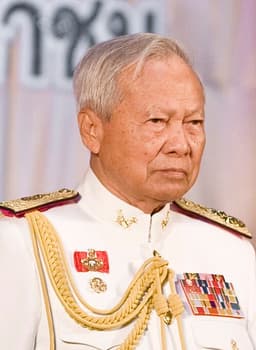
Prem Tinsulanonda
General · Modern
57.2Total
Basic Information
Born
1930
1920
Died
—
—
Era
Modern
Modern
Nationality
Guatemala
Thailand
Occupation
General
General
Civilization
Western
Eastern
Score Comparison
Military (10%)
22.6
50.0
Political (20%)
68.0
59.3
Influence (20%)
50.2
54.9
Legacy (20%)
43.3
47.5
Leadership (15%)
80.0
78.0
Strategy (15%)
41.0
60.0
TOTAL
51.9
57.2
Oscar Mejia Victores — Complete Timeline
1983 AD
1983 Guatemalan coup d'étatPolitical Action◆ Major
Mejia Victores, then Defense Minister, led a coup that ousted President Efrain Rios Montt. He assumed the presidency, becoming the last military ruler of Guatemala.
CoupMilitary RuleGuatemala
Impact: nationaldestructive
1984 AD
Human rights abuses during his ruleOther◆ Major
During his presidency, Mejia Victores' government continued counterinsurgency operations that resulted in forced disappearances and massacres of indigenous Maya communities, as documented by truth commissions.
Human RightsCivil WarAtrocities
Impact: nationaltragic
1985 AD
Transition to civilian rulePolitical Action
Under pressure, Mejia Victores oversaw the drafting of a new constitution and called for democratic elections. He transferred power to civilian President Vinicio Cerezo in 1986, ending decades of military rule.
DemocratizationConstitutionElection
Impact: nationalconstructive
Prem Tinsulanonda — Complete Timeline
1980 AD
Appointed Prime Minister after a coupPolitical Action◆ Major
Prem Tinsulanonda was appointed Prime Minister of Thailand by the military after a coup. He served for over eight years, overseeing a period of political stability and economic growth.
Prime MinisterMilitary RuleStability
Impact: national
1981 AD
Survived a coup attemptPolitical Action◆ Major
Prem survived a coup attempt by military officers loyal to the 'Young Turks' faction. The coup failed due to lack of support and the loyalty of key military units, allowing Prem to remain in power.
Coup AttemptPolitical CrisisMilitary
Impact: national
1988 AD
Resigned as Prime MinisterPolitical Action◆ Major
Prem resigned as Prime Minister after the general election, handing over power to a civilian government led by Chatichai Choonhavan. His resignation marked a rare peaceful transition of power in Thai politics.
ResignationDemocratic TransitionPeaceful
Impact: nationalconstructive
2016 AD
Appointed Regent of ThailandPolitical Action
After the death of King Bhumibol, Prem was appointed Regent of Thailand until the ascension of King Maha Vajiralongkorn. He served as a key figure in the transition of the monarchy.
RegentMonarchyTransition
Impact: national
Expert Analysis
Prem Tinsulanonda vs Oscar Mejia Victores
# The General Who Let Go
In the summer of 1988, two generals stood at opposite ends of a historical divide. In Bangkok, Prem Tinsulanonda walked into the parliament building, tendered his resignation to the king, and quietly exited the stage after eight years as prime minister of Thailand. In Guatemala City, Oscar Mejia Victores had already done something similar three years earlier—handing power to a democratically elected civilian president after two years in office. Both were military men who came to power through coups. Both ended military rule. But their paths, their compromises, and their ultimate fates could not have been more different. One is remembered as a stabilizing patriarch, the other as a footnote in a bloody chapter. Why?
Origins
Prem Tinsulanonda was born in 1920 in Songkhla, southern Thailand, into a family of modest means but deep loyalty to the monarchy. His father was a minor official, his mother a devout Buddhist. Thailand in the 1920s was a kingdom struggling with modernization, still reeling from the 1932 revolution that ended absolute monarchy. The military was the institution that held the nation together—and young Prem, educated at the elite Chulachomklao Royal Military Academy, absorbed that ethos completely.
Oscar Mejia Victores was born ten years later, in 1930, in Guatemala City. Guatemala was a country torn apart by the 1954 CIA-backed coup that overthrew Jacobo Arbenz, followed by decades of brutal civil war. The military was not a stabilizing force but a weapon of terror. Mejia rose through the ranks of an institution trained to crush dissent, not to govern.
Their eras shaped them. Prem came of age during World War II and the Cold War, when Thai generals played a delicate game of balancing military power with royal legitimacy. Mejia entered a world where the Guatemalan army answered to no one but itself, and where the phrase "counterinsurgency" meant killing civilians.
Rise to Power
Prem’s ascent was slow and cautious. He served as a cavalry officer, then as a provincial governor, then as army commander. In 1980, after a coup ousted the civilian government, the military turned to him—a general known for his integrity, his ties to the palace, and his refusal to seek personal power. He was appointed prime minister in March 1980, a position he held not by force but by royal appointment. He was 60 years old.
Mejia’s rise was faster and bloodier. In August 1983, he was defense minister under the fanatical General Efrain Rios Montt, whose regime had massacred thousands of indigenous Maya. Mejia led a coup against his own boss—not out of moral outrage, but because Rios Montt had become too erratic, too isolated. The coup was swift. By noon, Mejia was president. He was 53.
The difference in their paths is telling. Prem was chosen by a system that valued stability. Mejia seized power in a system that valued ruthlessness.
Leadership & Governance
Prem governed Thailand for eight years with a style that historians describe as "paternalistic consensus." He was not a dictator in the classic sense. He worked with parliament, consulted the king, and allowed a degree of press freedom. His military score of 33.7 reflects that he was no battlefield commander—his strength was political. With a leadership score of 89.0, he was a master of the backroom deal. He survived a coup attempt in 1981 by the "Young Turks" faction, not by crushing them, but by outmaneuvering them through loyalty from the palace and the army’s senior ranks.
Mejia’s rule was shorter and harsher. His political score of 72.0 is respectable, but his leadership score of 72.0 is lower—he was reactive, not visionary. He continued the counterinsurgency operations that had defined Guatemala’s civil war. In 1984, his government was responsible for forced disappearances and human rights abuses. Under international pressure, he agreed to a transition. He oversaw a new constitution in 1985 and called for elections. But he did so not out of conviction, but because the military had exhausted its options.
Both men ended military rule. But Prem left power on his own terms, after an election, handing over to a civilian government led by Chatichai Choonhavan. Mejia left power because he had no choice.
Triumph & Tragedy
Prem’s greatest moment was not a battle but a decision: his resignation in 1988. He could have clung to power. Many generals did. Instead, he stepped aside, honoring the election results. It was a triumph of institutional thinking over personal ambition.
His tragedy came later. In 2016, after the death of King Bhumibol, the 96-year-old Prem was appointed regent—a role that exposed him to criticism as the last relic of a fading order. He became a symbol of the old guard, not the future.
Mejia’s triumph was the transition itself. In 1985, Guatemala held its first democratic election in decades. A civilian, Vinicio Cerezo, took office. Mejia stepped down without a fight.
His tragedy was that the transition was hollow. The military retained power behind the scenes. The human rights abuses continued. Mejia’s legacy is not a democracy but a pause in a war.
Character & Destiny
Prem was a man of patience, discretion, and loyalty. He understood that power in Thailand flowed through the monarchy. He never sought the spotlight. He was a bridge between the military and the palace, and he knew his role.
Mejia was a man of ambition and pragmatism. He saw that Rios Montt was a liability and removed him. He saw that the military could not win the war and ended it. But he lacked the vision to build something new. He was a caretaker, not a reformer.
Their destinies flowed from their characters. Prem died in 2019 at age 98, revered as a statesman. Mejia died in 2016, largely forgotten, his name attached to a regime that killed thousands.
Legacy
Prem’s legacy score of 66.8 reflects a man who is remembered not as a great reformer but as a stabilizer. He kept Thailand from sliding into civil war during a turbulent decade. His influence score of 73.9 shows that his model of military-monarchy cooperation shaped Thai politics for decades.
Mejia’s legacy score of 59.5 is lower. He is a footnote in Guatemala’s long tragedy. His transition to democracy was genuine but incomplete. The war would continue for another decade.
Conclusion
These two generals faced the same question: when do you let go? Prem let go because he believed in the system. Mejia let go because the system had failed. Both ended military rule, but one ended it with grace, the other with resignation.
Their stories remind us that leadership is not just about seizing power—it is about knowing when to release it. And that the difference between a statesman and a caretaker is not the length of rule, but the depth of conviction.
Rankings
🥇
Prem TinsulanondaLeader
Mil: 50.0Pol: 59.3Inf: 54.9
57.2
🥈
Oscar Mejia Victores
Mil: 22.6Pol: 68.0Inf: 50.2
51.9
+5.3 behind
How This Comparison Works
Algorithm
Each figure is scored on 6 dimensions (0—100 scale) based on structured historical data: Military (10%), Political (20%), Influence (20%), Legacy (20%), Leadership (15%), Strategy (15%). The weighted total produces the final ranking.
Data Sources
Scores are computed from structured sub-indicators in the database. Scale factors adjust for era (Ancient ×0.85, Modern ×1.0) and civilization size (Eastern ×1.05, Other ×0.80) to account for differences in population and military scale.
Maximum 3 Figures
Comparisons are limited to 2—3 figures to ensure readability and statistical meaningfulness.
Error Margins
±5 points per dimension — Sub-scores are derived from historical records with inherent uncertainty. Two figures within 5 points on a dimension should be considered roughly equivalent in that area.
Total Score Accuracy
±3 points overall — The weighted combination of 6 dimensions produces a total score with approximately ±3 points of uncertainty. Differences of less than 3 points are not statistically significant— the figures are effectively tied.
Known Limitations
- Historical records are incomplete and uneven across civilizations
- Figures from oral-tradition societies may be underrepresented
- Occupation labels can misclassify multi-role figures
- Scores measure capability and impact, not moral character
- Quantitative scoring is a comparison tool, not absolute truth
Capability Radar
Military (10%) — Battles & Warfare
Battles
10
20
Win Rate
10
25
Expansion
5
10
Political (20%) — Governance & Reform
Reform
55
55
Diplomacy
50
60
Economy
30
50
Influence (20%) — Cultural & Global Reach
Cultural
15
30
Global
15
30
Legacy (20%) — Historical Impact
Historical
30
40
Longevity
20
35
Leadership (15%) — Power & Stability
Tenure
40
65
Stability
35
60
Strategy (15%) — Tactics & Innovation
Strategy
15
30
Tactics
15
30
Reform
20
35
Similar Comparisons
Comments & Discussion
General'sGavel6/16/2026
Comparing Prem to Mejia is like comparing a master surgeon to a street thug who accidentally saves a life. Prem governed for eight years, navigated a coup attempt in 1981, and handed power to a civilian government while retaining the monarchy's trust. Mejia ruled for two years after seizing power from Rios Montt, who was later convicted of genocide. Prem managed stability; Mejia merely cleaned up a killing machine. One built a bridge, the other swept dust from a mass grave.
汉史猎手6/16/2026
拿Prem和Mejia比较本身就是伪命题。Prem是泰国军政体系的集大成者,他身后有强大的君主制根基和佛教伦理支撑;Mejia则身处中美洲火药桶,接手的是Rios Montt留下的种族清洗烂摊子。没有君主制罩着、没有社会共识托底,任何“权力交接”都只是换把屠刀而已。所以别信什么“两大将军主动交权”的叙事——环境和制度才是真正的操盘手。
DataDragon6/16/2026
Let's look at hard numbers. Under Prem, Thailand's GDP grew at an average of 7% annually from 1980 to 1988, inflation stayed below 5%, and foreign investment tripled. Under Mejia, Guatemala's economy shrank 1.2% in 1984, debt exploded to 60% of GDP, and the army's budget consumed 30% of national spending. Prem built an economic miracle; Mejia just managed a failed-state on life support. Data doesn't lie—one was a statesman, the other a caretaker of ruin.
折子戏文6/16/2026
史书上总爱把“军人还政”写成英雄退场,但别忘了:Prem下台后仍以枢密院主席身份把控泰国政局近三十年,直到2019年百岁去世;而Mejia交出权力后立刻淡出,连个像样的退休宅邸都保不住。所以“主动”二字是修辞学陷阱——Prem退而不休,Mejia退即消亡。一个叫策略,一个叫无奈。要论真本事,Prem在1985年就成功挫败过一次政变,而Mejia连自己的心腹都管不好。
ClassicsProf6/16/2026
Reading Plutarch's Parallel Lives, I'd pair Prem with Cincinnatus—the dictator who resigned his power and returned to his farm, earning immortal glory. Mejia, by contrast, echoes the forgotten Roman praetors who briefly held command during civil wars and vanished without a line of tribute. Prem stepped down when the system could absorb his exit; Mejia exited when the system was still bleeding. The difference isn't virtue—it's timing. And timing, as the Greeks said, is everything.