Loading...
Muhammadu Buhari vs Oscar Mejia Victores
Oscar Mejia Victores leads by 0.4 pts · 2 figures compared
…
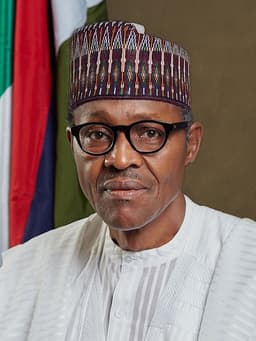
Muhammadu Buhari
General · Modern
51.5Total

Oscar Mejia Victores
General · Modern
51.9Total
Basic Information
Born
1942
1930
Died
—
—
Era
Modern
Modern
Nationality
Nigeria
Guatemala
Occupation
General
General
Civilization
Other
Western
Score Comparison
Military (10%)
22.6
22.6
Political (20%)
68.0
68.0
Influence (20%)
53.3
50.2
Legacy (20%)
43.3
43.3
Leadership (15%)
72.0
80.0
Strategy (15%)
41.0
41.0
TOTAL
51.5
51.9
Muhammadu Buhari — Complete Timeline
1983 AD
1983 Nigerian coup d'étatPolitical Action
Major General Muhammadu Buhari led a military coup that overthrew the civilian government of President Shehu Shagari. Buhari cited corruption and economic mismanagement as justifications, and he became the head of state.
CoupMilitary RuleCorruption
Impact: nationaldestructive
1984 AD
War Against Indiscipline (WAI)Reform◆ Major
Buhari launched the War Against Indiscipline, a campaign to enforce discipline and order in Nigerian society. It included harsh penalties for minor offenses, such as queue-jumping, and was criticized for human rights abuses.
DisciplineSocial PolicyHuman Rights
Impact: nationaldestructive
1985 AD
Overthrow by Ibrahim BabangidaPolitical Action◆ Major
Buhari was overthrown in a palace coup led by his Chief of Army Staff, Ibrahim Babangida. Babangida cited Buhari's authoritarian style and failure to address the economy as reasons for the coup.
CoupOverthrowBabangida
Impact: national
2015 AD
Anti-corruption campaignReform◆ Major
Buhari launched a high-profile anti-corruption campaign, targeting government officials and recovering stolen assets. The campaign was praised internationally but criticized for being selective and politically motivated.
Anti-CorruptionReformGovernance
Impact: nationalconstructive
Election as President of NigeriaPolitical Action
Buhari won the 2015 Nigerian presidential election, defeating incumbent Goodluck Jonathan. This was the first time an opposition candidate had defeated a sitting president in Nigeria's history, marking a democratic milestone.
ElectionDemocracyOpposition Victory
Impact: nationalprogressive
Oscar Mejia Victores — Complete Timeline
1983 AD
1983 Guatemalan coup d'étatPolitical Action◆ Major
Mejia Victores, then Defense Minister, led a coup that ousted President Efrain Rios Montt. He assumed the presidency, becoming the last military ruler of Guatemala.
CoupMilitary RuleGuatemala
Impact: nationaldestructive
1984 AD
Human rights abuses during his ruleOther◆ Major
During his presidency, Mejia Victores' government continued counterinsurgency operations that resulted in forced disappearances and massacres of indigenous Maya communities, as documented by truth commissions.
Human RightsCivil WarAtrocities
Impact: nationaltragic
1985 AD
Transition to civilian rulePolitical Action
Under pressure, Mejia Victores oversaw the drafting of a new constitution and called for democratic elections. He transferred power to civilian President Vinicio Cerezo in 1986, ending decades of military rule.
DemocratizationConstitutionElection
Impact: nationalconstructive
Expert Analysis
Muhammadu Buhari vs Oscar Mejia Victores
### The General’s Dilemma
In 1985, Muhammadu Buhari sat in a Nigerian prison cell, a general without a command, overthrown by his own army chief. Half a world away, in Guatemala City, Oscar Mejia Victores was drafting a new constitution, preparing to hand power to civilians he had once helped suppress. Both men seized control in the same year—1983—through coups d’état. Both were generals ruling volatile nations. Yet one ended in disgrace, the other in a peaceful transition. Why did their paths diverge so sharply? The answer lies not in their uniforms, but in the eras and ideas that shaped them.
### Origins
Muhammadu Buhari was born in 1942 in Daura, northern Nigeria, into a Fulani Muslim family steeped in tradition. He joined the Nigerian Army in 1962, a time when the military was seen as a modernizing force in a fractured post-colonial state. His formative years were marked by the Biafran War (1967–1970), where he commanded troops and absorbed a deep distrust of corruption and ethnic division. Buhari emerged as a disciplinarian, believing that order—imposed by force if necessary—was the only cure for Nigeria’s chaos.
Oscar Mejia Victores, born in 1930 in Guatemala City, grew up in a nation haunted by a 1954 CIA-backed coup that had overthrown a democratic government. He entered the military during a decades-long civil war, where the army was both a tool of state repression and a path to power. By the 1970s, Guatemala’s generals ruled with impunity, but the Cold War was ending, and international pressure for human rights was mounting. Mejia Victores was a product of this twilight—a soldier who saw that the old ways were failing.
### Rise to Power
Buhari’s rise was swift and surgical. On December 31, 1983, he led a bloodless coup that ousted President Shehu Shagari, whom he accused of economic mismanagement and rampant corruption. Nigeria was drowning in oil revenue debt, and Buhari promised a cleansing fire. His coup was popular; many Nigerians cheered the soldiers in the streets. But Buhari’s path to power was a dead end—he seized control without a broader political vision, only a mission to punish.
Mejia Victores’ rise was more calculated. On August 8, 1983, he overthrew General Efrain Rios Montt, a brutal evangelical dictator who had unleashed a genocide against indigenous Maya communities. Mejia Victores, as defense minister, executed the coup with the backing of military hardliners. Yet unlike Buhari, he did not seek to entrench his rule. He inherited a country under international sanctions, with a shattered economy and a guerilla war still simmering. His path was one of necessity: he had to pacify, then retreat.
### Leadership & Governance
Buhari’s rule was a hammer. In 1984, he launched the War Against Indiscipline (WAI), a campaign that forced Nigerians to queue at bus stops, punished lateness in government offices, and jailed petty criminals. He also cracked down on drug trafficking and currency smuggling. But his authoritarian style—muzzling the press, detaining critics without trial—alienated even his allies. His military score of 20.7 reflects a commander who could order, but not inspire. His strategy score of 62.4 shows competence in tactics, but a failure in statecraft.
Mejia Victores governed with a scalpel. He continued the army’s counterinsurgency operations—resulting in forced disappearances and human rights abuses that scar his legacy—but he also opened negotiations with guerilla groups. In 1984, under mounting domestic and international pressure, he agreed to a new constitution. By 1985, he called for elections. His political score of 72.0 is higher than Buhari’s 61.0, reflecting a leader who understood that democracy was the only exit. His leadership score of 72.0, compared to Buhari’s 77.5, suggests a less charismatic but more pragmatic hand.
### Triumph & Tragedy
Buhari’s greatest moment was his 2015 return to power, when he won Nigeria’s presidency as a democrat—the first opposition candidate to defeat an incumbent. His anti-corruption campaign recovered billions in stolen assets, and his integrity was beyond reproach. But his tragedy was twofold: his first rule ended in a coup, and his second rule was paralyzed by illness and economic stagnation. His legacy score of 56.7 reflects a man who tried twice, but never fully succeeded.
Mejia Victores’ triumph was the 1985 transition itself—a peaceful handover to civilian President Vinicio Cerezo. He left office without bloodshed, a rare feat in Guatemala’s history. His tragedy was the blood on his hands: the disappeared, the tortured, the villages razed. His legacy score of 59.5 is slightly higher than Buhari’s, but it is a moral paradox: a man who gave democracy but took lives.
### Character & Destiny
Buhari was a moralist, rigid and austere. He once said, “I belong to everyone, and I belong to no one,” a phrase that captured his aloofness. His personality drove him to see governance as a battle—against corruption, indiscipline, and ethnic loyalty. That same rigidity made him unable to compromise, leading to his overthrow in 1985. Destiny gave him a second chance in 2015, but his health failed, and his economic policies faltered. He remains a figure of respect, but not affection.
Mejia Victores was a pragmatist, cold and calculating. He did not believe in democracy, but he saw that the Cold War was over and the United States had abandoned its support for dictators. His character allowed him to adapt, to trade power for survival. Destiny placed him at a hinge of history, and he chose to open the door rather than barricade it.
### Legacy
Today, Buhari is remembered as a flawed reformer. In Nigeria, he is both praised for his anti-corruption zeal and criticized for his economic failures. His legacy is a cautionary tale about the limits of authoritarian virtue.
Mejia Victores is a ghost in Guatemala’s memory. He is rarely celebrated—his human rights abuses are too fresh—but his transition is acknowledged as a necessary step. His legacy is a reminder that even tyrants can serve history, if only by stepping aside.
### Conclusion
Two generals, two nations, two outcomes. Buhari tried to build a fortress of order and was overthrown; Mejia Victores saw the fortress crumbling and opened the gates. Their differences were not accidents of fate, but products of time and temperament. Buhari was a man of the 20th century, believing that iron could hold a nation together. Mejia Victores was a man of the 21st, knowing that iron only rusts. In the end, the general who learned to let go left a deeper mark than the one who held on.
Rankings
🥇
Oscar Mejia VictoresLeader
Mil: 22.6Pol: 68.0Inf: 50.2
51.9
🥈
Muhammadu Buhari
Mil: 22.6Pol: 68.0Inf: 53.3
51.5
+0.4 behind
How This Comparison Works
Algorithm
Each figure is scored on 6 dimensions (0—100 scale) based on structured historical data: Military (10%), Political (20%), Influence (20%), Legacy (20%), Leadership (15%), Strategy (15%). The weighted total produces the final ranking.
Data Sources
Scores are computed from structured sub-indicators in the database. Scale factors adjust for era (Ancient ×0.85, Modern ×1.0) and civilization size (Eastern ×1.05, Other ×0.80) to account for differences in population and military scale.
Maximum 3 Figures
Comparisons are limited to 2—3 figures to ensure readability and statistical meaningfulness.
Error Margins
±5 points per dimension — Sub-scores are derived from historical records with inherent uncertainty. Two figures within 5 points on a dimension should be considered roughly equivalent in that area.
Total Score Accuracy
±3 points overall — The weighted combination of 6 dimensions produces a total score with approximately ±3 points of uncertainty. Differences of less than 3 points are not statistically significant— the figures are effectively tied.
Known Limitations
- Historical records are incomplete and uneven across civilizations
- Figures from oral-tradition societies may be underrepresented
- Occupation labels can misclassify multi-role figures
- Scores measure capability and impact, not moral character
- Quantitative scoring is a comparison tool, not absolute truth
Capability Radar
Military (10%) — Battles & Warfare
Battles
10
10
Win Rate
10
10
Expansion
5
5
Political (20%) — Governance & Reform
Reform
30
55
Diplomacy
25
50
Economy
20
30
Influence (20%) — Cultural & Global Reach
Cultural
25
15
Global
25
15
Legacy (20%) — Historical Impact
Historical
30
30
Longevity
20
20
Leadership (15%) — Power & Stability
Tenure
45
40
Stability
15
35
Strategy (15%) — Tactics & Innovation
Strategy
15
15
Tactics
15
15
Reform
20
20
Similar Comparisons
Comments & Discussion
Buhari'sBash6/16/2026
As a military historian, I'd argue Buhari was doomed by timing—he ruled during the oil bust, when Nigeria's petro-state crumbled. Mejia Victores inherited a Cold War CIA safety net, ensuring his transition stayed orderly. Buhari's austerity alienated everyone; Mejia's 1985 constitution was a PR move to keep U.S. aid flowing. Same uniforms, different bank accounts. Facts: Nigeria's GDP fell 30% under Buhari; Guatemala got $100M in U.S. military aid.
统计谎言家6/16/2026
数据不能解释一切。Buhari在位时通胀率冲到40%,人均GDP暴跌;Mejia虽也搞镇压,但1985年交出权力前,危地马拉GDP增长了4%。这暗示Mejia的经济管理更聪明,或美国资金更慷慨。但别被骗了——死亡率数字呢?危地马拉内战期间死了20万平民,Buhari只关了几个反对派。所谓“成功过渡”是假象,数据只是遮羞布。
RomanRoads6/16/2026
Classics scholar here—it's a tale of civic legitimacy vs. raw control. Mejia modeled his exit on Roman proconsuls: draft a constitution, hand over power, avoid a damnatio memoriae. Buhari, like a failed consul, clung to power without institutional cover. Mejia's 1985 election code even copied Cicero's checks on magistrates. Buhari's 1983 coup? No legal roots—pure Sullan terror without the retirements.
尼日利亚老油条6/16/2026
我是历史迷,觉得关键在文化。Buhari的豪萨-富拉尼背景强调荣誉和复仇;他被政变时,穆斯林上层觉得他“丢脸”,所以后来选总统赢得认可。Mejia拉美风格,更懂“皮萨式”交易——给腐败将军们分肉,写宪法当封口费。Buhari太固执,不玩黑箱政治;Mejia知道何时妥协。具体点:1984年Buhari处决毒贩,吓跑盟友;Mejia特赦对手,保住了权力网。
Revisionist_Rock6/16/2026
Both were authoritarian thugs, but Mejia got a whitewash because he ceded power to a civilian front for death squads. Buhari, at least, jailed less and built no genocide record. Mejia's constitution enshrined amnesty for the military's 200,000 murders; Buhari's War Against Indiscipline was farcical by comparison. History's bias: Mejia is "peaceful," Buhari "failed." I call it Cold War PR. Guatemala's 1985 election was a sham with 95% abstention in rural areas.