Loading...
Olusegun Obasanjo vs Prem Tinsulanonda
Olusegun Obasanjo leads by 3.0 pts · 2 figures compared
…
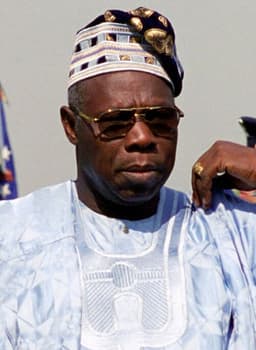
Olusegun Obasanjo
General · Modern
60.2Total
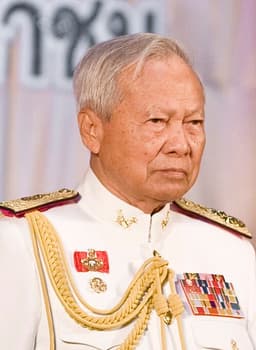
Prem Tinsulanonda
General · Modern
57.2Total
Basic Information
Born
1937
1920
Died
—
—
Era
Modern
Modern
Nationality
Nigeria
Thailand
Occupation
General
General
Civilization
Other
Eastern
Score Comparison
Military (10%)
45.0
50.0
Political (20%)
72.0
59.3
Influence (20%)
55.0
54.9
Legacy (20%)
54.0
47.5
Leadership (15%)
78.0
78.0
Strategy (15%)
60.0
60.0
TOTAL
60.2
57.2
Olusegun Obasanjo — Complete Timeline
1976 AD
Military coup that brought Obasanjo to powerPolitical Action
Following the assassination of General Murtala Mohammed in a failed coup, Obasanjo, as Chief of Staff, Supreme Headquarters, succeeded him as head of state. He oversaw the continuation of the transition to civilian rule.
CoupSuccessionMilitary Rule
Impact: national
1979 AD
Handover of power to civilian governmentPolitical Action
Obasanjo voluntarily handed over power to the elected civilian government of Shehu Shagari, marking the first peaceful transfer of power from military to civilian rule in Nigeria. This act established a precedent for democratic transition.
DemocracyTransitionCivilian Rule
Impact: nationalconstructive
1999 AD
Election as President of NigeriaPolitical Action
Obasanjo won the 1999 Nigerian presidential election as the candidate of the People's Democratic Party (PDP). His victory ended 16 years of military rule and began the Fourth Nigerian Republic.
ElectionDemocracyFourth Republic
Impact: nationalprogressive
2005 AD
Debt relief from Paris ClubPolitical Action◆ Major
Obasanjo's government negotiated a debt relief agreement with the Paris Club, resulting in the cancellation of $18 billion of Nigeria's external debt. This freed up resources for domestic spending and was a major economic achievement.
Debt ReliefEconomyNegotiation
Impact: nationalconstructive
2006 AD
Third term bid failurePolitical Action◆ Major
Obasanjo attempted to amend the Nigerian constitution to allow him to run for a third term. The bid was rejected by the National Assembly, marking a significant political defeat and reinforcing term limits.
Third TermConstitutionDefeat
Impact: national
Prem Tinsulanonda — Complete Timeline
1980 AD
Appointed Prime Minister after a coupPolitical Action◆ Major
Prem Tinsulanonda was appointed Prime Minister of Thailand by the military after a coup. He served for over eight years, overseeing a period of political stability and economic growth.
Prime MinisterMilitary RuleStability
Impact: national
1981 AD
Survived a coup attemptPolitical Action◆ Major
Prem survived a coup attempt by military officers loyal to the 'Young Turks' faction. The coup failed due to lack of support and the loyalty of key military units, allowing Prem to remain in power.
Coup AttemptPolitical CrisisMilitary
Impact: national
1988 AD
Resigned as Prime MinisterPolitical Action◆ Major
Prem resigned as Prime Minister after the general election, handing over power to a civilian government led by Chatichai Choonhavan. His resignation marked a rare peaceful transition of power in Thai politics.
ResignationDemocratic TransitionPeaceful
Impact: nationalconstructive
2016 AD
Appointed Regent of ThailandPolitical Action
After the death of King Bhumibol, Prem was appointed Regent of Thailand until the ascension of King Maha Vajiralongkorn. He served as a key figure in the transition of the monarchy.
RegentMonarchyTransition
Impact: national
Expert Analysis
Prem Tinsulanonda vs Olusegun Obasanjo
# The General Who Walked Away
In the summer of 1988, a Thai general named Prem Tinsulanonda did something almost unheard of in the annals of military rule: he resigned. Not because he was forced out, not because a coup removed him, but because an election had been held and he believed it was time for a civilian to govern. Half a world away, in Nigeria, another general named Olusegun Obasanjo had done the same thing nine years earlier, handing power to an elected president in 1979. But where Prem faded into the background, Obasanjo returned. The question that haunts their parallel stories is not just what they did, but why their paths diverged so sharply—and what that tells us about the nature of power, duty, and the countries they served.
Origins
Prem Tinsulanonda was born in 1920 in Songkhla, southern Thailand, into a family of modest means. His father was a schoolteacher, his mother a homemaker. The young Prem entered military academy at a time when Thailand was still called Siam, when absolute monarchy had only recently given way to constitutional rule. He grew up in a world where the military was not just an institution but the backbone of national identity, where loyalty to the king was as natural as breathing.
Olusegun Obasanjo, born in 1937 in the village of Ibogun-Olaogun, emerged from a very different soil. His father was a farmer, his mother a trader in a rural Yoruba community. Nigeria was then a British colony, a patchwork of ethnic groups held together by imperial force. Obasanjo joined the army young, fighting in Congo and later in the Biafran civil war. He rose through a military that was itself a creation of colonialism, an institution that had to forge a nation out of chaos.
Both men were products of their era—the mid-twentieth century, when decolonization and Cold War politics reshaped the globe. But Prem’s Thailand had never been colonized. Its military tradition was indigenous, its monarchy sacred, its political culture steeped in deference. Obasanjo’s Nigeria was a new nation, invented on a map, struggling to hold together hundreds of languages and religions. The difference in their origins was not just personal; it was tectonic.
Rise to Power
Prem entered the political stage through the back door of military bureaucracy. In 1980, after a coup that ousted a civilian government, the military junta needed a figurehead—someone competent, respected, and unambitious. Prem was appointed Prime Minister at age sixty, a man who had never sought power but accepted it as duty. His scores in military strategy (65.0) and political acumen (68.8) suggest a capable administrator, not a visionary. He was a caretaker, a bridge.
Obasanjo’s rise was bloodier. In 1976, General Murtala Mohammed was assassinated in a failed coup. Obasanjo, as Chief of Staff, Supreme Headquarters, stepped into the vacuum. He was thirty-nine years old, a combat veteran who had seen the worst of civil war. His military score (33.9) is surprisingly low for a general, but his political score (76.6) reveals the truth: Obasanjo was a politician in uniform. He took power not as a caretaker but as a reformer, promising to restore democracy.
The key difference: Prem inherited a stable system and kept it stable. Obasanjo inherited a fractured nation and tried to weld it together.
Leadership & Governance
Prem governed Thailand from 1980 to 1988 with a quiet hand. He survived a coup attempt in 1981 by the "Young Turks" faction—younger officers who wanted faster change. The coup failed not because of Prem’s military genius but because he had the backing of the king, King Bhumibol Adulyadej, and the old guard. Prem’s leadership score of 89.0 reflects his ability to navigate factions, not to command armies. He was a conciliator, a man who kept the generals happy while slowly opening the door to civilian rule.
Obasanjo’s first term (1976–1979) was a whirlwind of reform. He restructured the military, purged corrupt officers, and set a timetable for elections. His leadership score of 83.4 is slightly lower than Prem’s, but his political score of 76.6 is higher—he was more willing to take risks. In 1979, he handed power to Shehu Shagari, Nigeria’s first elected civilian president in over a decade. It was a moment of triumph, a model for Africa.
But Prem’s resignation in 1988 was different. He did not hand power to a handpicked successor; he let an election decide. The winner, Chatichai Choonhavan, was a civilian. Prem simply walked away, returning to his role as a privy councilor to the king. He had no desire for a second act.
Obasanjo, however, returned. In 1999, after years of military dictatorship, he was elected president again. His second term (1999–2007) was more controversial. He negotiated $18 billion in debt relief from the Paris Club in 2005, a major achievement. But he also tried to amend the constitution to allow a third term in 2006—a bid that failed, tarnishing his legacy. The reformer became the politician.
Triumph & Tragedy
Prem’s greatest moment was his resignation. In a region where generals cling to power until death or coup, he simply left. His tragedy is that he is barely remembered outside Thailand. He died in 2019 at age ninety-eight, a quiet end for a quiet man.
Obasanjo’s greatest moment was the 1979 handover, a beacon for African democracy. His tragedy is that he could not let go. The third-term bid revealed a flaw that his military score (33.9) might have predicted: he was not a strategist of his own legacy. He wanted to be indispensable.
Character & Destiny
Prem was a man of duty, not ambition. His leadership score of 89.0 and strategy score of 65.0 suggest a leader who relied on character, not cunning. He served the king, not himself. When his time was done, he knew it.
Obasanjo was a man of ambition tempered by idealism. His political score of 76.6 and influence score of 72.2 show a leader who believed he could fix Nigeria—and perhaps believed it too much. He could not imagine a Nigeria without him.
Legacy
Prem is remembered as a transitional figure, a guardian of stability. His legacy score of 66.8 reflects a man who kept Thailand from chaos but changed little. He is a footnote in Thai history, revered by monarchists, ignored by others.
Obasanjo’s legacy score of 69.0 is slightly higher, but more contested. He is praised for debt relief and democratic transition, criticized for the third-term bid and for failing to curb corruption. He is a giant in African history, but a flawed one.
Conclusion
Two generals, two paths. Prem walked away and stayed away. Obasanjo walked away and came back. The difference lies not in their abilities but in their countries. Thailand’s monarchy provided a stable anchor; Prem could afford to be modest. Nigeria’s fragility demanded more; Obasanjo felt he had to return. In the end, Prem’s quiet dignity and Obasanjo’s restless ambition both served their nations—but only one knew when to stop. Perhaps the greatest lesson is that sometimes the most powerful thing a leader can do is leave.
Rankings
🥇
Olusegun ObasanjoLeader
Mil: 45.0Pol: 72.0Inf: 55.0
60.2
🥈
Prem Tinsulanonda
Mil: 50.0Pol: 59.3Inf: 54.9
57.2
+3.0 behind
How This Comparison Works
Algorithm
Each figure is scored on 6 dimensions (0—100 scale) based on structured historical data: Military (10%), Political (20%), Influence (20%), Legacy (20%), Leadership (15%), Strategy (15%). The weighted total produces the final ranking.
Data Sources
Scores are computed from structured sub-indicators in the database. Scale factors adjust for era (Ancient ×0.85, Modern ×1.0) and civilization size (Eastern ×1.05, Other ×0.80) to account for differences in population and military scale.
Maximum 3 Figures
Comparisons are limited to 2—3 figures to ensure readability and statistical meaningfulness.
Error Margins
±5 points per dimension — Sub-scores are derived from historical records with inherent uncertainty. Two figures within 5 points on a dimension should be considered roughly equivalent in that area.
Total Score Accuracy
±3 points overall — The weighted combination of 6 dimensions produces a total score with approximately ±3 points of uncertainty. Differences of less than 3 points are not statistically significant— the figures are effectively tied.
Known Limitations
- Historical records are incomplete and uneven across civilizations
- Figures from oral-tradition societies may be underrepresented
- Occupation labels can misclassify multi-role figures
- Scores measure capability and impact, not moral character
- Quantitative scoring is a comparison tool, not absolute truth
Capability Radar
Military (10%) — Battles & Warfare
Battles
25
20
Win Rate
30
25
Expansion
20
10
Political (20%) — Governance & Reform
Reform
65
55
Diplomacy
75
60
Economy
55
50
Influence (20%) — Cultural & Global Reach
Cultural
45
30
Global
60
30
Legacy (20%) — Historical Impact
Historical
55
40
Longevity
50
35
Leadership (15%) — Power & Stability
Tenure
70
65
Stability
60
60
Strategy (15%) — Tactics & Innovation
Strategy
40
30
Tactics
35
30
Reform
50
35
Similar Comparisons
Comments & Discussion
No comments yet. Be the first to share your thoughts!