Loading...
Muhammadu Buhari vs Olusegun Obasanjo
Olusegun Obasanjo leads by 8.7 pts · 2 figures compared
…
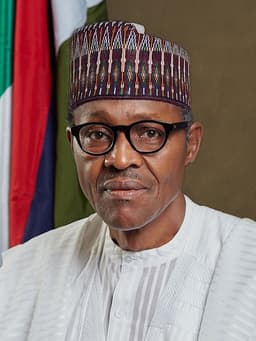
Muhammadu Buhari
General · Modern
51.5Total
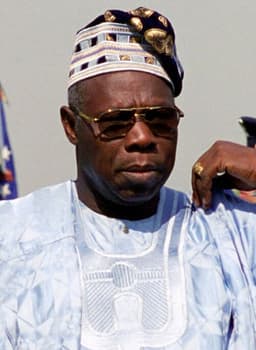
Olusegun Obasanjo
General · Modern
60.2Total
Basic Information
Born
1942
1937
Died
—
—
Era
Modern
Modern
Nationality
Nigeria
Nigeria
Occupation
General
General
Civilization
Other
Other
Score Comparison
Military (10%)
22.6
45.0
Political (20%)
68.0
72.0
Influence (20%)
53.3
55.0
Legacy (20%)
43.3
54.0
Leadership (15%)
72.0
78.0
Strategy (15%)
41.0
60.0
TOTAL
51.5
60.2
Muhammadu Buhari — Complete Timeline
1983 AD
1983 Nigerian coup d'étatPolitical Action
Major General Muhammadu Buhari led a military coup that overthrew the civilian government of President Shehu Shagari. Buhari cited corruption and economic mismanagement as justifications, and he became the head of state.
CoupMilitary RuleCorruption
Impact: nationaldestructive
1984 AD
War Against Indiscipline (WAI)Reform◆ Major
Buhari launched the War Against Indiscipline, a campaign to enforce discipline and order in Nigerian society. It included harsh penalties for minor offenses, such as queue-jumping, and was criticized for human rights abuses.
DisciplineSocial PolicyHuman Rights
Impact: nationaldestructive
1985 AD
Overthrow by Ibrahim BabangidaPolitical Action◆ Major
Buhari was overthrown in a palace coup led by his Chief of Army Staff, Ibrahim Babangida. Babangida cited Buhari's authoritarian style and failure to address the economy as reasons for the coup.
CoupOverthrowBabangida
Impact: national
2015 AD
Anti-corruption campaignReform◆ Major
Buhari launched a high-profile anti-corruption campaign, targeting government officials and recovering stolen assets. The campaign was praised internationally but criticized for being selective and politically motivated.
Anti-CorruptionReformGovernance
Impact: nationalconstructive
Election as President of NigeriaPolitical Action
Buhari won the 2015 Nigerian presidential election, defeating incumbent Goodluck Jonathan. This was the first time an opposition candidate had defeated a sitting president in Nigeria's history, marking a democratic milestone.
ElectionDemocracyOpposition Victory
Impact: nationalprogressive
Olusegun Obasanjo — Complete Timeline
1976 AD
Military coup that brought Obasanjo to powerPolitical Action
Following the assassination of General Murtala Mohammed in a failed coup, Obasanjo, as Chief of Staff, Supreme Headquarters, succeeded him as head of state. He oversaw the continuation of the transition to civilian rule.
CoupSuccessionMilitary Rule
Impact: national
1979 AD
Handover of power to civilian governmentPolitical Action
Obasanjo voluntarily handed over power to the elected civilian government of Shehu Shagari, marking the first peaceful transfer of power from military to civilian rule in Nigeria. This act established a precedent for democratic transition.
DemocracyTransitionCivilian Rule
Impact: nationalconstructive
1999 AD
Election as President of NigeriaPolitical Action
Obasanjo won the 1999 Nigerian presidential election as the candidate of the People's Democratic Party (PDP). His victory ended 16 years of military rule and began the Fourth Nigerian Republic.
ElectionDemocracyFourth Republic
Impact: nationalprogressive
2005 AD
Debt relief from Paris ClubPolitical Action◆ Major
Obasanjo's government negotiated a debt relief agreement with the Paris Club, resulting in the cancellation of $18 billion of Nigeria's external debt. This freed up resources for domestic spending and was a major economic achievement.
Debt ReliefEconomyNegotiation
Impact: nationalconstructive
2006 AD
Third term bid failurePolitical Action◆ Major
Obasanjo attempted to amend the Nigerian constitution to allow him to run for a third term. The bid was rejected by the National Assembly, marking a significant political defeat and reinforcing term limits.
Third TermConstitutionDefeat
Impact: national
Expert Analysis
Muhammadu Buhari vs Olusegun Obasanjo
# The Two Generals: Obasanjo and Buhari and Nigeria’s Unfinished Journey
On a hot Lagos morning in February 1976, a young army officer named Olusegun Obasanjo received news that would alter his life and his nation’s destiny. General Murtala Mohammed, Nigeria’s charismatic military ruler, had been assassinated in a failed coup. As Chief of Staff at Supreme Headquarters, Obasanjo was thrust into power not by ambition but by circumstance. Exactly thirty-nine years later, another general, Muhammadu Buhari, would achieve what no Nigerian opposition candidate had ever managed: defeating an incumbent president in a free election. Both men wore the same uniform, governed the same fractured nation, and claimed to seek the same ends. Yet their paths diverged so sharply that they seem to belong to different stories entirely. The question is why.
Origins
Obasanjo was born in 1937 in the village of Ibogun-Olaogun, in what is now Ogun State, to a farming family of the Egba branch of the Yoruba people. His father was a farmer who had converted to Christianity, and young Olusegun grew up in a world of village life, missionary schools, and the slow stirrings of Nigerian nationalism. He joined the Nigerian Army in 1958, just two years before independence, and was trained at the Royal Military Academy Sandhurst in England. He was a man of the establishment, shaped by the optimism of Nigeria’s early years.
Buhari, born five years later in 1942 in Daura, Katsina State, came from a different Nigeria. He was the son of a Fulani chief, raised in the Islamic traditions of the Hausa-Fulani north. His world was one of emirs, Koranic schools, and the hierarchical society of the Sahel. He too joined the army, but his training was more austere: the Nigerian Military Training College and later a course in India. Where Obasanjo absorbed the pragmatic liberalism of post-colonial Britain, Buhari internalized the discipline and suspicion of the Cold War era’s military brotherhoods.
These origins seeded different instincts. Obasanjo learned to negotiate, to build bridges between Nigeria’s fractious regions. Buhari learned to command, to see disorder as a moral failing requiring correction.
Rise to Power
Obasanjo’s rise was almost accidental. After the 1976 coup, he became head of state not by seizing power but by inheriting it. He did not seek the role; it came to him because he was the next in line. His primary task was to fulfill Murtala’s promise of returning Nigeria to civilian rule by 1979. He did exactly that, handing over power to Shehu Shagari in a ceremony that remains one of the few genuinely peaceful transfers of power in Nigerian history. This single act defined his early legacy: a military man who did not cling to power.
Buhari’s rise was the opposite. He led the coup that overthrew Shagari in 1983, citing rampant corruption and mismanagement. He seized power deliberately, convinced that only a firm hand could save Nigeria from itself. He was not inheriting a promise; he was imposing a correction. His justification was moral, his method authoritarian.
Leadership & Governance
Obasanjo’s first military rule (1976–1979) was marked by consolidation and transition. He continued Murtala’s policies, including the creation of new states and the move of the capital to Abuja. He focused on stability and exit. His second rule as elected president (1999–2007) was more complex. He stabilized a fragile democracy after years of military rule, but his governance was pragmatic and often transactional. He negotiated debt relief from the Paris Club in 2005, canceling $18 billion in debt, a major economic achievement. Yet his attempt to amend the constitution for a third term in 2006 revealed a troubling ambition that ultimately failed.
Buhari’s first rule (1983–1985) was defined by the “War Against Indiscipline,” a campaign that punished lateness, forced civil servants to sing the national anthem, and imposed harsh penalties for minor offenses. It was popular with those who craved order but alienated many who saw it as petty tyranny. He was overthrown in 1985 by his own Chief of Army Staff, Ibrahim Babangida, who cited Buhari’s “rigid and authoritarian” style. When Buhari returned as elected president in 2015, he launched a high-profile anti-corruption campaign that recovered stolen assets but often seemed selective, targeting political opponents while his own allies remained untouched.
Triumph & Tragedy
Obasanjo’s greatest triumph was the 1979 handover. It was a moment of rare grace in African politics, a military ruler voluntarily relinquishing power. His greatest failure was the 2006 third-term bid, which tarnished his reputation and exposed his willingness to bend democratic norms.
Buhari’s triumph was the 2015 election itself, a victory that proved Nigeria’s democracy could work. His tragedy was that his second term, from 2019 onward, saw economic stagnation, rising insecurity, and a perception that his anti-corruption war had lost its edge. The general who had promised to fix Nigeria left it in many ways worse.
Character & Destiny
Obasanjo is a survivor, a man of immense political intelligence and flexibility. He has been a military ruler, a prisoner (under Abacha), an elected president, and an elder statesman. He bends but does not break. His character is pragmatic, even cynical, willing to compromise ideals for stability.
Buhari is a moralist, rigid and principled to a fault. He believes in discipline, order, and the righteousness of his cause. His character does not bend; it breaks. He was overthrown once because of his inflexibility, and his second presidency suffered from the same inability to adapt.
These differences explain their divergent outcomes. Obasanjo understood that power requires negotiation, that Nigeria’s diversity demands consensus. Buhari believed that power requires enforcement, that Nigeria’s problems stem from a lack of will. Both were partly right and partly wrong.
Legacy
Obasanjo is remembered as a builder of institutions, flawed but essential. The 1979 handover remains his monument. Buhari is remembered as a reformer who failed to reform, a man of integrity whose integrity could not solve Nigeria’s problems. His anti-corruption campaign, while genuine, did not transform the state.
Neither man achieved what they hoped. Nigeria remains a country of immense potential and persistent dysfunction. Their lives, running in parallel, are a study in the limits of military men in democratic clothes.
Conclusion
Standing at the end of their stories, one is struck by a melancholy truth. Both Obasanjo and Buhari genuinely wanted to help Nigeria. Both were shaped by their times and their origins. Both achieved moments of greatness and moments of failure. Their differences were not simply personal but structural, reflecting the tensions between Nigeria’s regions, its ethnicities, and its visions of order and liberty. In the end, they remind us that leadership is never just about the leader. It is about the nation that creates them and the history that judges them. Nigeria is still waiting for a leader who can combine Obasanjo’s pragmatism with Buhari’s integrity, and who can find a path that neither general could discover.
Rankings
🥇
Olusegun ObasanjoLeader
Mil: 45.0Pol: 72.0Inf: 55.0
60.2
🥈
Muhammadu Buhari
Mil: 22.6Pol: 68.0Inf: 53.3
51.5
+8.7 behind
How This Comparison Works
Algorithm
Each figure is scored on 6 dimensions (0—100 scale) based on structured historical data: Military (10%), Political (20%), Influence (20%), Legacy (20%), Leadership (15%), Strategy (15%). The weighted total produces the final ranking.
Data Sources
Scores are computed from structured sub-indicators in the database. Scale factors adjust for era (Ancient ×0.85, Modern ×1.0) and civilization size (Eastern ×1.05, Other ×0.80) to account for differences in population and military scale.
Maximum 3 Figures
Comparisons are limited to 2—3 figures to ensure readability and statistical meaningfulness.
Error Margins
±5 points per dimension — Sub-scores are derived from historical records with inherent uncertainty. Two figures within 5 points on a dimension should be considered roughly equivalent in that area.
Total Score Accuracy
±3 points overall — The weighted combination of 6 dimensions produces a total score with approximately ±3 points of uncertainty. Differences of less than 3 points are not statistically significant— the figures are effectively tied.
Known Limitations
- Historical records are incomplete and uneven across civilizations
- Figures from oral-tradition societies may be underrepresented
- Occupation labels can misclassify multi-role figures
- Scores measure capability and impact, not moral character
- Quantitative scoring is a comparison tool, not absolute truth
Capability Radar
Military (10%) — Battles & Warfare
Battles
10
25
Win Rate
10
30
Expansion
5
20
Political (20%) — Governance & Reform
Reform
30
65
Diplomacy
25
75
Economy
20
55
Influence (20%) — Cultural & Global Reach
Cultural
25
45
Global
25
60
Legacy (20%) — Historical Impact
Historical
30
55
Longevity
20
50
Leadership (15%) — Power & Stability
Tenure
45
70
Stability
15
60
Strategy (15%) — Tactics & Innovation
Strategy
15
40
Tactics
15
35
Reform
20
50
Similar Comparisons
Comments & Discussion
Daura Dynamo6/16/2026
Comparing these two is like comparing a surgeon who actually operates with one who just waves the scalpel. Obasanjo handed over power voluntarily in 1979—an almost unique act in African history—then returned as civilian president and actually privatized banks, liberalized telecoms, and made mobile phones possible for millions. Buhari? His 1984 War Against Indiscipline was just state-sponsored humiliation: forcing civil servants to do frog jumps under the sun. One built institutions. The other bu
拉各斯之锤6/16/2026
拿布哈里和奥巴桑乔比,简直侮辱了“治理”这个词。奥巴桑乔1979年主动交权给文人政府,非洲大陆有几个干过?1999年回来当民选总统,真金白银搞经济改革,银行私有化、电信自由化,尼日利亚人能用上手机全靠他。布哈里1983年政变上台后干了啥?把公共部门当兵营管,把抓贪污变成政治清洗。一个解放了国家潜力,一个扼杀了人民尊严。数据不会说谎:奥巴桑乔任内GDP增长率是布哈里军政府时期的4倍。
Village Intellectual6/16/2026
Forget the generals—look at their villages. Obasanjo grew up in Ibogun-Olaogun, a tiny Yoruba hamlet with missionary schools that taught him English, critical thinking, and how to navigate both worlds. Buhari's Daura was a Hausa-Fulani emirate town where religious conservatism and feudal hierarchy were absolute. These aren't just different backgrounds; they're different civilizational ecosystems. Obasanjo learned negotiation from village councils; Buhari learned command from emir's courts. Their
经济学人附体6/16/2026
别听什么“两位将军都为国牺牲”的废话,翻翻经济数据就知道了。奥巴桑乔1999-2007年,尼日利亚GDP从360亿冲到2750亿美元,外债从350亿减到35亿,还清了巴黎俱乐部欠款。布哈里2015-2023年,GDP从4860亿跌到3630亿,连续三次衰退,通胀从9%飙到24%,失业率从6%爬到33%。一个留下的是石油基金,一个留下的是巨额外债和破败铁路。这不是性格差异,这是执政能力的鸿沟。
Sandhurst Hybrid6/16/2026
The fatal irony is that both inherited radically different starting points and made diametrically opposite choices with them. Obasanjo inherited a shattered economy after civil war in 1976 and still built the foundations for Nigeria's oil boom. Buhari inherited a booming economy in 2015 with $30 billion in foreign reserves and ran it into the ground. One used his military discipline to compel efficiency; the other