Loading...
Nicolas Sarkozy vs Otto von Bismarck
Otto von Bismarck leads by 14.4 pts · 2 figures compared
…

Nicolas Sarkozy
Politician · Modern
51.4Total
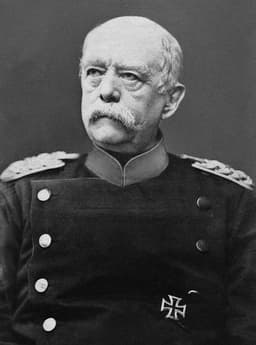
Otto von Bismarck
Politician · Modern
65.8Total
Basic Information
Born
1955
1815
Died
—
1898
Era
Modern
Modern
Nationality
France
Germany
Occupation
Politician
Politician
Civilization
Western
Western
Score Comparison
Military (10%)
10.0
55.0
Political (20%)
62.7
85.0
Influence (20%)
61.0
82.0
Legacy (20%)
46.7
40.0
Leadership (15%)
68.0
80.0
Strategy (15%)
38.3
50.0
TOTAL
51.4
65.8
Nicolas Sarkozy — Complete Timeline
2007 AD
Election as President of FrancePolitical Action
Sarkozy defeated Socialist candidate S
French ElectionUMPPresidency
Impact: national
2010 AD
Reform of the French Pension SystemReform◆ Major
Sarkozy's government raised the minimum retirement age from 60 to 62 and the full-pension age from 65 to 67. The reform sparked massive strikes and protests across France but was passed to address the system's long-term financial sustainability.
Pension ReformLabor PolicyProtests
Impact: nationaldestructive
2011 AD
Leadership in the 2011 Libyan InterventionWar◆ Major
Sarkozy played a leading role in the NATO-led military intervention in Libya, launching airstrikes against Muammar Gaddafi's forces. The intervention helped topple Gaddafi but led to prolonged instability and civil war in Libya.
LibyaNATOMilitary Intervention
Impact: regional
Otto von Bismarck — Complete Timeline
1870 AD
Franco-Prussian WarWar
Bismarck provoked France into declaring war by editing the Ems Dispatch to appear insulting. The resulting conflict saw Prussia and its allies decisively defeat France, leading to the fall of Napoleon III, the capture of Paris, and the annexation of Alsace-Lorraine.
WarProvocationAnnexation
Impact: globaldestructive
1871 AD
Unification of Germany ProclaimedPolitical Action
Following the Franco-Prussian War, Bismarck orchestrated the proclamation of the German Empire in the Hall of Mirrors at Versailles. King Wilhelm I of Prussia was declared German Emperor, uniting the German states under Prussian leadership and establishing the Second Reich.
UnificationGerman EmpireNationalism
Impact: globalconstructive
1878 AD
Enactment of the Anti-Socialist LawsPolitical Action◆ Major
After two assassination attempts on Kaiser Wilhelm I, Bismarck pushed through laws banning socialist organizations, publications, and meetings. The laws remained in force until 1890, suppressing the Social Democratic Party while Bismarck simultaneously introduced welfare reforms to undercut its appeal.
RepressionSocialismWelfare State
Impact: nationaldestructive
Congress of BerlinPolitical Action◆ Major
Bismarck hosted the Congress of Berlin to revise the Treaty of San Stefano and resolve the Eastern Crisis. He acted as 'honest broker,' reducing Russian gains, granting independence to Romania, Serbia, and Montenegro, and placing Bosnia-Herzegovina under Austro-Hungarian administration.
DiplomacyBalkansBalance of Power
Impact: global
1883 AD
Establishment of the Welfare StateReform◆ Major
Bismarck introduced the Health Insurance Bill (1883), Accident Insurance Bill (1884), and Old Age and Disability Insurance Bill (1889). These laws created the first modern welfare state, providing workers with social security and aiming to reduce support for socialist movements.
Social ReformWelfareInsurance
Impact: globalprogressive
1890 AD
Dismissal as ChancellorPolitical Action◆ Major
Emperor Wilhelm II forced Bismarck to resign due to policy disagreements, particularly over anti-socialist laws and foreign policy. Bismarck's departure marked the end of an era, leading to a more aggressive German foreign policy and the eventual unraveling of his alliance system.
ResignationWilhelm IIPolicy Shift
Impact: global
Expert Analysis
Origins
Nicolas Sarkozy was born in 1955 in Paris to a Hungarian immigrant father and a French mother. He studied law and political science, entering politics early as mayor of Neuilly-sur-Seine at age 28. His background in conservative politics and his father's departure shaped his drive for success.
Otto von Bismarck was born in 1815 into an aristocratic Junker family in Schönhausen, Prussia. He studied law at Göttingen and Berlin, then served as a diplomat. His conservative upbringing and military family background instilled a pragmatic, power-oriented worldview.
Rise to Power
Sarkozy rose through the French conservative party, serving as interior minister under Jacques Chirac. He became president in 2007 by defeating Socialist candidate Ségolène Royal with 53% of the vote. His campaign focused on breaking with the past and reforming France.
Bismarck became Minister President of Prussia in 1862 after a constitutional crisis. He engineered wars against Denmark (1864), Austria (1866), and France (1870-71), culminating in the unification of Germany in 1871. He then served as Chancellor until 1890.
Leadership & Governance
Sarkozy's leadership was energetic and hands-on. He reformed the pension system, raising the retirement age from 60 to 62, despite massive protests. He also led France's intervention in Libya in 2011. His style was often confrontational and media-savvy, earning him the nickname "Sarko the Bling-Bling."
Bismarck governed with a mix of ruthless pragmatism and strategic reforms. He enacted the Anti-Socialist Laws (1878) to suppress political opposition while simultaneously introducing pioneering welfare state measures: health insurance (1883), accident insurance (1884), and old-age pensions (1889). His governance scored 80.0 in leadership, compared to Sarkozy's 68.0.
Triumph & Tragedy
Sarkozy's greatest success was his pension reform, which aimed to stabilize France's finances. His biggest failure was the Libyan intervention, which led to chaos and a power vacuum. His presidency also saw economic stagnation and a decline in French influence.
Bismarck's triumph was unifying Germany and creating a welfare state that became a model worldwide. His tragedy was the Kulturkampf against the Catholic Church and his eventual dismissal by Kaiser Wilhelm II, which undermined his carefully constructed alliances.
Character & Destiny
Sarkozy's energetic, ambitious personality drove his rapid rise but also led to legal troubles after his presidency, including corruption charges. His character scored 62.7 in political skill versus Bismarck's 85.0. Bismarck was calculating, authoritarian, and skilled at manipulation, as shown by the Ems Dispatch incident that provoked the Franco-Prussian War.
Legacy
Sarkozy's legacy is mixed: his reforms were significant but controversial, and his post-presidential legal issues tarnished his image. His influence score is 61.0. Bismarck's legacy is profound: he unified Germany, established a welfare state, and shaped European diplomacy. His influence score is 82.0, and his political score is 85.0. However, his legacy score of 40.0 reflects the eventual collapse of his system.
Conclusion
Otto von Bismarck had a greater impact than Nicolas Sarkozy, as shown by his higher total score of 65.8 versus 51.4. Bismarck fundamentally reshaped Europe by creating a unified German state and pioneering social welfare, while Sarkozy's reforms were important but less transformative. Bismarck's political skill (85.0) and influence (82.0) dwarf Sarkozy's, and his actions continue to shape modern Germany.
Rankings
🥇
Otto von BismarckLeader
Mil: 55.0Pol: 85.0Inf: 82.0
65.8
🥈
Nicolas Sarkozy
Mil: 10.0Pol: 62.7Inf: 61.0
51.4
+14.4 behind
How This Comparison Works
Algorithm
Each figure is scored on 6 dimensions (0—100 scale) based on structured historical data: Military (10%), Political (20%), Influence (20%), Legacy (20%), Leadership (15%), Strategy (15%). The weighted total produces the final ranking.
Data Sources
Scores are computed from structured sub-indicators in the database. Scale factors adjust for era (Ancient ×0.85, Modern ×1.0) and civilization size (Eastern ×1.05, Other ×0.80) to account for differences in population and military scale.
Maximum 3 Figures
Comparisons are limited to 2—3 figures to ensure readability and statistical meaningfulness.
Error Margins
±5 points per dimension — Sub-scores are derived from historical records with inherent uncertainty. Two figures within 5 points on a dimension should be considered roughly equivalent in that area.
Total Score Accuracy
±3 points overall — The weighted combination of 6 dimensions produces a total score with approximately ±3 points of uncertainty. Differences of less than 3 points are not statistically significant— the figures are effectively tied.
Known Limitations
- Historical records are incomplete and uneven across civilizations
- Figures from oral-tradition societies may be underrepresented
- Occupation labels can misclassify multi-role figures
- Scores measure capability and impact, not moral character
- Quantitative scoring is a comparison tool, not absolute truth
Capability Radar
Military (10%) — Battles & Warfare
Battles
0
60
Win Rate
0
70
Expansion
0
80
Political (20%) — Governance & Reform
Reform
55
90
Diplomacy
65
95
Economy
50
80
Influence (20%) — Cultural & Global Reach
Cultural
40
65
Global
55
75
Legacy (20%) — Historical Impact
Historical
40
85
Longevity
30
70
Leadership (15%) — Power & Stability
Tenure
60
85
Stability
45
70
Strategy (15%) — Tactics & Innovation
Strategy
0
85
Tactics
0
55
Reform
10
75
Similar Comparisons
Comments & Discussion
No comments yet. Be the first to share your thoughts!