Loading...
Napoleon Bonaparte vs Suharto
Napoleon Bonaparte leads by 13.7 pts · 2 figures compared
…

Napoleon Bonaparte
General · Modern
70.9Total
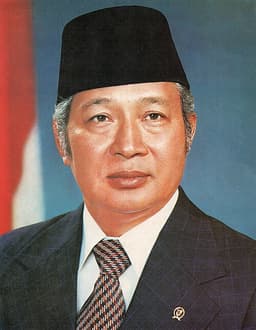
Suharto
General · Modern
57.2Total
Basic Information
Born
1769
1921
Died
1821
—
Era
Modern
Modern
Nationality
France
Indonesia
Occupation
General
General
Civilization
Western
Eastern
Score Comparison
Military (10%)
94.0
20.0
Political (20%)
72.0
59.3
Influence (20%)
40.0
60.0
Legacy (20%)
80.0
52.0
Leadership (15%)
78.0
82.0
Strategy (15%)
90.0
60.0
TOTAL
70.9
57.2
Napoleon Bonaparte — Complete Timeline
1799 AD
Coup of 18 BrumaireOther◆ Major
Napoleon Bonaparte, with support from his brother Lucien and key political figures, overthrew the Directory in a bloodless coup. He established the Consulate with himself as First Consul, effectively becoming the ruler of France. This event ended the French Revolution's most unstable period.
French RevolutionCoupRise to Power
Impact: regional
1804 AD
Promulgation of the Napoleonic CodeOther◆ Major
Napoleon enacted the Civil Code of the French, known as the Napoleonic Code, a comprehensive set of laws that replaced the fragmented feudal legal systems. The code established legal equality, protected property rights, and secularized law. It became the basis for legal systems in many European and world countries.
Legal ReformNapoleonic CodeCivil Law
Impact: globalconstructive
1805 AD
Battle of AusterlitzWar◆ Major
Napoleon's Grande Arm
Napoleonic WarsBattleDecisive Victory
Impact: global
1812 AD
Invasion of RussiaWar◆ Major
Napoleon led the Grande Arm
Napoleonic WarsInvasionDisaster
Impact: globaldestructive
1815 AD
Battle of WaterlooWar◆ Major
Napoleon's French army was defeated by the combined forces of the Duke of Wellington's Anglo-Allied army and Gebhard Leberecht von Bl
Napoleonic WarsBattleFinal Defeat
Impact: globaldestructive
Suharto — Complete Timeline
1966 AD
Supersemar and Transfer of PowerPolitical Action
President Sukarno signed the Supersemar order, delegating authority to General Suharto to restore order after the 30 September Movement. Suharto used this to ban the Communist Party, purge leftists, and gradually assume executive power, effectively beginning his New Order regime.
SupersemarNew OrderIndonesia
Impact: nationaldestructive
1967 AD
New Order Economic DevelopmentReform◆ Major
Suharto implemented the New Order's economic policies, focusing on foreign investment, agricultural self-sufficiency, and industrialization. The government achieved high growth rates, reduced poverty, and stabilized the economy, but also fostered crony capitalism and corruption.
Economic GrowthDevelopmentIndonesia
Impact: nationalconstructive
1975 AD
Invasion of East TimorWar◆ Major
Suharto ordered the invasion of East Timor after Portugal withdrew. Indonesian forces occupied the territory, leading to a 24-year occupation marked by widespread human rights abuses, including massacres and forced displacement, resulting in an estimated 100,000-200,000 deaths.
East TimorOccupationHuman Rights
Impact: regionaldestructive
1998 AD
Asian Financial Crisis and Fall from PowerPolitical Action
The Asian Financial Crisis devastated Indonesia's economy, leading to massive unemployment and food shortages. Widespread protests and riots forced Suharto to resign in May 1998 after 31 years in power, ending his authoritarian rule and ushering in the Reformasi era.
Financial CrisisResignationReformasi
Impact: nationaltragic
Expert Analysis
Napoleon Bonaparte vs Suharto
The Emperor and the General: Two Paths to Power, Two Ends of Glory
The year is 1815. Napoleon Bonaparte, master of Europe, stands on a muddy field near Waterloo, watching his Imperial Guard crumble under British fire. Half a world away and 150 years later, another scene unfolds: in Jakarta, 1998, General Suharto sits alone in a palace, his thirty-one-year rule dissolving as students storm the gates. Both men were generals who seized supreme power. One conquered a continent, changed the laws of an era, and died in exile on a remote island. The other built a nation from chaos, lifted millions from poverty, and fell in disgrace to a financial crisis. What drove these two fates so far apart? The answer lies not in their uniforms, but in the worlds they inherited—and the choices they made within them.
Origins
Napoleon Bonaparte was born in 1769 on Corsica, a Mediterranean island that had just become French. His family was minor nobility, poor and proud. Young Napoleon devoured books on military history and Enlightenment philosophy. He was short, intense, and burning with ambition—a product of the French Revolution, which had shattered the old order and opened doors for talent over birth. His era was one of upheaval, where a man could rise from obscurity to emperor by sheer will and genius.
Suharto was born in 1921 in a village in Java, Dutch East Indies. His father was a minor official, and his family was poor. He grew up in a world of rice paddies, shadow puppets, and colonial rule. He never attended a military academy; he joined the Dutch colonial army, then the Japanese-sponsored militia during World War II, and finally the Indonesian independence struggle. His era was one of revolution and nation-building, where a man could rise by loyalty, patience, and survival instinct. If Napoleon was forged in the fire of revolution, Suharto was molded in the mud of occupation and independence.
Rise to Power
Napoleon’s rise was meteoric. At 24, he was a general; at 30, he was First Consul of France. His key turning point came in 1799, when he returned from Egypt and overthrew the corrupt Directory in a coup. He had no political base—only his sword and his reputation. He won power through audacity, brilliance on the battlefield, and the support of a nation tired of chaos.
Suharto’s rise was slow and shadowy. For decades, he was a mid-ranking officer in the Indonesian army, loyal to President Sukarno. His turning point came in 1966, when Sukarno signed the Supersemar order, delegating authority to Suharto to restore order after the 30 September Movement. Suharto did not storm a palace; he waited for power to be handed to him. He then methodically sidelined his rivals, crushed leftist movements, and declared the “New Order.” He became president in 1967, not by coup but by gradual, ruthless consolidation.
Leadership & Governance
Napoleon ruled as emperor, a military dictator who also reformed. His Napoleonic Code standardized French law, abolished feudalism, and established meritocracy. He built roads, schools, and a centralized state. He was a military genius—scoring 94 in military and 93 in strategy—who won battles at Austerlitz and Jena. But he was also a political gambler, scoring only 75. He trusted his own brilliance, alienated allies, and overreached.
Suharto ruled as a father-figure dictator. He called his regime the “New Order,” focused on economic development. He invited foreign investment, achieved agricultural self-sufficiency, and reduced poverty. His military score was low—45.5—because he fought no major wars. His strategy score was 58.2, but his leadership score was 80.7, reflecting his ability to manage a sprawling archipelago. He built a system of patronage, corruption, and fear. He was not a conqueror; he was a stabilizer.
Triumph & Tragedy
Napoleon’s greatest triumph was Austerlitz in 1805, where he crushed the Austrian and Russian armies. His greatest tragedy was the invasion of Russia in 1812—a catastrophic miscalculation that destroyed his Grand Army. He was exiled to Elba, returned for 100 days, and met final defeat at Waterloo in 1815. He died in 1821 on Saint Helena, a prisoner.
Suharto’s greatest triumph was economic development. In the 1970s and 1980s, Indonesia grew rapidly, and millions escaped poverty. His greatest tragedy was the invasion of East Timor in 1975, which led to decades of occupation, famine, and international condemnation. His fall came in 1998, when the Asian Financial Crisis collapsed the economy. Riots erupted, students protested, and his own generals abandoned him. He resigned in May 1998, dying in 2008 under house arrest, unrepentant.
Character & Destiny
Napoleon was driven by ambition, genius, and a belief in his own destiny. He once said, “Impossible is a word to be found only in the dictionary of fools.” His personality—arrogant, restless, visionary—led him to conquer Europe but also to overreach. He could not stop, and that was his doom.
Suharto was driven by survival, control, and pragmatism. He once said, “I am not a hero. I am just a man who did his duty.” His personality—patient, calculating, ruthless—led him to build a stable but corrupt regime. He could not adapt to crisis, and that was his fall.
Legacy
Napoleon’s legacy is immense. His Napoleonic Code influenced legal systems across Europe and the world. He is remembered as a military genius and a reformer, but also as a tyrant who caused millions of deaths. His total score is 82.4, reflecting his towering but flawed impact.
Suharto’s legacy is contested. He is remembered as the “Father of Development” who lifted Indonesia from poverty, but also as a dictator who suppressed dissent, stole billions, and invaded East Timor. His total score is 67.7, lower than Napoleon’s, reflecting a narrower, more ambiguous impact. Today, Indonesia is a democracy, but his shadow lingers.
Conclusion
Napoleon and Suharto were both generals who became rulers, but their fates were shaped by their eras. Napoleon lived in an age of revolution, where a man could reshape the world with a sword and a law code. Suharto lived in an age of decolonization, where a man could build a nation with patronage and fear. One died in exile, the other in disgrace. Yet both remind us that power is a double-edged sword: it can build empires or destroy them, lift millions or crush them. The difference is not in the sword, but in the hand that wields it—and the world that shaped that hand.
Rankings
🥇
Napoleon BonaparteLeader
Mil: 94.0Pol: 72.0Inf: 40.0
70.9
🥈
Suharto
Mil: 20.0Pol: 59.3Inf: 60.0
57.2
+13.7 behind
How This Comparison Works
Algorithm
Each figure is scored on 6 dimensions (0—100 scale) based on structured historical data: Military (10%), Political (20%), Influence (20%), Legacy (20%), Leadership (15%), Strategy (15%). The weighted total produces the final ranking.
Data Sources
Scores are computed from structured sub-indicators in the database. Scale factors adjust for era (Ancient ×0.85, Modern ×1.0) and civilization size (Eastern ×1.05, Other ×0.80) to account for differences in population and military scale.
Maximum 3 Figures
Comparisons are limited to 2—3 figures to ensure readability and statistical meaningfulness.
Error Margins
±5 points per dimension — Sub-scores are derived from historical records with inherent uncertainty. Two figures within 5 points on a dimension should be considered roughly equivalent in that area.
Total Score Accuracy
±3 points overall — The weighted combination of 6 dimensions produces a total score with approximately ±3 points of uncertainty. Differences of less than 3 points are not statistically significant— the figures are effectively tied.
Known Limitations
- Historical records are incomplete and uneven across civilizations
- Figures from oral-tradition societies may be underrepresented
- Occupation labels can misclassify multi-role figures
- Scores measure capability and impact, not moral character
- Quantitative scoring is a comparison tool, not absolute truth
Capability Radar
Military (10%) — Battles & Warfare
Battles
95
40
Win Rate
90
45
Expansion
95
30
Political (20%) — Governance & Reform
Reform
95
55
Diplomacy
80
60
Economy
85
65
Influence (20%) — Cultural & Global Reach
Cultural
85
40
Global
90
50
Legacy (20%) — Historical Impact
Historical
95
55
Longevity
90
45
Leadership (15%) — Power & Stability
Tenure
85
85
Stability
70
50
Strategy (15%) — Tactics & Innovation
Strategy
95
40
Tactics
98
35
Reform
92
50
Similar Comparisons
Comments & Discussion
Boneyard Brilliance6/16/2026
Napoleon vs Suharto? That’s like comparing a meteor to a mudslide. The Emperor rewrote Europe’s map in a decade, from the Code Napoleon to the Duchy of Warsaw. Suharto kept Indonesia stable with brutal repression and crony corruption—hardly a legacy. Waterloo was a tragedy; Suharto’s 1998 exit was a farce. One shaped centuries; the other just filled pockets. Give me the Corsican any day—he at least burned bright.
财务报表侦探6/16/2026
数据上,拿破仑打仗烧了法国三分之一的人口,苏哈托用石油美元养肥了家族和军队。你选哪个?一个在圣赫勒拿岛写回忆录,一个在雅加达躲法院。但别忘了,拿破仑的法典影响了现代民法,苏哈托的“秩序”只是压住火山。别美化独裁者,也别神化征服者。数据不会撒谎,只是选择太多。
Classical Contrast6/16/2026
Apples and oranges? More like a Roman triumph versus a Javanese wayang show. Napoleon, a student of Plutarch and Caesar, saw power as a stage for glory—Austerlitz was his Parthenon. Suharto, steeped in priyayi mysticism, ruled through shadow networks and puppet masters. One died quoting Corneille; the other vanished into a world of batik and silence. Both dictators, but the Frenchman had epic poetry; the Javanese had bank accounts.
修正主义炮手6/16/2026
别跟我扯拿破仑是天才,苏哈托是小丑。拿破仑入侵俄国死了五十万人,还把奴隶制带回加勒比。苏哈托至少让印尼从饿殍变自给,1997年危机不是他的原罪,是IMF的阴谋。两人都是美国养的恶犬,但苏哈托的“新秩序”比拿破仑的军靴更持久。历史是赢家写的?放屁,是编剧写的。
History Buff’s Gut6/16/2026
Look, I get the comparison—two generals, two falls. But context is king. Napoleon rode a revolutionary wave that reshaped Europe’s soul; Suharto surfed a Cold War current that drowned East Timor. Napoleon’s exile was tragic solitude; Suharto’s was cushy house arrest. One had the Louvre; the other had overpriced real estate. If I’m picking dinner guests, give me Napoleon—he’d at least argue about strategy. Suharto just grins.