Loading...
Afonso de Albuquerque vs Suharto
Afonso de Albuquerque leads by 22.4 pts · 2 figures compared
…
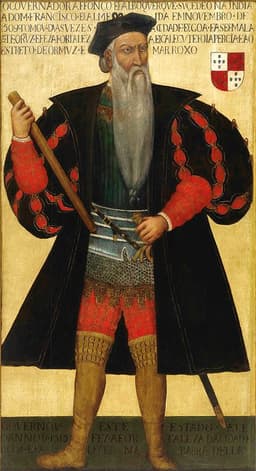
Afonso de Albuquerque
General · Medieval
79.6Total
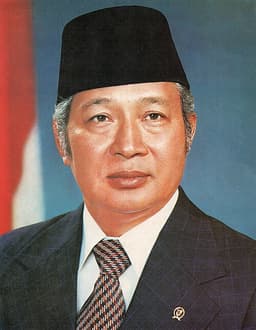
Suharto
General · Modern
57.2Total
Basic Information
Born
1453
1921
Died
1515
—
Era
Medieval
Modern
Nationality
Portugal
Indonesia
Occupation
General
General
Civilization
Western
Eastern
Score Comparison
Military (10%)
77.5
20.0
Political (20%)
88.0
59.3
Influence (20%)
80.0
60.0
Legacy (20%)
75.0
52.0
Leadership (15%)
78.0
82.0
Strategy (15%)
82.0
60.0
TOTAL
79.6
57.2
Afonso de Albuquerque — Complete Timeline
1503 AD
First voyage to IndiaWar◆ Major
Afonso de Albuquerque led a fleet to India, establishing the first Portuguese fort at Cochin. This voyage laid the foundation for Portuguese control of the Indian Ocean trade.
ExplorationColonialismIndia
Impact: global
1510 AD
Conquest of GoaWar◆ Major
Albuquerque captured Goa from the Sultan of Bijapur. He made Goa the capital of Portuguese India, a position it held for over 400 years.
ConquestColonialismIndia
Impact: regional
1511 AD
Conquest of MalaccaWar◆ Major
Albuquerque led a Portuguese fleet to capture the strategic port of Malacca. This gave Portugal control of the spice trade route between the Indian Ocean and the Pacific.
ConquestSpice TradeSoutheast Asia
Impact: global
1513 AD
Siege of AdenWar
Albuquerque attempted to capture Aden in Yemen but failed. This failure prevented Portugal from controlling the entrance to the Red Sea and limited their influence in the region.
SiegeFailureRed Sea
Impact: regional
1515 AD
Death at seaOther◆ Major
Afonso de Albuquerque died at sea off the coast of Goa, possibly from illness or poison. His death left the Portuguese Empire in the Indian Ocean without its most capable leader.
DeathLeadershipEmpire
Impact: regionaltragic
Suharto — Complete Timeline
1966 AD
Supersemar and Transfer of PowerPolitical Action
President Sukarno signed the Supersemar order, delegating authority to General Suharto to restore order after the 30 September Movement. Suharto used this to ban the Communist Party, purge leftists, and gradually assume executive power, effectively beginning his New Order regime.
SupersemarNew OrderIndonesia
Impact: nationaldestructive
1967 AD
New Order Economic DevelopmentReform◆ Major
Suharto implemented the New Order's economic policies, focusing on foreign investment, agricultural self-sufficiency, and industrialization. The government achieved high growth rates, reduced poverty, and stabilized the economy, but also fostered crony capitalism and corruption.
Economic GrowthDevelopmentIndonesia
Impact: nationalconstructive
1975 AD
Invasion of East TimorWar◆ Major
Suharto ordered the invasion of East Timor after Portugal withdrew. Indonesian forces occupied the territory, leading to a 24-year occupation marked by widespread human rights abuses, including massacres and forced displacement, resulting in an estimated 100,000-200,000 deaths.
East TimorOccupationHuman Rights
Impact: regionaldestructive
1998 AD
Asian Financial Crisis and Fall from PowerPolitical Action
The Asian Financial Crisis devastated Indonesia's economy, leading to massive unemployment and food shortages. Widespread protests and riots forced Suharto to resign in May 1998 after 31 years in power, ending his authoritarian rule and ushering in the Reformasi era.
Financial CrisisResignationReformasi
Impact: nationaltragic
Expert Analysis
Afonso de Albuquerque vs Suharto
# The Strongman and the Sea King
On a sweltering March morning in 1998, President Suharto of Indonesia stood before a nation that had once worshipped him. The rupiah had collapsed, students filled the streets, and the man who had ruled for three decades was about to learn a brutal lesson: economic tides can drown even the most entrenched dictator. Four centuries earlier, another empire-builder had faced his own reckoning. Afonso de Albuquerque, dying at sea off the coast of Goa in 1515, left behind a Portuguese empire in the Indian Ocean that would outlast him by centuries. One man built with iron and gunpowder, the other with patronage and fear. Both shaped worlds. But only one left foundations that survived his fall.
Origins
Suharto was born into Javanese peasant obscurity in 1921, a world of rice paddies and Dutch colonial overseers. His father was a village irrigation official, his mother a woman of modest means. He grew up surrounded by the mysticism of Java—the belief in *kekuasaan*, the sacred power that flows through rulers. This was not a world of grand ideals but of survival, hierarchy, and submission to authority. When the Japanese swept through Indonesia in 1942, young Suharto learned a different lesson: power belonged to those who could take it.
Albuquerque, born in 1453 near Lisbon, came from a world already stretching toward horizons. His father was a nobleman, his uncle a chancellor to the king. Portugal was a small kingdom with a big appetite—recently freed from Moorish rule, it had turned its gaze south and east, chasing spices and souls. Albuquerque was raised on stories of crusades and discoveries, trained in mathematics and navigation, schooled in the art of war. If Suharto learned patience in the shadows of empire, Albuquerque learned ambition in its sunlight.
Rise to Power
Suharto's path was slow, methodical, and blood-soaked. He rose through the Dutch colonial army, then the Japanese-sponsored militia, then the revolutionary forces fighting for Indonesian independence. By 1965, he was a major general watching his nation spiral into chaos—President Sukarno's "Guided Democracy" had failed, inflation raged, and the Communist Party was ascendant. When a mysterious coup attempt killed six generals on the night of September 30, 1965, Suharto seized the moment. He crushed the coup, then unleashed a purge that killed perhaps half a million suspected communists. By March 1966, President Sukarno was forced to sign the Supersemar order, delegating authority to the general who would never give it back.
Albuquerque's rise was swifter, more direct. He first sailed to India in 1503, leading a fleet that built Portugal's first fort at Cochin. At fifty, he was already a veteran of North African campaigns, a man who believed that God, gold, and glory were one. In 1509, King Manuel I appointed him Governor of Portuguese India. Unlike Suharto, who maneuvered through shadows, Albuquerque attacked head-on. He captured Goa in 1510, then Malacca in 1511, smashing sultanates and building fortresses. His strategy was simple: seize the choke points of the spice trade, and let the world come to Lisbon.
Leadership & Governance
Suharto's New Order was a masterpiece of controlled development. He invited foreign investment, opened Indonesia's oil fields, and achieved agricultural self-sufficiency through the Green Revolution. For two decades, the economy grew at seven percent annually. But this prosperity came with a price: a police state, a corrupt family dynasty, and the 1975 invasion of East Timor, which left perhaps 200,000 dead. Suharto ruled through a Javanese philosophy of *bapakisme*—father knows best. He was not a military genius; his military score of 45.5 reflects a cautious commander who never fought a major war. Instead, he was a political master—68.8 in political skill—who balanced generals, businessmen, and bureaucrats with the subtlety of a puppet master.
Albuquerque ruled by cannon and code. He built a network of fortresses—Goa, Malacca, Hormuz—that controlled the Indian Ocean's trade routes. He married Portuguese soldiers to local women, created a mixed-race population loyal to Lisbon, and introduced a system of naval patrols that taxed every merchant ship. His military score of 82.2 and strategy of 75.5 reflect a commander who understood that victory came from logistics, alliances, and terror. When he conquered Malacca, he ordered the slaughter of its Muslim defenders to send a message. He also reformed Portuguese administration, established hospitals, and encouraged mixed marriages. His vision was imperial, not national.
Triumph & Tragedy
Suharto's greatest moment came in the 1970s and 1980s, when Indonesia seemed to rise from poverty to prosperity. The World Bank praised his New Order as a model for developing nations. His tragedy came in 1997-1998, when the Asian Financial Crisis exposed the rot beneath the surface. Crony capitalism, a collapsed banking system, and massive unemployment turned the streets against him. In May 1998, after weeks of riots that killed over a thousand people, Suharto resigned. He died in 2008, a recluse, his legacy stained by corruption and human rights abuses, his total score of 67.7 a fitting average for a man who was neither brilliant nor monstrous, but ruthlessly effective.
Albuquerque's triumph was the conquest of Malacca in 1511, a city that controlled the spice route between the Indian Ocean and the South China Sea. He gave Portugal a monopoly on nutmeg, cloves, and pepper that would last for a century. His tragedy came in 1513, when he failed to capture Aden, the gateway to the Red Sea. This failure allowed the Ottoman Empire to challenge Portuguese dominance. Worse, his political enemies at court poisoned the king's mind against him. When he died at sea in 1515—possibly poisoned, possibly of illness—he was returning to Goa, recalled in disgrace. His total score of 77.1 reflects a greater historical impact, but a personal end as bitter as Suharto's.
Character & Destiny
Suharto was a man of masks. In public, he was the smiling grandfather, the humble Javanese *priyayi* who consulted mystics and wore simple batik. In private, he built a family empire worth billions, stole from his own people, and crushed dissent without mercy. His personality was shaped by Javanese culture—indirect, patient, and fatalistic. He believed that power was a sacred force that flowed to those destined to hold it. This belief made him ruthless in acquisition but passive in crisis. When the 1998 riots began, he waited, expecting the sacred power to protect him. It did not.
Albuquerque was a man of fire. He wrote passionate letters to his king, demanded more ships, more men, more guns. He was arrogant, cruel, and visionary. He believed that Portugal's destiny was to dominate the East, and he would burn any city that stood in his way. His personality was shaped by the crusading spirit of medieval Portugal—a belief that God had chosen his nation to spread Christianity and seize wealth. This made him unstoppable in conquest but vulnerable at court, where his bluntness made enemies. He died believing he had failed, not knowing that his empire would endure.
Legacy
Suharto left behind an Indonesia transformed—and traumatized. The New Order's infrastructure, schools, and economic growth remain, but so do its corruption, inequality, and authoritarian habits. He is remembered ambivalently: some Indonesians praise his stability, others curse his brutality. His legacy score of 67.1 reflects this ambiguity. The invasion of East Timor, the massacres of 1965-66, and the plunder of state wealth are scars that have not healed.
Albuquerque left behind an empire that lasted until 1975, when Portuguese India was finally dissolved. His fortresses, his mixed-race communities, his naval system—all became the foundation of European colonialism in Asia. He is remembered as "the Great" by Portuguese historians, a hero of imperial expansion. His legacy score of 67.4 is nearly identical to Suharto's, but for different reasons: one built a nation, the other built an empire. Both were ruthless. Both were effective. Both left behind worlds that could not forget them.
Conclusion
Suharto and Albuquerque were products of their times—the first a child of decolonization and Cold War patronage, the second a son of crusade and discovery. Suharto ruled through patience and patronage, building a nation that depended on him until it collapsed under him. Albuquerque ruled through audacity and violence, building an empire that outlasted him precisely because it was not dependent on one man. In the end, the difference between them is not in their scores or their achievements, but in what they built. Suharto built a house of cards—impressive, but fragile. Albuquerque built a fortress—brutal, but enduring. Both fell. Only one left walls that still stand.
Rankings
🥇
Afonso de AlbuquerqueLeader
Mil: 77.5Pol: 88.0Inf: 80.0
79.6
🥈
Suharto
Mil: 20.0Pol: 59.3Inf: 60.0
57.2
+22.4 behind
How This Comparison Works
Algorithm
Each figure is scored on 6 dimensions (0—100 scale) based on structured historical data: Military (10%), Political (20%), Influence (20%), Legacy (20%), Leadership (15%), Strategy (15%). The weighted total produces the final ranking.
Data Sources
Scores are computed from structured sub-indicators in the database. Scale factors adjust for era (Ancient ×0.85, Modern ×1.0) and civilization size (Eastern ×1.05, Other ×0.80) to account for differences in population and military scale.
Maximum 3 Figures
Comparisons are limited to 2—3 figures to ensure readability and statistical meaningfulness.
Error Margins
±5 points per dimension — Sub-scores are derived from historical records with inherent uncertainty. Two figures within 5 points on a dimension should be considered roughly equivalent in that area.
Total Score Accuracy
±3 points overall — The weighted combination of 6 dimensions produces a total score with approximately ±3 points of uncertainty. Differences of less than 3 points are not statistically significant— the figures are effectively tied.
Known Limitations
- Historical records are incomplete and uneven across civilizations
- Figures from oral-tradition societies may be underrepresented
- Occupation labels can misclassify multi-role figures
- Scores measure capability and impact, not moral character
- Quantitative scoring is a comparison tool, not absolute truth
Capability Radar
Military (10%) — Battles & Warfare
Battles
85
40
Win Rate
80
45
Expansion
95
30
Political (20%) — Governance & Reform
Reform
80
55
Diplomacy
85
60
Economy
80
65
Influence (20%) — Cultural & Global Reach
Cultural
70
40
Global
85
50
Legacy (20%) — Historical Impact
Historical
85
55
Longevity
80
45
Leadership (15%) — Power & Stability
Tenure
70
85
Stability
65
50
Strategy (15%) — Tactics & Innovation
Strategy
95
40
Tactics
90
35
Reform
75
50
Similar Comparisons
Comments & Discussion
Sea-KingSkeptic6/16/2026
Let's be real: comparing Albuquerque to Suharto is like comparing a hurricane to a sewage leak. One reshaped the Indian Ocean with naval strategy and fortresses that still stand in Goa and Malacca. The other looted a nation for 32 years and left it in economic ruin. Albuquerque didn't need a "cult of personality"—he had superior cannon and a vision of *mare clausum*. Suharto had cronies, corruption, and a currency that evaporated. Foundations? Albuquerque's lasted. Suharto's? They crumbled with
历史比较家6/16/2026
把阿尔布开克和苏哈托放在一起比较?这是对前者智商的侮辱。一个是在1511年只用18艘船就攻下马六甲的战术天才,为葡萄牙帝国打下了持续200年的东方据点。另一个是靠着日本军队训练和荷兰殖民体系上位的政变将军,用血腥镇压和经济腐败搞垮了印尼。什么"两人都塑造了世界"?苏哈托塑造的是家族暴发户,阿尔布开克塑造的是海洋帝国。别把枪炮商人跟账房蛀虫相提并论。
ClassicsScholarNick6/16/2026
The comparison fundamentally misunderstands what empire means. Albuquerque was a *conquistador* in the truest sense—he took risks, died in harness, and left behind the Estado da Índia, a thalassocracy that controlled trade from Hormuz to Timor. Suharto was a rent-seeker, pure and simple. He came to power via the 1965 massacres, eliminated political rivals, and ran Indonesia as a family business—his children own stakes in everything from toll roads to airlines. One built ships. The other just bui
数据质疑者6/16/2026
别跟我扯什么"一位用铁与枪炮,另一位用庇护与恐惧"。看看数字:阿尔布开克在1510年攻下果阿时,葡萄牙在亚洲的总兵力不超过3000人。苏哈托在1965年政变后,直接指挥20万军队和数十万准军事组织,杀害了至少50万"左派分子"。一个是资源受限的冒险家,一个是拥有压倒性暴力机器的大规模肃清者。这叫类似?这叫历史白痴在拿统计数据玩概念游戏。
BaliBoomEcho6/16/2026
Suharto's real legacy isn't some abstract "foundation"—it's the millions of Chinese-Indonesian entrepreneurs he forced to flee, the corruption that still gnaws at Indonesian infrastructure, and the pile of debt he left his successors. Albuquerque's Portuguese in Asia were brutal, sure—but they never destroyed an entire ethnic minority's economic base for personal enrichment. The comparison collapses when you ask: who made their world better after they left? Suharto's Indonesia is still paying hi