Loading...
Muhammad ibn Abd al-Karim al-Khattabi vs Napoleon Bonaparte
Napoleon Bonaparte leads by 29.2 pts · 2 figures compared
…
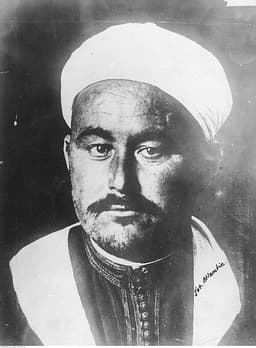
Muhammad ibn Abd al-Karim al-Khattabi
Revolutionary · Modern
41.7Total

Napoleon Bonaparte
General · Modern
70.9Total
Basic Information
Born
1854
1769
Died
1927
1821
Era
Modern
Modern
Nationality
Sudan
France
Occupation
Revolutionary
General
Civilization
Other
Western
Score Comparison
Military (10%)
47.5
94.0
Political (20%)
25.0
72.0
Influence (20%)
52.5
40.0
Legacy (20%)
40.0
80.0
Leadership (15%)
41.5
78.0
Strategy (15%)
38.3
90.0
TOTAL
41.7
70.9
Muhammad ibn Abd al-Karim al-Khattabi — Complete Timeline
1884 AD
Command at the Battle of El TebWar◆ Major
Muhammad ibn Abd al-Karim al-Khattabi led Mahdist forces at the Battle of El Teb against a British relief column. Although the Mahdists were defeated, the battle demonstrated their ability to challenge British military power in Sudan.
Mahdist WarBattle of El TebBritish Relief
Impact: regional
Participation in the Siege of KhartoumWar◆ Major
Al-Khattabi commanded Mahdist forces during the siege of Khartoum. His troops played a key role in the final assault that captured the city and killed General Gordon, contributing to the Mahdist victory.
Siege of KhartoumMahdist WarGordon's Death
Impact: regional
1899 AD
Capture by British ForcesWar◆ Major
Following the fall of the Mahdist state, al-Khattabi was captured by British forces. He was taken prisoner and later exiled, ending his military career and role in the Mahdist movement.
CaptureExileMahdist Defeat
Impact: regionaltragic
Napoleon Bonaparte — Complete Timeline
1799 AD
Coup of 18 BrumaireOther◆ Major
Napoleon Bonaparte, with support from his brother Lucien and key political figures, overthrew the Directory in a bloodless coup. He established the Consulate with himself as First Consul, effectively becoming the ruler of France. This event ended the French Revolution's most unstable period.
French RevolutionCoupRise to Power
Impact: regional
1804 AD
Promulgation of the Napoleonic CodeOther◆ Major
Napoleon enacted the Civil Code of the French, known as the Napoleonic Code, a comprehensive set of laws that replaced the fragmented feudal legal systems. The code established legal equality, protected property rights, and secularized law. It became the basis for legal systems in many European and world countries.
Legal ReformNapoleonic CodeCivil Law
Impact: globalconstructive
1805 AD
Battle of AusterlitzWar◆ Major
Napoleon's Grande Arm
Napoleonic WarsBattleDecisive Victory
Impact: global
1812 AD
Invasion of RussiaWar◆ Major
Napoleon led the Grande Arm
Napoleonic WarsInvasionDisaster
Impact: globaldestructive
1815 AD
Battle of WaterlooWar◆ Major
Napoleon's French army was defeated by the combined forces of the Duke of Wellington's Anglo-Allied army and Gebhard Leberecht von Bl
Napoleonic WarsBattleFinal Defeat
Impact: globaldestructive
Expert Analysis
muhammad-ibn-abd-al-karim-al-khattabi-vs-napoleon-bonaparte
# The Conqueror and the Commander: Two Fates in the Age of Empire
On a June morning in 1815, Napoleon Bonaparte stood on a muddy ridge near Waterloo, watching his Imperial Guard march into the muzzles of British cannon. Less than a century later, on a dusty plain in Sudan, Muhammad ibn Abd al-Karim al-Khattabi watched his own Mahdist warriors charge British machine guns at the Battle of El Teb. Both men commanded armies that believed they were fighting for God and glory. Both faced the same enemy: the expanding British Empire. One became a legend whose name still echoes in every military academy; the other faded into the footnotes of colonial history. What made the difference?
Origins
Napoleon was born in 1769 on Corsica, an island that had just become French. His family was minor nobility, struggling and ambitious. He spoke Italian before French, and his schoolmates mocked his accent. This outsider status forged something in him—a hunger to prove himself, a cold determination to climb. The French Revolution shattered the old order, and for a brilliant young artillery officer, that chaos was opportunity.
Al-Khattabi was born in 1854 in the Nile valley, into a world where the Ottoman Empire was crumbling and European powers were carving up Africa. His people, the Sudanese, had suffered under Egyptian rule and foreign exploitation. When Muhammad Ahmad declared himself the Mahdi—the prophesied redeemer of Islam—al-Khattabi joined him. He was not an outsider seeking personal glory; he was a believer fighting for a holy cause.
Rise to Power
Napoleon’s ascent was meteoric. At twenty-four, he drove the British out of Toulon. At twenty-six, he crushed a royalist uprising in Paris with a “whiff of grapeshot.” By thirty, he was First Consul, master of France. Each victory was a stepping stone: Italy, Egypt, Austerlitz. He understood that in the chaos of revolution, audacity was the only currency that mattered.
Al-Khattabi’s rise was slower, rooted in faith and endurance. He commanded at the Battle of El Teb in 1884, leading Mahdist forces against a British relief column. The British had better weapons, better training, better logistics. Al-Khattabi had courage and conviction. His forces fought fiercely but were driven back. He was not defeated in spirit, however. Later that year, he participated in the Siege of Khartoum, where his troops played a key role in the final assault that killed General Gordon. That victory was the high tide of the Mahdist state—a moment of triumph that would not last.
Leadership & Governance
Napoleon was a military genius and a political architect. His reforms—the Napoleonic Code, the centralized bureaucracy, the lycées—transformed France and influenced Europe for generations. He was ruthless in war and pragmatic in peace. He could charm diplomats and terrify generals. His leadership was personal, charismatic, and absolute. He believed he was the state.
Al-Khattabi was a commander of faith, not a builder of institutions. He led by example, sharing the hardships of his men. His strategy was shaped by the terrain and the enemy’s overwhelming firepower. He did not write codes or reform governments; he fought for survival. The Mahdist state was a theocracy, and its leaders were warriors, not administrators. When the British returned in force in 1898, the Mahdist army was shattered at Omdurman. Al-Khattabi was captured in 1899 and taken prisoner, his world reduced to exile.
Triumph & Tragedy
Napoleon’s greatest moment was Austerlitz in 1805, where he destroyed the combined armies of Russia and Austria. His tragedy was the invasion of Russia in 1812—a catastrophe of hubris and cold. He lost half a million men. He was exiled to Elba, returned, and then met Waterloo. His final years were spent on Saint Helena, dictating memoirs and blaming others.
Al-Khattabi’s triumph was Khartoum, the victory that avenged years of humiliation. His tragedy was the fall of his state and his own captivity. He was not exiled to a distant island; he was taken to Egypt, then to a prison in Wadi Halfa. He died in 1927, forgotten by most of the world, a relic of a lost war.
Character & Destiny
Napoleon was driven by ambition, ego, and a belief in his own destiny. “Impossible is a word to be found only in the dictionary of fools,” he said. He could not stop, could not consolidate. His character demanded constant conquest, and that need destroyed him.
Al-Khattabi was driven by duty and faith. He fought for a cause larger than himself. When that cause failed, he accepted his fate with dignity. He did not rage against his captors; he prayed. His character was not about personal glory but about submission to God’s will.
Legacy
Napoleon’s legacy is immense: the Napoleonic Code, the modern military staff system, the reshaping of Europe. He is studied, debated, and remembered. His name is synonymous with ambition and genius.
Al-Khattabi’s legacy is smaller, but no less real. He is remembered in Sudan as a hero of the Mahdiya, a symbol of resistance against colonialism. His story is a reminder that history belongs to the victors, but not always. In the end, both men faced the same enemy and the same fate—defeat by the British Empire. One became a giant; the other, a footnote. The difference was not courage or conviction. It was the accident of time and place, and the shape of the world they were born into.
Conclusion
Standing on the ridge at Waterloo, Napoleon watched his dreams die. Standing in the dust of El Teb, al-Khattabi watched his brothers fall. Both knew they had done everything they could. Both were, in the end, human. Their stories remind us that greatness is not a measure of victory alone. It is also measured in how we face defeat.
Rankings
🥇
Napoleon BonaparteLeader
Mil: 94.0Pol: 72.0Inf: 40.0
70.9
🥈
Muhammad ibn Abd al-Karim al-Khattabi
Mil: 47.5Pol: 25.0Inf: 52.5
41.7
+29.2 behind
How This Comparison Works
Algorithm
Each figure is scored on 6 dimensions (0—100 scale) based on structured historical data: Military (10%), Political (20%), Influence (20%), Legacy (20%), Leadership (15%), Strategy (15%). The weighted total produces the final ranking.
Data Sources
Scores are computed from structured sub-indicators in the database. Scale factors adjust for era (Ancient ×0.85, Modern ×1.0) and civilization size (Eastern ×1.05, Other ×0.80) to account for differences in population and military scale.
Maximum 3 Figures
Comparisons are limited to 2—3 figures to ensure readability and statistical meaningfulness.
Error Margins
±5 points per dimension — Sub-scores are derived from historical records with inherent uncertainty. Two figures within 5 points on a dimension should be considered roughly equivalent in that area.
Total Score Accuracy
±3 points overall — The weighted combination of 6 dimensions produces a total score with approximately ±3 points of uncertainty. Differences of less than 3 points are not statistically significant— the figures are effectively tied.
Known Limitations
- Historical records are incomplete and uneven across civilizations
- Figures from oral-tradition societies may be underrepresented
- Occupation labels can misclassify multi-role figures
- Scores measure capability and impact, not moral character
- Quantitative scoring is a comparison tool, not absolute truth
Capability Radar
Military (10%) — Battles & Warfare
Battles
35
95
Win Rate
30
90
Expansion
25
95
Political (20%) — Governance & Reform
Reform
15
95
Diplomacy
15
80
Economy
10
85
Influence (20%) — Cultural & Global Reach
Cultural
15
85
Global
10
90
Legacy (20%) — Historical Impact
Historical
20
95
Longevity
10
90
Leadership (15%) — Power & Stability
Tenure
20
85
Stability
10
70
Strategy (15%) — Tactics & Innovation
Strategy
35
95
Tactics
40
98
Reform
20
92
Similar Comparisons
Muhammad ibn Abd al-Karim al-Khattabi vs Abd el-KrimMuhammad ibn Abd al-Karim al-Khattabi vs Bal Gangadhar TilakMuhammad ibn Abd al-Karim al-Khattabi vs Theobald Wolfe ToneMuhammad ibn Abd al-Karim al-Khattabi vs Bhagat SinghMuhammad ibn Abd al-Karim al-Khattabi vs Li ZichengMuhammad ibn Abd al-Karim al-Khattabi vs Miguel Hidalgo
Comments & Discussion
No comments yet. Be the first to share your thoughts!