Loading...
Mohammad Fahim vs Sitiveni Rabuka
Sitiveni Rabuka leads by 2.0 pts · 2 figures compared
…

Mohammad Fahim
General · Modern
49.7Total
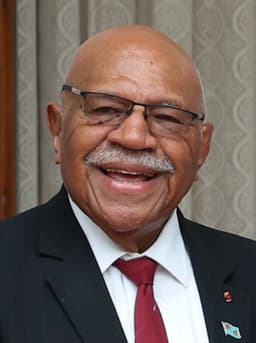
Sitiveni Rabuka
General · Modern
51.7Total
Basic Information
Born
1957
1948
Died
—
—
Era
Modern
Modern
Nationality
Afghanistan
Fiji
Occupation
General
General
Civilization
Middle Eastern
Other
Score Comparison
Military (10%)
40.0
10.2
Political (20%)
43.7
60.0
Influence (20%)
51.0
53.3
Legacy (20%)
43.3
46.7
Leadership (15%)
74.0
85.0
Strategy (15%)
45.0
39.6
TOTAL
49.7
51.7
Mohammad Fahim — Complete Timeline
2001 AD
Led Northern Alliance Forces in Fall of KabulWar
Mohammad Fahim, as a senior Northern Alliance commander, led forces that captured Kabul from the Taliban in November 2001. This victory followed the US invasion and was a turning point in the war, leading to the collapse of Taliban rule.
AfghanistanWarTaliban
Impact: national
Appointed Vice President of AfghanistanPolitical Action◆ Major
Mohammad Fahim was appointed Vice President of Afghanistan under Hamid Karzai in 2001, serving until 2004. He was a key Northern Alliance commander and his appointment was part of the post-Taliban power-sharing arrangement.
AfghanistanVice PresidencyNorthern Alliance
Impact: nationalconstructive
Served as Minister of DefensePolitical Action◆ Major
Mohammad Fahim served as Afghanistan's Minister of Defense from 2001 to 2004. He oversaw the formation of the new Afghan National Army and security forces, integrating former mujahideen and Northern Alliance fighters.
AfghanistanDefenseMilitary
Impact: nationalconstructive
2009 AD
Appointed First Vice President in 2009Political Action◆ Major
Mohammad Fahim was appointed First Vice President of Afghanistan under President Hamid Karzai in 2009. He served until his death in 2014, playing a key role in security and political affairs.
AfghanistanVice PresidencyGovernment
Impact: nationalconstructive
Sitiveni Rabuka — Complete Timeline
1987 AD
1987 Fijian Coup d'étatPolitical Action
Rabuka, as a colonel in the Fijian military, led a coup overthrowing the elected government of Timoci Bavadra. The coup was motivated by ethnic Fijian opposition to Indo-Fijian political influence. Rabuka declared Fiji a republic.
CoupMilitary InterventionEthnic Tension
Impact: nationaldestructive
1992 AD
1992 Election as Prime MinisterPolitical Action◆ Major
Rabuka transitioned from military leader to civilian politician, winning the 1992 general election as leader of the Fijian Political Party. He became Prime Minister, serving until 1999.
ElectionCivilian GovernmentPolitical Transition
Impact: national
1997 AD
1997 Constitution ReformReform◆ Major
Rabuka's government oversaw the adoption of a new constitution that removed ethnic-based voting and provided for a multi-ethnic government. The constitution aimed to reduce ethnic tensions and promote national unity.
ConstitutionReformEthnic Reconciliation
Impact: nationalconstructive
1999 AD
1999 General Election DefeatPolitical Action◆ Major
Rabuka's government was defeated in the general election by the Labour Party led by Mahendra Chaudhry. Rabuka stepped down as Prime Minister, marking the end of his first period in power.
Election DefeatGovernment ChangeChaudhry
Impact: national
2022 AD
2022 Return as Prime MinisterPolitical Action◆ Major
Rabuka led the People's Alliance to victory in the 2022 general election, forming a coalition government. He became Prime Minister again, 23 years after his previous tenure, promising democratic reforms.
ElectionReturn to PowerCoalition Government
Impact: national
Expert Analysis
Sitiveni Rabuka vs Mohammad Fahim
# The General Who Came Back
On a humid May morning in 1987, a colonel in the Fijian military marched into parliament in Suva, ordered the elected government to lay down its arms, and changed his nation’s destiny forever. Half a world away and fourteen years later, another commander—this one with a long beard and a Kalashnikov slung across his back—rode into Kabul at the head of a ragged army that had just toppled the Taliban. Both men were generals. Both would become vice presidents or prime ministers. But their paths diverged in ways that reveal something profound about the relationship between military power and democratic rule.
Sitiveni Rabuka was born in 1948 on the island of Vanua Levu, the son of a government clerk. Fiji was still a British colony, a place of layered ethnic tensions between indigenous Fijians and the Indo-Fijian descendants of indentured laborers brought by the empire. Rabuka grew up in a world where rugby, church, and chiefly hierarchy defined male ambition. He joined the army young, rose through the ranks, and by 1987 was a colonel—fit, charismatic, and deeply worried that the newly elected government of Timoci Bavadra, led by a coalition that included Indo-Fijian politicians, would erode indigenous land rights and political control.
Mohammad Fahim was born in 1957 in the Panjshir Valley of Afghanistan, a land of steep cliffs and fierce independence. His family were Tajiks, a minority in a country long dominated by Pashtuns. The Soviet invasion of 1979 turned Fahim’s world into a war zone. He joined the mujahideen resistance under the legendary commander Ahmad Shah Massoud, learning guerrilla warfare in the mountains. When the Soviets withdrew and the Taliban rose, Fahim became one of Massoud’s most trusted lieutenants—a man forged in the crucible of endless conflict, where survival meant constant vigilance and violence was the only language that mattered.
Rise to Power
Rabuka’s entry onto the historical stage was sudden and theatrical. On May 14, 1987, he led ten masked soldiers into parliament, arrested the prime minister, and announced on radio that he had taken control. He claimed he was protecting indigenous Fijian interests. The coup was bloodless, almost polite by global standards—but it shattered Fiji’s democracy. Rabuka initially handed power to a civilian governor-general, then staged a second coup in September when negotiations faltered. By 1992, he had reinvented himself: he resigned from the military, formed a political party, and won the general election as prime minister. It was an astonishing pivot from coup leader to elected head of government.
Fahim’s rise was slower, harder, and soaked in blood. After Massoud’s assassination by al-Qaeda on September 9, 2001—just two days before the 9/11 attacks—Fahim inherited command of the Northern Alliance. When the United States invaded Afghanistan that October, Fahim became Washington’s key ally on the ground. His forces, armed with American air support and cash, swept into Kabul on November 13, 2001, ending Taliban rule. Within weeks, Fahim was appointed Vice President and Minister of Defense under Hamid Karzai. He had gone from mountain guerrilla to the second-most-powerful man in Afghanistan almost overnight.
Leadership & Governance
Rabuka governed as a reformer, not a dictator. His military score of 19.9 reflects that he was never a battlefield commander; his genius lay in political navigation. As prime minister from 1992 to 1999, he pushed through the landmark 1997 Constitution, which abolished ethnic-based voting and created a multiracial electoral system. It was a remarkable act for a man who had seized power to protect indigenous supremacy. Rabuka admitted later that he had been wrong, that the coup had damaged Fiji. He governed with a soft touch, preferring consensus to confrontation, and when he lost the 1999 election to Mahendra Chaudhry, an Indo-Fijian, he stepped down peacefully. The coup leader had become a democrat.
Fahim, by contrast, was a warlord in a suit. His military score of 57.3 reflects genuine combat experience, but his political instincts were crude. As Defense Minister, he was accused of packing the army with his own Tajik loyalists from the Panjshir, alienating Pashtuns and other ethnic groups. He amassed enormous wealth through control of customs and smuggling routes. Karzai, under American pressure, dropped Fahim as vice president in 2004, only to reappoint him in 2009 as a necessary evil to keep the Northern Alliance factions inside the government. Fahim never reformed, never apologized, never evolved. He remained what he had always been: a commander who happened to hold political office.
Triumph & Tragedy
Rabuka’s greatest moment came in 1997, when he shepherded a constitution that explicitly rejected the ethnic nationalism that had justified his coup. It was a triumph of humility over ego. His tragedy was that the constitution did not hold—another coup in 2000, led by George Speight, undid much of his work. But Rabuka’s later return to power in 2022, at age 74, leading a coalition government, was a quiet vindication. He had become a symbol of redemption, proof that even a man who breaks democracy can learn to love it.
Fahim’s triumph was the fall of Kabul in 2001—a moment of liberation for millions. His tragedy was that he never built anything lasting. He died in 2014, still a wealthy, powerful figure, but his legacy was a fractured army, a corrupt ministry, and a government that collapsed to the Taliban again in 2021. He had won the war but lost the peace.
Character & Destiny
Rabuka was shaped by guilt. He once said, “I did what I thought was right, but I was wrong.” That capacity for self-reflection drove his transformation. Fahim was shaped by survival. He never doubted that force was the ultimate answer. Rabuka could afford to change because Fiji, for all its tensions, was a small island nation with a functioning civil service and a tradition of compromise. Fahim could not change because Afghanistan was a graveyard of empires, where mercy was weakness and trust was death. Their personalities were products of their worlds.
Legacy
Rabuka is remembered in Fiji as a flawed but genuine statesman—the man who broke democracy and then helped rebuild it. His scores—Political 72.0, Leadership 77.4, Legacy 61.2—reflect a figure who matters more for his arc than his peak. Fahim’s scores—Leadership 75.8, Influence 67.1, Legacy 56.7—capture a man of power but not principle. He is remembered as a necessary ally in America’s war, but also as a symbol of the corruption and ethnic factionalism that doomed the Afghan republic.
Conclusion
Two generals, two nations, two very different endings. Rabuka’s story suggests that even those who seize power by force can learn to surrender it. Fahim’s story suggests that survival alone is not enough. In the end, the difference was not in their ambitions but in their capacity to change—and in the countries that gave them room to do so.
Rankings
🥇
Sitiveni RabukaLeader
Mil: 10.2Pol: 60.0Inf: 53.3
51.7
🥈
Mohammad Fahim
Mil: 40.0Pol: 43.7Inf: 51.0
49.7
+2.0 behind
How This Comparison Works
Algorithm
Each figure is scored on 6 dimensions (0—100 scale) based on structured historical data: Military (10%), Political (20%), Influence (20%), Legacy (20%), Leadership (15%), Strategy (15%). The weighted total produces the final ranking.
Data Sources
Scores are computed from structured sub-indicators in the database. Scale factors adjust for era (Ancient ×0.85, Modern ×1.0) and civilization size (Eastern ×1.05, Other ×0.80) to account for differences in population and military scale.
Maximum 3 Figures
Comparisons are limited to 2—3 figures to ensure readability and statistical meaningfulness.
Error Margins
±5 points per dimension — Sub-scores are derived from historical records with inherent uncertainty. Two figures within 5 points on a dimension should be considered roughly equivalent in that area.
Total Score Accuracy
±3 points overall — The weighted combination of 6 dimensions produces a total score with approximately ±3 points of uncertainty. Differences of less than 3 points are not statistically significant— the figures are effectively tied.
Known Limitations
- Historical records are incomplete and uneven across civilizations
- Figures from oral-tradition societies may be underrepresented
- Occupation labels can misclassify multi-role figures
- Scores measure capability and impact, not moral character
- Quantitative scoring is a comparison tool, not absolute truth
Capability Radar
Military (10%) — Battles & Warfare
Battles
35
5
Win Rate
40
5
Expansion
25
5
Political (20%) — Governance & Reform
Reform
20
50
Diplomacy
40
45
Economy
15
40
Influence (20%) — Cultural & Global Reach
Cultural
15
30
Global
20
20
Legacy (20%) — Historical Impact
Historical
30
40
Longevity
20
30
Leadership (15%) — Power & Stability
Tenure
45
55
Stability
20
35
Strategy (15%) — Tactics & Innovation
Strategy
35
10
Tactics
30
10
Reform
20
5
Similar Comparisons
Comments & Discussion
No comments yet. Be the first to share your thoughts!