Loading...
Mohammad Fahim vs Prem Tinsulanonda
Prem Tinsulanonda leads by 7.5 pts · 2 figures compared
…

Mohammad Fahim
General · Modern
49.7Total
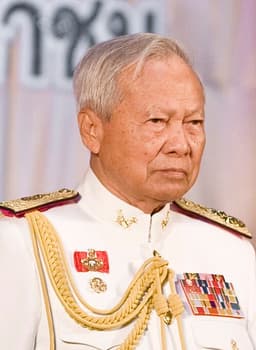
Prem Tinsulanonda
General · Modern
57.2Total
Basic Information
Born
1957
1920
Died
—
—
Era
Modern
Modern
Nationality
Afghanistan
Thailand
Occupation
General
General
Civilization
Middle Eastern
Eastern
Score Comparison
Military (10%)
40.0
50.0
Political (20%)
43.7
59.3
Influence (20%)
51.0
54.9
Legacy (20%)
43.3
47.5
Leadership (15%)
74.0
78.0
Strategy (15%)
45.0
60.0
TOTAL
49.7
57.2
Mohammad Fahim — Complete Timeline
2001 AD
Led Northern Alliance Forces in Fall of KabulWar
Mohammad Fahim, as a senior Northern Alliance commander, led forces that captured Kabul from the Taliban in November 2001. This victory followed the US invasion and was a turning point in the war, leading to the collapse of Taliban rule.
AfghanistanWarTaliban
Impact: national
Appointed Vice President of AfghanistanPolitical Action◆ Major
Mohammad Fahim was appointed Vice President of Afghanistan under Hamid Karzai in 2001, serving until 2004. He was a key Northern Alliance commander and his appointment was part of the post-Taliban power-sharing arrangement.
AfghanistanVice PresidencyNorthern Alliance
Impact: nationalconstructive
Served as Minister of DefensePolitical Action◆ Major
Mohammad Fahim served as Afghanistan's Minister of Defense from 2001 to 2004. He oversaw the formation of the new Afghan National Army and security forces, integrating former mujahideen and Northern Alliance fighters.
AfghanistanDefenseMilitary
Impact: nationalconstructive
2009 AD
Appointed First Vice President in 2009Political Action◆ Major
Mohammad Fahim was appointed First Vice President of Afghanistan under President Hamid Karzai in 2009. He served until his death in 2014, playing a key role in security and political affairs.
AfghanistanVice PresidencyGovernment
Impact: nationalconstructive
Prem Tinsulanonda — Complete Timeline
1980 AD
Appointed Prime Minister after a coupPolitical Action◆ Major
Prem Tinsulanonda was appointed Prime Minister of Thailand by the military after a coup. He served for over eight years, overseeing a period of political stability and economic growth.
Prime MinisterMilitary RuleStability
Impact: national
1981 AD
Survived a coup attemptPolitical Action◆ Major
Prem survived a coup attempt by military officers loyal to the 'Young Turks' faction. The coup failed due to lack of support and the loyalty of key military units, allowing Prem to remain in power.
Coup AttemptPolitical CrisisMilitary
Impact: national
1988 AD
Resigned as Prime MinisterPolitical Action◆ Major
Prem resigned as Prime Minister after the general election, handing over power to a civilian government led by Chatichai Choonhavan. His resignation marked a rare peaceful transition of power in Thai politics.
ResignationDemocratic TransitionPeaceful
Impact: nationalconstructive
2016 AD
Appointed Regent of ThailandPolitical Action
After the death of King Bhumibol, Prem was appointed Regent of Thailand until the ascension of King Maha Vajiralongkorn. He served as a key figure in the transition of the monarchy.
RegentMonarchyTransition
Impact: national
Expert Analysis
Prem Tinsulanonda vs Mohammad Fahim
# The General Who Stepped Back, and the General Who Stepped Forward
In the summer of 1981, a small group of army officers in Bangkok surrounded the prime minister’s residence, confident they would seize power within hours. Across the world, in the mountains of northern Afghanistan, another general was learning to fight a war with nothing but captured rifles and the loyalty of his men. Both were military men thrust into politics, but their paths would diverge in ways that reveal the deepest currents of their nations. Why did one choose to hand over power voluntarily, while the other clung to it until death? The answer lies not just in the men themselves, but in the worlds that forged them.
Origins
Prem Tinsulanonda was born in 1920 in Songkhla, a quiet coastal province in southern Thailand, into a family of modest means. His father was a schoolteacher, his mother a homemaker. The young Prem grew up in the shadow of absolute monarchy, a system that would collapse when he was just twelve. He entered military academy in the 1930s, a time when Thailand’s army was becoming the arbiter of national destiny. He learned discipline, hierarchy, and the art of serving a king whose authority was sacred even after the 1932 revolution.
Mohammad Fahim was born in 1957 in the Panjshir Valley of Afghanistan, a place of jagged peaks and fierce independence. His father was a local landowner, but the family’s real inheritance was a tradition of resistance. When the Soviet Union invaded in 1979, Fahim was a young army officer. He defected to the mujahideen, joining the Northern Alliance under the legendary Ahmad Shah Massoud. Here, survival was the only curriculum. Loyalty was earned in blood, and betrayal was a constant threat.
Rise to Power
Prem’s ascent was slow, measured, and institutional. He rose through the ranks of the Thai army, never commanding a battlefield but mastering the politics of the barracks. In 1980, after a coup ousted the civilian government, the military appointed him prime minister. He was sixty years old, a general with no personal ambition for the throne—a safe pair of hands. His appointment was a compromise between rival factions, and he understood from the start that his power was borrowed.
Fahim’s rise was forged in fire. When Massoud was assassinated by al-Qaeda on September 9, 2001, just two days before 9/11, Fahim inherited command of the Northern Alliance. He was forty-four, a battlefield commander with a reputation for ruthlessness. Two months later, as American bombs pounded Taliban positions, Fahim led his forces into Kabul. The city fell on November 13, 2001. He was suddenly not just a warlord but a national figure, and within weeks he was appointed Vice President and Minister of Defense under Hamid Karzai.
Leadership & Governance
Prem governed Thailand for eight years, from 1980 to 1988, with a style that was patient, conciliatory, and deeply conservative. He survived a coup attempt in 1981 by the “Young Turks” faction—younger officers who wanted faster reforms. Instead of crushing them, he negotiated, offering amnesty to many. His political wisdom lay in knowing when to yield. He stabilized the economy after years of instability, but he never sought to transform Thailand. His leadership score of 89.0 reflects this: not a visionary, but a steady hand who kept the ship afloat.
Fahim’s governance was the opposite. As Defense Minister, he oversaw the creation of a new Afghan army from scratch, but he was also accused of building a personal power base, appointing fellow Tajiks to key positions, and tolerating corruption. His political score of 56.5 tells a story of a commander who never fully transitioned to statesman. He was a creature of war, and peace did not suit him. His military genius—scoring 57.3—was real but limited to guerrilla tactics; his strategy score of 48.9 suggests he was no grand strategist.
Triumph & Tragedy
Prem’s greatest triumph was his resignation. In 1988, after a general election, he stepped down voluntarily, handing power to a civilian government led by Chatichai Choonhavan. This was almost unheard of in a country where military strongmen typically clung to power. He had served for eight years, longer than any elected prime minister, and he chose to leave. It was an act of political maturity that preserved Thailand’s fragile democracy.
Fahim’s triumph was the fall of Kabul. Leading his forces into the capital was a moment of vindication after years of fighting the Taliban. But his tragedy was that he could not build on it. He was reappointed Vice President in 2009, but his influence waned. When he died in 2014, he left behind a fractured political system and a growing insurgency. His legacy score of 56.7 reflects a man who won a battle but lost the peace.
Character & Destiny
Prem was a man of discipline and restraint. He once said, “Power is like a shadow—it follows you only when you walk away from it.” His personality was shaped by the Thai concept of *kreng jai*—deference and respect for hierarchy. He saw himself as a servant of the king, not a ruler. This humility allowed him to survive multiple coups and retire with dignity.
Fahim was shaped by war. He trusted only his inner circle, and his personality was marked by suspicion and ambition. He once told a journalist, “In Afghanistan, power is a gun and a bag of money.” He was not wrong, but this worldview made him unable to build the institutions that could outlast him. His character was a product of his environment—a world where the only law was the Kalashnikov.
Legacy
Today, Prem Tinsulanonda is remembered as a stabilizing figure, a regent who served after King Bhumibol’s death in 2016, and a symbol of military professionalism. His total score of 68.4 places him as a competent but not transformative leader. He is studied as an example of how a general can step back from power.
Mohammad Fahim is remembered more ambivalently. He is honored by the Tajik community as a hero of the anti-Taliban struggle, but criticized by others for his role in the corruption and warlordism that plagued post-2001 Afghanistan. His total score of 60.5 reflects a life of high stakes and incomplete achievements.
Conclusion
Standing at the end of their stories, we see two generals who faced similar choices but made different ones. Prem chose to yield; Fahim chose to hold. One preserved a fragile democracy; the other left a vacuum that the Taliban would eventually fill. Their differences were not just personal but structural: Thailand’s monarchy and bureaucracy provided a framework that rewarded restraint; Afghanistan’s chaos rewarded force. In the end, the question is not who was the better general, but what kind of system allows a soldier to become a statesman. The answer, as their lives show, is everything.
Rankings
🥇
Prem TinsulanondaLeader
Mil: 50.0Pol: 59.3Inf: 54.9
57.2
🥈
Mohammad Fahim
Mil: 40.0Pol: 43.7Inf: 51.0
49.7
+7.5 behind
How This Comparison Works
Algorithm
Each figure is scored on 6 dimensions (0—100 scale) based on structured historical data: Military (10%), Political (20%), Influence (20%), Legacy (20%), Leadership (15%), Strategy (15%). The weighted total produces the final ranking.
Data Sources
Scores are computed from structured sub-indicators in the database. Scale factors adjust for era (Ancient ×0.85, Modern ×1.0) and civilization size (Eastern ×1.05, Other ×0.80) to account for differences in population and military scale.
Maximum 3 Figures
Comparisons are limited to 2—3 figures to ensure readability and statistical meaningfulness.
Error Margins
±5 points per dimension — Sub-scores are derived from historical records with inherent uncertainty. Two figures within 5 points on a dimension should be considered roughly equivalent in that area.
Total Score Accuracy
±3 points overall — The weighted combination of 6 dimensions produces a total score with approximately ±3 points of uncertainty. Differences of less than 3 points are not statistically significant— the figures are effectively tied.
Known Limitations
- Historical records are incomplete and uneven across civilizations
- Figures from oral-tradition societies may be underrepresented
- Occupation labels can misclassify multi-role figures
- Scores measure capability and impact, not moral character
- Quantitative scoring is a comparison tool, not absolute truth
Capability Radar
Military (10%) — Battles & Warfare
Battles
35
20
Win Rate
40
25
Expansion
25
10
Political (20%) — Governance & Reform
Reform
20
55
Diplomacy
40
60
Economy
15
50
Influence (20%) — Cultural & Global Reach
Cultural
15
30
Global
20
30
Legacy (20%) — Historical Impact
Historical
30
40
Longevity
20
35
Leadership (15%) — Power & Stability
Tenure
45
65
Stability
20
60
Strategy (15%) — Tactics & Innovation
Strategy
35
30
Tactics
30
30
Reform
20
35
Similar Comparisons
Comments & Discussion
山地狐老6/16/2026
普雷姆懂泰王心,法希姆只会搂钱。八一年那场未遂政变,普雷姆保住了炳·廷素拉暖政府,这才是真功夫。法希姆呢?马苏德死了,他捡现成便宜,成了哈米德·卡尔扎伊的副手,还霸着国防部不放。两个军人一个退得漂亮,一个死得丑陋。你说,权力这玩意儿,到底是该握紧还是该松开?
Historian6076/16/2026
Prem Tinsulanonda represents the rare military leader who understood that true power sometimes lies in stepping away. When the 1992 Black May uprising erupted, he didn't send tanks—he facilitated the king's intervention. That's strategic genius, not weakness. Meanwhile, Fahim grabbed power after 9/11 and built a Northern Alliance fiefdom. Lavished $200 million on his birthday party while Afghanistan burned. One man saw the palace as a trust; the other saw the treasury as a buffet.