Loading...
Mohammad Fahim vs Mohan Singh
Mohammad Fahim leads by 3.1 pts · 2 figures compared
…

Mohammad Fahim
General · Modern
49.7Total
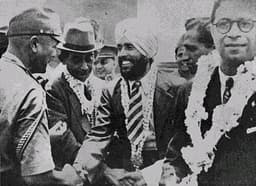
Mohan Singh
General · Modern
46.6Total
Basic Information
Born
1957
1909
Died
—
1989
Era
Modern
Modern
Nationality
Afghanistan
India
Occupation
General
General
Civilization
Middle Eastern
Indian
Score Comparison
Military (10%)
40.0
50.0
Political (20%)
43.7
36.5
Influence (20%)
51.0
57.2
Legacy (20%)
43.3
48.3
Leadership (15%)
74.0
36.9
Strategy (15%)
45.0
41.7
TOTAL
49.7
46.6
Mohammad Fahim — Complete Timeline
2001 AD
Led Northern Alliance Forces in Fall of KabulWar
Mohammad Fahim, as a senior Northern Alliance commander, led forces that captured Kabul from the Taliban in November 2001. This victory followed the US invasion and was a turning point in the war, leading to the collapse of Taliban rule.
AfghanistanWarTaliban
Impact: national
Appointed Vice President of AfghanistanPolitical Action◆ Major
Mohammad Fahim was appointed Vice President of Afghanistan under Hamid Karzai in 2001, serving until 2004. He was a key Northern Alliance commander and his appointment was part of the post-Taliban power-sharing arrangement.
AfghanistanVice PresidencyNorthern Alliance
Impact: nationalconstructive
Served as Minister of DefensePolitical Action◆ Major
Mohammad Fahim served as Afghanistan's Minister of Defense from 2001 to 2004. He oversaw the formation of the new Afghan National Army and security forces, integrating former mujahideen and Northern Alliance fighters.
AfghanistanDefenseMilitary
Impact: nationalconstructive
2009 AD
Appointed First Vice President in 2009Political Action◆ Major
Mohammad Fahim was appointed First Vice President of Afghanistan under President Hamid Karzai in 2009. He served until his death in 2014, playing a key role in security and political affairs.
AfghanistanVice PresidencyGovernment
Impact: nationalconstructive
Mohan Singh — Complete Timeline
1942 AD
Founding of the Indian National ArmyPolitical Action◆ Major
Mohan Singh founded the Indian National Army (INA) in Singapore with captured Indian soldiers from the British Indian Army. He aimed to fight alongside Japan for Indian independence, but later fell out with Japanese leadership.
Indian National ArmyWorld War IIIndependence
Impact: nationalconstructive
Dissolution of the First INAPolitical Action◆ Major
Mohan Singh dissolved the first Indian National Army after disagreements with the Japanese over its command and objectives. He was arrested by the Japanese, and the INA was later revived by Subhas Chandra Bose.
Indian National ArmyJapanese ConflictDissolution
Impact: nationaldestructive
1945 AD
Imprisonment by BritishPolitical Action
Mohan Singh was imprisoned by the British after World War II for his role in the INA. He was tried and sentenced, but later released after Indian independence, becoming a symbol of resistance.
ImprisonmentBritish EmpireINA
Impact: nationaltragic
Expert Analysis
Mohammad Fahim vs Mohan Singh
### The General Who Raised an Army, and the General Who Took a City
In the humid, desperate summer of 1942, a Sikh officer in the British Indian Army stood before thousands of captured Indian soldiers in Japanese-occupied Singapore. He asked them to trade their loyalty to the King-Emperor for a dream: a free India, won by Indian arms. Fifty-nine years later, in the dust-choked autumn of 2001, another general, a Tajik commander from the Panjshir Valley, rode a horse into the ruins of Kabul, his men sweeping the streets of a defeated Taliban. Both men were generals, both fought against empires, and both saw the pinnacle of power. But one faded into a footnote, while the other became a vice president. The difference lies not in their courage, but in the architecture of their ambition and the shape of the world that received them.
### Origins
Mohan Singh was born in 1909 in the Punjab, a land of soldiers and farmers. He was a product of the British Indian Army—a professional, disciplined institution that taught him order, hierarchy, and the art of command. His world was one of regimental colors, mess dinners, and the quiet, grinding loyalty of a colonial officer. He was a man of the Raj, and he knew its strengths intimately. The British had made him a leader of men; they had also made him a subject.
Mohammad Fahim, born in 1957, knew a different kind of warfare. He was a child of the Afghan civil wars, a world of shifting alliances, mountain ambushes, and Soviet helicopters. He rose not through a standing army but through the Northern Alliance, a coalition of warlords and ethnic militias. His teacher was Ahmad Shah Massoud, the Lion of Panjshir, who taught him that survival meant constant maneuver. Fahim’s world was one of personal loyalty, tribal networks, and the brutal calculus of who could supply the next truck of ammunition.
### Rise to Power
Mohan Singh’s rise was sudden and dramatic. In 1942, as a major in the British Indian Army, he was captured by the Japanese after the fall of Singapore. The Japanese, seeking to destabilize British rule, offered him a chance: lead a liberation army of Indian prisoners of war. He accepted. In a matter of months, he founded the Indian National Army (INA), a force of over 40,000 men. It was a staggering achievement—a national army born in captivity, forged in the crucible of defeat. But his power was borrowed. The Japanese held the guns, the supplies, and the strategic leash. When Mohan Singh insisted on the INA’s independence, demanding that it not be a puppet force, the Japanese balked. By December 1942, he dissolved his own creation, disillusioned and outmaneuvered.
Fahim’s rise was longer and more brutal. He fought the Soviet occupation in the 1980s, then the Taliban in the 1990s. He was a commander of the Northern Alliance, a force that controlled only a sliver of the country. His turning point came on September 9, 2001, when al-Qaeda assassins killed Massoud. Fahim inherited the leadership of the alliance. Two days later, the Twin Towers fell. The United States, needing a ground force to topple the Taliban, turned to the Northern Alliance. Fahim was suddenly the man with the horses and the maps. In November 2001, he led the capture of Kabul. He had not created a nation’s army from scratch; he had ridden a wave of global war into the capital.
### Leadership & Governance
Mohan Singh was a visionary, not a politician. He believed in the purity of the cause—a free India, independent of both Britain and Japan. He refused to compromise, even when compromise might have saved his army. His military score of 38.7 reflects a man who could inspire but not command a campaign. He did not lead battles; he led a parade of prisoners. His political score of 72.0 suggests a shrewd understanding of nationalist sentiment, but he lacked the Machiavellian patience to build a lasting structure. When the Japanese refused his terms, he simply walked away.
Fahim was a pragmatist. His military score of 57.3 is modest, but his leadership score of 75.8 reveals a man who could hold a coalition together. He did not fight for ideological purity; he fought for territory, then for a seat at the table. As Minister of Defense from 2001 to 2004, he oversaw the creation of the new Afghan army—a task that required bribing, threatening, and negotiating with former warlords. He was not a reformer; he was a broker. He understood that in Afghanistan, power meant personal loyalty, not national institutions.
### Triumph & Tragedy
Mohan Singh’s greatest moment was the creation of the INA. It was a moral triumph—a declaration that Indian soldiers could fight for their own freedom. His tragedy was that he could not sustain it. He was imprisoned by the British in 1945, tried, and sentenced. But the trial itself became a rallying cry for Indian nationalism, and he was later released. He lived until 1989, a forgotten figure, watching Subhas Chandra Bose—who took over the INA after him—become the legend.
Fahim’s triumph was the fall of Kabul in 2001. He was the general who ended the Taliban’s rule. His tragedy was the peace that followed. He was appointed Vice President in 2001, then again in 2009. But he was never a statesman. He was accused of corruption, of running a personal fiefdom, of enriching his clan. He died in 2014, a powerful man but not a beloved one. His legacy is the irony that the man who helped liberate Afghanistan also helped entrench its warlord politics.
### Character & Destiny
Mohan Singh was a man of principle. He believed in the idea of a free India so deeply that he would rather dissolve his army than let it be a tool of Japanese imperialism. That purity made him a martyr, but it also made him a failure. Fahim was a man of survival. He believed in the idea of power—his power, his clan’s power. He would rather compromise a thousand times than lose his seat. That pragmatism made him a vice president, but it also made him a symbol of the old Afghanistan that never quite died.
### Legacy
Mohan Singh is remembered as the founder of the INA, the man who lit the torch before Bose carried it. In India, his name is a footnote in textbooks, overshadowed by Bose’s charisma. His legacy score of 65.0 reflects a man who mattered, but whose moment passed. Fahim’s legacy score of 56.7 is lower, but his impact is more ambiguous. He is remembered as a warlord who became a statesman, a man who helped end a war but could not build a peace. In Afghanistan, his name is spoken with a mix of respect and resentment.
### Conclusion
Two generals, two wars, two different kinds of failure. Mohan Singh failed because he would not bend his principles; Fahim failed because he bent them too far. One dreamed of a nation, the other of a position. In the end, the world remembers the dreamer, but it follows the pragmatist. Perhaps that is the cruel arithmetic of history: the pure are honored, but the flexible survive. Both men were generals without armies in the end—Singh because he gave his up, Fahim because he never really had one. They remind us that the hardest battle is not against an enemy, but against the shape of the world you are born into.
Rankings
🥇
Mohammad FahimLeader
Mil: 40.0Pol: 43.7Inf: 51.0
49.7
🥈
Mohan Singh
Mil: 50.0Pol: 36.5Inf: 57.2
46.6
+3.1 behind
How This Comparison Works
Algorithm
Each figure is scored on 6 dimensions (0—100 scale) based on structured historical data: Military (10%), Political (20%), Influence (20%), Legacy (20%), Leadership (15%), Strategy (15%). The weighted total produces the final ranking.
Data Sources
Scores are computed from structured sub-indicators in the database. Scale factors adjust for era (Ancient ×0.85, Modern ×1.0) and civilization size (Eastern ×1.05, Other ×0.80) to account for differences in population and military scale.
Maximum 3 Figures
Comparisons are limited to 2—3 figures to ensure readability and statistical meaningfulness.
Error Margins
±5 points per dimension — Sub-scores are derived from historical records with inherent uncertainty. Two figures within 5 points on a dimension should be considered roughly equivalent in that area.
Total Score Accuracy
±3 points overall — The weighted combination of 6 dimensions produces a total score with approximately ±3 points of uncertainty. Differences of less than 3 points are not statistically significant— the figures are effectively tied.
Known Limitations
- Historical records are incomplete and uneven across civilizations
- Figures from oral-tradition societies may be underrepresented
- Occupation labels can misclassify multi-role figures
- Scores measure capability and impact, not moral character
- Quantitative scoring is a comparison tool, not absolute truth
Capability Radar
Military (10%) — Battles & Warfare
Battles
35
15
Win Rate
40
10
Expansion
25
10
Political (20%) — Governance & Reform
Reform
20
25
Diplomacy
40
30
Economy
15
10
Influence (20%) — Cultural & Global Reach
Cultural
15
30
Global
20
25
Legacy (20%) — Historical Impact
Historical
30
40
Longevity
20
30
Leadership (15%) — Power & Stability
Tenure
45
20
Stability
20
10
Strategy (15%) — Tactics & Innovation
Strategy
35
25
Tactics
30
20
Reform
20
30
Similar Comparisons
Comments & Discussion
李广贰6/16/2026
莫汉·辛格是个被历史低估的悲剧英雄——他在新加坡用日本人的战俘营,硬是拉出了一支两万人的印度国民军。这不是投降,这是借壳生蛋。相比之下,法希姆不过是苏联溃败后,靠着潘杰希尔的山地幸存者捡了喀布尔的便宜。一个自己造了把钥匙,一个捡了把掉在地上的钥匙。你说谁更有种?
PanjshirPundit6/16/2026
Fahim wasn't just a general—he was the Taliban's disaster capitalist. He turned a civil war into a real estate empire, pocketing millions while his men fought. Singh, for all his flaws, never profited personally from the INA. He was a nationalist, not a warlord. Fahim died a multi-millionaire vice president. Singh died bitter, broke, and forgotten. History remembers saints and sinners—but it forgets the corrupt ones who just got lucky.
蓝帽书生6/16/2026
说莫汉·辛格是个失败者,那是以西方胜败论英雄的偏见。别忘了,他组织的印度国民军后来成了尼赫鲁政治谈判的底牌——没有那支武装,英国人不会那么痛快放手。法希姆呢?他当了副总统,结果连个像样的继承人都没留下,死后阿富汗照样乱成一锅粥。辛格输在当下,赢在历史大势;法希姆赢在当下,输给了未来。谁更可悲?
Historian2586/16/2026
Mohan Singh didn't just surrender—he built an army from scratch in a prison camp. That takes real organizational guts. Fahim rode into Kabul with Northern Alliance tanks and a seat at the U.S. table. One man created a military institution where none existed; the other inherited a war machine and stayed afloat on foreign air power. Singh's failure was political, not military. Fahim's success was circumstantial, not strategic. Big difference.
Historian5426/16/2026
Fact check: Fahim commanded maybe 15,000 men at his peak, while Singh raised over 40,000. Numbers don't lie. Fahim's "capture" of Kabul was a photo op—the Taliban had already fled. Singh's INA actually fought the British at Imphal and Kohima, bleeding real blood. One was a real general who lost; the other was a lucky warlord who won. I'll take the loser with a real army over the "winner" with a staged victory any day.