Loading...
Afonso de Albuquerque vs Mohammad Fahim
Afonso de Albuquerque leads by 29.9 pts · 2 figures compared
…
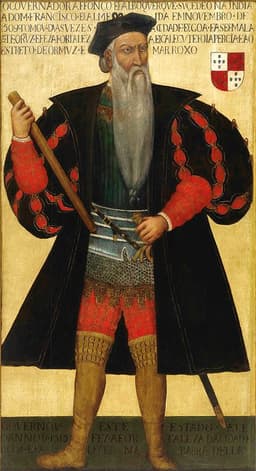
Afonso de Albuquerque
General · Medieval
79.6Total

Mohammad Fahim
General · Modern
49.7Total
Basic Information
Born
1453
1957
Died
1515
—
Era
Medieval
Modern
Nationality
Portugal
Afghanistan
Occupation
General
General
Civilization
Western
Middle Eastern
Score Comparison
Military (10%)
77.5
40.0
Political (20%)
88.0
43.7
Influence (20%)
80.0
51.0
Legacy (20%)
75.0
43.3
Leadership (15%)
78.0
74.0
Strategy (15%)
82.0
45.0
TOTAL
79.6
49.7
Afonso de Albuquerque — Complete Timeline
1503 AD
First voyage to IndiaWar◆ Major
Afonso de Albuquerque led a fleet to India, establishing the first Portuguese fort at Cochin. This voyage laid the foundation for Portuguese control of the Indian Ocean trade.
ExplorationColonialismIndia
Impact: global
1510 AD
Conquest of GoaWar◆ Major
Albuquerque captured Goa from the Sultan of Bijapur. He made Goa the capital of Portuguese India, a position it held for over 400 years.
ConquestColonialismIndia
Impact: regional
1511 AD
Conquest of MalaccaWar◆ Major
Albuquerque led a Portuguese fleet to capture the strategic port of Malacca. This gave Portugal control of the spice trade route between the Indian Ocean and the Pacific.
ConquestSpice TradeSoutheast Asia
Impact: global
1513 AD
Siege of AdenWar
Albuquerque attempted to capture Aden in Yemen but failed. This failure prevented Portugal from controlling the entrance to the Red Sea and limited their influence in the region.
SiegeFailureRed Sea
Impact: regional
1515 AD
Death at seaOther◆ Major
Afonso de Albuquerque died at sea off the coast of Goa, possibly from illness or poison. His death left the Portuguese Empire in the Indian Ocean without its most capable leader.
DeathLeadershipEmpire
Impact: regionaltragic
Mohammad Fahim — Complete Timeline
2001 AD
Led Northern Alliance Forces in Fall of KabulWar
Mohammad Fahim, as a senior Northern Alliance commander, led forces that captured Kabul from the Taliban in November 2001. This victory followed the US invasion and was a turning point in the war, leading to the collapse of Taliban rule.
AfghanistanWarTaliban
Impact: national
Appointed Vice President of AfghanistanPolitical Action◆ Major
Mohammad Fahim was appointed Vice President of Afghanistan under Hamid Karzai in 2001, serving until 2004. He was a key Northern Alliance commander and his appointment was part of the post-Taliban power-sharing arrangement.
AfghanistanVice PresidencyNorthern Alliance
Impact: nationalconstructive
Served as Minister of DefensePolitical Action◆ Major
Mohammad Fahim served as Afghanistan's Minister of Defense from 2001 to 2004. He oversaw the formation of the new Afghan National Army and security forces, integrating former mujahideen and Northern Alliance fighters.
AfghanistanDefenseMilitary
Impact: nationalconstructive
2009 AD
Appointed First Vice President in 2009Political Action◆ Major
Mohammad Fahim was appointed First Vice President of Afghanistan under President Hamid Karzai in 2009. He served until his death in 2014, playing a key role in security and political affairs.
AfghanistanVice PresidencyGovernment
Impact: nationalconstructive
Expert Analysis
Afonso de Albuquerque vs Mohammad Fahim
# The Admiral and the Warlord
On the deck of a Portuguese carrack, somewhere off the coast of India in December 1515, a dying man dictated his final letter to the king. Afonso de Albuquerque, the architect of an empire, had just learned that his sovereign had replaced him. He was returning to Goa not as a victor but as a disgraced servant, and the bitterness mingled with the salt spray. Four centuries later, in the rugged mountains of northern Afghanistan, a young commander named Mohammad Fahim watched Soviet helicopters churn the dust of the Panjshir Valley. He could not have imagined that he would one day lead the charge into Kabul, nor that his own story would end with a quiet heart attack in 2014, far from the battlefield. These two men, separated by oceans and centuries, shared the same raw ambition: to seize power in a chaotic world. But the worlds they inhabited, and the tools they wielded, could not have been more different.
Origins
Albuquerque was born in 1453, the year Constantinople fell to the Ottomans—a coincidence that shaped his entire worldview. He was a son of Portuguese nobility, raised in the court of King Afonso V, where the air was thick with crusading zeal and Renaissance ambition. His father had served the crown; his uncle was a powerful churchman. From boyhood, Albuquerque absorbed the idea that Portugal’s destiny lay beyond Europe, in the spice-rich East that had fired the imagination of Prince Henry the Navigator. He learned mathematics, navigation, and the art of war, but more than that, he learned that the world was a chessboard and that Portugal could become a queen.
Mohammad Fahim was born in 1957 in the Panjshir Valley, a place of stark beauty and brutal winters. His family were ethnic Tajiks, a minority in a country long dominated by Pashtuns. There was no royal court, no Renaissance learning. Instead, there was the Soviet Union to the north, a weak monarchy in Kabul, and the constant whisper of jihad. Fahim’s education came not from books but from the mud-walled villages where he grew up, watching his elders resist whoever claimed to rule them. When the Soviets invaded in 1979, Fahim was a young man with a rifle and a cause. He joined the mujahideen, and his teacher was Ahmad Shah Massoud, the legendary “Lion of Panjshir.” Massoud taught him guerrilla warfare, patience, and the art of surviving when the world’s superpowers were your enemies.
Rise to Power
Albuquerque’s path was one of royal appointment and calculated risk. In 1503, at age fifty, he led his first fleet to India. The voyage was grueling—months at sea, scurvy, the constant threat of storms—but he succeeded in establishing the first Portuguese fort at Cochin. This was not a conquest of armies but of outposts: a few cannons, a wooden stockade, and a treaty with a local raja. The Portuguese crown had learned from Columbus’s mistakes: they did not seek to conquer vast territories, only to control the choke points of trade. Albuquerque understood this perfectly. His rise came not through popularity but through competence. He was a hard man, loyal to the king, and utterly ruthless.
Fahim’s rise was born of war and necessity. In the 1990s, as the mujahideen turned on each other after defeating the Soviets, Massoud’s Northern Alliance fought the Taliban for control of Afghanistan. Fahim rose through the ranks, not because of noble birth but because he was brave, loyal, and knew the terrain. When Massoud was assassinated by al-Qaeda on September 9, 2001—just two days before 9/11—Fahim inherited command. He was not the strategic genius Massoud had been, but he was the man on the ground. When American bombs began falling on Taliban positions in October 2001, Fahim led his forces into Kabul. It was a turning point, but one made possible by the might of the United States Air Force, not by his own naval cannon.
Leadership & Governance
Albuquerque governed like a man building a machine. After capturing Goa from the Sultan of Bijapur in 1510, he made it the capital of Portuguese India. He encouraged Portuguese men to marry local women, offered religious tolerance to Hindus, and built a bureaucracy that could tax trade and administer justice. His conquest of Malacca in 1511 gave Portugal control of the spice route to the Moluccas. He was a brilliant strategist who understood that an empire of trade required not just ships but ports, treaties, and a network of informants. Yet he was also a man of terrible violence: he ordered the massacre of Muslim prisoners after the fall of Malacca, believing that terror was a tool of statecraft.
Fahim’s governance was far more chaotic. As Minister of Defense from 2001 to 2004, he oversaw the creation of a new Afghan army from the rubble of civil war. But he was a warlord first, and his loyalties were to his Tajik commanders, not to the abstract idea of a nation. He was accused of corruption, of filling the army with his own men, of enriching himself through the drug trade. Unlike Albuquerque, who built institutions that outlasted him, Fahim built networks of personal loyalty that crumbled when he died. His appointment as Vice President in 2009 was a political compromise, not a recognition of administrative skill. He was there to keep the peace among factions, not to govern.
Triumph & Tragedy
Albuquerque’s greatest triumph was the conquest of Malacca. It was a feat of daring: he sailed into the harbor with eighteen ships, bombarded the city, and seized it within days. The spice trade of the East was now in Portuguese hands. But his greatest failure was the Siege of Aden in 1513. He tried to capture the city that controlled the entrance to the Red Sea, but the walls were too strong, the defenders too determined. He withdrew, and the failure meant that the Ottoman Empire could still threaten Portuguese interests in the Indian Ocean. It was a strategic mistake that haunted his legacy.
Fahim’s triumph was the fall of Kabul in November 2001. He rode into the city as a liberator, and for a brief moment, Afghanistan seemed to have a future. But his tragedy was that he could not build on that victory. The Taliban retreated, but they were not destroyed. The American-led coalition focused on hunting al-Qaeda, not on nation-building. Fahim’s own corruption and factionalism meant that the Afghan state he helped create was hollow. When he died in 2014, the Taliban were already resurgent. Seven years later, they would take Kabul again—this time, without a fight.
Character & Destiny
Albuquerque was a man of iron will. He believed that Portugal’s destiny was divine, and he acted with the certainty of a crusader. He was harsh, unforgiving, and brilliant. His death at sea in 1515, possibly from illness or poison, was a quiet end for a man who had lived so loudly. He left behind an empire that would last for centuries, but also a legacy of violence that would poison Portuguese relations with the Muslim world.
Fahim was a survivor. He had none of Albuquerque’s grand vision. He fought for his people, his valley, his faction. He was a good soldier but a mediocre statesman. His destiny was to be a transitional figure, a man who held the door open for a brief moment of hope before it slammed shut again. He died in his bed, surrounded by family, but his death was the end of an era, not the beginning of one.
Legacy
Albuquerque’s legacy is carved into the map of the world. The Portuguese Empire he built lasted until the 20th century. Goa remained Portuguese until 1961. The trade routes he secured shaped the global economy for generations. He is remembered as a founder, a conqueror, a man who changed history.
Fahim’s legacy is more fragile. He is remembered in Afghanistan as a commander of the Northern Alliance, a man who helped drive out the Taliban. But he is also remembered as a warlord, a corrupt politician, a symbol of the factionalism that doomed the post-2001 state. His name does not appear in history books outside Afghanistan. He was a man of his time, but his time passed quickly.
Conclusion
Standing on the deck of his carrack, Albuquerque saw an ocean that would carry Portuguese ships for centuries. Standing in the ruins of Kabul, Fahim saw a city that would fall again. Both men believed they were building something permanent. Both were wrong—but in very different ways. Albuquerque built an empire that lasted because he understood institutions, trade, and the long game. Fahim built a coalition that collapsed because he understood only survival. The difference between them is not just one of skill or luck. It is the difference between a man who believed in a future beyond his own life and a man who could only see the next battle. History remembers both, but it rewards only one.
Rankings
🥇
Afonso de AlbuquerqueLeader
Mil: 77.5Pol: 88.0Inf: 80.0
79.6
🥈
Mohammad Fahim
Mil: 40.0Pol: 43.7Inf: 51.0
49.7
+29.9 behind
How This Comparison Works
Algorithm
Each figure is scored on 6 dimensions (0—100 scale) based on structured historical data: Military (10%), Political (20%), Influence (20%), Legacy (20%), Leadership (15%), Strategy (15%). The weighted total produces the final ranking.
Data Sources
Scores are computed from structured sub-indicators in the database. Scale factors adjust for era (Ancient ×0.85, Modern ×1.0) and civilization size (Eastern ×1.05, Other ×0.80) to account for differences in population and military scale.
Maximum 3 Figures
Comparisons are limited to 2—3 figures to ensure readability and statistical meaningfulness.
Error Margins
±5 points per dimension — Sub-scores are derived from historical records with inherent uncertainty. Two figures within 5 points on a dimension should be considered roughly equivalent in that area.
Total Score Accuracy
±3 points overall — The weighted combination of 6 dimensions produces a total score with approximately ±3 points of uncertainty. Differences of less than 3 points are not statistically significant— the figures are effectively tied.
Known Limitations
- Historical records are incomplete and uneven across civilizations
- Figures from oral-tradition societies may be underrepresented
- Occupation labels can misclassify multi-role figures
- Scores measure capability and impact, not moral character
- Quantitative scoring is a comparison tool, not absolute truth
Capability Radar
Military (10%) — Battles & Warfare
Battles
85
35
Win Rate
80
40
Expansion
95
25
Political (20%) — Governance & Reform
Reform
80
20
Diplomacy
85
40
Economy
80
15
Influence (20%) — Cultural & Global Reach
Cultural
70
15
Global
85
20
Legacy (20%) — Historical Impact
Historical
85
30
Longevity
80
20
Leadership (15%) — Power & Stability
Tenure
70
45
Stability
65
20
Strategy (15%) — Tactics & Innovation
Strategy
95
35
Tactics
90
30
Reform
75
20
Similar Comparisons
Comments & Discussion
AlbuWhacker6/16/2026
Albuquerque was a globe-spanning admiral who cracked the Indian Ocean trade in a few short years. Fahim was a regional commander who lucked into national power when his warlord boss got blown up. Albuquerque didn‘t need a charismatic patron to fall from the sky — he built his own legacy, fort by fort. Fahim was a competent second-in-command, not a visionary founder. There’s a difference between driving the car and just riding shotgun.
战略考据派6/16/2026
你们把阿方索定义为“帝国建筑师”,却忽略了他在印度洋建立的是军事垄断,而非文明融合。他烧杀果阿的穆斯林商贩,靠的是火药与恐惧。法希姆倒是更现实——在潘杰希尔山谷里,他明白靠部落联盟制衡苏军和塔利班。前者是欧洲中心主义的炮舰始祖,后者是阿富汗地方军阀的实用主义杰作。别把海上的征服和山里的生存混为一谈。
BoxOfficeTamer6/16/2026
Honestly, the only thing these two have in common is that they both died in bed, which is more than most in their lines of work can say. Fahim’s “career” peaked with that helicopter crash that killed Masood — talk about a lucky break. Albuquerque spent 20 years clawing for Hormuz and Malacca, then got swapped out by a jealous king. If they swapped birth years, Albuquerque would’ve been laughed out of the Panjshir, and Fahim would’ve drowned off Goa.
史海沉钩6/16/2026
别美化谁了。阿尔布开克在1510年打下果阿后,下令屠城三天,连教堂里的老弱妇孺都没放过。法希姆呢?2001年北方联盟进喀布尔,他的部队顺手洗劫了整条商业街,还和国防部争抢战利品。两个都是乱世里的暴力商人,只不过一个穿着铠甲念信给国王听,一个裹着头巾对镜头笑。非要比的话,我选法希姆——因为他至少不装文明。
DataPhobic6/16/2026
You can‘t compare a guy who commanded the first European fleet to blockade an entire ocean with a guy who peaked at being VP of a failed state. Albuquerque had a global naval strategy; Fahim had a pickup truck and some RPGs. The analysis fudges this by calling both “seize power in a chaotic world” — one did it with 15th-century supply chains and cartography, the other with local vendettas and foreign CIA backpacks. Mixing their contexts is like mixing a dreadnought with a dhow.