Loading...
Francisco Morazan vs Mohammad Fahim
Francisco Morazan leads by 8.3 pts · 2 figures compared
…
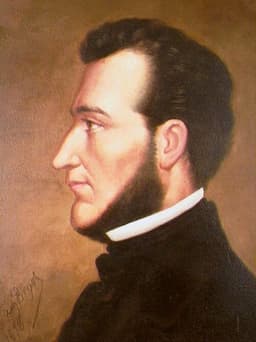
Francisco Morazan
General · Modern
58.0Total
Mohammad Fahim
General · Modern
49.7Total
Basic Information
Born
1792
1957
Died
1842
—
Era
Modern
Modern
Nationality
Honduras
Afghanistan
Occupation
General
General
Civilization
Western
Middle Eastern
Score Comparison
Military (10%)
52.5
40.0
Political (20%)
60.0
43.7
Influence (20%)
62.0
51.0
Legacy (20%)
50.0
43.3
Leadership (15%)
68.0
74.0
Strategy (15%)
55.0
45.0
TOTAL
58.0
49.7
Francisco Morazan — Complete Timeline
1824 AD
Abolition of slavery in Central AmericaReform◆ Major
As a key leader in the liberal movement, Moraz
AbolitionSlaveryLiberal Reform
Impact: regionalprogressive
1827 AD
Battle of La TrinidadWar◆ Major
Morazán led a liberal army to victory against conservative forces at La Trinidad, Honduras. This battle was a key turning point in the Central American civil war, allowing Morazán to consolidate power and eventually become president of the federation.
BattleLiberal VictoryCivil War
Impact: regional
1830 AD
Presidency of the Federal Republic of Central AmericaPolitical Action
Morazán was elected president of the Federal Republic of Central America, a union of Guatemala, El Salvador, Honduras, Nicaragua, and Costa Rica. He pursued liberal reforms including separation of church and state, free trade, and land reform, facing opposition from conservatives.
Federal RepublicLiberal ReformsCentral America
Impact: regionalconstructive
1842 AD
Execution by firing squadPolitical Action
After a failed attempt to restore the Federal Republic, Moraz
ExecutionEnd of FederationLiberal Defeat
Impact: regionaltragic
Mohammad Fahim — Complete Timeline
2001 AD
Led Northern Alliance Forces in Fall of KabulWar
Mohammad Fahim, as a senior Northern Alliance commander, led forces that captured Kabul from the Taliban in November 2001. This victory followed the US invasion and was a turning point in the war, leading to the collapse of Taliban rule.
AfghanistanWarTaliban
Impact: national
Appointed Vice President of AfghanistanPolitical Action◆ Major
Mohammad Fahim was appointed Vice President of Afghanistan under Hamid Karzai in 2001, serving until 2004. He was a key Northern Alliance commander and his appointment was part of the post-Taliban power-sharing arrangement.
AfghanistanVice PresidencyNorthern Alliance
Impact: nationalconstructive
Served as Minister of DefensePolitical Action◆ Major
Mohammad Fahim served as Afghanistan's Minister of Defense from 2001 to 2004. He oversaw the formation of the new Afghan National Army and security forces, integrating former mujahideen and Northern Alliance fighters.
AfghanistanDefenseMilitary
Impact: nationalconstructive
2009 AD
Appointed First Vice President in 2009Political Action◆ Major
Mohammad Fahim was appointed First Vice President of Afghanistan under President Hamid Karzai in 2009. He served until his death in 2014, playing a key role in security and political affairs.
AfghanistanVice PresidencyGovernment
Impact: nationalconstructive
Expert Analysis
Francisco Morazan vs Mohammad Fahim
### The General and the Reformer: Two Paths from the Ruins of Empire
On a dusty November morning in 2001, Mohammad Fahim, a battle-hardened commander of the Northern Alliance, rode into a liberated Kabul. The city had just fallen to his forces, and the Taliban had fled south. Across the Atlantic, in a very different era, another general had once entered a capital under similar circumstances. In April 1829, Francisco Morazán marched into Guatemala City at the head of a liberal army, having defeated the conservative forces that held the Federal Republic of Central America. Both men were generals who became political leaders in the aftermath of collapse. But one would die before a firing squad, his dream of a unified nation shattered; the other would die in his bed, vice president of a country still struggling to hold together. What drove these two men down such different roads?
### Origins
Mohammad Fahim was born in 1957 in the Panjshir Valley of Afghanistan, a landscape of jagged mountains and fierce independence. He was a Tajik, part of an ethnic group that had long been marginalized by the Pashtun-dominated governments of Kabul. His world was shaped by invasion, civil war, and the grinding poverty of a country that had become a Cold War battlefield. He learned warfare in the crucible of the Soviet-Afghan War, fighting alongside the legendary Ahmad Shah Massoud. Fahim was not a scholar or a reformer; he was a survivor, a man who understood that power came from the barrel of a gun and the loyalty of a militia.
Francisco Morazán was born in 1792 in Tegucigalpa, Honduras, then part of the Spanish Empire. He was a Creole, a man of European descent born in the colonies, and he came of age during the Napoleonic Wars that shattered Spanish authority. He was educated in the Enlightenment ideas of liberty, equality, and republicanism. While Fahim learned tactics from Soviet tanks and Stinger missiles, Morazán learned from Rousseau and Voltaire. His world was one of crumbling empires and the intoxicating promise of nation-building.
### Rise to Power
Fahim’s path to power was forged in violence. After the Soviet withdrawal, he rose through the ranks of the Northern Alliance, a loose coalition of anti-Taliban forces. His turning point came in 2001, when the United States invaded Afghanistan following the September 11 attacks. Fahim, now the military commander after Massoud’s assassination, led the charge into Kabul in November 2001. It was a moment of raw, opportunistic triumph. He was not elected; he was the man with the tanks.
Morazán’s rise was more political. In 1827, he defeated conservative forces at the Battle of La Trinidad, a victory that turned him into the champion of the liberal cause. He was elected president of the Federal Republic of Central America in 1830, a union of Guatemala, El Salvador, Honduras, Nicaragua, and Costa Rica. He came to power through a combination of military success and popular support, backed by a coherent ideology of reform.
### Leadership & Governance
As Minister of Defense and later Vice President, Fahim wielded enormous influence in post-Taliban Afghanistan. He oversaw the formation of a new national army, but his leadership was defined by patronage and ethnic loyalty. He was a warlord in a suit, more concerned with securing power for his Tajik faction than building institutions. His military strategy was pragmatic but not visionary; his political wisdom was transactional. He did not attempt to abolish slavery or reform land ownership; he simply tried to hold his coalition together.
Morazán was a reformer in the grand tradition. He abolished slavery in 1824, separated church and state, established freedom of the press, and promoted public education. He wanted to create a modern, secular republic modeled on the United States. But his governance was also marked by rigidity. He imposed liberal reforms on a deeply conservative, Catholic society, alienating the clergy, the landed elite, and much of the peasantry. He was a visionary who could not compromise.
### Triumph & Tragedy
Fahim’s greatest moment was the fall of Kabul in 2001. He had helped topple the Taliban and brought his faction to the center of power. His tragedy was that he never transcended his origins. He remained a symbol of the ethnic and factional divisions that would cripple Afghanistan. He died in 2014, still vice president, but his legacy was tarnished by accusations of corruption and warlordism.
Morazán’s triumph was the Federal Republic itself, a brief golden age of liberal reform in Central America. His tragedy was its collapse. By 1839, the union had dissolved into civil war. In 1842, after a desperate attempt to restore the republic, he was captured in Costa Rica and executed by firing squad. His last words were reportedly: “I die with the satisfaction of having served my country.”
### Character & Destiny
Fahim was a survivor, not a martyr. He adapted to the realities of power in a fractured, war-torn society. He was cautious, pragmatic, and willing to compromise with the Americans and the warlords. Morazán was a martyr, not a survivor. He believed in his ideals so deeply that he would rather die than abandon them. His character was his destiny: he could not bend, so he broke.
### Legacy
Fahim is remembered ambivalently in Afghanistan. He was a key figure in the defeat of the Taliban, but also a symbol of the corruption and ethnic strife that followed. His total score of 60.5 reflects this middling legacy. Morazán is revered as a hero in Honduras and across Central America. His face appears on currency, and his name adorns streets and schools. His total score of 69.8 is higher, but it masks the tragedy of a man whose dreams were too big for his time.
### Conclusion
Both men were generals who became politicians in the ruins of empire—one the Spanish Empire, the other the Soviet Union. Fahim’s story is one of survival in a world where power was personal and fleeting. Morazán’s story is one of sacrifice for a vision of unity that could not be realized. One died in bed, the other before a firing squad. Which is the greater tragedy? The man who lived to see his compromises, or the man who died for his ideals? The answer, perhaps, lies in the question itself.
Rankings
🥇
Francisco MorazanLeader
Mil: 52.5Pol: 60.0Inf: 62.0
58.0
🥈
Mohammad Fahim
Mil: 40.0Pol: 43.7Inf: 51.0
49.7
+8.3 behind
How This Comparison Works
Algorithm
Each figure is scored on 6 dimensions (0—100 scale) based on structured historical data: Military (10%), Political (20%), Influence (20%), Legacy (20%), Leadership (15%), Strategy (15%). The weighted total produces the final ranking.
Data Sources
Scores are computed from structured sub-indicators in the database. Scale factors adjust for era (Ancient ×0.85, Modern ×1.0) and civilization size (Eastern ×1.05, Other ×0.80) to account for differences in population and military scale.
Maximum 3 Figures
Comparisons are limited to 2—3 figures to ensure readability and statistical meaningfulness.
Error Margins
±5 points per dimension — Sub-scores are derived from historical records with inherent uncertainty. Two figures within 5 points on a dimension should be considered roughly equivalent in that area.
Total Score Accuracy
±3 points overall — The weighted combination of 6 dimensions produces a total score with approximately ±3 points of uncertainty. Differences of less than 3 points are not statistically significant— the figures are effectively tied.
Known Limitations
- Historical records are incomplete and uneven across civilizations
- Figures from oral-tradition societies may be underrepresented
- Occupation labels can misclassify multi-role figures
- Scores measure capability and impact, not moral character
- Quantitative scoring is a comparison tool, not absolute truth
Capability Radar
Military (10%) — Battles & Warfare
Battles
55
35
Win Rate
60
40
Expansion
40
25
Political (20%) — Governance & Reform
Reform
70
20
Diplomacy
45
40
Economy
50
15
Influence (20%) — Cultural & Global Reach
Cultural
45
15
Global
35
20
Legacy (20%) — Historical Impact
Historical
50
30
Longevity
40
20
Leadership (15%) — Power & Stability
Tenure
55
45
Stability
30
20
Strategy (15%) — Tactics & Innovation
Strategy
55
35
Tactics
50
30
Reform
45
20
Similar Comparisons
Comments & Discussion
Panjshir Historian6/16/2026
Fahim was Massoud's shadow, not his successor. A man who rose through loyalty rather than vision. Morazán had a unified dream for Central America; Fahim had a network of warlords and drug money. One died for a constitution, the other for a ministerial palace. Let's not romanticize: Fahim was a wartime expedient, not a reformer.
数据控6/16/2026
比较一个19世纪的中美洲将军和一个21世纪的阿富汗军阀,本身就是时代错乱。Morazán打仗用马刀和滑膛枪,Fahim用AK-47和丰田皮卡。军事实力对比纯属扯淡——这俩连火药配方都不一样。任何跨时代比较都是历史虚无主义,设定就是伪命题。
Classics Scholar6/16/2026
Both men built their power on the ruins of an empire—Spain's in one case, the Soviet Union's in another. But Morazán fought for a secular republic modeled on Enlightenment ideals; Fahim fought for ethnic privilege and personal fiefdoms. One reads like Plutarch, the other like a police blotter. Apples and Kalashnikovs.
德赛教授6/16/2026
Morazán被处决时喊的是“我死后,共和国永存”;Fahim病逝时留给阿富汗的是一屁股腐败指控和军阀割据。一个用鲜血书写宪法,一个用金条修补权力。别拿“历史比较”当遮羞布——这俩人的遗产,一个值得立碑,一个该被抹去。
Revisionist Critic6/16/2026
The Fahim apologists love to point out he was "pragmatic." So was every warlord who ever traded opium for NATO logistics. Morazán lost his war but won the argument—his liberal ideals actually shaped Central American constitutions. Fahim won his war but left Afghanistan more fractured than he found it. Pragmatism is just a fancy word for failure with a pension.