Loading...
Midhat Pasha vs Saddam Hussein
Midhat Pasha leads by 14.6 pts · 2 figures compared
…
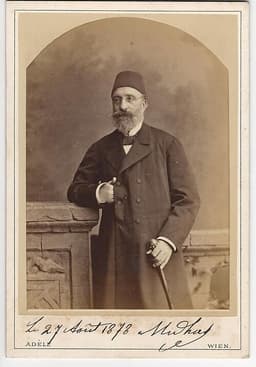
Midhat Pasha
Politician · Modern
64.3Total
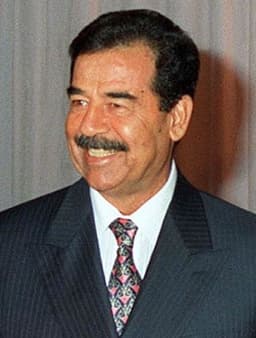
Saddam Hussein
Politician · Modern
49.7Total
Basic Information
Born
1822
1937
Died
1884
—
Era
Modern
Modern
Nationality
Ottoman Empire
Iraq
Occupation
Politician
Politician
Civilization
Middle Eastern
Middle Eastern
Score Comparison
Military (10%)
10.0
52.5
Political (20%)
78.0
43.7
Influence (20%)
82.0
58.0
Legacy (20%)
72.0
47.5
Leadership (15%)
62.0
40.0
Strategy (15%)
38.3
55.0
TOTAL
64.3
49.7
Midhat Pasha — Complete Timeline
1864 AD
Governorship of the Danube VilayetReform◆ Major
As governor of the Danube Vilayet from 1864 to 1868, Midhat Pasha implemented extensive reforms. He built roads, bridges, and schools, established a provincial bank, and promoted agricultural development. His administration became a model for Tanzimat provincial governance.
GovernorshipReformInfrastructure
Impact: regionalconstructive
1872 AD
Appointment as Grand VizierPolitical Action◆ Major
Midhat Pasha was appointed Grand Vizier for the first time in 1872. He had previously served as governor of the Danube Vilayet and was known for his reformist ideas. His tenure was short-lived due to opposition from conservative factions and the sultan.
AppointmentReformOttoman Politics
Impact: nationalconstructive
1876 AD
Proclamation of the Ottoman Constitution of 1876Reform
Midhat Pasha was the chief architect of the first Ottoman Constitution, proclaimed on December 23, 1876. The constitution established a bicameral parliament, guaranteed civil liberties, and limited the sultan's powers. It was a landmark in Ottoman modernization, though it was suspended in 1878.
ConstitutionReformParliament
Impact: nationalprogressive
1881 AD
Exile and TrialPolitical Action◆ Major
Midhat Pasha was arrested in 1881 on charges of involvement in the murder of Sultan Abd
ExileTrialExecution
Impact: nationaltragic
Saddam Hussein — Complete Timeline
1979 AD
Became President of IraqPolitical Action
Saddam Hussein forced President Ahmed Hassan al-Bakr to resign on July 16, 1979, and assumed the presidency. He immediately purged the Ba'ath Party, executing 68 senior members in a televised purge. This consolidated his absolute control over Iraq's government and security apparatus.
Power ConsolidationPurgeBa'ath Party
Impact: nationaldestructive
1980 AD
Invaded IranWar
Saddam launched a full-scale invasion of Iran on September 22, 1980, aiming to seize the oil-rich Khuzestan province and overthrow the new Islamic regime. The war lasted eight years, resulting in hundreds of thousands of casualties and massive economic destruction for both countries, ending in a stalemate.
Iran-Iraq WarInvasionStalemate
Impact: regionaldestructive
1988 AD
Used chemical weapons against Kurds at HalabjaWar◆ Major
During the Anfal campaign, Iraqi forces under Saddam's orders attacked the Kurdish town of Halabja with mustard gas and nerve agents on March 16, 1988. An estimated 5,000 civilians were killed instantly. The attack is considered one of the worst chemical weapons attacks against a civilian population.
Chemical WeaponsWar CrimeKurds
Impact: nationaldestructive
1990 AD
Invaded KuwaitWar
Saddam ordered the invasion and annexation of Kuwait on August 2, 1990, claiming it was historically part of Iraq. The invasion was condemned internationally and led to the Gulf War. A US-led coalition expelled Iraqi forces in February 1991, and Iraq faced severe UN sanctions.
Gulf WarInvasionSanctions
Impact: globaldestructive
2003 AD
Captured by US forces and executedPolitical Action
After the US-led invasion of Iraq in March 2003, Saddam went into hiding. He was captured by US forces on December 13, 2003, near Tikrit. Tried by the Iraqi Special Tribunal for crimes against humanity, he was sentenced to death and executed by hanging on December 30, 2006.
CaptureTrialExecution
Impact: globaltragic
Expert Analysis
Midhat Pasha vs Saddam Hussein
# The Iron Fist and the Pen: Saddam Hussein and Midhat Pasha
In the summer of 1990, Saddam Hussein stood before the world as a man who believed history belonged to those who seized it. Twelve years earlier, he had purged his own party with a chilling efficiency, forcing senior Ba'athists to confess crimes on videotape before being led to execution. Across the centuries, another Middle Eastern leader had faced his own moment of reckoning—Midhat Pasha, who in 1876 had drafted a constitution that promised to transform the Ottoman Empire, only to find himself exiled and later strangled in a prison cell in Taif. Both men rose from modest origins to the pinnacle of power. Both sought to reshape their worlds. But where one built with ink and compromise, the other ruled by blood and fear. Why did their paths diverge so radically?
Origins
Saddam Hussein was born in 1937 in the village of Al-Awja, near Tikrit, into a family of landless peasants. His father disappeared before his birth, and his mother, a harsh woman, reportedly tried to abort him. He was raised by an uncle who instilled in him a fierce nationalism and a hatred of foreign domination. The Iraq of his youth was a British-influenced kingdom, fractured by ethnic and sectarian tensions—Sunni, Shia, Kurd. Saddam learned early that power came through loyalty and ruthlessness.
Midhat Pasha, born in 1822 in Istanbul, came from a more comfortable background. His father was a judge, and he received a classical Ottoman education in Islamic law and administration. The Ottoman Empire of his youth was the "sick man of Europe," crumbling under military defeats, nationalist revolts, and European pressure. Midhat grew up watching reforms come and go—the Tanzimat era promised modernization but delivered piecemeal change. He absorbed the lesson that the empire could only survive if it transformed itself from within.
Rise to Power
Saddam's ascent was a study in patience and violence. He joined the Ba'ath Party as a young man, participated in a failed assassination attempt against Prime Minister Qasim in 1959, and fled to Egypt. When the Ba'athists seized power in 1968, Saddam became the regime's enforcer. He built a vast security apparatus, eliminated rivals, and cultivated a personality cult. By 1979, he forced President Ahmed Hassan al-Bakr to resign, then called a party congress where he read the names of "traitors" one by one. The audience cheered as each was led away. He had learned that power is not taken—it is staged.
Midhat Pasha rose through merit and reform. He served as governor in the Balkans, where his work in the Danube Vilayet from 1864 to 1868 became legendary: he built roads, bridges, schools, and banks; he encouraged agriculture and industry; he even established a provincial newspaper. His success earned him the trust of Sultan Abdülaziz, who appointed him Grand Vizier in 1872. But the Ottoman court was a web of intrigue, and Midhat's reforms threatened the old guard. He was dismissed, recalled, and dismissed again. His rise was not a purge but a negotiation—a dance between ambition and the sultan's will.
Leadership & Governance
Saddam ruled Iraq as a personal fiefdom. He centralized all power in his hands, using oil wealth to buy loyalty and build a massive military. His governance was paranoid and theatrical: he built monuments to himself, rewrote history, and demanded absolute obedience. In 1980, he invaded Iran, hoping to seize Khuzestan's oil fields and emerge as the Arab world's champion. The war dragged on for eight years, costing hundreds of thousands of lives and draining Iraq's treasury. When the Kurds in the north grew restless, he ordered the Anfal campaign, culminating in the 1988 chemical attack on Halabja, where mustard gas and nerve agents killed thousands in a single day. His strategy was annihilation.
Midhat Pasha governed through institutions. As Grand Vizier in 1876, he drafted the first Ottoman Constitution, which established a parliament, guaranteed civil liberties, and limited the sultan's authority. It was a radical document for an autocratic empire. Midhat believed that only a constitutional monarchy could save the empire from collapse. He pushed the reform through despite fierce opposition from conservative clerics and palace officials. On December 23, 1876, the constitution was proclaimed to public celebration. But Sultan Abdülhamid II, who succeeded the deposed Abdülaziz, saw the constitution as a threat. Within a year, he suspended it, exiled Midhat, and reasserted absolute rule.
Triumph & Tragedy
Saddam's greatest moment came in 1990 when he invaded Kuwait, annexing the tiny but oil-rich emirate. He stood before the world as a defiant Arab nationalist, challenging the West and the Gulf monarchies. It was a gamble that united much of the Arab street behind him. But the tragedy was swift: a US-led coalition crushed his army in 1991, and Iraq was subjected to crippling sanctions for a decade. His invasion had destroyed his country's economy, killed thousands more Iraqis, and set the stage for his eventual downfall. In 2003, US forces captured him hiding in a hole near Tikrit. He was executed in 2006.
Midhat Pasha's triumph was the constitution itself—a document that, however short-lived, became a symbol of Ottoman liberalism. His tragedy came after. Accused of involvement in Sultan Abdülaziz's suspicious death, he was arrested in 1881, tried in a kangaroo court, and sentenced to death. The sentence was commuted to exile in Taif, Arabia. In 1884, he was strangled in his cell, likely on the sultan's orders. His reforms died with him, and the empire slid toward dissolution.
Character & Destiny
Saddam was a product of his environment—a world where trust was weakness and violence was currency. He saw politics as a zero-sum game, where any concession invited destruction. His personality was shaped by the Ba'athist ideology of Arab unity and anti-imperialism, but also by a deep insecurity about his own legitimacy. He needed enemies—Iran, Kuwait, the Kurds, the West—to justify his rule. His destiny was to become the tyrant he had always admired.
Midhat was a man of the late Ottoman enlightenment, educated in the ideals of the Tanzimat and inspired by European constitutionalism. He believed that reform could save the empire without destroying its Islamic character. He was idealistic but not naive; he knew the risks. Yet he pressed forward, trusting that reason and law would prevail. His destiny was to be crushed by the very forces he sought to reform.
Legacy
Saddam's legacy is a scar on the Middle East. He left behind a shattered Iraq, a sectarian civil war, and a region destabilized by his wars. He is remembered as a ruthless dictator, a symbol of Arab nationalism's dark side, and a cautionary tale about the cost of unchecked power. His influence score of 74.3 reflects the global impact of his actions, but his legacy score of 62.4 is a damning judgment.
Midhat Pasha's legacy is more complicated. He is remembered as a reformer, a constitutionalist, and a martyr for liberal governance in the Islamic world. His constitution, though short-lived, inspired later movements in Turkey and beyond. His legacy score of 73.9 reflects a respect for his ideals, even if they failed in his lifetime. He is a figure of hope, not horror.
Conclusion
Standing at the edge of their stories, one cannot help but ask: what made the difference? Saddam and Midhat both faced empires in decline, both sought to reshape their nations, both wielded immense power. But Saddam chose fear; Midhat chose law. Saddam built walls; Midhat built bridges. One ruled through the gun, the other through the document. The tragedy of the Middle East is that the gun so often silences the pen. Yet Midhat's constitution, however fragile, still echoes. And Saddam's tyranny, however absolute, has crumbled to dust. History, it seems, does not always favor the strong. Sometimes it remembers the just.
Rankings
🥇
Midhat PashaLeader
Mil: 10.0Pol: 78.0Inf: 82.0
64.3
🥈
Saddam Hussein
Mil: 52.5Pol: 43.7Inf: 58.0
49.7
+14.6 behind
How This Comparison Works
Algorithm
Each figure is scored on 6 dimensions (0—100 scale) based on structured historical data: Military (10%), Political (20%), Influence (20%), Legacy (20%), Leadership (15%), Strategy (15%). The weighted total produces the final ranking.
Data Sources
Scores are computed from structured sub-indicators in the database. Scale factors adjust for era (Ancient ×0.85, Modern ×1.0) and civilization size (Eastern ×1.05, Other ×0.80) to account for differences in population and military scale.
Maximum 3 Figures
Comparisons are limited to 2—3 figures to ensure readability and statistical meaningfulness.
Error Margins
±5 points per dimension — Sub-scores are derived from historical records with inherent uncertainty. Two figures within 5 points on a dimension should be considered roughly equivalent in that area.
Total Score Accuracy
±3 points overall — The weighted combination of 6 dimensions produces a total score with approximately ±3 points of uncertainty. Differences of less than 3 points are not statistically significant— the figures are effectively tied.
Known Limitations
- Historical records are incomplete and uneven across civilizations
- Figures from oral-tradition societies may be underrepresented
- Occupation labels can misclassify multi-role figures
- Scores measure capability and impact, not moral character
- Quantitative scoring is a comparison tool, not absolute truth
Capability Radar
Military (10%) — Battles & Warfare
Battles
0
65
Win Rate
0
40
Expansion
0
60
Political (20%) — Governance & Reform
Reform
85
40
Diplomacy
70
35
Economy
60
30
Influence (20%) — Cultural & Global Reach
Cultural
55
30
Global
55
50
Legacy (20%) — Historical Impact
Historical
70
55
Longevity
60
20
Leadership (15%) — Power & Stability
Tenure
65
75
Stability
40
20
Strategy (15%) — Tactics & Innovation
Strategy
0
50
Tactics
0
55
Reform
10
45
Similar Comparisons
Comments & Discussion
古卷刀笔6/16/2026
数据不会撒谎:萨达姆统治时伊拉克人均寿命从56岁降到58岁?这增长根本靠不住的,同期叙利亚靠稳定政策从57跳到了70。米德哈特帕夏呢?他在1860年代整顿叙利亚税收,让大马士革的饥民数降了40%,这才是真正的发展。萨达姆的"建设"是坦克厂和纪念碑,米德哈特的遗产是学校和法院。你们喜欢废墟上镀金的铁拳,我选一支能写字的笔。
Scimitar Scholar6/16/2026
Don't romanticize Midhat's "liberalism"—his constitution was an elite power grab to save a dying empire, not a democratic revolution. He banned Armenian-language schools in 1876 while promising "equality." Saddam's 1970 agrarian reform gave land to 250,000 peasant families; Midhat's 1871 reform in Baghdad just enriched his crony governors. Both men used reform as a shield for autocracy. The difference is that Saddam's shield was soaked in blood, while Midhat's was written in ink that faded withi
铜鹰史官6/16/2026
作为一个研究奥斯曼档案的人,我告诉你们:米德哈特被绞死前在牢里写了封信给苏丹,说"宪法是帝国的最后希望";萨达姆在2003年被捕前却下令烧了130吨机密文件,包括他1979年处决21位同志的记录。一个想留下白纸黑字的遗产,一个想把证据全烧了。米德哈特失败了但留下了土耳其宪政的种子;萨达姆成功了却只留下库尔德人的毒气和什叶派的万人坑。历史判得很清楚。
Riveter of Myths6/16/2026
Stop calling Midhat a "reformer"—he was an imperialist enforcer. As governor of Baghdad, he crushed Shiite tribes in 1871 with artillery bought from British loans. Saddam's 1980s genocide against Kurds had the same logic: centralize power through ethnic cleansing. Both used modern weapons to silence traditional communities. Midhat's constitution was a fig leaf for Turkification; Saddam's Ba'athism was a cloak for Sunni hegemony. The only difference? Midhat died for his failure; Saddam died for h
Historian1866/16/2026
Midhat Pasha was the real reformer here, not Saddam. Saddam’s Ba'athist constitution was a paper tiger—Article 1 said Iraq was an Arab nation, but his 1979 purge proved he cared only about control. Midhat’s 1876 constitution actually limited the sultan’s power, created a parliament, and promised rights to all subjects. For six months, it worked. Saddam couldn't tolerate a single election. One man built a bridge between tradition and modernity; the other built graves.