Loading...
Midhat Pasha vs Yuan Shikai
Midhat Pasha leads by 4.3 pts · 2 figures compared
…
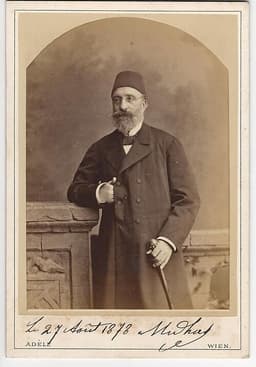
Midhat Pasha
Politician · Modern
64.3Total
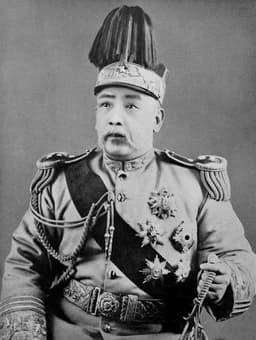
Yuan Shikai
Politician · Modern
60.0Total
Basic Information
Born
1822
1859
Died
1884
1916
Era
Modern
Modern
Nationality
Ottoman Empire
China
Occupation
Politician
Politician
Civilization
Middle Eastern
Eastern
Score Comparison
Military (10%)
10.0
45.0
Political (20%)
78.0
72.0
Influence (20%)
82.0
57.2
Legacy (20%)
72.0
54.0
Leadership (15%)
62.0
72.0
Strategy (15%)
38.3
61.2
TOTAL
64.3
60.0
Midhat Pasha — Complete Timeline
1864 AD
Governorship of the Danube VilayetReform◆ Major
As governor of the Danube Vilayet from 1864 to 1868, Midhat Pasha implemented extensive reforms. He built roads, bridges, and schools, established a provincial bank, and promoted agricultural development. His administration became a model for Tanzimat provincial governance.
GovernorshipReformInfrastructure
Impact: regionalconstructive
1872 AD
Appointment as Grand VizierPolitical Action◆ Major
Midhat Pasha was appointed Grand Vizier for the first time in 1872. He had previously served as governor of the Danube Vilayet and was known for his reformist ideas. His tenure was short-lived due to opposition from conservative factions and the sultan.
AppointmentReformOttoman Politics
Impact: nationalconstructive
1876 AD
Proclamation of the Ottoman Constitution of 1876Reform
Midhat Pasha was the chief architect of the first Ottoman Constitution, proclaimed on December 23, 1876. The constitution established a bicameral parliament, guaranteed civil liberties, and limited the sultan's powers. It was a landmark in Ottoman modernization, though it was suspended in 1878.
ConstitutionReformParliament
Impact: nationalprogressive
1881 AD
Exile and TrialPolitical Action◆ Major
Midhat Pasha was arrested in 1881 on charges of involvement in the murder of Sultan Abd
ExileTrialExecution
Impact: nationaltragic
Yuan Shikai — Complete Timeline
1901 AD
Command of the Beiyang ArmyReform◆ Major
Yuan Shikai took command of the Beiyang Army, the most modern military force in late Qing China. He expanded and trained the army, which became the basis for his political power and later dominated Chinese politics.
Military reformBeiyang Army
Impact: national
1912 AD
Appointed First President of the Republic of ChinaPolitical Action
Yuan Shikai became the first president of the Republic of China after negotiating the abdication of the Qing emperor. He used his control of the Beiyang Army to pressure the revolutionary government into accepting his leadership.
PresidencyRepublic of China
Impact: national
1915 AD
Declaration of the Empire of ChinaPolitical Action◆ Major
Yuan Shikai declared himself emperor of the Empire of China, attempting to restore the monarchy. This move sparked widespread opposition from provincial leaders and foreign powers, leading to the collapse of his regime.
Monarchy restorationPolitical crisis
Impact: nationaldestructive
Signing of the Twenty-One DemandsPolitical Action◆ Major
Yuan Shikai accepted most of Japan's Twenty-One Demands, which expanded Japanese influence in China. The agreement granted Japan economic rights in Manchuria and Shandong, and was seen as a national humiliation.
DiplomacyJapanese imperialism
Impact: globaltragic
1916 AD
Death and Collapse of the Beiyang GovernmentPolitical Action◆ Major
Yuan Shikai died of uremia, leaving no clear successor. His death led to the fragmentation of the Beiyang Army into warlord factions, plunging China into a period of civil war and political instability.
Warlord eraPolitical fragmentation
Impact: nationaltragic
Expert Analysis
Yuan Shikai vs Midhat Pasha
### The Reformer’s Gamble
In the winter of 1876, as snow fell on the minarets of Constantinople, a statesman named Midhat Pasha stood before a cheering crowd. He had just proclaimed the first constitution of the Ottoman Empire, a document that promised to transform a decaying autocracy into a constitutional monarchy. Across the world, forty years later, another man sat in the Forbidden City in Beijing, wearing a dragon robe. Yuan Shikai, the first president of the Republic of China, had just declared himself emperor. The crowd did not cheer. Within months, his empire would collapse, and he would die a hated man. Both men faced the same fundamental question: how to save a vast, ancient empire from collapse. One chose to share power; the other chose to seize it. Their divergent paths reveal not only the force of personality, but the cruel logic of history.
### Origins
Midhat Pasha was born in 1822 in Istanbul, the son of a Muslim judge. He grew up in the twilight of the Ottoman Empire, when the sultans were already struggling to hold together a polyglot realm stretching from the Balkans to Arabia. The Tanzimat reforms of the 1830s and 1840s had promised modernization, but they were half-hearted. Midhat absorbed a bureaucratic ethos: he believed that order, law, and infrastructure could save the state. He was a man of committees and reports, a builder of roads and schools.
Yuan Shikai, born in 1859 in Henan province, came of age in a different kind of twilight. The Qing Dynasty, too, was crumbling under the weight of foreign humiliation and internal rebellion. But Yuan was not a bureaucrat by birth. He was a soldier from a military family, a man who had failed the civil service exams and found his path through the army. Where Midhat believed in institutions, Yuan believed in loyalty, discipline, and personal power. The Beiyang Army, which he took command of in 1901, was his creation—a modern force of 70,000 men, drilled with German rifles, and loyal to him alone.
### Rise to Power
Midhat’s rise was slow and meritorious. He served as governor of the Danube Vilayet from 1864 to 1868, a vast province in the Balkans. There, he did not just build roads and bridges; he created a model of provincial governance that was efficient, honest, and responsive. He established a bank, a postal service, and a system of mixed courts where Muslims and Christians could litigate together. His reputation grew. In 1872, he was appointed Grand Vizier—the highest office in the empire—but the sultan dismissed him within months. The lesson was clear: reform from above required the consent of the sultan, and that consent was never guaranteed.
Yuan’s rise was more dramatic. In 1898, he betrayed the reformist Emperor Guangxu, siding with the conservative Empress Dowager Cixi. That act of betrayal made him indispensable. By 1901, he was the commander of the Beiyang Army, and by 1911, when the revolution broke out, he was the only man who could negotiate between the crumbling Qing court and the republican rebels. In 1912, he became the first president of the Republic of China. He had not fought for the republic; he had inherited it.
### Leadership & Governance
As a leader, Midhat was a builder and a constitutionalist. His greatest achievement was the constitution of 1876, which created an elected parliament, guaranteed civil liberties, and limited the sultan’s power. He believed that only a shared legal framework could hold the empire together. But he was also naive. He trusted that Sultan Abdülhamid II, who had ascended the throne that same year, would honor the constitution. Abdülhamid did not. Within two years, he suspended the parliament and exiled Midhat.
Yuan’s leadership was the opposite. He was a pragmatist and a centralizer. He did not believe in constitutions; he believed in control. As president, he dissolved the National Assembly, banned political parties, and ruled by decree. In 1915, he accepted Japan’s Twenty-One Demands, a series of humiliating treaties that granted Japan extensive economic and territorial rights in China. He did so to secure Japanese support for his imperial ambitions. It was a short-term gain for a long-term disaster.
### Triumph & Tragedy
Midhat’s triumph was the constitution itself. On December 23, 1876, cannons fired across Constantinople as the document was read aloud. For a moment, the empire seemed reborn. His tragedy came three years later. In 1881, he was arrested on charges of complicity in the murder of Sultan Abdülaziz, a crime he almost certainly did not commit. After a sham trial, he was exiled to Ta’if in Arabia. In 1884, he was strangled in his cell. The constitution he had written would not be revived for thirty years.
Yuan’s triumph was his presidency. He had unified China under a single government, albeit a fragile one. His tragedy was his imperial ambition. On January 1, 1916, he declared the Empire of China, with himself as emperor. The provinces rose in revolt. Within months, he was forced to abdicate. He died of uremia on June 6, 1916, a broken man. His death left a vacuum that warlords would fill for a generation.
### Character & Destiny
Midhat was a man of principle, but principle was not enough. He believed that institutions could transcend personalities, but in an empire where the sultan held absolute power, institutions were only as strong as the ruler’s will. His destiny was to be a martyr for a cause that would not succeed in his lifetime.
Yuan was a man of ambition, but ambition without legitimacy is brittle. He believed that power flowed from the barrel of a gun, but guns cannot buy loyalty. His destiny was to be a strongman who destroyed the very republic he was meant to lead.
### Legacy
Midhat is remembered as the father of Ottoman constitutionalism. His ideas lived on in the Young Turk Revolution of 1908, which restored the parliament he had created. In modern Turkey, he is honored as a reformer who tried to save the empire through law.
Yuan’s legacy is more ambiguous. In China, he is often reviled as a traitor and a would-be emperor. But his Beiyang Army became the seedbed for the warlords who followed, and his failure to create a stable republic paved the way for the rise of the Nationalists and, eventually, the Communists.
### Conclusion
Two men, two empires, two attempts at salvation. Midhat Pasha tried to reform the Ottoman Empire by sharing power; Yuan Shikai tried to save China by concentrating it. Both failed. Their stories remind us that in the twilight of empires, the choices are never easy, and the consequences are never clean. One man died in exile, strangled in the dark. The other died in power, surrounded by the ruins of his ambition. History does not reward good intentions or ruthless will. It simply moves on.
Rankings
🥇
Midhat PashaLeader
Mil: 10.0Pol: 78.0Inf: 82.0
64.3
🥈
Yuan Shikai
Mil: 45.0Pol: 72.0Inf: 57.2
60.0
+4.3 behind
How This Comparison Works
Algorithm
Each figure is scored on 6 dimensions (0—100 scale) based on structured historical data: Military (10%), Political (20%), Influence (20%), Legacy (20%), Leadership (15%), Strategy (15%). The weighted total produces the final ranking.
Data Sources
Scores are computed from structured sub-indicators in the database. Scale factors adjust for era (Ancient ×0.85, Modern ×1.0) and civilization size (Eastern ×1.05, Other ×0.80) to account for differences in population and military scale.
Maximum 3 Figures
Comparisons are limited to 2—3 figures to ensure readability and statistical meaningfulness.
Error Margins
±5 points per dimension — Sub-scores are derived from historical records with inherent uncertainty. Two figures within 5 points on a dimension should be considered roughly equivalent in that area.
Total Score Accuracy
±3 points overall — The weighted combination of 6 dimensions produces a total score with approximately ±3 points of uncertainty. Differences of less than 3 points are not statistically significant— the figures are effectively tied.
Known Limitations
- Historical records are incomplete and uneven across civilizations
- Figures from oral-tradition societies may be underrepresented
- Occupation labels can misclassify multi-role figures
- Scores measure capability and impact, not moral character
- Quantitative scoring is a comparison tool, not absolute truth
Capability Radar
Military (10%) — Battles & Warfare
Battles
0
45
Win Rate
0
55
Expansion
0
50
Political (20%) — Governance & Reform
Reform
85
55
Diplomacy
70
70
Economy
60
50
Influence (20%) — Cultural & Global Reach
Cultural
55
40
Global
55
35
Legacy (20%) — Historical Impact
Historical
70
65
Longevity
60
40
Leadership (15%) — Power & Stability
Tenure
65
60
Stability
40
30
Strategy (15%) — Tactics & Innovation
Strategy
0
65
Tactics
0
60
Reform
10
80
Similar Comparisons
Comments & Discussion
EmperorErasmus6/16/2026
The fatal flaw is timing not character. Midhat's constitution survived barely a year before Abdul Hamid II exiled him—constitutional monarchy requires a monarch willing to be constrained. By 1876 the Ottoman elite had been debating reform for decades, so Midhat had allies. Yuan in 1915 had none: after 1911 revolution, the very word "emperor" was poisoned. Midhat gambled with a sultan who might cooperate; Yuan gambled against the tide of Chinese republicanism. Context devours personality every ti
铁血史官6/16/2026
两个人都想救帝国,但手法决定结局。米德哈特搞宪法时奥斯曼还有士绅阶层支持改革,袁世凯搞帝制时连北洋旧部都离心离德。最讽刺的是:米德哈特被苏丹流放而死,袁世凯称帝笑柄而死。区别在于前者赢得后世尊敬,后者只配当历史的反面教材。你要问我看谁顺眼?必须是拿命赌宪法的那个。
SkepticalDataGuy6/16/2026
Let's check the win-loss records. Midhat: constitution proclaimed, then suspended; exiled twice; died assassinated in Taif prison 1884. Score: 0/3. Yuan: president 1912-1916; briefly emperor 1915; died of kidney failure in office. Score: 2/3. By cold metrics Yuan kept power longer. The "reformer" label is retrospective romance—Midhat's constitution didn't prevent Ottoman collapse. Yuan at least stabilized China post-1911 while utterly failing as emperor. Both were tragic figures, but Yuan's trag
曲笔书生6/16/2026
说穿了,这俩都是帝国末路的赌徒,只是下注不同。米德哈特押宪政,袁世凯押皇权。但别忘了:米德哈特改革的奥斯曼帝国还活了四十年,袁世凯搞洪宪帝制把北洋底裤都输光了。最妙的是,米德哈特是科层官僚出身,他相信制度能压过个人;袁世凯是军阀起家,他相信拳头比宪法管用。结果呢?两者都失败了,但米德哈特的失败体面得多。