Loading...
Chen Qun vs Midhat Pasha
Midhat Pasha leads by 8.4 pts · 2 figures compared
…

Chen Qun
Politician · Ancient
55.9Total
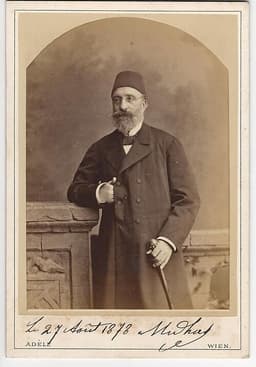
Midhat Pasha
Politician · Modern
64.3Total
Basic Information
Born
160
1822
Died
237
1884
Era
Ancient
Modern
Nationality
China
Ottoman Empire
Occupation
Politician
Politician
Civilization
Eastern
Middle Eastern
Score Comparison
Military (10%)
10.0
10.0
Political (20%)
72.0
78.0
Influence (20%)
40.0
82.0
Legacy (20%)
75.0
72.0
Leadership (15%)
72.0
62.0
Strategy (15%)
45.5
38.3
TOTAL
55.9
64.3
Chen Qun — Complete Timeline
220 AD
Proposed the Nine-rank SystemReform◆ Major
Chen Qun proposed the Nine-rank system for civil service appointments to Cao Pi, the first emperor of Wei. This system ranked candidates based on family background and personal merit, replacing the earlier recommendation system and becoming the standard for official selection in China for centuries.
Civil Service ReformWei DynastyBureaucracy
Impact: nationalconstructive
Advised Cao Pi on Legal CodeReform
Chen Qun assisted Cao Pi in drafting the new legal code for the Wei dynasty. He advocated for clearer laws and more consistent punishments, contributing to the legal framework that helped stabilize Wei's early rule.
Legal ReformWei DynastyLaw
Impact: nationalconstructive
226 AD
Served as Minister over the MassesPolitical Action
Chen Qun was appointed Minister over the Masses (Sikong) under Emperor Cao Rui of Wei. In this high-ranking position, he oversaw civil administration and continued to refine the implementation of the Nine-rank system, solidifying its role in Wei governance.
AppointmentWei DynastyGovernment
Impact: nationalconstructive
Midhat Pasha — Complete Timeline
1864 AD
Governorship of the Danube VilayetReform◆ Major
As governor of the Danube Vilayet from 1864 to 1868, Midhat Pasha implemented extensive reforms. He built roads, bridges, and schools, established a provincial bank, and promoted agricultural development. His administration became a model for Tanzimat provincial governance.
GovernorshipReformInfrastructure
Impact: regionalconstructive
1872 AD
Appointment as Grand VizierPolitical Action◆ Major
Midhat Pasha was appointed Grand Vizier for the first time in 1872. He had previously served as governor of the Danube Vilayet and was known for his reformist ideas. His tenure was short-lived due to opposition from conservative factions and the sultan.
AppointmentReformOttoman Politics
Impact: nationalconstructive
1876 AD
Proclamation of the Ottoman Constitution of 1876Reform
Midhat Pasha was the chief architect of the first Ottoman Constitution, proclaimed on December 23, 1876. The constitution established a bicameral parliament, guaranteed civil liberties, and limited the sultan's powers. It was a landmark in Ottoman modernization, though it was suspended in 1878.
ConstitutionReformParliament
Impact: nationalprogressive
1881 AD
Exile and TrialPolitical Action◆ Major
Midhat Pasha was arrested in 1881 on charges of involvement in the murder of Sultan Abd
ExileTrialExecution
Impact: nationaltragic
Expert Analysis
Chen Qun vs Midhat Pasha
### The Reformer’s Gambit
In the winter of 1876, as snow fell on Constantinople, a gray-bearded Ottoman statesman named Midhat Pasha stood before the Sultan and presented a document that would, for a fleeting moment, transform an empire. Half a world away and seventeen centuries earlier, in the palace of Cao Pi in Luoyang, a Chinese official named Chen Qun unrolled a scroll that would quietly reshape the bureaucracy of a dynasty. Both men were reformers; both sought to tame the chaos of their age with systems of order. But one died in exile, strangled in a dungeon, while the other died in office, his name woven into the fabric of Chinese governance for four hundred years. Why did their fates diverge so sharply? The answer lies not in their brilliance, but in the soil where they planted their seeds.
### Origins
Chen Qun was born in 160, into the twilight of the Han dynasty. China was splintering: warlords carved up provinces, and the old Confucian order was crumbling. His family were scholar-officials, steeped in the classics and the art of administration. From childhood, Chen Qun learned that the empire’s survival depended not on swords, but on the right men filling the right posts. He grew up in a world where nepotism and clan loyalty had choked the civil service, and he saw firsthand that a system built on birth alone could not hold a fractured realm together.
Midhat Pasha, born in 1822 in Istanbul, entered an empire in its own long decline. The Ottoman Empire, once the terror of Europe, was now the “Sick Man of Europe.” His father was a judge, and young Ahmed Şefik—later known as Midhat—was educated in Islamic law and modern statecraft. He traveled across the Balkans and Anatolia as a young official, witnessing the rot: corrupt governors, crumbling roads, and a tax system that bled the peasantry dry. Where Chen Qun saw a dynasty struggling to reunify, Midhat saw a dying giant that must reform or be carved up by European powers.
### Rise to Power
Chen Qun’s path was slow and patient. He served under the warlord Liu Bei briefly, then switched allegiance to Cao Cao, the most powerful figure of the era. Cao Cao valued talent over pedigree, and Chen Qun rose by drafting legal codes and advising on appointments. His great moment came in 220, when Cao Pi, Cao Cao’s son, was about to found the Wei dynasty. Chen Qun proposed the Nine-rank System: every local official would evaluate candidates into nine grades of talent, from the most brilliant to the merely competent. This was not a revolution—it still favored the elite—but it was a ladder where none had existed. Cao Pi, hungry for legitimacy, adopted it.
Midhat Pasha’s rise was swifter and more perilous. By 1864, at age 42, he was governor of the Danube Vilayet, a sprawling province in the Balkans. He built roads, bridges, and schools; he reformed tax collection and created a provincial council. His success made him famous, and in 1872 he became Grand Vizier—the Sultan’s prime minister. But the Ottoman court was a nest of intrigue, and his first term lasted only three months. He was dismissed, recalled, and dismissed again. His power came not from a stable system, but from the Sultan’s whim and the pressure of European ambassadors.
### Leadership & Governance
Chen Qun governed as a bureaucrat, not a conqueror. His military score is a mere 30.2, but his political wisdom—69.8—was directed at structure. He believed that an empire’s strength lay in its offices, not its generals. As Minister over the Masses from 226, he oversaw the implementation of the Nine-rank System, advising Emperor Cao Rui to keep laws clear and punishments consistent. He was cautious, conservative, and meticulous. He did not dream of remaking society; he dreamed of oiling its machinery.
Midhat Pasha was a builder and a gambler. His political score is 63.7, lower than Chen Qun’s, but his strategy—63.7—reflects a man who thought in bold strokes. As governor, he transformed the Danube region into a model province. As Grand Vizier, he pushed for the first Ottoman Constitution of 1876, which promised a parliament, civil liberties, and limits on the Sultan’s power. It was a breathtaking leap for a medieval empire. But Midhat governed by force of personality, not by institutional roots. He had no Nine-rank System to outlast him.
### Triumph & Tragedy
Chen Qun’s triumph was quiet but deep. The Nine-rank System, proposed in 220, became the backbone of Chinese civil service selection for nearly four centuries, until the Sui dynasty replaced it with the imperial examination. It was not perfect—corruption crept back in—but it was a foundation. His tragedy was that he lived long enough to see its flaws. By his death in 237, the system was already being twisted by powerful families. Yet he died in his bed, honored, his legacy intact.
Midhat Pasha’s triumph was the Constitution of 1876, a document that made the Ottoman Empire a constitutional monarchy for a few precious months. It was his crowning achievement, a beacon of hope for reformers across the empire. But the triumph was short-lived. Sultan Abdülhamid II, fearing loss of control, suspended the constitution in 1878, exiled Midhat, and then, in 1881, had him arrested on trumped-up charges of murdering the previous Sultan. After a show trial, Midhat was sentenced to death, commuted to life exile in Taif, Arabia. There, in 1884, he was strangled by guards—some say on the Sultan’s orders. He died at 62, alone, his dream crushed.
### Character & Destiny
Chen Qun was a man of the system. He was patient, diplomatic, and pragmatic. He understood that reform must be gradual, that it must serve the ruler’s interests as much as the people’s. He did not challenge the throne; he built around it. His caution kept him alive and his work enduring.
Midhat Pasha was a man of the moment. He was passionate, idealistic, and impatient. He believed that reform could be forced through by sheer will and the pressure of events. He underestimated the Sultan’s cunning and the depth of conservative resistance. His character—bold, sometimes reckless—made him a hero to reformers but a target to autocrats. He gambled everything on a constitution, and lost.
### Legacy
Chen Qun’s legacy is institutional. The Nine-rank System shaped Chinese governance for centuries, and even after its replacement, the idea of merit-based selection remained. He is remembered as a wise administrator, not a glamorous hero, but his name appears in every history of Chinese bureaucracy. His score of 89.6 in legacy reflects that quiet permanence.
Midhat Pasha’s legacy is symbolic. The 1876 Constitution was a dead letter, but it inspired later reformers in Turkey and the Arab world. He is remembered as a martyr for constitutionalism, a man who tried to drag an empire into modernity and was destroyed for it. His legacy score of 73.9 is lower, but it burns brighter in the memory of those who fight for freedom.
### Conclusion
Chen Qun and Midhat Pasha both sought to build order out of chaos. One succeeded because he worked within the grain of his civilization, offering the emperor a tool of control. The other failed because he tried to transplant a foreign idea—constitutional government—into soil that could not yet sustain it. Chen Qun’s system endured because it served the powerful; Midhat’s constitution crumbled because it threatened them. In the end, the difference between a reformer who dies in bed and one who dies in chains is not courage or vision, but timing—and the willingness of the powerful to let the new world be born.
Rankings
🥇
Midhat PashaLeader
Mil: 10.0Pol: 78.0Inf: 82.0
64.3
🥈
Chen Qun
Mil: 10.0Pol: 72.0Inf: 40.0
55.9
+8.4 behind
How This Comparison Works
Algorithm
Each figure is scored on 6 dimensions (0—100 scale) based on structured historical data: Military (10%), Political (20%), Influence (20%), Legacy (20%), Leadership (15%), Strategy (15%). The weighted total produces the final ranking.
Data Sources
Scores are computed from structured sub-indicators in the database. Scale factors adjust for era (Ancient ×0.85, Modern ×1.0) and civilization size (Eastern ×1.05, Other ×0.80) to account for differences in population and military scale.
Maximum 3 Figures
Comparisons are limited to 2—3 figures to ensure readability and statistical meaningfulness.
Error Margins
±5 points per dimension — Sub-scores are derived from historical records with inherent uncertainty. Two figures within 5 points on a dimension should be considered roughly equivalent in that area.
Total Score Accuracy
±3 points overall — The weighted combination of 6 dimensions produces a total score with approximately ±3 points of uncertainty. Differences of less than 3 points are not statistically significant— the figures are effectively tied.
Known Limitations
- Historical records are incomplete and uneven across civilizations
- Figures from oral-tradition societies may be underrepresented
- Occupation labels can misclassify multi-role figures
- Scores measure capability and impact, not moral character
- Quantitative scoring is a comparison tool, not absolute truth
Capability Radar
Military (10%) — Battles & Warfare
Battles
19
0
Win Rate
22
0
Expansion
25
0
Political (20%) — Governance & Reform
Reform
85
85
Diplomacy
50
70
Economy
60
60
Influence (20%) — Cultural & Global Reach
Cultural
70
55
Global
65
55
Legacy (20%) — Historical Impact
Historical
80
70
Longevity
85
60
Leadership (15%) — Power & Stability
Tenure
40
65
Stability
65
40
Strategy (15%) — Tactics & Innovation
Strategy
31
0
Tactics
32
0
Reform
36
10
Similar Comparisons
Comments & Discussion
Midhat's Iron Constitution6/16/2026
Midhat was a revolutionary trapped in a sultan's body. Chen Qun was an incrementalist who understood that Chinese bureaucrats would only accept reform if it preserved their Confucian face. Midhat tried to force a constitution down Abdul Hamid's throat in 1876—ended up strangled in Taif. Chen Qun proposed the Nine-Rank System gradually, letting Cao Pi test it slowly. Reform is about timing, not just brilliance.
科举老爹6/16/2026
陈群这小子懂个屁改革!九品中正制?不就是给司马家当狗,把选官权从皇帝手里捞到士族手里吗?说什么削弱门阀,结果呢?两晋南北朝三百年,上品无寒门,下品无势族。你跟我说这叫成功?Midhat至少真搞出了奥斯曼第一部宪法,哪怕活不过半年。陈群那套只不过把换了个封建包装,本质还是裙带关系。
Aegean Analytics6/16/2026
Let's talk outcomes, not intentions. Chen Qun's system ran for 400 years across multiple dynasties—objectively the longest-lasting civil service reform in pre-modern history. Midhat's constitution lasted 6 months before suspension, and his "reforms" triggered the disastrous Russo-Turkish War of 1877-78. If we measure by durability of institutional change, Chen Qun wins and it's not even close. Sentiment doesn't beat data.
历史拆解师6/16/2026
有意思,两个都是帝国衰落期的修补匠,但底层逻辑完全不同。陈群搞九品中正制,本质上是用精英联盟来稳定政权——他给地方豪强分蛋糕,换他们支持曹魏。Midhat搞宪法,是试图用制度架空苏丹权力。一个收买既得利益者,一个挑战他们。猜猜谁活得更久?当然是那个看起来最保守、最不革命的人。历史上真正的改革高手,从来不自称改革者。