Loading...
Midhat Pasha vs Napoleon Bonaparte
Napoleon Bonaparte leads by 6.6 pts · 2 figures compared
…
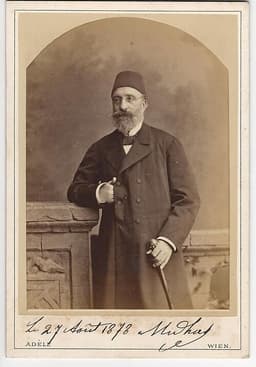
Midhat Pasha
Politician · Modern
64.3Total

Napoleon Bonaparte
General · Modern
70.9Total
Basic Information
Born
1822
1769
Died
1884
1821
Era
Modern
Modern
Nationality
Ottoman Empire
France
Occupation
Politician
General
Civilization
Middle Eastern
Western
Score Comparison
Military (10%)
10.0
94.0
Political (20%)
78.0
72.0
Influence (20%)
82.0
40.0
Legacy (20%)
72.0
80.0
Leadership (15%)
62.0
78.0
Strategy (15%)
38.3
90.0
TOTAL
64.3
70.9
Midhat Pasha — Complete Timeline
1864 AD
Governorship of the Danube VilayetReform◆ Major
As governor of the Danube Vilayet from 1864 to 1868, Midhat Pasha implemented extensive reforms. He built roads, bridges, and schools, established a provincial bank, and promoted agricultural development. His administration became a model for Tanzimat provincial governance.
GovernorshipReformInfrastructure
Impact: regionalconstructive
1872 AD
Appointment as Grand VizierPolitical Action◆ Major
Midhat Pasha was appointed Grand Vizier for the first time in 1872. He had previously served as governor of the Danube Vilayet and was known for his reformist ideas. His tenure was short-lived due to opposition from conservative factions and the sultan.
AppointmentReformOttoman Politics
Impact: nationalconstructive
1876 AD
Proclamation of the Ottoman Constitution of 1876Reform
Midhat Pasha was the chief architect of the first Ottoman Constitution, proclaimed on December 23, 1876. The constitution established a bicameral parliament, guaranteed civil liberties, and limited the sultan's powers. It was a landmark in Ottoman modernization, though it was suspended in 1878.
ConstitutionReformParliament
Impact: nationalprogressive
1881 AD
Exile and TrialPolitical Action◆ Major
Midhat Pasha was arrested in 1881 on charges of involvement in the murder of Sultan Abd
ExileTrialExecution
Impact: nationaltragic
Napoleon Bonaparte — Complete Timeline
1799 AD
Coup of 18 BrumaireOther◆ Major
Napoleon Bonaparte, with support from his brother Lucien and key political figures, overthrew the Directory in a bloodless coup. He established the Consulate with himself as First Consul, effectively becoming the ruler of France. This event ended the French Revolution's most unstable period.
French RevolutionCoupRise to Power
Impact: regional
1804 AD
Promulgation of the Napoleonic CodeOther◆ Major
Napoleon enacted the Civil Code of the French, known as the Napoleonic Code, a comprehensive set of laws that replaced the fragmented feudal legal systems. The code established legal equality, protected property rights, and secularized law. It became the basis for legal systems in many European and world countries.
Legal ReformNapoleonic CodeCivil Law
Impact: globalconstructive
1805 AD
Battle of AusterlitzWar◆ Major
Napoleon's Grande Arm
Napoleonic WarsBattleDecisive Victory
Impact: global
1812 AD
Invasion of RussiaWar◆ Major
Napoleon led the Grande Arm
Napoleonic WarsInvasionDisaster
Impact: globaldestructive
1815 AD
Battle of WaterlooWar◆ Major
Napoleon's French army was defeated by the combined forces of the Duke of Wellington's Anglo-Allied army and Gebhard Leberecht von Bl
Napoleonic WarsBattleFinal Defeat
Impact: globaldestructive
Expert Analysis
midhat-pasha-vs-napoleon-bonaparte
# The Emperor and the Reformer: Two Paths to Power, Two Fates in History
On a December morning in 1876, Midhat Pasha stood before the Sultan’s palace in Constantinople, watching as the first Ottoman constitution was read aloud to a gathered crowd. Cannon fire echoed across the Bosphorus. Half a continent away and sixty years earlier, Napoleon Bonaparte had stood in the snow at Austerlitz, watching his Grand Army crush the combined forces of Austria and Russia. One man conquered nations with cannon and cavalry; the other tried to save an empire with laws and paper. Both sought to reshape their worlds. Only one understood that power, once seized, must be held with an iron grip—or it will slip away entirely.
Origins
Napoleon Bonaparte was born in 1769 on the island of Corsica, a place that had only become French the year before. His family was minor nobility, poor but proud. He spoke Italian before he learned French, and his accent marked him as an outsider in the schools of mainland France. That sense of being an outsider, of having something to prove, never left him. He devoured military history and mathematics, and by the age of twenty-four, he had already distinguished himself at the siege of Toulon.
Midhat Pasha was born in 1822 in Constantinople, the heart of an empire that had been in slow decline for two centuries. His father was a religious judge, and young Midhat received a traditional Islamic education alongside training in the new secular schools that the reforming sultans had established. Where Napoleon grew up watching the old order of Europe collapse into revolution, Midhat grew up watching his own empire struggle to modernize before it collapsed entirely. The difference in their worlds was the difference between a man who could tear down the old and a man who had to prop up the crumbling.
Rise to Power
Napoleon’s rise was meteoric, a streak of lightning across the sky of Europe. In 1796, at twenty-six, he took command of the French army in Italy—a starving, ragged force that he turned into a conquering machine. Victory after victory followed: the Battle of Arcole, the Battle of Rivoli, the Egyptian campaign. By 1799, he had returned to France, overthrown the Directory in a coup d’état, and made himself First Consul. In 1804, he crowned himself Emperor in Notre Dame. He was thirty-five.
Midhat Pasha’s rise was slower, a matter of bureaucratic skill and political maneuvering. He rose through the provincial administration, governing first in Syria, then in Baghdad, and finally in the Danube Vilayet from 1864 to 1868. There, he built roads, bridges, schools, and hospitals. He reformed tax collection and established local councils. His reputation as an able administrator grew, and in 1872, he was appointed Grand Vizier—the highest office in the Ottoman Empire. But his first term lasted only three months. The Sultan dismissed him, wary of his reformist zeal. Midhat would be appointed and dismissed four times in his career, always at the mercy of a monarch who feared his competence.
Leadership & Governance
Napoleon governed with the same energy he brought to battle. He reformed French law with the Napoleonic Code, establishing principles of equality before the law and merit-based advancement that would influence legal systems across Europe. He centralized the government, reformed education, and stabilized the French economy. But his genius was military. At Austerlitz in 1805, he destroyed the Third Coalition. At Jena in 1806, he crushed Prussia. His strategy was simple: move fast, strike hard, and keep your enemies divided. He trusted his instincts, and for a decade, they rarely failed him.
Midhat Pasha’s governance was the opposite: patient, diplomatic, and institutional. He believed that the Ottoman Empire could only survive if it reformed itself from within. The centerpiece of his vision was the constitution of 1876, which established a parliament, guaranteed civil liberties, and limited the Sultan’s absolute power. It was a bold experiment, the first of its kind in the Islamic world. But Midhat lacked Napoleon’s ruthlessness. He tried to persuade the Sultan, not overthrow him. He tried to reform the system, not seize control of it.
Triumph & Tragedy
Napoleon’s greatest triumph was the Empire itself—the conquest of most of Europe, the spread of revolutionary ideals, the transformation of a continent. His greatest tragedy was the invasion of Russia in 1812. He marched east with over 600,000 men; fewer than 100,000 returned. The disaster broke his myth of invincibility. Exiled to Elba in 1814, he escaped and returned to power for a hundred days, only to be defeated at Waterloo in 1815. He died in exile on Saint Helena in 1821, a prisoner of the British.
Midhat Pasha’s triumph was the constitution, proclaimed on December 23, 1876. It was a moment of hope, a signal that the Ottoman Empire could change. But the hope was short-lived. The new Sultan, Abdülhamid II, suspended the constitution within two years and dissolved the parliament. Midhat was arrested in 1881, accused of involvement in the murder of Sultan Abdülaziz. He was tried, sentenced to death, and then had his sentence commuted to exile. In 1884, he was strangled in his prison cell in Taif, Arabia. His murderers made it look like suicide.
Character & Destiny
Napoleon was driven by ambition, but also by a cold, calculating intelligence. He knew when to strike and when to negotiate. He understood that power was a thing to be used, not shared. His famous saying—“Impossible is a word to be found only in the dictionary of fools”—captures his relentless will. But that will also blinded him. He could not stop. He could not consolidate. He kept reaching, and eventually, he overreached.
Midhat Pasha was driven by conviction, not ambition. He believed in law, in institutions, in the possibility of reform. He was a patriot who loved his empire and wanted to save it. But he was also naive. He trusted that good ideas would prevail, that the Sultan would honor his promises, that the constitution would protect itself. He never understood that in the game of power, the man who refuses to play dirty will be destroyed by those who do. His famous words—“The constitution is the only salvation for the empire”—proved true, but too late.
Legacy
Napoleon’s legacy is written across the map of Europe. His legal code, his administrative reforms, his military tactics—all shaped the modern world. He is remembered as a genius and a tyrant, a liberator and a conqueror. In France, his tomb at Les Invalides is a place of pilgrimage. In the rest of Europe, his name still stirs debate.
Midhat Pasha’s legacy is quieter, but no less significant. The Ottoman constitution he authored was the first in the Islamic world, a precursor to the constitutional movements that would sweep the Middle East in the twentieth century. The Turkish Republic that emerged from the empire’s ashes would look back to him as a founding father. He is remembered in Turkey as a martyr for democracy, a man who tried to save an empire by giving it a soul.
Conclusion
Standing at the edge of their respective histories, Napoleon and Midhat Pasha embody two different kinds of greatness—and two different kinds of failure. Napoleon built an empire that collapsed under its own weight. Midhat built a constitution that was strangled before it could breathe. One trusted in force; the other trusted in law. One conquered; the other persuaded. In the end, both were destroyed by forces they could not control. But their stories remind us that the most dangerous question in history is not “What do you want to achieve?” but “How far are you willing to go to achieve it?” Napoleon went all the way—and fell. Midhat stopped short—and was crushed. The difference between them is the difference between a man who believed he could change the world by breaking it, and a man who believed he could change it by fixing it. Both were right. Both were wrong.
Rankings
🥇
Napoleon BonaparteLeader
Mil: 94.0Pol: 72.0Inf: 40.0
70.9
🥈
Midhat Pasha
Mil: 10.0Pol: 78.0Inf: 82.0
64.3
+6.6 behind
How This Comparison Works
Algorithm
Each figure is scored on 6 dimensions (0—100 scale) based on structured historical data: Military (10%), Political (20%), Influence (20%), Legacy (20%), Leadership (15%), Strategy (15%). The weighted total produces the final ranking.
Data Sources
Scores are computed from structured sub-indicators in the database. Scale factors adjust for era (Ancient ×0.85, Modern ×1.0) and civilization size (Eastern ×1.05, Other ×0.80) to account for differences in population and military scale.
Maximum 3 Figures
Comparisons are limited to 2—3 figures to ensure readability and statistical meaningfulness.
Error Margins
±5 points per dimension — Sub-scores are derived from historical records with inherent uncertainty. Two figures within 5 points on a dimension should be considered roughly equivalent in that area.
Total Score Accuracy
±3 points overall — The weighted combination of 6 dimensions produces a total score with approximately ±3 points of uncertainty. Differences of less than 3 points are not statistically significant— the figures are effectively tied.
Known Limitations
- Historical records are incomplete and uneven across civilizations
- Figures from oral-tradition societies may be underrepresented
- Occupation labels can misclassify multi-role figures
- Scores measure capability and impact, not moral character
- Quantitative scoring is a comparison tool, not absolute truth
Capability Radar
Military (10%) — Battles & Warfare
Battles
0
95
Win Rate
0
90
Expansion
0
95
Political (20%) — Governance & Reform
Reform
85
95
Diplomacy
70
80
Economy
60
85
Influence (20%) — Cultural & Global Reach
Cultural
55
85
Global
55
90
Legacy (20%) — Historical Impact
Historical
70
95
Longevity
60
90
Leadership (15%) — Power & Stability
Tenure
65
85
Stability
40
70
Strategy (15%) — Tactics & Innovation
Strategy
0
95
Tactics
0
98
Reform
10
92
Similar Comparisons
Comments & Discussion
No comments yet. Be the first to share your thoughts!