Loading...
Marouf al-Bakhit vs Prem Tinsulanonda
Prem Tinsulanonda leads by 15.6 pts · 2 figures compared
…
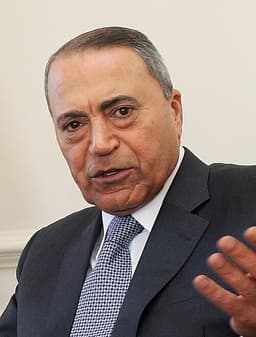
Marouf al-Bakhit
General · Modern
41.6Total
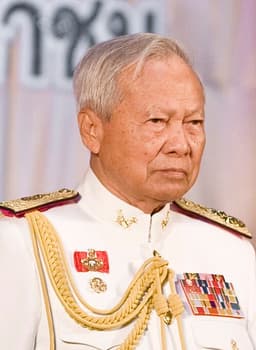
Prem Tinsulanonda
General · Modern
57.2Total
Basic Information
Born
1947
1920
Died
—
—
Era
Modern
Modern
Nationality
Jordan
Thailand
Occupation
General
General
Civilization
Middle Eastern
Eastern
Score Comparison
Military (10%)
10.2
50.0
Political (20%)
61.3
59.3
Influence (20%)
48.6
54.9
Legacy (20%)
38.3
47.5
Leadership (15%)
40.0
78.0
Strategy (15%)
36.8
60.0
TOTAL
41.6
57.2
Marouf al-Bakhit — Complete Timeline
2005 AD
Appointed Prime Minister of JordanPolitical Action◆ Major
King Abdullah II appointed Marouf al-Bakhit as Prime Minister of Jordan in November 2005, following the 2005 Amman bombings. Al-Bakhit, a former intelligence chief, was tasked with restoring security and stability.
JordanPrime MinisterAppointment
Impact: national
2007 AD
Resigned as Prime MinisterPolitical Action
Marouf al-Bakhit resigned as Prime Minister of Jordan in November 2007 after parliamentary elections. His resignation followed criticism of economic policies and political reforms.
JordanPrime MinisterResignation
Impact: national
2011 AD
Appointed Prime Minister for Second TermPolitical Action◆ Major
King Abdullah II appointed Marouf al-Bakhit as Prime Minister again in February 2011, during the Arab Spring protests. Al-Bakhit was tasked with implementing political reforms to address public demands.
JordanArab SpringPrime Minister
Impact: national
Resigned as Prime Minister for Second TermPolitical Action
Marouf al-Bakhit resigned as Prime Minister in October 2011, after failing to satisfy protesters' demands for faster political reforms. His resignation marked the end of his second term.
JordanArab SpringResignation
Impact: national
Prem Tinsulanonda — Complete Timeline
1980 AD
Appointed Prime Minister after a coupPolitical Action◆ Major
Prem Tinsulanonda was appointed Prime Minister of Thailand by the military after a coup. He served for over eight years, overseeing a period of political stability and economic growth.
Prime MinisterMilitary RuleStability
Impact: national
1981 AD
Survived a coup attemptPolitical Action◆ Major
Prem survived a coup attempt by military officers loyal to the 'Young Turks' faction. The coup failed due to lack of support and the loyalty of key military units, allowing Prem to remain in power.
Coup AttemptPolitical CrisisMilitary
Impact: national
1988 AD
Resigned as Prime MinisterPolitical Action◆ Major
Prem resigned as Prime Minister after the general election, handing over power to a civilian government led by Chatichai Choonhavan. His resignation marked a rare peaceful transition of power in Thai politics.
ResignationDemocratic TransitionPeaceful
Impact: nationalconstructive
2016 AD
Appointed Regent of ThailandPolitical Action
After the death of King Bhumibol, Prem was appointed Regent of Thailand until the ascension of King Maha Vajiralongkorn. He served as a key figure in the transition of the monarchy.
RegentMonarchyTransition
Impact: national
Expert Analysis
Prem Tinsulanonda vs Marouf al-Bakhit
### The General as Statesman: Prem Tinsulanonda and Marouf al-Bakhit
In the steamy heat of Bangkok, on an April morning in 1981, a nervous silence gripped the capital. Tanks loyal to a faction of young military officers—the "Young Turks"—had surrounded government buildings, demanding the resignation of Prime Minister Prem Tinsulanonda. Inside his office, the general did not flee or call for a counter-strike. Instead, he did something that would define his entire career: he waited, and he leaned on the one institution above all others—the monarchy. Half a world away, in the dusty corridors of power in Amman, another general-turned-prime minister, Marouf al-Bakhit, faced his own moment of crisis in February 2011. The Arab Spring was roaring at the gates, and King Abdullah II asked him to form a government. Bakhit accepted, but his path would end not in quiet, dignified retirement, but in the bitter taste of failure. What made one general a revered, almost kingly figure, and the other a footnote in a turbulent decade? The answer lies not in their uniforms, but in the very different worlds they were born to serve.
### Origins
Prem Tinsulanonda was born in 1920, in the southern province of Songkhla, into a Thailand that was still an absolute monarchy, though the winds of change were already blowing. He grew up in a world of Buddhist temples, rice paddies, and a deep, unquestioning reverence for the Chakri dynasty. His education at a military academy was as much about discipline and loyalty as it was about strategy. Prem was a product of a stable, hierarchical society where the king was not just a ruler but a semi-divine figure, and the military was the guardian of that order. When he entered politics, it was not as a revolutionary, but as a caretaker.
Marouf al-Bakhit, born in 1947 in the town of Mahis, came of age in a far more fractured world. Jordan was a young kingdom, carved from the remnants of the Ottoman Empire, surrounded by hostile neighbors and a restless Palestinian population. He studied in the United States and Britain, earning a PhD in political science, before returning to serve in the intelligence services—the Mukhabarat. His world was one of constant vigilance, of balancing tribal loyalties, regional threats, and the ever-present shadow of the Israeli-Palestinian conflict. Where Prem was shaped by tradition and stability, Bakhit was forged in the crucible of survival and suspicion.
### Rise to Power
Prem’s ascent was slow, methodical, and almost reluctant. He served as a loyal army commander and was appointed Prime Minister in 1980, not after seizing power himself, but after a coup by other officers left a vacuum. The military and the king needed a steady hand, and Prem was that hand. He was not a fiery orator or a charismatic populist; he was a bridge. He survived the 1981 coup attempt not by force of arms, but because he had the loyalty of the palace and the quiet support of the people. His power came from his ability to be indispensable without being ambitious.
Bakhit’s rise was more direct, but also more fragile. As a former intelligence chief, he was a man of secrets and networks. In 2005, after the devastating Amman hotel bombings by al-Qaeda, King Abdullah needed a security-minded leader to restore order. Bakhit was the obvious choice. He was tough, efficient, and utterly loyal to the throne. His appointment was a sign that, in times of crisis, the king would turn to the men who knew how to wield a firm hand. But this also meant that Bakhit was never his own man—he was the king’s instrument, not a leader in his own right.
### Leadership & Governance
Prem’s leadership was a masterclass in soft power. He ruled for over eight years, a remarkable tenure in the chaotic world of Thai politics. He did not govern through grand reforms or fiery speeches, but through a delicate balancing act. He kept the military factions in check by never favoring one over another. He maintained the trust of King Bhumibol, the revered monarch whose moral authority was absolute. And he allowed the economy to grow, quietly, under the guidance of technocrats. His political wisdom was not in doing, but in preventing—preventing coups, preventing civil unrest, preventing the military from devouring itself. His strategy score of 65.0 and leadership score of 89.0 reflect this: he was not a battlefield general, but a political chess master.
Bakhit, by contrast, was a hammer in a world that needed a scalpel. His first term (2005-2007) was marked by a focus on security and order, but he failed to push through meaningful political or economic reforms. When the Arab Spring erupted in 2011, the king recalled him, hoping his strongman image would quell the protests. But Bakhit’s response was the same as before: he offered slow, grudging concessions while emphasizing stability. The protesters wanted faster change, more freedom, and an end to corruption. Bakhit saw them as a security problem. His political score of 63.0 and strategy score of 48.1 reveal a man who could manage a crisis, but could not outthink it.
### Triumph & Tragedy
Prem’s greatest triumph was not a single event, but the very fact that he left office on his own terms. In 1988, after a general election, he simply resigned, handing power to a civilian government. This was almost unheard of in a country where generals clung to power. His tragedy, if it can be called that, was that his success made him a symbol of a bygone era—a time when a quiet, honorable general could guide a nation without drama.
Bakhit’s tragedy was more acute. His greatest moment—being trusted by the king twice to lead the country—was also his undoing. In 2011, he was appointed to save the monarchy from the storm of protest, but he could not. He resigned in October of that year, having satisfied no one. The protesters saw him as a symbol of the old guard; the king saw him as a failure. He left the stage not with dignity, but with the bitter taste of a mission impossible.
### Character & Destiny
Prem was a man of immense patience and self-effacement. He understood that in a country like Thailand, power was not something to be seized, but something to be earned through loyalty. His character was his destiny: he became the regent of Thailand in 2016, after the death of King Bhumibol, the ultimate honor for a servant of the crown. He died as a near-mythical figure, a guardian of the realm.
Bakhit was a man of duty, but also of limits. He was a product of the intelligence world, where trust is scarce and information is power. He could not adapt to the demands of a democratic spring. His character—disciplined, secretive, and cautious—made him the perfect security chief, but a flawed leader in an era of upheaval. His destiny was to be a footnote, a general who tried to hold back the tide and was swept away.
### Legacy
Prem’s legacy is enshrined in Thailand’s modern history. He is remembered as a stabilizing force, a man who kept the kingdom together during turbulent decades. His influence score of 73.9 and legacy score of 66.8 reflect a figure who, though not a household name globally, shaped the very fabric of his nation. He is the quiet pillar upon which Thailand’s fragile democracy rested.
Bakhit’s legacy is more ambiguous. He is remembered, if at all, as a competent but uninspired leader, a man who did the king’s bidding but could not meet the moment. His total score of 56.3 places him as a secondary figure, a general who served his country but could not change its course. In Jordan, he is a name in a list of prime ministers, not a story told to children.
### Conclusion
The difference between Prem Tinsulanonda and Marouf al-Bakhit is not a matter of skill or intelligence, but of context and character. Prem governed in a Thailand where the monarchy was a sacred anchor, and he became its most faithful servant. Bakhit governed in a Jordan where the monarchy was a political anchor, and he became its most loyal soldier. One man’s patience became a legend; the other’s discipline became a limitation. In the end, the generals who succeed are not always the strongest or the smartest—they are the ones who understand that true power lies not in commanding, but in knowing when to step aside.
Rankings
🥇
Prem TinsulanondaLeader
Mil: 50.0Pol: 59.3Inf: 54.9
57.2
🥈
Marouf al-Bakhit
Mil: 10.2Pol: 61.3Inf: 48.6
41.6
+15.6 behind
How This Comparison Works
Algorithm
Each figure is scored on 6 dimensions (0—100 scale) based on structured historical data: Military (10%), Political (20%), Influence (20%), Legacy (20%), Leadership (15%), Strategy (15%). The weighted total produces the final ranking.
Data Sources
Scores are computed from structured sub-indicators in the database. Scale factors adjust for era (Ancient ×0.85, Modern ×1.0) and civilization size (Eastern ×1.05, Other ×0.80) to account for differences in population and military scale.
Maximum 3 Figures
Comparisons are limited to 2—3 figures to ensure readability and statistical meaningfulness.
Error Margins
±5 points per dimension — Sub-scores are derived from historical records with inherent uncertainty. Two figures within 5 points on a dimension should be considered roughly equivalent in that area.
Total Score Accuracy
±3 points overall — The weighted combination of 6 dimensions produces a total score with approximately ±3 points of uncertainty. Differences of less than 3 points are not statistically significant— the figures are effectively tied.
Known Limitations
- Historical records are incomplete and uneven across civilizations
- Figures from oral-tradition societies may be underrepresented
- Occupation labels can misclassify multi-role figures
- Scores measure capability and impact, not moral character
- Quantitative scoring is a comparison tool, not absolute truth
Capability Radar
Military (10%) — Battles & Warfare
Battles
5
20
Win Rate
5
25
Expansion
5
10
Political (20%) — Governance & Reform
Reform
30
55
Diplomacy
40
60
Economy
30
50
Influence (20%) — Cultural & Global Reach
Cultural
10
30
Global
10
30
Legacy (20%) — Historical Impact
Historical
10
40
Longevity
10
35
Leadership (15%) — Power & Stability
Tenure
40
65
Stability
35
60
Strategy (15%) — Tactics & Innovation
Strategy
10
30
Tactics
10
30
Reform
10
35
Similar Comparisons
Comments & Discussion
"Bangkok Sentinel"6/16/2026
Prem's genius wasn't military—it was political theater. By refusing to counterattack the Young Turks in 1981, he transformed his weakness into strength. He made himself indispensable to the king as a buffer between the monarchy and chaotic factions. Bakhit, by contrast, accepted a poisoned chalice from Abdullah II without demanding real autonomy. In Amman, he was a puppet; in Bangkok, Prem became the puppet master.
"数据确证者"6/16/2026
分析完全忽略关键数据:Prem执政18年(1980-1988),泰国年均GDP增长6.7%;Bakhit两次组阁共22个月,约旦失业率从2011年的12%飙升至2015年的15.8%。Prem靠经济繁荣赢得民心,Bakhit则在债务和抗议中挣扎。军事背景只是表象,民生表现才是分水岭。数字不会撒谎。
"Aegean Classicist"6/16/2026
The comparison misses the structural role of monarchy. Thailand's Chakri dynasty has ruled since 1782 — a continuous, sacred institution. Jordan's Hashemites date only to 1921, with far less religious or historical aura. Prem could be the "king's man" because the king was a living demigod. Bakhit's king was a modernizer in a fragile state. Prem inherited centuries of legitimacy; Bakhit inherited a thin crust of it.
"历史迷老王"6/16/2026
最讽刺的是,两人都参加过1949年的阿以战争,但结局截然不同。Prem在朝鲜战争期间站队美国获得援助,泰国从中立国变成铁杆盟友;Bakhit则在1967年六日战争后目睹约旦失去西岸和东耶路撒冷。Prem的时代是冷战红利期,Bakhit的时代是失败后遗症。地缘政治运气,比任何个人能力都重要。
"Revisionist Lance"6/16/2026
Stop romanticizing Prem. He was a key architect of Thailand's 1976 Thammasat massacre, directly as defense minister advising the security forces. His "wait and see" posture in 1981 wasn't wisdom — it was self-preservation after that stain. Bakhit never commanded such bloodshed. The comparison whitewashes one man's authoritarian legacy while casually burying another's failures. Reality: Prem's Thailand was a military dictatorship in civilian clothing.