Loading...
Mangal Pandey vs Zhang Xianzhong
Mangal Pandey leads by 7.5 pts · 2 figures compared
…
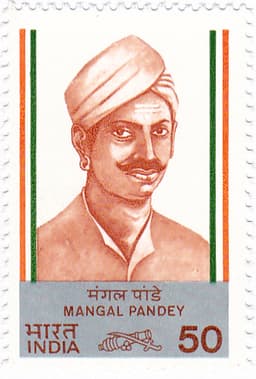
Mangal Pandey
Revolutionary · Modern
48.6Total

Zhang Xianzhong
Revolutionary · Modern
41.1Total
Basic Information
Born
1827
1606
Died
1857
1647
Era
Modern
Modern
Nationality
India
China
Occupation
Revolutionary
Revolutionary
Civilization
Indian
Eastern
Score Comparison
Military (10%)
39.9
55.0
Political (20%)
35.0
35.0
Influence (20%)
51.8
44.8
Legacy (20%)
46.7
40.0
Leadership (15%)
62.6
35.4
Strategy (15%)
53.8
38.3
TOTAL
48.6
41.1
Mangal Pandey — Complete Timeline
1857 AD
Attack on British officers at BarrackporePolitical Action◆ Major
Mangal Pandey attacked two British officers at the Barrackpore military cantonment. He was arrested after the attack, and his actions sparked widespread unrest among Indian sepoys, leading to the 1857 rebellion.
Indian Rebellion of 1857Trigger Event
Impact: regional
Execution by hangingPolitical Action◆ Major
Mangal Pandey was tried by a British military court and executed by hanging at Barrackpore. His execution made him a martyr and a symbol of resistance against British rule in India.
Indian Rebellion of 1857ExecutionMartyr
Impact: regionaltragic
Zhang Xianzhong — Complete Timeline
1630 AD
Launched Rebellion in ShaanxiWar◆ Major
Zhang Xianzhong joined a peasant rebellion in Shaanxi province during the late Ming dynasty. He quickly rose to become a major rebel leader, gathering a large army and establishing a base of operations in the region.
Ming DynastyRebellionShaanxi
Impact: regionaldestructive
1644 AD
Captured and Sacked ChengduWar◆ Major
Zhang Xianzhong captured the city of Chengdu, the capital of Sichuan province. He then proclaimed the Daxi dynasty and made Chengdu his capital. The capture was accompanied by widespread destruction and massacres of the local population.
Ming-Qing TransitionSichuanMassacre
Impact: regionaldestructive
Proclaimed the Daxi DynastyPolitical Action◆ Major
Zhang Xianzhong proclaimed the Daxi (Great Western) dynasty in Sichuan. He established a government and minted his own coinage. His rule was characterized by extreme violence, including the systematic killing of scholars, officials, and civilians.
Daxi DynastyProclamationSichuan
Impact: regionaldestructive
1647 AD
Killed in Battle Against Qing ForcesWar◆ Major
Zhang Xianzhong was killed in battle against Qing forces in Xichong, Sichuan. His death led to the collapse of the Daxi dynasty. The Qing conquest of Sichuan was completed shortly after, but the province had been devastated by years of warfare.
Qing DynastyBattleDeath
Impact: regionaltragic
Expert Analysis
Mangal Pandey vs Zhang Xianzhong
### The Rebel and the Martyr
In the spring of 1644, as the Ming dynasty crumbled, a man named Zhang Xianzhong rode into the city of Chengdu. He did not come as a liberator. Within days, the capital of Sichuan province was being systematically sacked, its people put to the sword in a massacre so vast that it would echo through Chinese history for centuries. Just over two hundred years later, on a dusty parade ground in Barrackpore, India, another man—a sepoy named Mangal Pandey—raised his musket against his British officers. He fired once, missed, and set in motion a chain of events that would shake an empire. Both men were revolutionaries, born on opposite sides of Asia, yet their fates could not have been more different. Zhang Xianzhong ravaged a province and built a short-lived dynasty; Mangal Pandey’s single, failed act of defiance ignited a rebellion and carved his name into the soul of a nation. What drove these two men, and why did their rebellions lead to such divergent outcomes?
### Origins
Zhang Xianzhong was born in 1606, a child of a China buckling under the weight of the late Ming dynasty. Famine, corruption, and a collapsing bureaucracy had turned the countryside into a tinderbox. As a young man, he drifted into the margins of society—some accounts say he was a soldier, others a bandit—before joining a peasant rebellion in Shaanxi province in 1630. The era forged him: desperate, ruthless, and pragmatic. He learned that in a world where the old order was dying, the only law was survival.
Mangal Pandey, born in 1827 into a high-caste Brahmin family in northern India, grew up in a very different world—one that was stable, but only because it was occupied. The British East India Company ruled with an iron grip, and discipline in its army was absolute. Pandey enlisted as a sepoy, a soldier in the Company’s service, and by 1857 he was stationed at Barrackpore, near Calcutta. His world was one of order, but also of simmering resentment. The British had introduced new rifle cartridges greased with animal fat—cow and pig—that had to be bitten open. For a high-caste Hindu and a Muslim alike, this was a profound violation. The tinder was dry; Pandey would be the spark.
### Rise to Power
Zhang Xianzhong’s path was one of brutal ascent. He rose through the ranks of the peasant armies by sheer force of will, leading raids and outmaneuvering Ming forces. By 1644, as the Manchu Qing armies swept into Beijing, Zhang saw his opportunity. He turned his attention to the rich, isolated province of Sichuan. That year, he captured Chengdu, proclaimed the Daxi (Great Western) dynasty, and began minting his own coins. His rise was not a matter of ideology—it was a conquest. He ruled through terror, burning towns and slaughtering those who resisted.
Mangal Pandey’s rise was not a rise at all—it was a single, desperate moment. On March 29, 1857, at the Barrackpore parade ground, he broke ranks, seized his musket, and attacked two British officers. He was quickly overpowered, arrested, and tried. There was no army behind him, no grand strategy. His rebellion was the act of a man who, facing an unbearable insult, chose to die rather than submit. His “rise” was instantaneous, and it ended in a noose.
### Leadership & Governance
Zhang Xianzhong’s leadership was the rule of the sword. He established a government in Sichuan, but it was a government of fear. He is infamous for ordering massacres that may have killed millions—though the numbers are debated, the scale is undeniable. His military score of 63.4 reflects a capable commander, but his political score of 34.4 reveals a man who could not build, only destroy. He minted coins, but they bought nothing in a land of corpses. His strategy score of 45.9 suggests he was more a warlord than a tactician—his victories came from shock and terror, not from careful planning.
Mangal Pandey never governed anything. His leadership score of 28.5 is the lowest of the two, but it is misleading. He led by example, not by command. His attack was not a bid for power but a cry of defiance. He had no political program, no vision for a new India. His rebellion was moral, not strategic. And yet, in that act, he became a symbol that outlived any of Zhang’s decrees.
### Triumph & Tragedy
Zhang Xianzhong’s greatest triumph was the capture of Chengdu and the proclamation of the Daxi dynasty in 1644. For a brief moment, he was a king. But his tragedy was total: in 1647, he was killed in battle against Qing forces near Xichong, Sichuan. His dynasty collapsed with him, and the province he had ravaged would not recover for decades.
Mangal Pandey’s triumph was his martyrdom. He was executed by hanging on April 8, 1857, at Barrackpore. His death was the spark that lit the Indian Rebellion of 1857, a massive uprising that nearly ended British rule in India. His tragedy was that he did not live to see it. He died believing he had failed, but his name became a rallying cry.
### Character & Destiny
Zhang Xianzhong was a creature of his time—a man shaped by the chaos of the Ming collapse. He was cunning, brutal, and utterly without mercy. His personality was that of a survivor who saw the world as a zero-sum game: to win, others had to lose. This drove him to extremes, and ultimately, it isolated him. He trusted no one, and no one trusted him. His destiny was to be a footnote in the Qing conquest.
Mangal Pandey, by contrast, was a man of conscience. He acted not out of ambition but out of faith and honor. He was a soldier who broke his oath because a greater oath—to his religion and his dignity—demanded it. His personality was that of a martyr, not a general. And his destiny was to become a symbol of resistance, not a ruler. His influence score of 69.8 and legacy score of 62.7 far exceed Zhang’s, because his rebellion was not for a throne but for a cause.
### Legacy
Zhang Xianzhong’s legacy is a dark one. In Chinese history, he is remembered as a butcher, a chaos-bringer whose name is synonymous with destruction. His total score of 49.1 reflects a figure of moderate historical impact, but that impact was almost entirely negative. He left no institutions, no ideas, only ruins.
Mangal Pandey’s legacy is radiant. In India, he is a hero, a martyr, and a founding figure of the struggle for independence. His face appears on stamps, his name in textbooks, and his story in films. His total score of 48.7 is nearly identical to Zhang’s, but the quality of that legacy is utterly different. One man destroyed; the other inspired.
### Conclusion
Standing at the crossroads of history, Zhang Xianzhong and Mangal Pandey reveal two faces of revolution. Zhang’s rebellion was a fire that consumed everything in its path, leaving only ash. Pandey’s was a spark that lit a long-burning flame. One sought power and found only death; the other sought justice and found immortality. Their stories remind us that the difference between a tyrant and a hero is not always in the scale of their actions, but in the meaning those actions carry for those who come after. Zhang Xianzhong conquered a province and is forgotten by all but historians. Mangal Pandey fired a single shot, missed, and changed the world.
Rankings
🥇
Mangal PandeyLeader
Mil: 39.9Pol: 35.0Inf: 51.8
48.6
🥈
Zhang Xianzhong
Mil: 55.0Pol: 35.0Inf: 44.8
41.1
+7.5 behind
How This Comparison Works
Algorithm
Each figure is scored on 6 dimensions (0—100 scale) based on structured historical data: Military (10%), Political (20%), Influence (20%), Legacy (20%), Leadership (15%), Strategy (15%). The weighted total produces the final ranking.
Data Sources
Scores are computed from structured sub-indicators in the database. Scale factors adjust for era (Ancient ×0.85, Modern ×1.0) and civilization size (Eastern ×1.05, Other ×0.80) to account for differences in population and military scale.
Maximum 3 Figures
Comparisons are limited to 2—3 figures to ensure readability and statistical meaningfulness.
Error Margins
±5 points per dimension — Sub-scores are derived from historical records with inherent uncertainty. Two figures within 5 points on a dimension should be considered roughly equivalent in that area.
Total Score Accuracy
±3 points overall — The weighted combination of 6 dimensions produces a total score with approximately ±3 points of uncertainty. Differences of less than 3 points are not statistically significant— the figures are effectively tied.
Known Limitations
- Historical records are incomplete and uneven across civilizations
- Figures from oral-tradition societies may be underrepresented
- Occupation labels can misclassify multi-role figures
- Scores measure capability and impact, not moral character
- Quantitative scoring is a comparison tool, not absolute truth
Capability Radar
Military (10%) — Battles & Warfare
Battles
5
55
Win Rate
5
50
Expansion
5
60
Political (20%) — Governance & Reform
Reform
5
5
Diplomacy
5
10
Economy
5
5
Influence (20%) — Cultural & Global Reach
Cultural
40
20
Global
40
15
Legacy (20%) — Historical Impact
Historical
60
35
Longevity
50
25
Leadership (15%) — Power & Stability
Tenure
5
30
Stability
5
5
Strategy (15%) — Tactics & Innovation
Strategy
5
40
Tactics
10
45
Reform
5
10
Similar Comparisons
Comments & Discussion
No comments yet. Be the first to share your thoughts!