Loading...
Ho Chi Minh vs Zhang Xianzhong
Ho Chi Minh leads by 21.8 pts · 2 figures compared
…
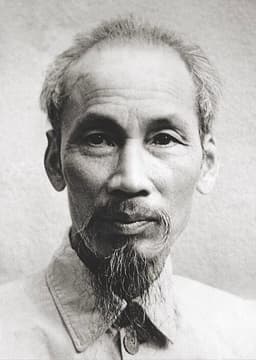
Ho Chi Minh
Revolutionary · Modern
62.9Total

Zhang Xianzhong
Revolutionary · Modern
41.1Total
Basic Information
Born
1890
1606
Died
1969
1647
Era
Modern
Modern
Nationality
Vietnam
China
Occupation
Revolutionary
Revolutionary
Civilization
Eastern
Eastern
Score Comparison
Military (10%)
55.0
55.0
Political (20%)
72.0
35.0
Influence (20%)
62.0
44.8
Legacy (20%)
58.0
40.0
Leadership (15%)
72.0
35.4
Strategy (15%)
58.0
38.3
TOTAL
62.9
41.1
Ho Chi Minh — Complete Timeline
1941 AD
Establishment of the Viet MinhPolitical Action◆ Major
Ho Chi Minh founded the Viet Minh (League for the Independence of Vietnam) in southern China. This coalition of nationalist and communist groups became the primary force for Vietnamese independence, fighting both Japanese occupation and French colonialism.
Viet MinhIndependence MovementWorld War II
Impact: nationalconstructive
1945 AD
Declaration of Independence of VietnamPolitical Action
Ho Chi Minh proclaimed the Democratic Republic of Vietnam in Hanoi's Ba Dinh Square, citing the US Declaration of Independence. This established the Viet Minh government and began the struggle for independence from French colonial rule.
IndependenceVietnamDecolonization
Impact: nationalconstructive
1954 AD
Battle of Dien Bien PhuWar
Ho Chi Minh's Viet Minh forces, under General Giap, defeated the French garrison at Dien Bien Phu. This victory ended French colonial rule in Indochina and led to the Geneva Accords dividing Vietnam at the 17th parallel.
Vietnam WarDecolonizationFrench Indochina
Impact: regional
Geneva AccordsPolitical Action◆ Major
Ho Chi Minh's delegation signed the Geneva Accords, temporarily dividing Vietnam at the 17th parallel. The agreement promised nationwide elections in 1956, which were never held, leading to the permanent division of Vietnam.
Geneva ConferenceDivision of VietnamDiplomacy
Impact: regional
1959 AD
Start of the Vietnam WarWar
Ho Chi Minh's government in North Vietnam authorized armed struggle against the US-backed South Vietnamese regime. This escalated into the Vietnam War, a prolonged conflict that resulted in millions of deaths and US withdrawal in 1973.
Vietnam WarCold WarCommunism
Impact: globaldestructive
Zhang Xianzhong — Complete Timeline
1630 AD
Launched Rebellion in ShaanxiWar◆ Major
Zhang Xianzhong joined a peasant rebellion in Shaanxi province during the late Ming dynasty. He quickly rose to become a major rebel leader, gathering a large army and establishing a base of operations in the region.
Ming DynastyRebellionShaanxi
Impact: regionaldestructive
1644 AD
Captured and Sacked ChengduWar◆ Major
Zhang Xianzhong captured the city of Chengdu, the capital of Sichuan province. He then proclaimed the Daxi dynasty and made Chengdu his capital. The capture was accompanied by widespread destruction and massacres of the local population.
Ming-Qing TransitionSichuanMassacre
Impact: regionaldestructive
Proclaimed the Daxi DynastyPolitical Action◆ Major
Zhang Xianzhong proclaimed the Daxi (Great Western) dynasty in Sichuan. He established a government and minted his own coinage. His rule was characterized by extreme violence, including the systematic killing of scholars, officials, and civilians.
Daxi DynastyProclamationSichuan
Impact: regionaldestructive
1647 AD
Killed in Battle Against Qing ForcesWar◆ Major
Zhang Xianzhong was killed in battle against Qing forces in Xichong, Sichuan. His death led to the collapse of the Daxi dynasty. The Qing conquest of Sichuan was completed shortly after, but the province had been devastated by years of warfare.
Qing DynastyBattleDeath
Impact: regionaltragic
Expert Analysis
Ho Chi Minh vs Zhang Xianzhong
# The Revolutionary and the Rebel: Two Paths Through Chaos
In the autumn of 1945, a frail, bearded man in a plain khaki suit stood before a crowd in Hanoi’s Ba Dinh Square and read words that echoed across the world: “All men are created equal.” Ho Chi Minh was quoting Thomas Jefferson, but his meaning was unmistakably Vietnamese. Three centuries earlier, another revolutionary had seized a city—Chengdu, the capital of Sichuan—and proclaimed a dynasty of his own. Zhang Xianzhong’s proclamation came not with borrowed Enlightenment phrases, but with the roar of fire and the clatter of swords. Both men rose from the depths of peasant society; both led armed movements against crumbling empires. One became a founding father, the other a byword for terror. Why did their paths diverge so radically?
Origins
Ho Chi Minh was born Nguyen Sinh Cung in 1890 in Nghe An province, central Vietnam, into a family of Confucian scholars who had resisted French colonial rule. His father was a mandarin who refused to learn French; his older sister was imprisoned by the colonial authorities. From childhood, Ho absorbed a visceral hatred of foreign domination, but also a respect for education and discipline. He left Vietnam as a young man, working as a cook and a photographer’s assistant in Paris, London, and New York, reading Marx and Lenin, and learning to speak French, English, and Chinese fluently. By the time he returned to Asia in the 1920s, he was not merely a nationalist but a cosmopolitan revolutionary, shaped by both Eastern tradition and Western political theory.
Zhang Xianzhong was born in 1606 in Shaanxi province, northwestern China, into a family of impoverished peasants. The Ming dynasty was collapsing under the weight of corruption, famine, and peasant uprisings. Zhang grew up in a world of banditry and survival. He joined the rebel ranks in 1630 at age twenty-four, not as an ideologue but as a desperate man in a desperate time. He never left China, never studied foreign philosophies, never formed a political party. His education was the battlefield; his teachers were hunger, rage, and the example of other rebel warlords.
Rise to Power
Ho Chi Minh’s rise was slow, patient, and strategic. For decades, he worked in the shadows—founding the Indochinese Communist Party in 1930, building networks in southern China and Moscow, and waiting for the moment when the chaos of World War II would open a door. That door came in 1941, when he established the Viet Minh, a broad nationalist coalition that included communists, socialists, and anti-colonial patriots. He understood that revolution required not just soldiers, but a political movement, an ideology, and international legitimacy.
Zhang Xianzhong’s rise was swift, violent, and chaotic. In 1630, he joined a rebellion that had already erupted across Shaanxi. Within months, he was a leader, not because of political acumen but because of personal charisma, ruthlessness, and the ability to attract followers in a world where loyalty was fleeting. By 1644, he had captured Chengdu and proclaimed the Daxi dynasty. He did not build a party or a bureaucracy; he built an army of conquest, and he ruled through fear.
Leadership & Governance
Ho Chi Minh governed as a consensus-builder and a master of symbolism. He was not a military commander—General Vo Nguyen Giap led the troops at Dien Bien Phu in 1954—but Ho provided the political vision that made victory possible. He kept the Viet Minh united through diplomacy, compromise, and an almost saintly personal image. He was “Uncle Ho,” a father figure who lived simply, wrote poetry, and seemed to embody the nation’s soul. His governance was pragmatic: he accepted the Geneva Accords in 1954, dividing Vietnam temporarily, because he understood that a full victory was not yet possible.
Zhang Xianzhong governed through terror. Historical accounts, though disputed in their scale, describe massacres that depopulated Sichuan. He is said to have killed scholars, officials, and ordinary peasants alike, suspecting betrayal everywhere. His Daxi dynasty minted coins and issued decrees, but it never built institutions or won loyalty. It was a regime of plunder, not of nation-building. While Ho Chi Minh inspired people to die for a cause, Zhang Xianzhong inspired people to flee or resist.
Triumph & Tragedy
Ho Chi Minh’s greatest triumph was the declaration of independence on September 2, 1945, when he stood in Ba Dinh Square and announced the birth of the Democratic Republic of Vietnam. It was a moment of pure hope, when a small, colonized nation seemed to claim its place among the free. His greatest tragedy came later: the Vietnam War, which he authorized in 1959, would kill millions of Vietnamese, devastate his country, and end in victory only after his death in 1969. He never saw the reunification he had fought for.
Zhang Xianzhong’s triumph was the capture of Chengdu in 1644, the seat of a province rich in rice and silk. But he could not hold it. In 1647, Qing forces caught him in battle at Xichong, and he was killed. His dynasty collapsed with him. His tragedy was not that he lost, but that he never built anything that could outlast him.
Character & Destiny
Ho Chi Minh was patient, disciplined, and ideologically flexible. He could quote Confucius, Lenin, and Jefferson in the same speech. He understood that power required legitimacy, and legitimacy required ideas. Zhang Xianzhong was impulsive, brutal, and narrow. He understood only force. Their personalities were products of their times: Ho lived in an age of nationalism and communism, when revolutionaries needed to be statesmen. Zhang lived in an age of dynastic collapse, when a rebel’s only tools were a sword and a slogan.
Legacy
Ho Chi Minh is remembered as the father of modern Vietnam. His mausoleum in Hanoi is a pilgrimage site. His image appears on currency and in classrooms. His legacy is contested—some criticize the authoritarianism of the communist state he founded—but his role as a liberator is beyond dispute. He scored 72.2 in legacy and 84.8 in leadership, reflecting his enduring political influence.
Zhang Xianzhong is remembered as a monster or a myth. For centuries, Chinese historians blamed him for the depopulation of Sichuan, though modern scholarship suggests that famine and Qing forces were equally responsible. He is a cautionary tale, not a founding father. His scores—34.4 in politics, 34.5 in leadership—reflect a life that achieved nothing lasting.
Conclusion
Ho Chi Minh and Zhang Xianzhong both rose from the dust of peasant rebellion to challenge empires. Both fought, killed, and died for a vision of a different world. But one built a nation; the other burned a province. The difference was not in their goals—both wanted independence and power—but in their understanding of what power requires. Ho Chi Minh knew that revolution is not just a war; it is a political act, a story, a promise. Zhang Xianzhong knew only war. And in the end, the stories we tell about ourselves determine whether we are remembered as liberators or as destroyers.
Rankings
🥇
Ho Chi MinhLeader
Mil: 55.0Pol: 72.0Inf: 62.0
62.9
🥈
Zhang Xianzhong
Mil: 55.0Pol: 35.0Inf: 44.8
41.1
+21.8 behind
How This Comparison Works
Algorithm
Each figure is scored on 6 dimensions (0—100 scale) based on structured historical data: Military (10%), Political (20%), Influence (20%), Legacy (20%), Leadership (15%), Strategy (15%). The weighted total produces the final ranking.
Data Sources
Scores are computed from structured sub-indicators in the database. Scale factors adjust for era (Ancient ×0.85, Modern ×1.0) and civilization size (Eastern ×1.05, Other ×0.80) to account for differences in population and military scale.
Maximum 3 Figures
Comparisons are limited to 2—3 figures to ensure readability and statistical meaningfulness.
Error Margins
±5 points per dimension — Sub-scores are derived from historical records with inherent uncertainty. Two figures within 5 points on a dimension should be considered roughly equivalent in that area.
Total Score Accuracy
±3 points overall — The weighted combination of 6 dimensions produces a total score with approximately ±3 points of uncertainty. Differences of less than 3 points are not statistically significant— the figures are effectively tied.
Known Limitations
- Historical records are incomplete and uneven across civilizations
- Figures from oral-tradition societies may be underrepresented
- Occupation labels can misclassify multi-role figures
- Scores measure capability and impact, not moral character
- Quantitative scoring is a comparison tool, not absolute truth
Capability Radar
Military (10%) — Battles & Warfare
Battles
65
55
Win Rate
60
50
Expansion
55
60
Political (20%) — Governance & Reform
Reform
85
5
Diplomacy
90
10
Economy
40
5
Influence (20%) — Cultural & Global Reach
Cultural
75
20
Global
75
15
Legacy (20%) — Historical Impact
Historical
85
35
Longevity
70
25
Leadership (15%) — Power & Stability
Tenure
70
30
Stability
50
5
Strategy (15%) — Tactics & Innovation
Strategy
80
40
Tactics
70
45
Reform
75
10
Similar Comparisons
Comments & Discussion
Hopped-Up Historian6/16/2026
Let’s not pretend Ho Chi Minh was some pure-hearted freedom fighter—he was a ruthless pragmatist who switched alliances like a chameleon. Sure, he quoted Jefferson in 1945, but he later purged fellow Vietnamese nationalists and sided with Stalin. Zhang Xianzhong was equally brutal, but at least he didn’t hide behind Western platitudes. Ho’s success was timing—he rode the anti-colonial wave, while Zhang failed in a fractured 17th-century China. Both were tyrants with different PR teams.
铁血考据党6/16/2026
张献忠的“屠蜀”在《蜀碧》里记载得血淋淋的,但仔细一想,清朝官方史料夸大了十倍不止,无非是为自己入川洗白。霍志明呢?越南那边吹他是“民族之父”,可别忘了,他把多少同僚送去劳改营?两人都靠暴力起家,只是一个有列宁手册,一个只有大刀长矛。建议历史课少点偶像崇拜,多点数字核实。
Mao's Shadow6/16/2026
Ho Chi Minh wasn’t just a nationalist—he was a disciplined Communist who endured exile and built a cadre system from scratch. Zhang Xianzhong was a peasant bandit, pure chaos, who couldn’t even hold Sichuan for a decade. Ho quoting Jefferson was tactical brilliance; Zhang’s “kill the rich, spare the poor” was dumb class war. One created North Vietnam, the other left a pile of bones. Revisionists love to muddy the waters, but outcomes speak: Ho’s revolution lasted, Zhang’s didn’t.
流民观察员6/16/2026
说张献忠只会杀人,那是读野史读傻了。他进驻四川后尝试过与地方士绅合作,推行过“屯田令”,只是明朝残部和社会崩溃让一切失控。霍志明在1945年搞的“八月革命”也不是什么干净行动——他接手政权时,越南还有六成文盲、一团混乱。两人都是乱世产物,区别是霍志明有苏联做靠山,张献忠只有一副赌徒胆量。历史是胜利者的史官,别信单方面叙事。
Classics Cop6/16/2026
Let’s talk about borrowed legitimacy. Ho Chi Minh channeling Jefferson in Ba Dinh Square was a masterclass in universalist framing—he knew the West would wince at their own ideals turned against them. Zhang Xianzhong, by contrast, proclaimed his “Great Western Dynasty” with Confucian rituals he half-understood, mixing baojia registration with random massacres. One used enlightenment rhetoric as a weapon; the other wielded superstition and terror. Both failed their ideals, but Ho’s failure is wor