Loading...
Sun Yat-sen vs Zhang Xianzhong
Sun Yat-sen leads by 11.4 pts · 2 figures compared
…
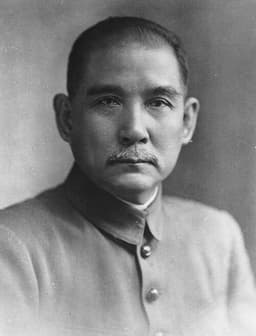
Sun Yat-sen
Revolutionary · Modern
52.5Total

Zhang Xianzhong
Revolutionary · Modern
41.1Total
Basic Information
Born
1866
1606
Died
1925
1647
Era
Modern
Modern
Nationality
China
China
Occupation
Revolutionary
Revolutionary
Civilization
Eastern
Eastern
Score Comparison
Military (10%)
45.0
55.0
Political (20%)
68.0
35.0
Influence (20%)
61.0
44.8
Legacy (20%)
58.0
40.0
Leadership (15%)
33.5
35.4
Strategy (15%)
30.3
38.3
TOTAL
52.5
41.1
Sun Yat-sen — Complete Timeline
1894 AD
Founded the Revive China SocietyPolitical Action◆ Major
Sun Yat-sen founded the Revive China Society (Xingzhonghui) in Honolulu, the first modern revolutionary organization among overseas Chinese. The society aimed to overthrow the Qing dynasty and establish a republic, marking the beginning of organized revolutionary activity.
RevolutionOverseas ChineseRepublic
Impact: nationalconstructive
1911 AD
Led the Xinhai RevolutionPolitical Action
Sun Yat-sen's revolutionary activities culminated in the Wuchang Uprising of October 1911, which sparked the Xinhai Revolution. The uprising spread across China, leading to the abdication of the Qing emperor in 1912 and the end of 2,000 years of imperial rule.
RevolutionQing DynastyRepublic
Impact: globalconstructive
1912 AD
Proclaimed the Republic of ChinaPolitical Action
On January 1, 1912, Sun Yat-sen was inaugurated as the provisional president of the Republic of China in Nanjing. He proclaimed the establishment of the first republic in Asia, based on his Three Principles of the People: nationalism, democracy, and livelihood.
RepublicPresidencyThree Principles
Impact: globalconstructive
Resigned Presidency in Favor of Yuan ShikaiPolitical Action◆ Major
To secure the abdication of the Qing emperor and avoid civil war, Sun Yat-sen resigned the provisional presidency in February 1912 in favor of Yuan Shikai. This decision, while pragmatic, allowed Yuan to consolidate power and later attempt to restore the monarchy.
Power TransferYuan ShikaiCompromise
Impact: national
1919 AD
Reorganized the KuomintangPolitical Action◆ Major
Sun Yat-sen reorganized the Chinese Revolutionary Party into the Kuomintang (KMT) in 1919, with a more centralized structure. He later accepted Soviet aid and CCP members into the party under the policy of 'alliance with Russia and the Communists,' reshaping the revolutionary movement.
KuomintangSoviet AllianceCCP
Impact: nationalconstructive
Zhang Xianzhong — Complete Timeline
1630 AD
Launched Rebellion in ShaanxiWar◆ Major
Zhang Xianzhong joined a peasant rebellion in Shaanxi province during the late Ming dynasty. He quickly rose to become a major rebel leader, gathering a large army and establishing a base of operations in the region.
Ming DynastyRebellionShaanxi
Impact: regionaldestructive
1644 AD
Captured and Sacked ChengduWar◆ Major
Zhang Xianzhong captured the city of Chengdu, the capital of Sichuan province. He then proclaimed the Daxi dynasty and made Chengdu his capital. The capture was accompanied by widespread destruction and massacres of the local population.
Ming-Qing TransitionSichuanMassacre
Impact: regionaldestructive
Proclaimed the Daxi DynastyPolitical Action◆ Major
Zhang Xianzhong proclaimed the Daxi (Great Western) dynasty in Sichuan. He established a government and minted his own coinage. His rule was characterized by extreme violence, including the systematic killing of scholars, officials, and civilians.
Daxi DynastyProclamationSichuan
Impact: regionaldestructive
1647 AD
Killed in Battle Against Qing ForcesWar◆ Major
Zhang Xianzhong was killed in battle against Qing forces in Xichong, Sichuan. His death led to the collapse of the Daxi dynasty. The Qing conquest of Sichuan was completed shortly after, but the province had been devastated by years of warfare.
Qing DynastyBattleDeath
Impact: regionaltragic
Expert Analysis
Sun Yat-sen vs Zhang Xianzhong
# The Revolutionary's Crossroads: Sun Yat-sen and Zhang Xianzhong
On a bitter winter morning in January 1912, Sun Yat-sen stood before a crowd in Nanjing, his voice carrying the weight of two millennia. He had just been inaugurated as the provisional president of the first republic in Chinese history. Less than three centuries earlier, another man had proclaimed himself emperor in Chengdu, declaring a new dynasty amid the smoke of a sacked city. Zhang Xianzhong's Daxi dynasty lasted barely three years before he was cut down by Qing forces. Sun Yat-sen's republic, though fragile, would outlive him and reshape a nation. Both men were revolutionaries who rose against an established order, yet one is remembered as the father of modern China, the other as a byword for destruction. What drove them down such different paths?
Origins
Sun Yat-sen was born in 1866 in a small village in Guangdong province, into a family of modest farmers. His world changed when he joined his elder brother in Honolulu at age thirteen. There, he received a Western education, learned English, and encountered ideas of constitutional government and democracy that would never leave him. He later studied medicine in Hong Kong, where he absorbed the writings of Rousseau and Lincoln alongside his medical texts. The humiliation of China's defeat in the Sino-Japanese War of 1894-1895 burned into his consciousness a single conviction: China could not survive without fundamental change.
Zhang Xianzhong came from a different China entirely. Born in 1606 in Shaanxi province, he grew up in a world unraveling. The Ming dynasty was collapsing under corruption, famine, and a fiscal crisis that pushed millions into starvation. Zhang was a soldier, then a deserter, then a bandit leader. When he joined a peasant rebellion in 1630, he was already hardened by a life where violence was the only currency that mattered. His world had no schools, no foreign ideas, no hope of reform—only survival and revenge.
Rise to Power
Sun Yat-sen's path was that of an organizer and intellectual. In 1894, he founded the Revive China Society in Honolulu, the first modern revolutionary organization among Chinese overseas. He spent years in exile, traveling the world to raise funds and build networks. His methods were those of pamphlets, secret societies, and persuasion. When the Xinhai Revolution finally erupted in October 1911, sparked by a railway dispute and a mutiny in Wuchang, Sun was not even in China. He was in Denver, Colorado, reading about it in a newspaper.
Zhang Xianzhong rose through blood. By 1644, he had fought his way across central China, amassing an army of tens of thousands. When he captured Chengdu that year, he did not negotiate or build coalitions. He sacked the city, massacred its defenders, and proclaimed himself emperor of the Daxi dynasty. His power rested entirely on the sword.
Leadership & Governance
Here the two men diverge most sharply. Sun Yat-sen's Three Principles of the People—nationalism, democracy, and livelihood—were an attempt to synthesize Western political thought with Chinese realities. He believed in constitutional governance, land reform, and gradual political development. When he became provisional president in 1912, he immediately issued decrees abolishing torture, promoting education, and establishing a parliamentary system. His political score of 80.0 reflects a genuine, if imperfect, commitment to building institutions.
Yet Sun was no military commander. His military score of 45.4 reveals a man who could inspire but not command armies. This weakness forced him into painful compromises. In February 1912, he resigned the presidency to Yuan Shikai, a former Qing general, hoping to secure a peaceful transition. It was a decision that haunted him—Yuan would later dissolve parliament and declare himself emperor.
Zhang Xianzhong governed through terror. His reign in Sichuan was marked by systematic massacres that depopulated entire regions. Historical records, though contested, suggest his campaigns killed hundreds of thousands. He minted coins bearing his name, built a palace, and appointed officials—but his political score of 34.4 and leadership score of 34.5 tell a story of rule by fear alone. He had no vision beyond conquest, no program beyond destruction.
Triumph & Tragedy
Sun Yat-sen's greatest triumph was the Xinhai Revolution itself—the bloodless end of an imperial system that had lasted since the Qin dynasty. His tragedy came afterward: he spent his final years in exile, watching his republic crumble into warlordism. He died in 1925 at age 58, never seeing the unified China he dreamed of. His last words reportedly were: "Peace, struggle, salvation."
Zhang Xianzhong's triumph was the brief moment when he sat on a throne in Chengdu. His tragedy was total and swift. In 1647, Qing forces cornered him in Xichong, Sichuan. He was killed in battle, and his Daxi dynasty vanished with him. The Qing would rule China for another 267 years.
Character & Destiny
Sun Yat-sen was a man of ideas, not armies. His strategy score of 60.2 reflects a mind that thought in decades and centuries, not battles and sieges. He was willing to compromise, to retreat, to wait—traits that made him a poor revolutionary but a lasting symbol. His charisma and conviction kept the revolutionary flame alive even when all seemed lost.
Zhang Xianzhong was a man of action, not ideas. His military score of 63.4 shows competence in the field, but his strategy score of 45.9 reveals a leader who could win battles but not build a future. He had no answer to the question every revolutionary must face: what comes after the old order falls?
Legacy
Sun Yat-sen's legacy score of 72.2 understates his true impact. Both the Republic of China on Taiwan and the People's Republic on the mainland claim him as a founding father. His Three Principles remain embedded in the constitutional frameworks of both Chinas. He is the rare revolutionary whose ideas outlived his failures.
Zhang Xianzhong's legacy score of 56.0 is perhaps too generous. In Sichuan, his name became a curse. For centuries, mothers would tell children: "If you misbehave, Zhang Xianzhong will get you." He is remembered not as a revolutionary but as a catastrophe, a warning about what happens when rebellion has no purpose beyond destruction.
Conclusion
The difference between Sun Yat-sen and Zhang Xianzhong is not simply one of morality or talent. It is the difference between a man who had a vision of what China could become and a man who only knew what he wanted to destroy. Sun Yat-sen failed many times, but he failed forward—each defeat taught him something, each exile brought new ideas. Zhang Xianzhong succeeded once, and that success consumed him. In the end, the revolutionary who read books changed history more than the revolutionary who only read battlefields. The question every revolutionary must answer is not whether they can tear down the old world, but what they will build in its place.
Rankings
🥇
Sun Yat-senLeader
Mil: 45.0Pol: 68.0Inf: 61.0
52.5
🥈
Zhang Xianzhong
Mil: 55.0Pol: 35.0Inf: 44.8
41.1
+11.4 behind
How This Comparison Works
Algorithm
Each figure is scored on 6 dimensions (0—100 scale) based on structured historical data: Military (10%), Political (20%), Influence (20%), Legacy (20%), Leadership (15%), Strategy (15%). The weighted total produces the final ranking.
Data Sources
Scores are computed from structured sub-indicators in the database. Scale factors adjust for era (Ancient ×0.85, Modern ×1.0) and civilization size (Eastern ×1.05, Other ×0.80) to account for differences in population and military scale.
Maximum 3 Figures
Comparisons are limited to 2—3 figures to ensure readability and statistical meaningfulness.
Error Margins
±5 points per dimension — Sub-scores are derived from historical records with inherent uncertainty. Two figures within 5 points on a dimension should be considered roughly equivalent in that area.
Total Score Accuracy
±3 points overall — The weighted combination of 6 dimensions produces a total score with approximately ±3 points of uncertainty. Differences of less than 3 points are not statistically significant— the figures are effectively tied.
Known Limitations
- Historical records are incomplete and uneven across civilizations
- Figures from oral-tradition societies may be underrepresented
- Occupation labels can misclassify multi-role figures
- Scores measure capability and impact, not moral character
- Quantitative scoring is a comparison tool, not absolute truth
Capability Radar
Military (10%) — Battles & Warfare
Battles
15
55
Win Rate
10
50
Expansion
5
60
Political (20%) — Governance & Reform
Reform
85
5
Diplomacy
60
10
Economy
20
5
Influence (20%) — Cultural & Global Reach
Cultural
70
20
Global
65
15
Legacy (20%) — Historical Impact
Historical
80
35
Longevity
75
25
Leadership (15%) — Power & Stability
Tenure
30
30
Stability
15
5
Strategy (15%) — Tactics & Innovation
Strategy
20
40
Tactics
10
45
Reform
40
10
Similar Comparisons
Comments & Discussion
ZhangButcher6/16/2026
Sun Yat-sen studied Western governance and medicine, then built a revolution with pamphlets and foreign support. Zhang Xianzhong? He torched Sichuan, massacred maybe 600,000 people, and declared himself emperor with zero administrative plan. Sun's republic was flawed but aimed at modernity; Zhang's Daxi was just a longer hostage crisis. Anyone romanticizing Zhang as a "peasant rebel" ignores the skeletons stacked like timber in Chengdu.
历史计量控6/16/2026
比人口损失,张献忠在四川屠戮导致的死亡人数估计高达百万级,而孙中山的革命牺牲远小于此。但数据嘛,总是被情绪吃掉。张献忠的“清剿”是系统性杀戮,孙中山的起义是战略性牺牲,两者动机不同,数字却常被混为一谈。别拿大西政权当“农民起义”来洗白,它本质是军阀割据的最高级——无治国、无制度、无未来。
BronzeRebelCritic6/16/2026
Call Sun Yat-sen "father of the republic" all you want, but he borrowed ideas from every empire except China's own. Zhang Xianzhong, for all his bloodshed, at least rejected the Ming dynasty's rotting framework outright. Sun compromised with warlords and foreign powers to get his republic; Zhang refused to kneel, even if it meant burning himself with the old world. One built a hospital, the other a bonfire. Which legacy truly broke the cycle?
三民主义学徒6/16/2026
孙中山不是完美的人,但他至少给了中国一个方向:三民主义、五权宪法、联俄联共扶助农工。张献忠呢?除了“开科取士”和“七杀碑”之外,他在政治遗产上几乎空白。一个建立黄埔军校,一个只会屠城立威。比军事?张献忠被清军砍头;孙中山的北伐虽未竟,但其精神策动了整个民国。大西朝的“革命”连草稿都没打完。
TheSymmetryMan6/16/2026
Both men stood at a dynasty's collapse, but Sun faced the Qing's twilight while Zhang arrived during the Ming's implosion. Sun had steamships, newspapers, and foreign universities; Zhang had matchlocks, famine, and a peasant army that half-starved before he even marched. Context isn't destiny, but it's close. Zhang's brutality was also a product of desperation—the world offered him no textbooks, only swords. Sun chose the pen, Zhang the torch. History picked the winner, not the moral one.