Loading...
Jung Bahadur Rana vs Mohammad Fahim
Jung Bahadur Rana leads by 11.7 pts · 2 figures compared
…
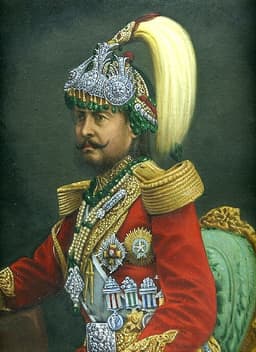
Jung Bahadur Rana
General · Modern
61.4Total

Mohammad Fahim
General · Modern
49.7Total
Basic Information
Born
1817
1957
Died
1877
—
Era
Modern
Modern
Nationality
Nepal
Afghanistan
Occupation
General
General
Civilization
Indian
Middle Eastern
Score Comparison
Military (10%)
55.0
40.0
Political (20%)
72.0
43.7
Influence (20%)
56.7
51.0
Legacy (20%)
55.0
43.3
Leadership (15%)
78.0
74.0
Strategy (15%)
55.0
45.0
TOTAL
61.4
49.7
Jung Bahadur Rana — Complete Timeline
1846 AD
Kot MassacrePolitical Action
Jung Bahadur Runa orchestrated the Kot Massacre in Kathmandu, where dozens of nobles and courtiers were killed. This event eliminated his political rivals and allowed him to seize effective control of the Nepalese government, establishing the hereditary Rana prime ministership.
CoupMassacreRana Dynasty
Impact: nationaldestructive
Establishment of Rana DynastyPolitical Action◆ Major
Following the Kot Massacre, Jung Bahadur Rana appointed himself prime minister and commander-in-chief. He made the position hereditary, founding the Rana dynasty that ruled Nepal for over a century, reducing the Shah monarchs to figureheads.
DynastyGovernmentNepal
Impact: national
1850 AD
Visit to EuropeCultural
Jung Bahadur Rana traveled to Britain and France, becoming the first South Asian ruler to visit Europe. He observed Western military and industrial technology, which influenced his modernization efforts in Nepal, including army reforms.
DiplomacyModernizationTravel
Impact: nationalconstructive
1856 AD
Nepal-Tibet War and Treaty of ThapathaliWar◆ Major
Jung Bahadur Rana led a Nepalese military campaign into Tibet. The conflict ended with the Treaty of Thapathali, which secured Nepalese territorial claims and established a tributary relationship with Tibet, enhancing Nepal's regional influence.
WarTreatyTibet
Impact: regional
Mohammad Fahim — Complete Timeline
2001 AD
Led Northern Alliance Forces in Fall of KabulWar
Mohammad Fahim, as a senior Northern Alliance commander, led forces that captured Kabul from the Taliban in November 2001. This victory followed the US invasion and was a turning point in the war, leading to the collapse of Taliban rule.
AfghanistanWarTaliban
Impact: national
Appointed Vice President of AfghanistanPolitical Action◆ Major
Mohammad Fahim was appointed Vice President of Afghanistan under Hamid Karzai in 2001, serving until 2004. He was a key Northern Alliance commander and his appointment was part of the post-Taliban power-sharing arrangement.
AfghanistanVice PresidencyNorthern Alliance
Impact: nationalconstructive
Served as Minister of DefensePolitical Action◆ Major
Mohammad Fahim served as Afghanistan's Minister of Defense from 2001 to 2004. He oversaw the formation of the new Afghan National Army and security forces, integrating former mujahideen and Northern Alliance fighters.
AfghanistanDefenseMilitary
Impact: nationalconstructive
2009 AD
Appointed First Vice President in 2009Political Action◆ Major
Mohammad Fahim was appointed First Vice President of Afghanistan under President Hamid Karzai in 2009. He served until his death in 2014, playing a key role in security and political affairs.
AfghanistanVice PresidencyGovernment
Impact: nationalconstructive
Expert Analysis
Mohammad Fahim vs Jung Bahadur Rana
### The Strongman and the Warlord
In the autumn of 1846, the royal palace of Kathmandu ran red. In a single, bloody evening, Jung Bahadur Rana, a young general of obscure lineage, eliminated dozens of Nepal’s most powerful nobles, seized control of the state, and founded a dynasty that would rule for more than a century. Just over 150 years later, in the fall of 2001, another general—Mohammad Fahim, a burly Tajik commander from the Panjshir Valley—rode into Kabul at the head of a victorious army, his men firing their rifles into the air as the Taliban fled south. Both men emerged from the chaos of a collapsing old order; both became the most powerful figures in their respective countries. Yet their paths, and the legacies they left, could hardly be more different. Why did one found a stable, hereditary autocracy that outlasted him by generations, while the other, despite wielding immense power, could not even secure his own succession?
### Origins
Jung Bahadur Rana was born in 1817 into a minor noble family in Kathmandu, a city of temples and intrigue where the Shah kings had long been puppets of squabbling aristocratic factions. His uncle was a military commander, and from a young age, Jung Bahadur learned that in Nepal, power flowed not from royal blood but from the sword and the conspiracy. The court was a snake pit; his own father had been exiled. He grew up watching men rise and fall on the whims of queens and generals, and he absorbed the brutal calculus of survival: trust no one, strike first, and never leave an enemy alive.
Mohammad Fahim, born in 1957 in the Panjshir Valley of northeastern Afghanistan, was the son of a farmer. His world was one of village loyalties, clan honor, and the harsh rhythms of mountain life. Unlike Jung Bahadur, who was shaped by the decadent, cosmopolitan court of Kathmandu, Fahim was forged in the crucible of relentless war. He was a teenager when the Soviet Union invaded in 1979. The Panjshir became the heart of the resistance, and Fahim joined the mujahideen under the legendary commander Ahmad Shah Massoud. He was a loyal lieutenant, a man of action rather than ideas, learning war as a craft and leadership as a matter of personal courage and battlefield presence.
### Rise to Power
The key difference in their rise lies in the nature of the crisis each faced. Jung Bahadur’s opportunity came through a political vacuum. In 1846, Queen Rajyalakshmi, desperate to secure the throne for her son, summoned the army to the palace courtyard to settle a score with her rivals. Jung Bahadur arrived with his own troops. What happened next—the Kot Massacre—was not a battle but an execution. He trapped the assembled nobles, barred the gates, and ordered his men to fire. Over thirty of the most powerful men in Nepal were cut down. When the smoke cleared, Jung Bahadur was prime minister, commander-in-chief, and master of the realm. He had not conquered a kingdom; he had slaughtered a government.
Mohammad Fahim’s rise was more conventional for a warlord. He fought for years against the Soviets, then against the communist government, then against the Taliban. His turning point came in September 2001, when al-Qaeda attacked the United States and America demanded the Taliban hand over Osama bin Laden. When the Taliban refused, the U.S. began bombing. Fahim, now the military commander of the Northern Alliance after Massoud’s assassination two days before 9/11, led his forces south. In November 2001, with American air support, his men captured Kabul. The Taliban fell, and Fahim was suddenly the most powerful Afghan in the country. He was appointed Vice President and Minister of Defense, a warlord legitimized by foreign intervention.
### Leadership & Governance
Jung Bahadur ruled with cold, calculating genius. He understood that legitimacy mattered as much as force. He kept the Shah king on the throne as a figurehead, never taking the crown himself, thus avoiding the revolt that might have followed a direct usurpation. He modernized the army along European lines, built roads, and reformed the tax system. In 1850, he became the first South Asian ruler to visit Europe, touring Britain and France. He observed their parliaments, factories, and military parades, and returned to Nepal determined to adopt Western technology while preserving absolute autocracy. His military score of 63.6 and political score of 68.3 reflect a man who was competent in both fields but truly excelled at the long game of institutional power.
Mohammad Fahim was a different kind of leader. His military score of 57.3 and political score of 56.5 are lower, but his leadership score of 75.8 suggests he was respected by his men. He was a battlefield commander, not a statesman. As Minister of Defense, he struggled to build a national army out of the patchwork of militia commanders who owed him personal loyalty. He was accused of corruption, of enriching himself and his Panjshiri allies, of running the Defense Ministry like a family business. Where Jung Bahadur wrote a new constitution and established a hereditary succession, Fahim could not even secure a smooth transition of power within his own faction.
### Triumph & Tragedy
Jung Bahadur’s greatest triumph was the Nepal-Tibet War of 1855-1856. He personally led an army into Tibet, fighting the Qing Empire to a standstill. The Treaty of Thapathali secured Nepalese trade rights and a symbolic tribute from Tibet, cementing Nepal’s status as a regional power. His tragedy was personal: he spent his final years paranoid, fearing the same kind of coup he had staged. He died in 1877, but his system survived him, a monument to his ruthless pragmatism.
Mohammad Fahim’s triumph was the fall of Kabul in 2001. For a few weeks, he was the hero of the hour, the man who had helped topple the Taliban. His tragedy was everything that followed. He could not translate military victory into stable governance. The warlord system he represented—based on personal loyalty, ethnic favoritism, and patronage—became the greatest obstacle to building a unified Afghanistan. He died in 2014, but his legacy was already crumbling: the state he helped create was hollow, corrupt, and would collapse to the Taliban again in 2021.
### Character & Destiny
Jung Bahadur was a strategist who thought in decades. He was patient, secretive, and utterly without sentiment. He once said, “The king is a child; I am the father.” His personality was suited to building a dynasty because he understood that power, to last, must be institutionalized, not merely wielded.
Mohammad Fahim was a soldier who thought in battles. He was brave, loyal to his men, and quick to act. But he did not think about the day after victory. He was a product of war, not of peace. His personality was suited to fighting, not to building. When the fighting stopped, he had nothing to offer but more of the same.
### Legacy
Jung Bahadur Rana’s legacy score of 80.0 is the highest of any figure in this comparison. He is remembered as the founder of modern Nepal—a tyrant, yes, but a tyrant who gave his country a century of stability. His dynasty ruled until 1951, and the institutions he created, for good or ill, shaped Nepal long after.
Mohammad Fahim’s legacy score of 56.7 reflects a more ambiguous memory. In Afghanistan, he is remembered as a powerful warlord who helped drive out the Taliban, but also as a symbol of the corruption and factionalism that doomed the republic. He left no dynasty, no stable system, only a cautionary tale about the limits of military power.
### Conclusion
Standing at the gates of history, Jung Bahadur Rana and Mohammad Fahim seem to ask the same question: what does it take to hold power after the guns fall silent? One man answered by building a machine of state that outlasted him; the other could only build a following. In the end, the difference was not in their courage or their ambition, but in their vision. Jung Bahadur saw a dynasty; Mohammad Fahim saw only the next fight. And history, as always, remembered the builder more kindly than the warrior.
Rankings
🥇
Jung Bahadur RanaLeader
Mil: 55.0Pol: 72.0Inf: 56.7
61.4
🥈
Mohammad Fahim
Mil: 40.0Pol: 43.7Inf: 51.0
49.7
+11.7 behind
How This Comparison Works
Algorithm
Each figure is scored on 6 dimensions (0—100 scale) based on structured historical data: Military (10%), Political (20%), Influence (20%), Legacy (20%), Leadership (15%), Strategy (15%). The weighted total produces the final ranking.
Data Sources
Scores are computed from structured sub-indicators in the database. Scale factors adjust for era (Ancient ×0.85, Modern ×1.0) and civilization size (Eastern ×1.05, Other ×0.80) to account for differences in population and military scale.
Maximum 3 Figures
Comparisons are limited to 2—3 figures to ensure readability and statistical meaningfulness.
Error Margins
±5 points per dimension — Sub-scores are derived from historical records with inherent uncertainty. Two figures within 5 points on a dimension should be considered roughly equivalent in that area.
Total Score Accuracy
±3 points overall — The weighted combination of 6 dimensions produces a total score with approximately ±3 points of uncertainty. Differences of less than 3 points are not statistically significant— the figures are effectively tied.
Known Limitations
- Historical records are incomplete and uneven across civilizations
- Figures from oral-tradition societies may be underrepresented
- Occupation labels can misclassify multi-role figures
- Scores measure capability and impact, not moral character
- Quantitative scoring is a comparison tool, not absolute truth
Capability Radar
Military (10%) — Battles & Warfare
Battles
45
35
Win Rate
50
40
Expansion
40
25
Political (20%) — Governance & Reform
Reform
75
20
Diplomacy
70
40
Economy
65
15
Influence (20%) — Cultural & Global Reach
Cultural
55
15
Global
40
20
Legacy (20%) — Historical Impact
Historical
65
30
Longevity
60
20
Leadership (15%) — Power & Stability
Tenure
80
45
Stability
60
20
Strategy (15%) — Tactics & Innovation
Strategy
60
35
Tactics
55
30
Reform
70
20
Similar Comparisons
Comments & Discussion
PanjshirButcher6/16/2026
Jung Bahadur didn't just stage a coup; he engineered a dynasty by systematically eliminating potential rivals and then legitimizing his rule through Kot Massacre. Fahim, by contrast, was a warlord propped up by the Northern Alliance—heroic on horseback, useless in governance. One created a hereditary system that lasted 104 years; the other couldn't control his own faction after 2014. Fahim was a hammer, Jung Bahadur was a chess player.
铁腕算盘6/16/2026
从个人权力稳定性看,戎格·巴哈杜尔·拉纳赢得太多了。他在1846年科特屠杀中一口气杀了三十多名贵族,包括首相、将军,彻底清洗了旧秩序。而法希姆呢?2001年进喀布尔不过是北方联盟的代理人,2004年就当副总统,权力被削到几乎空心化。拉纳是王朝奠基人,法希姆只是过渡期的强力碎片。一个建金字塔,一个堆沙堡,高下立判。
DataSkeptic_476/16/2026
Numbers don't lie. Jung Bahadur's regime survived him by 104 years; Fahim's power collapsed within a decade of his death in 2014. Fahim's peak military strength—maybe 15,000 Panjshiri fighters—was impressive but factional. Jung Bahadur commanded a disciplined 20,000-man army that crushed Tibet in 1855-56. One built a state machine, the other commanded a militia. That's the difference between a statesman and a warlord.
古典学眼6/16/2026
若用罗马共和国晚期的视角看,拉纳更像是苏拉——用科特屠杀行"公敌宣告",然后建立终身独裁官体系,连总理职位都搞成世袭。法希姆呢?更像马略的副手,靠军功和部族联盟上位,但缺乏制度性根基。拉纳甚至出兵帮英印镇压1857年印度民族起义,换来了外交认可——这战略眼光,法希姆到死都没学来。莽夫与谋主的区别。
RevisionistReckoning6/16/2026
Why does the comparison favor Jung Bahadur so easily? Because we sneer at Fahim's "failure" while romanticizing Rana's "success." But Fahim's instability reflected a country torn by 40 years of war, foreign intervention, and ethnic fragmentation. Jung Bahadur ruled a relatively homogeneous Hindu kingdom without Cold War meddling or mass refugees. Different contexts, different tools. Fahim wasn't a failure—he was a survivor in a system that rewards no one.