Loading...
John Lambert vs Marouf al-Bakhit
John Lambert leads by 15.1 pts · 2 figures compared
…
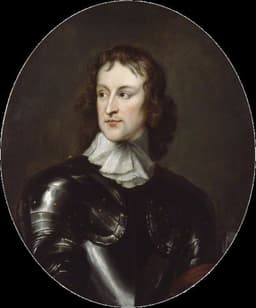
John Lambert
General · Modern
56.7Total

Marouf al-Bakhit
General · Modern
41.6Total
Basic Information
Born
1619
1947
Died
1684
—
Era
Modern
Modern
Nationality
England
Jordan
Occupation
General
General
Civilization
Western
Middle Eastern
Score Comparison
Military (10%)
70.0
10.2
Political (20%)
45.0
61.3
Influence (20%)
59.0
48.6
Legacy (20%)
50.0
38.3
Leadership (15%)
68.0
40.0
Strategy (15%)
55.0
36.8
TOTAL
56.7
41.6
John Lambert — Complete Timeline
1648 AD
Battle of PrestonWar◆ Major
John Lambert commanded parliamentary forces at the Battle of Preston, defeating a Scottish royalist army. The victory helped secure the parliamentary cause in the Second English Civil War.
BattleEnglish Civil WarParliament
Impact: national
1653 AD
Drafted the Instrument of GovernmentPolitical Action◆ Major
John Lambert was the principal author of the Instrument of Government, the written constitution that established the Protectorate under Oliver Cromwell. The document created a Lord Protector and a Council of State, but was never fully implemented.
ConstitutionProtectorateCromwell
Impact: nationalconstructive
1662 AD
Exiled to GuernseyPolitical Action◆ Major
After the Restoration, John Lambert was tried for treason and exiled to the island of Guernsey. He spent the remainder of his life in captivity, never regaining political influence.
ExileRestorationPunishment
Impact: nationaltragic
Marouf al-Bakhit — Complete Timeline
2005 AD
Appointed Prime Minister of JordanPolitical Action◆ Major
King Abdullah II appointed Marouf al-Bakhit as Prime Minister of Jordan in November 2005, following the 2005 Amman bombings. Al-Bakhit, a former intelligence chief, was tasked with restoring security and stability.
JordanPrime MinisterAppointment
Impact: national
2007 AD
Resigned as Prime MinisterPolitical Action
Marouf al-Bakhit resigned as Prime Minister of Jordan in November 2007 after parliamentary elections. His resignation followed criticism of economic policies and political reforms.
JordanPrime MinisterResignation
Impact: national
2011 AD
Appointed Prime Minister for Second TermPolitical Action◆ Major
King Abdullah II appointed Marouf al-Bakhit as Prime Minister again in February 2011, during the Arab Spring protests. Al-Bakhit was tasked with implementing political reforms to address public demands.
JordanArab SpringPrime Minister
Impact: national
Resigned as Prime Minister for Second TermPolitical Action
Marouf al-Bakhit resigned as Prime Minister in October 2011, after failing to satisfy protesters' demands for faster political reforms. His resignation marked the end of his second term.
JordanArab SpringResignation
Impact: national
Expert Analysis
John Lambert vs Marouf al-Bakhit
# The General as Statesman: Two Paths from Battlefield to Power
On a raw November morning in 2005, Marouf al-Bakhit stepped into the prime minister’s office in Amman, a former intelligence chief tasked with restoring order after suicide bombers had torn through three hotels in the capital. Four hundred years earlier and a thousand miles away, John Lambert stood in Westminster, quill in hand, drafting a written constitution that would—for the first time in English history—enshrine the rights of Parliament over any single ruler. Both men were generals who traded their swords for statecraft. Yet one would be remembered as a visionary architect of republican government, the other as a capable but forgettable caretaker in a monarchy that never truly needed him. Why did their trajectories diverge so sharply?
Origins
John Lambert was born in 1619 into the Yorkshire gentry, a world of manor houses and Puritan piety, where the authority of King Charles I was increasingly seen as a threat to godly governance. The English Civil War was not merely a power struggle; it was a constitutional crisis that forced men to choose sides. Lambert, educated in law at the Inns of Court, chose Parliament—not out of radical fervor, but from a conviction that the ancient liberties of England required a check on royal absolutism. His world was one of pamphlets, sermons, and debates about sovereignty, where ideas could become bullets.
Marouf al-Bakhit, born in 1947, came of age in a very different crucible: the Hashemite Kingdom of Jordan, a nation carved from the remnants of the Ottoman Empire and held together by the shrewd diplomacy of its monarchs. He was trained as a soldier and later as an intelligence officer—a career that demanded loyalty, discretion, and an instinct for survival rather than ideological conviction. Jordan’s politics were not about drafting constitutions but about navigating tribal loyalties, regional threats, and the whims of a king who held ultimate power. Bakhit’s upbringing taught him to serve, not to challenge.
Rise to Power
Lambert’s rise was forged in fire. At the Battle of Preston in 1648, he commanded parliamentary forces against a Scottish royalist army, crushing the threat with a combination of tactical brilliance and relentless pursuit. The victory was decisive—it ended the Second English Civil War and sealed the fate of Charles I. Lambert emerged not just as a general but as a political heavyweight, trusted by Oliver Cromwell and feared by his enemies. His military success gave him the credibility to step into the constitutional arena.
Bakhit’s ascent was quieter. He served as Jordan’s intelligence chief, a role that kept him in the shadows, managing security threats from Palestinian militants and Islamist groups. When King Abdullah II appointed him prime minister in 2005 after the Amman bombings, it was not because Bakhit had won a great battle, but because he was seen as a steady hand—a security man who could restore calm without rocking the boat. His path to power was paved by royal favor, not popular acclaim or battlefield glory.
Leadership & Governance
As a leader, Lambert was a radical innovator. In 1653, he drafted the Instrument of Government, England’s first and only written constitution. It established a Protectorate under Oliver Cromwell, with a Parliament elected by a reformed franchise and a separation of powers between the executive and legislature. Lambert believed that military victory must be secured by political architecture—that the sword alone could not build a lasting republic. He was a man of systems, of structures, of grand designs.
Bakhit governed in a different key. His two terms as prime minister (2005–2007 and 2011) were exercises in damage control. After the Amman bombings, he cracked down on Islamist groups and tightened security. During the Arab Spring in 2011, he was recalled to office to absorb public anger, but he offered only modest reforms—a new election law, promises of anti-corruption measures—that satisfied no one. He was a manager, not a maker. His military background gave him authority but not vision; his intelligence training gave him caution but not courage.
Triumph & Tragedy
Lambert’s greatest triumph was also his tragedy. The Instrument of Government was a masterpiece of political thought, but it could not survive the ambition of Oliver Cromwell, who dismissed Parliament and ruled as a virtual king. When Cromwell died and his son Richard proved weak, Lambert tried to seize power himself—only to be outmaneuvered by General George Monck, who restored the monarchy. In 1662, after the Restoration, Lambert was tried for treason and exiled to the island of Guernsey, where he spent the remainder of his life in obscurity. He had built a constitution, but he could not build a consensus.
Bakhit’s tragedy was smaller but no less poignant. He was appointed prime minister in 2011 to quell protests, but his cautious approach only deepened public frustration. He resigned in October of that year, having failed to deliver the political reforms that Jordan’s youth demanded. His legacy is not a constitution or a battle, but a lesson in the limits of loyal service: he did everything the king asked, and it was not enough.
Character & Destiny
Lambert was a man of conviction and ambition, perhaps too much of both. He believed that parliamentary government was the only legitimate form of rule, and he was willing to fight and scheme to achieve it. His downfall came from overreaching—from assuming that his military prestige could substitute for political legitimacy. Bakhit was the opposite: a man of discipline and deference, who never questioned the monarchy’s supremacy. His tragedy was not overreach but underreach—he never tried to be more than a servant, and so he was easily discarded.
Legacy
Today, John Lambert is remembered by historians as a forgotten father of English constitutionalism. The Instrument of Government influenced later republican movements, and his ideas about a written constitution echo in the American founding. His total score of 71.7 reflects a figure who mattered deeply in his time, even if his name is not a household word.
Marouf al-Bakhit, with a total score of 56.3, is largely forgotten outside Jordan. His influence was fleeting, his reforms superficial. He was a general who never fought a war, a politician who never passed a transformative law. He exists in history as a footnote to the Arab Spring, a reminder that survival is not the same as success.
Conclusion
What separates these two generals is not talent or courage, but the shape of the stage on which they performed. Lambert lived in a moment when the old order was shattered, and men could imagine—and fight for—a new one. Bakhit lived in a kingdom where the throne was never in doubt, and the best he could do was manage the cracks. One built a constitution; the other just held the door. Their stories remind us that leadership is not only about the man, but about the age that calls him forth.
Rankings
🥇
John LambertLeader
Mil: 70.0Pol: 45.0Inf: 59.0
56.7
🥈
Marouf al-Bakhit
Mil: 10.2Pol: 61.3Inf: 48.6
41.6
+15.1 behind
How This Comparison Works
Algorithm
Each figure is scored on 6 dimensions (0—100 scale) based on structured historical data: Military (10%), Political (20%), Influence (20%), Legacy (20%), Leadership (15%), Strategy (15%). The weighted total produces the final ranking.
Data Sources
Scores are computed from structured sub-indicators in the database. Scale factors adjust for era (Ancient ×0.85, Modern ×1.0) and civilization size (Eastern ×1.05, Other ×0.80) to account for differences in population and military scale.
Maximum 3 Figures
Comparisons are limited to 2—3 figures to ensure readability and statistical meaningfulness.
Error Margins
±5 points per dimension — Sub-scores are derived from historical records with inherent uncertainty. Two figures within 5 points on a dimension should be considered roughly equivalent in that area.
Total Score Accuracy
±3 points overall — The weighted combination of 6 dimensions produces a total score with approximately ±3 points of uncertainty. Differences of less than 3 points are not statistically significant— the figures are effectively tied.
Known Limitations
- Historical records are incomplete and uneven across civilizations
- Figures from oral-tradition societies may be underrepresented
- Occupation labels can misclassify multi-role figures
- Scores measure capability and impact, not moral character
- Quantitative scoring is a comparison tool, not absolute truth
Capability Radar
Military (10%) — Battles & Warfare
Battles
65
5
Win Rate
60
5
Expansion
40
5
Political (20%) — Governance & Reform
Reform
55
30
Diplomacy
50
40
Economy
45
30
Influence (20%) — Cultural & Global Reach
Cultural
35
10
Global
30
10
Legacy (20%) — Historical Impact
Historical
50
10
Longevity
40
10
Leadership (15%) — Power & Stability
Tenure
60
40
Stability
40
35
Strategy (15%) — Tactics & Innovation
Strategy
65
10
Tactics
70
10
Reform
55
10
Similar Comparisons
Comments & Discussion
GeneralLambert6/16/2026
John Lambert was the Cromwellian version of a constitutional scholar with a sword. He drafted the Instrument of Government in 1653—the only written constitution England ever had—and it gave Parliament permanent supremacy over any single ruler. Compare that to al-Bakhit, who was just another security general propping up a Hashemite monarchy after the 2005 Amman bombings. Lambert actually reshaped state theory; al-Bakhit was a glorified crisis manager. One is studied in political science classes,
穆罕默德·分析6/16/2026
我只想说,这两位将军压根儿不在一个量级上。兰伯特在1653年设计了《政府约法》,那是英国历史上唯一一部成文宪法,确立了议会的最高权威。而巴希特呢?他不过是2005年安曼连环爆炸后,侯赛因国王用来维稳的“安全将军”。一个是宪政建筑师,一个是维稳消防员。历史记住谁?当然是那个让国王低头的人啊。巴希特连一个像样的政治遗产都没留下,就被人遗忘了。
TheDataKnight6/16/2026
Numbers don't lie, and they're brutal here. Lambert's Instrument of Government lasted from 1653 to 1657—that's 4 years of direct constitutional impact, plus his legacy influenced later republican thought. Al-Bakhit served two non-consecutive terms as PM (2005–2007 and 2011), totaling about 2½ years. During his tenure, Jordan's GDP growth averaged around 6%, but political reform? Zilch. In contrast, Lambert's constitutional framework was the first to mandate triennial Parliaments and religious to
云中观史6/16/2026
有趣的是,两个人都来自不同的“传统”世界。兰伯特是清教徒革命家,在1640年代参与处死国王、建立共和国,他代表的是一种对制度根本性改造的渴望。巴希特是约旦贝都因军事精英,他效忠的不是制度创新,而是哈希姆王室的连续性。他处理的主要是1999年阿卜杜拉二世继位后的政治稳定和巴勒斯坦难民问题。说白了,兰伯特想重塑世界,巴希特只想稳住局子。一个是造钟人,一个是调钟人。
SkepticalScribe6/16/2026
Let's not romanticize Lambert. His "republican constitution" was the product of a military dictatorship—the Instrument of Government basically made Oliver Cromwell a king in all but name, with executive power concentrated in his hands. Lambert wrote it to legitimize rule by the Army Council, not out of democratic idealism. Al-Bakhit at least operated within a constitutional monarchy that held elections (however flawed). The difference? Lambert failed spectacularly, leading