Loading...
John Diefenbaker vs Nikolai Bulganin
John Diefenbaker leads by 11.3 pts · 2 figures compared
…
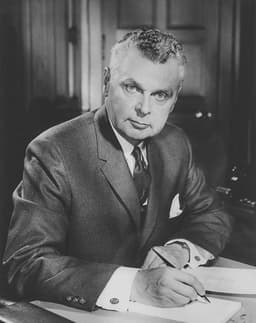
John Diefenbaker
Politician · Modern
53.4Total
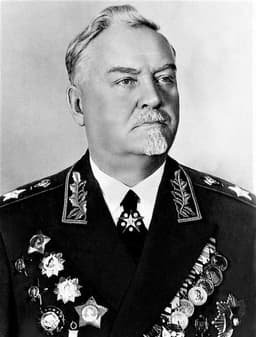
Nikolai Bulganin
Politician · Modern
42.1Total
Basic Information
Born
1895
1895
Died
1979
1975
Era
Modern
Modern
Nationality
Canada
Russia
Occupation
Politician
Politician
Civilization
Western
Western
Score Comparison
Military (10%)
50.0
12.6
Political (20%)
68.0
48.0
Influence (20%)
56.4
48.6
Legacy (20%)
47.5
38.3
Leadership (15%)
53.2
53.2
Strategy (15%)
42.5
39.7
TOTAL
53.4
42.1
John Diefenbaker — Complete Timeline
1957 AD
Became Prime Minister of CanadaPolitical Action◆ Major
Diefenbaker became the 13th Prime Minister of Canada, leading the Progressive Conservative Party. His victory ended 22 years of Liberal rule and was built on a populist platform.
Government FormationElectionConservatism
Impact: national
1959 AD
Cancelled the Avro Arrow projectPolitical Action◆ Major
Diefenbaker's government cancelled the Avro CF-105 Arrow, a state-of-the-art supersonic interceptor aircraft. The decision was controversial, leading to the loss of thousands of jobs and the destruction of the prototypes, but was driven by cost concerns.
AviationDefenseEconomic Policy
Impact: nationaldestructive
1960 AD
Passed the Canadian Bill of RightsReform◆ Major
Diefenbaker's government passed the Canadian Bill of Rights, a federal statute that guaranteed fundamental freedoms such as speech, assembly, and religion. Though not constitutional, it was a landmark in human rights protection.
Human RightsLegislationCivil Liberties
Impact: nationalconstructive
Extended the franchise to Indigenous peoplesReform◆ Major
Diefenbaker's government amended the Canada Elections Act to give First Nations people the right to vote in federal elections without losing their status. This was a significant step toward Indigenous rights.
Indigenous RightsVoting RightsEquality
Impact: nationalconstructive
Nikolai Bulganin — Complete Timeline
1955 AD
Appointment as Premier of the Soviet UnionPolitical Action◆ Major
Bulganin succeeded Malenkov as Chairman of the Council of Ministers (Premier) in February 1955. He served as a figurehead leader while Khrushchev held real power, representing the Soviet Union in diplomatic engagements during the early Cold War.
Soviet LeadershipAppointmentCold War
Impact: national
1956 AD
Role in the Hungarian Revolution of 1956Political Action◆ Major
As Premier, Bulganin supported the Soviet decision to crush the Hungarian Revolution in November 1956. He authorized the military intervention that suppressed the uprising, resulting in thousands of deaths and the installation of a pro-Soviet government.
Cold WarHungarian RevolutionIntervention
Impact: regionaldestructive
1958 AD
Removal from Power and ExpulsionPolitical Action◆ Major
Bulganin was removed from the premiership in March 1958 and replaced by Khrushchev. He was later expelled from the Communist Party in 1961 for his involvement in the 'Anti-Party Group' that opposed Khrushchev, ending his political career.
Power StruggleKhrushchevExpulsion
Impact: nationaldestructive
Expert Analysis
Origins
John George Diefenbaker was born on September 18, 1895, in Neustadt, Ontario, to German immigrant parents. His family moved to Saskatchewan, where he experienced the hardships of prairie life. He studied at the University of Saskatchewan, earning a law degree, and served in World War I but was discharged due to injury. His early law practice focused on defending the marginalized, shaping his commitment to civil rights.
Nikolai Alexandrovich Bulganin was born on June 11, 1895, in Nizhny Novgorod, Russia, into a middle-class family. He joined the Bolsheviks in 1917 and worked in the Cheka (secret police) and later in economic management. He rose through the Party ranks under Stalin, serving as mayor of Moscow and later as Minister of Defense. His background was bureaucratic rather than ideological.
Rise to Power
Diefenbaker entered federal politics in 1940 as a Conservative MP. He ran for party leadership in 1942 and 1948, losing both times, but persisted. In 1956, he won the Progressive Conservative leadership and led the party to a landslide victory in 1957, ending 22 years of Liberal rule. He became Prime Minister on June 21, 1957, with a minority government, then won the largest majority in Canadian history in 1958 (208 of 265 seats).
Bulganin rose through Stalin's patronage. He became a member of the Central Committee in 1937 and served as Chairman of the State Bank. During World War II, he held political commissar roles. After Stalin's death, he allied with Khrushchev and became Premier in February 1955, succeeding Malenkov. However, he was a figurehead; Khrushchev held real power as First Secretary.
Leadership & Governance
Diefenbaker's leadership style was populist and confrontational. He championed individual rights and social justice, passing the Canadian Bill of Rights in 1960, a federal law protecting freedoms of speech, assembly, and religion. He extended voting rights to First Nations people in 1960 without requiring them to give up treaty status. His government also introduced old-age pensions and agricultural subsidies. However, his indecisiveness on economic policy and the Avro Arrow cancellation led to criticism.
Bulganin's governance was subordinate to Khrushchev. He served as a loyal administrator, supporting de-Stalinization and some economic reforms, but lacked independent initiative. He endorsed the Soviet invasion of Hungary in 1956 to crush the revolution, authorizing military force that resulted in thousands of deaths. His leadership score of 53.2 matches Diefenbaker's, but his political score of 48.0 is lower than Diefenbaker's 68.0.
Triumph & Tragedy
Diefenbaker's greatest triumph was the Canadian Bill of Rights, a foundational document for civil liberties. He also expanded voting rights to Indigenous peoples, a significant step toward equality. His tragedy was the cancellation of the Avro Arrow in 1959, a supersonic jet fighter project, which led to job losses and a perception of technological weakness. His indecision during the Cuban Missile Crisis (1962) damaged his reputation, and he lost the 1963 election.
Bulganin's triumph was his role in stabilizing the Soviet economy after Stalin, but his tragedy was his complicity in the Hungarian Revolution crackdown. He was removed from power in 1958 when Khrushchev deemed him unnecessary. Expelled from the Party in 1961, he died in obscurity in 1975. His military score of 12.6 reflects his lack of direct command, while Diefenbaker's military score of 50.0 stems from his wartime service and defense decisions.
Character & Destiny
Diefenbaker was combative, charismatic, and deeply principled, but also stubborn and suspicious of advisors. His personality attracted devoted followers but alienated many within his party. His fate was to be a transformative figure who lost power due to his inability to adapt to changing political currents. Historians rate his influence at 56.4 and legacy at 47.5.
Bulganin was a loyal apparatchik, cautious and unambitious. He lacked the ruthlessness to survive in the Soviet system. His destiny was to be a placeholder for Khrushchev, and his removal was inevitable once he outlived his usefulness. His legacy score of 38.3 reflects his minor historical role.
Legacy
Diefenbaker's legacy endures through the Canadian Bill of Rights, which influenced the later Charter of Rights and Freedoms (1982). His extension of voting rights to Indigenous peoples set a precedent for inclusion. The Diefenbaker Centre at the University of Saskatchewan preserves his records. His overall score of 53.4 exceeds Bulganin's 42.1, reflecting greater tangible impact.
Bulganin's legacy is minimal. He is remembered as a figurehead premier during a turbulent period. The Hungarian Revolution of 1956 is his most notable association, but his role was secondary to Khrushchev's. His influence score of 48.6 is close to Diefenbaker's 56.4, but his total score is lower.
Conclusion
Between John Diefenbaker and Nikolai Bulganin, Diefenbaker had greater impact. His score of 53.4 versus Bulganin's 42.1 reflects his concrete achievements in civil rights and democratic governance. Diefenbaker's reforms changed Canadian society, while Bulganin's tenure was ephemeral and subordinate. Diefenbaker's legacy of individual freedoms outlasts Bulganin's role in a repressive regime. The data supports Diefenbaker as the more consequential figure.
Rankings
🥇
John DiefenbakerLeader
Mil: 50.0Pol: 68.0Inf: 56.4
53.4
🥈
Nikolai Bulganin
Mil: 12.6Pol: 48.0Inf: 48.6
42.1
+11.3 behind
How This Comparison Works
Algorithm
Each figure is scored on 6 dimensions (0—100 scale) based on structured historical data: Military (10%), Political (20%), Influence (20%), Legacy (20%), Leadership (15%), Strategy (15%). The weighted total produces the final ranking.
Data Sources
Scores are computed from structured sub-indicators in the database. Scale factors adjust for era (Ancient ×0.85, Modern ×1.0) and civilization size (Eastern ×1.05, Other ×0.80) to account for differences in population and military scale.
Maximum 3 Figures
Comparisons are limited to 2—3 figures to ensure readability and statistical meaningfulness.
Error Margins
±5 points per dimension — Sub-scores are derived from historical records with inherent uncertainty. Two figures within 5 points on a dimension should be considered roughly equivalent in that area.
Total Score Accuracy
±3 points overall — The weighted combination of 6 dimensions produces a total score with approximately ±3 points of uncertainty. Differences of less than 3 points are not statistically significant— the figures are effectively tied.
Known Limitations
- Historical records are incomplete and uneven across civilizations
- Figures from oral-tradition societies may be underrepresented
- Occupation labels can misclassify multi-role figures
- Scores measure capability and impact, not moral character
- Quantitative scoring is a comparison tool, not absolute truth
Capability Radar
Military (10%) — Battles & Warfare
Battles
29
20
Win Rate
31
27
Expansion
32
25
Political (20%) — Governance & Reform
Reform
60
40
Diplomacy
50
50
Economy
40
30
Influence (20%) — Cultural & Global Reach
Cultural
40
10
Global
30
20
Legacy (20%) — Historical Impact
Historical
50
20
Longevity
35
10
Leadership (15%) — Power & Stability
Tenure
55
60
Stability
45
40
Strategy (15%) — Tactics & Innovation
Strategy
36
32
Tactics
40
33
Reform
47
39
Similar Comparisons
Comments & Discussion
No comments yet. Be the first to share your thoughts!